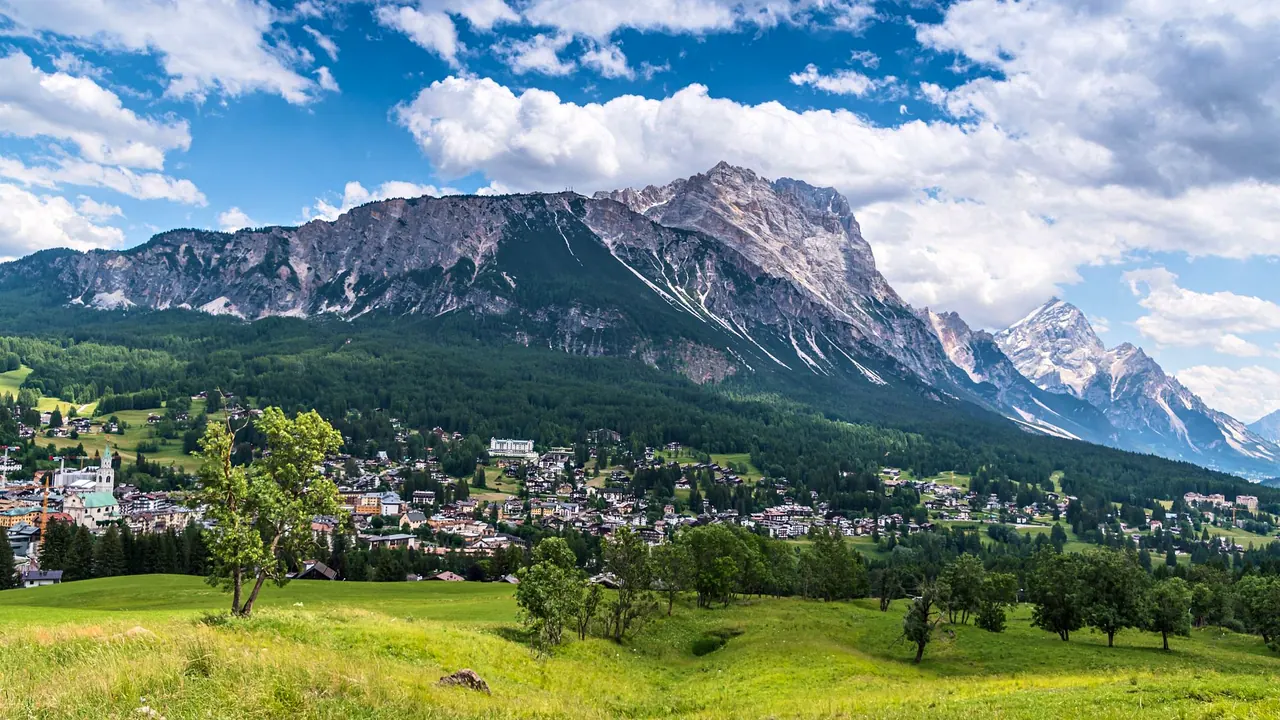
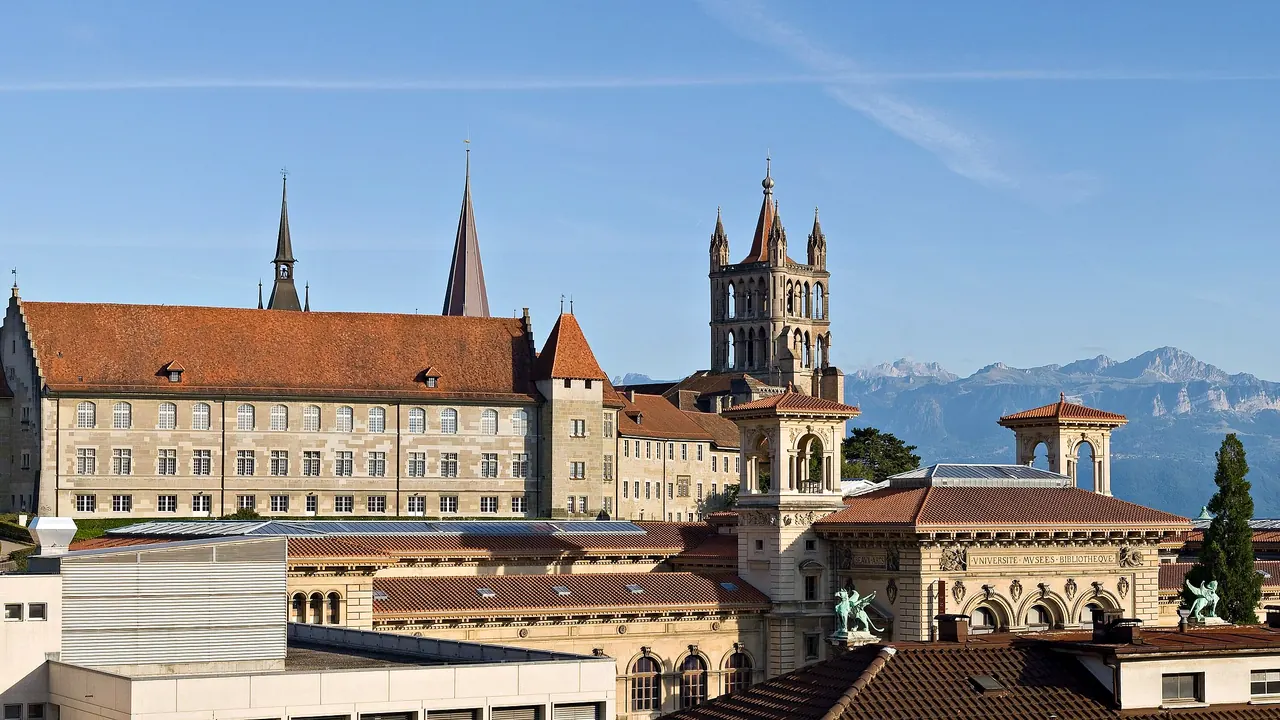
Photos: Cortina d'Ampezzo by Andreas Neubauer, Pexels License; Lausanne by Christian Mehlführer, CC BY-SA 3.0, cropped.
Cortina d'Ampezzo or Lausanne?
Our verdict in twelve categories, each scored against the same fixed benchmark cities, and the climate month by month, so you can choose for your trip.
Choose Cortina d'Ampezzo for
- nature and the outdoors
- prices
Cortina d'Ampezzo is for travellers whose vacation happens on the mountain. Skiers step from the town lifts into the Dolomiti Superski area. Summer visitors get the Tre Cime, via ferrata routes and hut lunches among some of the most striking peaks in Europe. Evenings are quiet and there are few sights, so it suits people who want long active days and then a good dinner.
Choose Lausanne for
- live music and the arts
- day trips
- culture and sights
If you want a real city with the outdoors close by, Lausanne is the better pick. It has a Gothic cathedral, strong museums and a serious stage life, a lake to swim in through summer, and trains to Montreux, Geneva and Gruyères. That gives you plenty to do in any weather, and the Alps are still only an hour away. It suits couples, families and culture lovers who would rather not drive.
Scoreboard
Twelve categories on one fixed scale from 0 to 100. The shaded stretch is the gap between the two.
Your match
Pick a travel style or drag the sliders, and both match scores follow your weighting.
Wins on nature and the outdoors and prices with your weighting.
Wins on live music and the arts and day trips with your weighting.
What matters to you?
Category by category
What the scores mean for a trip.
Beaches & swimming
Neither has a coast, but Lausanne at least has water you can swim in through summer. From late June to early September, Lake Geneva is warm enough for an afternoon on the lawns at Bellerive or off the piers at Vidy. It is lake bathing on grass and shingle, though, not a beach.
Cortina's alpine lakes, Ghedina and Pianozes, are fed by snowmelt and stay cold even in July. Swimming there mostly means a hotel pool, and the Adriatic is more than two hours' drive away.
Food & drink
Cortina eats better than a town its size might suggest. The cooking is mountain food with a Venetian accent: casunziei dressed with poppy seeds, polenta with game, and long lunches on rifugio terraces among the peaks. Beyond that the choice soon thins out, with almost nothing international or casual.
Lausanne has the broader table, and wine is what lifts it. You get lake perch, papet vaudois, the Saturday market around Riponne and Lavaux Chasselas tasted at the growers' caveaux, and some of Switzerland's most celebrated restaurants are close by.
Culture & sights
Lausanne has far more to see. There is the Gothic cathedral with its night watchman, the stepped lanes of the old town, the Olympic Museum at Ouchy and the group of museums at Plateforme 10. Together they fill two or three days, and the Collection de l'Art Brut is unlike anything in the Alps.
In Cortina, the centre, the basilica's bell tower and the 1956 Olympic ice stadium take an hour or two, and the Regole museums fill a rainy afternoon. Its most moving history is up in the mountains, in the First World War tunnels on Lagazuoi and the Cinque Torri.
Nightlife
Lausanne has a proper night out. The Flon has clubs and late bars in old warehouses, full of students at weekends, and on summer evenings people gather by the lake at Ouchy. In Cortina, evenings mean après-ski drinks, the passeggiata on the Corso Italia and long dinners. A few smart bars and clubs stay open late only in the peak winter weeks, and in summer the town is quiet by late evening.
Nature & outdoors
Cortina puts you right inside one of the great mountain landscapes. Lifts rise from town onto the Tofane and Cristallo, and the Tre Cime and Lago di Misurina are under an hour away. In winter you are on the Dolomiti Superski area, and in summer you have the Alta Via 1 and some of the oldest via ferrata routes in the Alps.
Lausanne's outdoors are gentler and more mixed. You can walk the Lavaux terraces, sail or paddleboard on the lake, and reach the Vaud Alps or the Jura in about an hour. It makes a good base for varied days outside, but a big mountain day starts with a train ride, not a lift from the street.
Day trips
Lausanne is much the better base. Montreux and the Château de Chillon are a short train ride along the lake, and Geneva, Bern and Fribourg are all easy days out. Gruyères and Murten are classic outings, and boats cross the lake to Évian, so you rarely need a car.
From Cortina, most trips lead back into the mountains. South Tyrol is the best of the rest, with San Candido, Brunico and the Iceman in Bolzano, but you will usually need a car, and Venice is a long day by coach.
Good for families
Lausanne gives children more to do whatever the weather. There is the hands-on Olympic Museum, the aquarium-vivarium, the animal park and pedal boats at Sauvabelin, and paddle steamers on the lake. Its steep streets are the weak point if you have a pushchair.
Cortina suits families who ski or hike. It has ski schools, beginner slopes at Socrepes, public skating at the Olympic stadium and easy walks to huts with meadows. On rainy days, with no zoo or aquarium, young children can quickly get restless.
Getting around
Lausanne is far easier without a car. The m2 metro climbs from Ouchy to the upper town, and the main station connects to fast, punctual Swiss trains, so the steep slopes are the only real effort.
Cortina's flat centre takes only minutes to cross on foot, and ski buses serve the slopes in winter. Beyond that it is harder. There has been no railway since 1964, so you arrive by coach from Venice or after a long drive, and the buses up to the passes are infrequent. Most visitors who want to explore the Dolomites hire a car.
Shopping & style
Both towns offer polished but narrow shopping, so the difference is in the type of shops. Cortina's Corso Italia is luxury fashion, jewellers, furriers and upmarket mountain wear, with the old Cooperativa di Cortina as its anchor and wood carving and filigree as local crafts. Lausanne's Rue de Bourg is the place for a Swiss watch or chocolate, with international names around Saint-François, a few design shops in the Flon and cheese on market days.
Affordability
Cortina's costs rise and fall with the seasons, while Lausanne's stay high all year. In Cortina the winter peak and August bring luxury-resort prices, with lift passes and equipment hire on top. Early summer and late September are easier, rifugio meals are fair value for the setting, and many budget travellers stay in a cheaper valley and drive in.
Lausanne is dear in every month, as Swiss hotels, meals and taxis always are. You can soften the bill with picnics from bakeries, the free lakeside promenades and a glass of Chasselas in a village caveau.
Live music & performing arts
Here Lausanne is in another league. The Béjart Ballet Lausanne, the Prix de Lausanne, contemporary theatre at the Théâtre de Vidy, a full opera season and a respected chamber orchestra keep its stages busy all year. In July the Montreux Jazz Festival is a short train ride away.
Cortina has no theatre season and no regular venue. Its music comes from summer festival concerts in churches and halls, sometimes out in the mountains, plus the odd concert around Christmas.
Wellness & relaxation
Both towns do their pampering in hotel spas, not public baths, but the setting is quite different. Cortina's is the Alpine kind, with saunas and hay baths after a day on the slopes. How calm it feels depends on when you go: June, September and the quieter winter weeks are restful, while the peak weeks are not.
Lausanne slows down along its lakeside promenades and in the Lavaux vines. It also has something Cortina lacks, warm spring water within easy reach at Yverdon-les-Bains and Lavey-les-Bains.
When should you go?
Pick your month. The climate figures are measured averages, not a forecast.
Cortina d'Ampezzo in July
Lausanne in July
Daytime high, °C
Rainfall in the month, mm
Where the figures come from
Lausanne's temperatures are measured 40 km from the centre, at Payerne.
Lausanne has no rain gauge within 25 km of the centre, so its rainfall comes from a gridded climate dataset read at the city rather than from a gauge further away.
Temperature and rainfall are climate normals, averaged over the years shown. Cortina d'Ampezzo: 1991-2020 normals, Dobbiaco (22.5 km from centre). Lausanne: 1991-2020 (sunshine 1961-1990) normals, Payerne (39.7 km from centre).
Cortina is a two-season resort. In midwinter the daytime highs stay around freezing and little rain falls, which suits snow and ski days. July and August reach about 22°C, ideal for hiking, but summer is also the wettest time, with 130mm in July. September stays mild and is noticeably drier, which makes it a good month for walking. Spring and late autumn fall between the two seasons.
Lausanne is milder all year. July is around 26°C, warm enough for swimming in the lake and evenings outside, and it is also the sunniest month at 240 hours. Rain falls steadily in every season, and winters are grey, with only 41 hours of sunshine in December. May to September is when the city is at its best.
Which traveller are you?
On an outdoors trip, Cortina wins: the mountains are the point of the place, and serious days in high country, skiing or hiking, begin at your door. Lausanne suits gentler, mixed days on water and hillsides rather than big peaks.
For a culture and arts trip, choose Lausanne. Cortina's sights fill an afternoon, and its stages are mostly silent outside summer. Lausanne keeps you busy day and night for several days, and its dance alone is worth the trip.
On a short city break, Lausanne makes more sense. Cortina takes too long to reach for two days and rewards a week on the mountain, not a weekend in town. Lausanne is compact, quick to reach and easily fills the time.
Before you go
| Measure | Cortina d'Ampezzo | Lausanne |
|---|---|---|
| Official language | Italian | French, German, Italian, Romansh |
| Currency | Euro (EUR) | Swiss Franc (CHF) |
| Sockets | CFL230 V, 50 Hz | CJ230 V, 50 Hz |
| Driving side | Right | Right |
| Time zone | UTC+1, UTC+2 in summer | UTC+1, UTC+2 in summer |
| Emergency number | 112 | 112 |
| Elevation | 1,224 m | 495 m |
| Main airport | Venice Marco Polo Airport (VCE)116 km from centre103 non-stop destinations | Geneva International Airport (GVA)52 km from centre150 non-stop destinations |
| Public holidays this year | 13 days | 9 days |
By the numbers
| Measure | Cortina d'Ampezzo | Lausanne |
|---|---|---|
| City population | 5,546 | 144,873 |
| People per km² | 22 | 3,499 |
| Museums within 10 km | 3 | 31 |
| UNESCO World Heritage sites within 50 km | 1 | 3 |
Where else could you go?
Every comparison below shares a destination with this one, so you can follow Cortina d'Ampezzo or Lausanne somewhere new.
- Genevavs Lausanne
- Chamonixvs Lausanne
- Bernvs Lausanne
- Annecyvs Lausanne
- Interlakenvs Lausanne
- Innsbruckvs Cortina d'Ampezzo