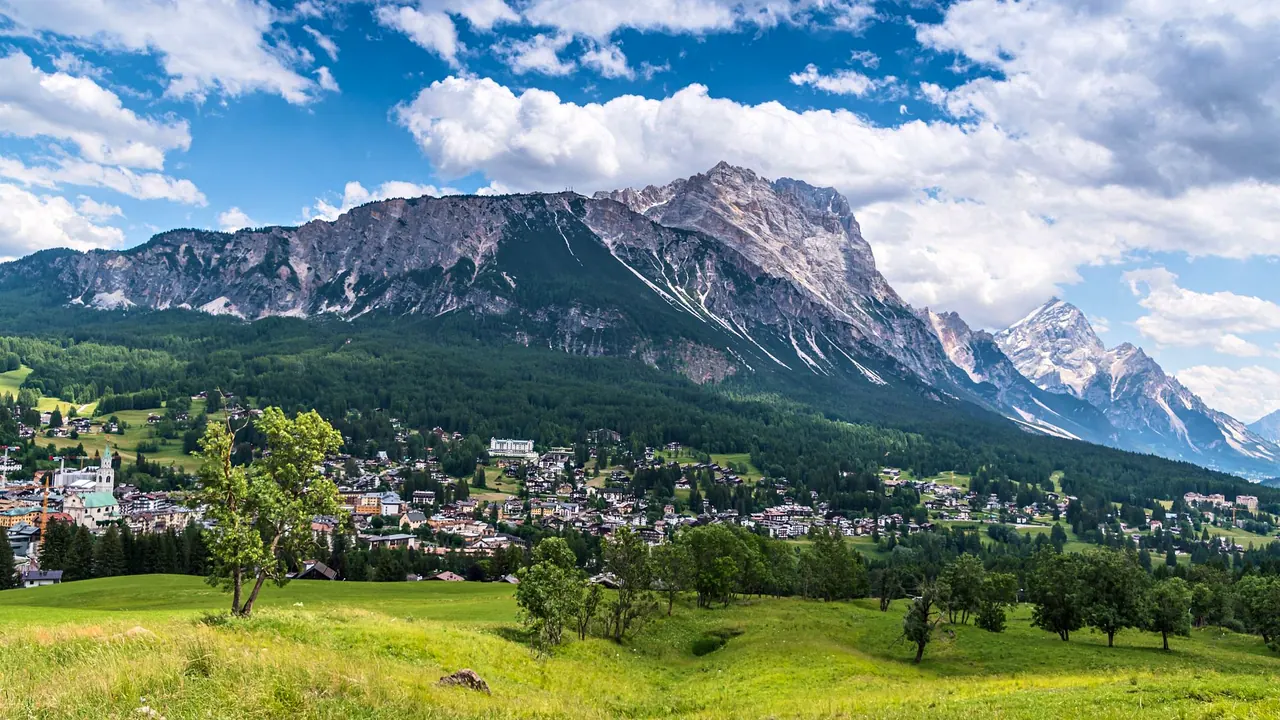
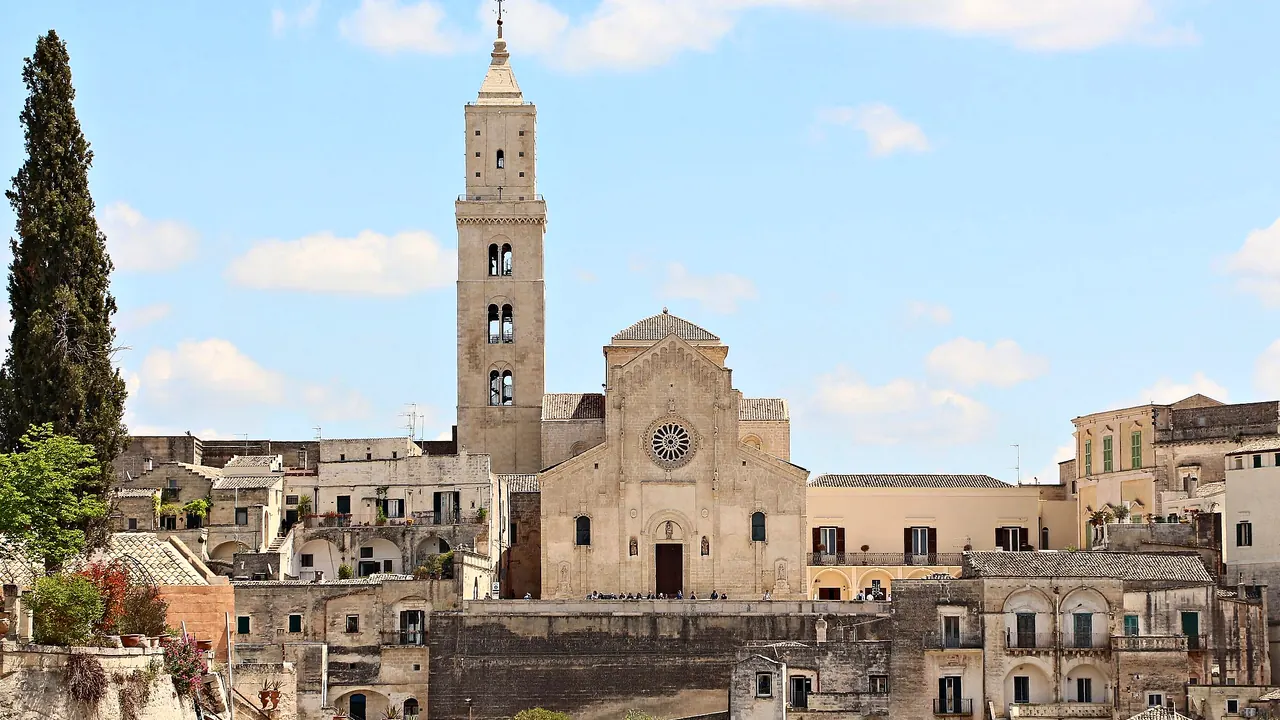
Photos: Cortina d'Ampezzo by Andreas Neubauer, Pexels License; Matera by Bernard Gagnon, CC BY 4.0, cropped.
Cortina d'Ampezzo or Matera?
Our verdict in twelve categories, each scored against the same fixed benchmark cities, and the climate month by month, so you can choose for your trip.
Choose Cortina d'Ampezzo for
- nature and the outdoors
- families
- shopping
Cortina is the choice for travellers who come for the mountains themselves: skiing the Dolomiti Superski area in winter, or hiking hut to hut and climbing via ferrata in summer. Polished hotel spas and the Corso Italia are waiting at the end of the day. It suits people who judge a trip by their days outdoors and can absorb high prices, not anyone hoping for sights or a lively evening.
Choose Matera for
- culture and sights
- prices
- beaches
Pick Matera if you want a place that is itself the attraction. The cave districts of the Sassi, the rock churches and the gorge make a short stay memorable. With a car, the town is also an affordable base for Puglia's trulli, its white towns and the sand of the Ionian coast. It asks less of the wallet but more of the legs, and it has little for small children.
Scoreboard
Twelve categories on one fixed scale from 0 to 100. The shaded stretch is the gap between the two.
Your match
Pick a travel style or drag the sliders, and both match scores follow your weighting.
Wins on nature and the outdoors and families with your weighting.
Wins on culture and sights and prices with your weighting.
What matters to you?
Category by category
What the scores mean for a trip.
Beaches & swimming
Neither is a beach town, but only Matera has real sand within reach. The Ionian shore at Metaponto and Policoro is about 45 minutes away by car, with wide beaches backed by pine woods and shallow, warm water that suits children. Puglia's rocky Adriatic coves are a longer drive.
Cortina's water is alpine. Lakes such as Ghedina and Pianozes are lovely to walk round but stay cold even in July, and the Adriatic is more than two hours away. Swimming there mostly means a hotel pool.
Food & drink
Both eat well for small towns, but they draw on very different traditions. Cortina's Ampezzan cooking is mountain food with a Venetian edge: beetroot casunziei, polenta with game, barley soup. Its best meals come on rifugio terraces high among the peaks, and there are a few ambitious kitchens and Veneto and South Tyrolean wines in the valley.
Matera's food is southern peasant cooking built around its horn-shaped durum-wheat bread, with pulses, hand-made cavatelli, lamb and crackling dried peppers, washed down with Aglianico. You eat in cave dining rooms and upper-town trattorias rather than with mountain views. Neither town offers much street food or anything beyond its own region.
Culture & sights
Here Matera is in another league. The Sassi themselves are the main sight: cave houses lived in since prehistoric times, rock churches with Byzantine frescoes, the Romanesque cathedral on the Civita and, under the main piazza, the Palombaro Lungo cistern you can walk through. Carlo Levi's panorama at Palazzo Lanfranchi and MUSMA's sculpture in rock rooms complete the picture.
Cortina's centre is pleasant, with its tall bell tower and painted houses, and the Rimoldi collection of twentieth-century Italian art is worth a rainy hour. Its most striking history, the First World War tunnels on Lagazuoi and the Cinque Torri, takes a day in the mountains to reach.
Nightlife
Neither town is a place for a big night out, and in both the evening follows the Italian pattern of a passeggiata and then a long dinner. What differs is the season and the style. Cortina has après-ski as the lifts close and, in the peak winter weeks, a few smart bars and a club or two for a glamorous crowd. Matera's late drinks are in cave wine bars and on terraces above the lit-up Sassi, and it is liveliest in summer, with a small student crowd.
Nature & outdoors
Cortina sits inside one of the world's great mountain landscapes. Lifts climb straight from the town into the ring of Dolomite peaks, and the Tre Cime and Lago di Misurina are under an hour away. The year divides between skiing in winter and hiking, climbing, via ferrata and mountain biking in summer.
Matera's nature is smaller and wilder: the Gravina gorge below the Sassi and the stony Murgia plateau on the far side, with abandoned rock churches and Neolithic village sites along the trails. The Lucanian Dolomites and the Pollino forests make good days out, but the bare plateau is too hot for walking in high summer.
Day trips
Matera is the better base for exploring. Within about an hour you can reach the trulli of Alberobello, the white towns of the Valle d'Itria, Castel del Monte, the old town of Bari and the sea cliffs of Polignano a Mare. Basilicata adds the abandoned town of Craco and the Greek temple of Hera at Metaponto. You need a car for nearly all of it.
From Cortina, most outings head back into the mountains. The best towns are in South Tyrol, such as Brunico with its castle and Bolzano with the Iceman. Venice is possible as a long coach day, but the places within range are pleasant rather than essential.
Good for families
Cortina is the easier choice for families, as long as they ski or walk. Ski schools for every age, beginner slopes at Socrepes, public skating at the Olympic ice stadium and summer trails to huts with meadows give children plenty to do. Wet days drag, though, and costs mount quickly.
Matera has nothing designed for children, and its steep stone stairways make a pushchair useless. Older children love the caves and the cistern, and the shallow Ionian beaches are a short drive away, but the town works best as a brief stop.
Getting around
Both have small centres you can walk, and both are awkward to reach without a car. Cortina's centre is flat and compact, and in winter ski buses and lifts do much of the work. There has been no railway since 1964, though, and summer buses up to the passes are limited.
Matera's upper town is flat too, but the Sassi below are all steep stairways, and cars cannot enter most of the old districts. The town's only rail link is a slow narrow-gauge line to Bari.
Shopping & style
Cortina has the more serious shopping, all of it on the Corso Italia: luxury fashion, jewellers, furriers and upmarket mountain wear. The multi-storey Cooperativa, founded in 1893, anchors the street, and there is local wood carving and filigree to buy.
Matera's shopping is mostly souvenirs and food. Cuccù whistles, tufa carvings and ceramics fill the workshops in the Sassi, and Via del Corso has ordinary Italian high-street shops. The best things to take home are dried peppers, local pasta and Aglianico.
Affordability
The gap here is wide, and Cortina is the one that stretches the budget. Rooms and dinners in town cost luxury-resort rates, and they climb highest twice a year, in the winter peak and in August. Early summer and late September are the gentler times to book, and lunch at a rifugio costs less than the view would suggest.
Matera sits well below that, and eating out there costs less than in Italy's big cities. Its premium comes from the cave hotels in the Sassi, the town's speciality, and its only real price peak falls in the busiest summer weeks. Most sights charge little, so once the room is paid for, the days themselves cost little.
Live music & performing arts
Live performance is thin in both towns, and neither has a theatre season or a regular venue. Matera has slightly more: concerts by its music conservatory, a summer jazz festival with the Sassi as a backdrop, and the Festa della Bruna, when a papier-mâché float is paraded and then torn apart. Cortina's live music comes mainly from summer chamber and classical festivals in churches, halls and sometimes mountain settings.
Wellness & relaxation
Cortina has the stronger spa culture, even without thermal springs. Many hotels have Alpine-style saunas, steam rooms, hay baths and indoor pools, which are welcome after skiing or a long hike. The clear air of June and September adds to the calm, though the peak weeks bring traffic and crowds.
Matera has fewer hotel spas, but some are unusual, with candlelit pools cut into the rock. The town's calm comes more from its pace: quiet mornings in the Sassi and evenings watching the light fade over the gorge, best from autumn to spring.
When should you go?
Pick your month. The climate figures are measured averages, not a forecast.
Cortina d'Ampezzo in July
Matera in July
Daytime high, °C
Rainfall in the month, mm
Where the figures come from
Matera has no rain gauge within 25 km of the centre, so its rainfall comes from a gridded climate dataset read at the city rather than from a gauge further away.
Temperature and rainfall are climate normals, averaged over the years shown. Cortina d'Ampezzo: 1991-2020 normals, Dobbiaco (22.5 km from centre). Matera: 2005-2025, 10 years observed (rainfall 1991-2020) normals, Matera / Martella (4.8 km from centre).
Cortina has two clear seasons. Midwinter sits around freezing, with January highs near 0°C, and the ski season runs through March, when milder air and longer days make it one of the best months on the slopes, before the snow season winds down in early April. Summer brings mild walking weather, with highs that peak at 22°C. June to August is also the wettest stretch, though, with about 130mm of rain in July, so pack for wet afternoons on the trail. September is drier and still mild. April and May, and again October and November, fall between the seasons: cool and unsettled, with the slopes closed and the high trails not yet reliable.
Matera runs the other way. Its winters are mild, and October to December are its wettest months. Summers are hot, reaching 32°C in July, which is too hot for the Sassi stairways in the middle of the day. That heat is the season for the Ionian beaches, where the sea reaches 26°C in August and stays warm into September. For walking the Sassi and the Murgia, the best times are May and late September to early October. High summer belongs to Cortina's trails, while Matera is at its best on either side of it.
Which traveller are you?
For a culture and arts trip, Matera is far stronger. The Sassi, the frescoed rock churches, the Palombaro Lungo cistern and MUSMA's sculpture in carved rooms fill several days. Cortina's three small museums and its Olympic stadium fill an afternoon.
On an outdoors trip, Cortina is one of the finest bases anywhere. Lifts climb from the town into the Dolomites, the Alta Via 1 and some very old via ferrata routes start nearby, and winter brings vast ski terrain. Matera's gorge walks are lovely but modest by comparison.
On a tight budget, Matera is the realistic choice. Its upper-town trattorias and guesthouses cost far less than Cortina's luxury-resort hotels, lift passes and equipment hire, and walking the Sassi and the Murgia costs nothing. Budget visitors to Cortina often sleep in cheaper valleys nearby.
Before you go
| Measure | Cortina d'Ampezzo | Matera |
|---|---|---|
| Official language | Italian | Italian |
| Currency | Euro (EUR) | Euro (EUR) |
| Sockets | CFL230 V, 50 Hz | CFL230 V, 50 Hz |
| Driving side | Right | Right |
| Time zone | UTC+1, UTC+2 in summer | UTC+1, UTC+2 in summer |
| Emergency number | 112 | 112 |
| Elevation | 1,224 m | 401 m |
| Main airport | Venice Marco Polo Airport (VCE)116 km from centre103 non-stop destinations | Bari Karol Wojtyła International Airport (BRI)54 km from centre104 non-stop destinations |
| Public holidays this year | 13 days | 13 days |
By the numbers
| Measure | Cortina d'Ampezzo | Matera |
|---|---|---|
| City population | 5,546 | 59,685 |
| People per km² | 22 | 152 |
| Museums within 10 km | 3 | 8 |
| UNESCO World Heritage sites within 50 km | 1 | 1 |
| Swim season, months above 21 °C | - | 5 months |
Where else could you go?
Every comparison below shares a destination with this one, so you can follow Cortina d'Ampezzo or Matera somewhere new.
- Barivs Matera
- Innsbruckvs Cortina d'Ampezzo
- Venicevs Cortina d'Ampezzo
- Leccevs Matera
- Veronavs Cortina d'Ampezzo
- Bledvs Cortina d'Ampezzo