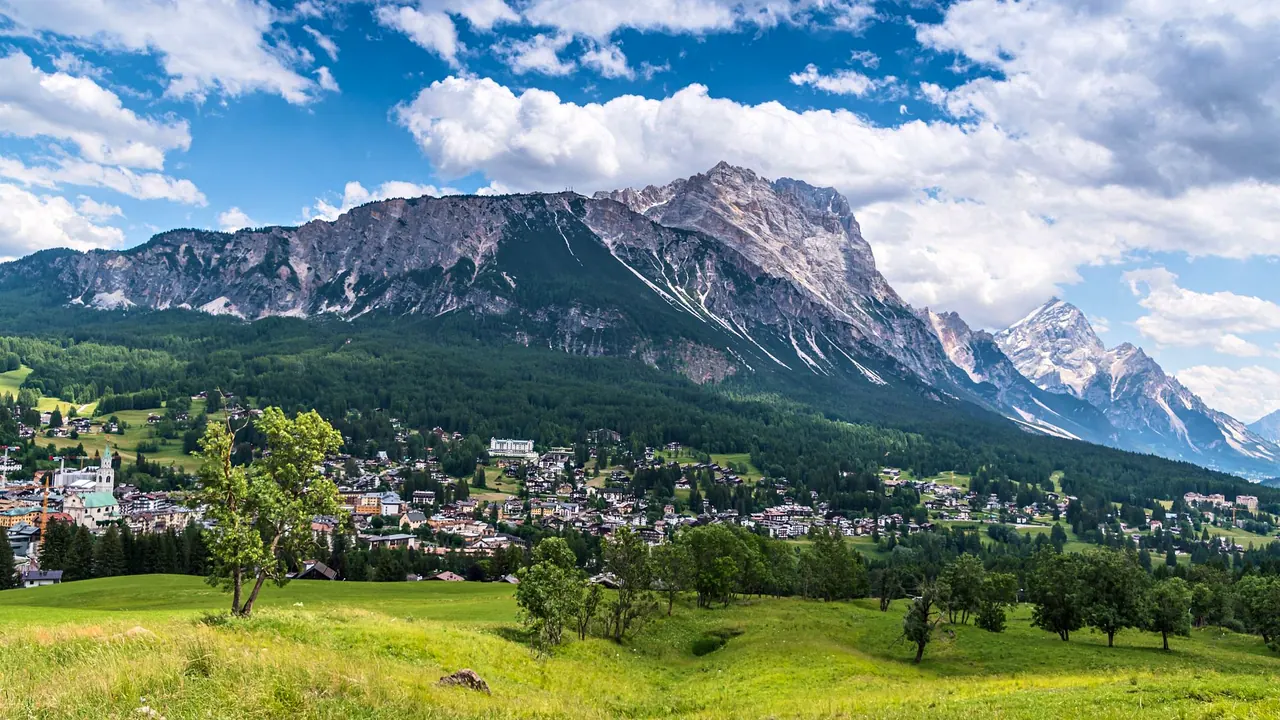
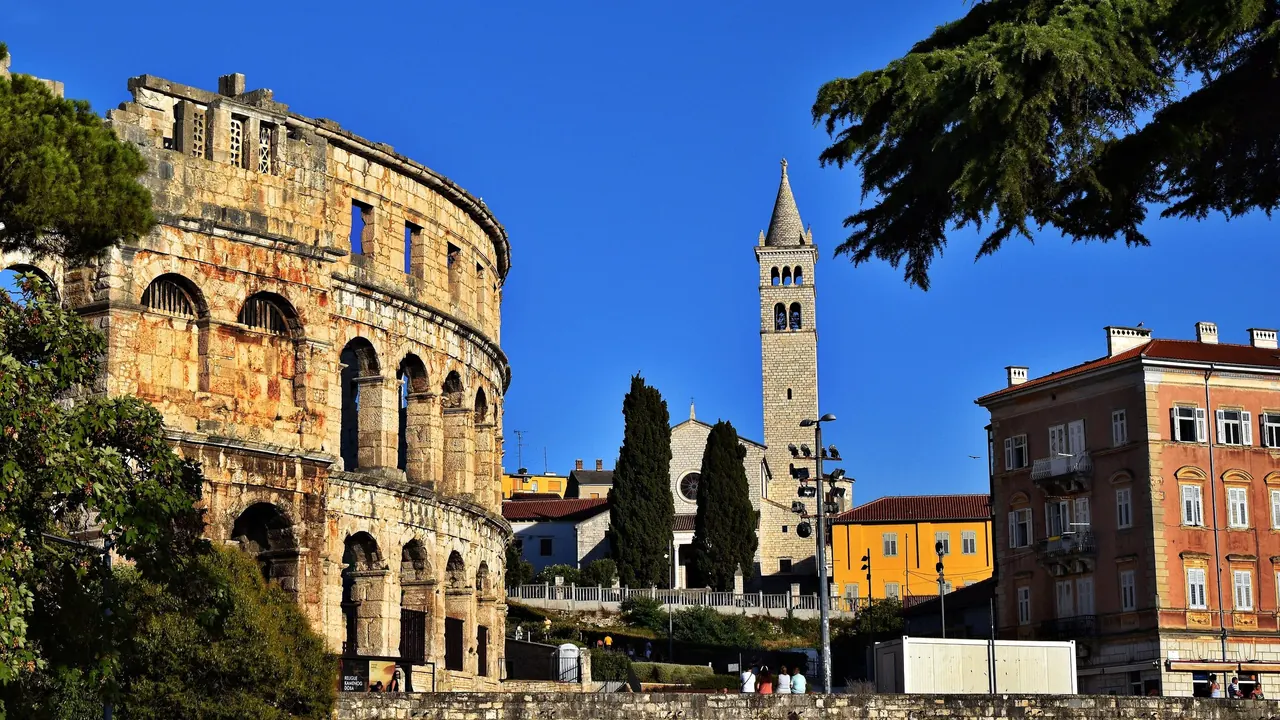
Photos: Cortina d'Ampezzo by Andreas Neubauer, Pexels License; Pula by Miroslav.vajdic, CC BY-SA 4.0, cropped.
Cortina d'Ampezzo or Pula?
Our verdict in twelve categories, each scored against the same fixed benchmark cities, and the climate month by month, so you can choose for your trip.
Choose Cortina d'Ampezzo for
- nature and the outdoors
- wellness
- shopping
Cortina d'Ampezzo is for travellers who measure a trip in peaks, pistes and trails. The pale Dolomites start at the edge of town, lifts carry you straight onto them, and the skiing, via ferrata and hut-to-hut hiking are some of the best in the Alps. Expect to pay resort prices, and expect quiet evenings and only a handful of sights in town.
Choose Pula for
- beaches
- culture and sights
- prices
Pula makes more sense for a sea-and-history trip at a gentler cost. You get clear water in the coves of Kamenjak, a Roman amphitheatre standing almost whole above the harbour, Istrian cooking and a string of Venetian towns within easy reach for day trips. The scenery is lower and softer, but there is far more to fill a week that doesn't revolve around mountains.
Scoreboard
Twelve categories on one fixed scale from 0 to 100. The shaded stretch is the gap between the two.
Your match
Pick a travel style or drag the sliders, and both match scores follow your weighting.
Wins on nature and the outdoors and wellness with your weighting.
Wins on beaches and culture and sights with your weighting.
What matters to you?
Category by category
What the scores mean for a trip.
Beaches & swimming
For a beach, Pula is the clear choice. It has no sand, but the coast south of town around Verudela, Stoja and Medulin has rock ledges and pebble coves with very clear, warm summer water. Cape Kamenjak, with its wild inlets, is the highlight.
Cortina is high in the mountains, and the Adriatic is more than two hours away. Lakes such as Ghedina are fed by snowmelt and stay cold all year. Swimming there really means an indoor pool.
Food & drink
Both serve regional cooking rather than a broad international mix, and Pula comes out slightly ahead. Istrian food gives you truffle pasta, scampi buzara, Malvazija and Teran wine and a busy market hall, and the best meals are often in village konobas inland.
Cortina's Ampezzan cooking is mountain food: casunziei with poppy seeds, polenta with game and barley soup. It is at its best on a rifugio terrace among the peaks. Choice is narrower in the valley, and there is very little that is cheap.
Culture & sights
Pula offers far more history. The Arena still has its full three-storey outer ring, the Temple of Augustus stands intact on the Forum, and the Arch of the Sergii, the Venetian fortress and the Austro-Hungarian naval forts fill a day or two.
Cortina has a pretty church, painted houses, the 1956 Olympic ice stadium and the Rimoldi art collection. Its most memorable heritage is the First World War tunnels on Lagazuoi, and those take a day in the mountains to reach.
Nightlife
Neither is a place for big nights out, but Pula has a little more going on. On summer weekends, terraces around the Forum give way to beach and cocktail bars on Verudela and in Medulin, with a few small clubs.
Cortina's evenings mean après-ski, a stroll along the Corso Italia and long dinners. The smart late bars come alive only in peak winter weeks, and in summer the town is quiet by late evening.
Nature & outdoors
Cortina wins by a wide margin. A ring of jagged Dolomite peaks surrounds the valley, and lifts climb onto them straight from town. The Tre Cime, Lago di Misurina and the Fanes-Sennes-Braies park are all close by, with world-class skiing in winter and climbing and hut-to-hut trails in summer.
Pula's landscape is low and coastal: macchia, pine and the cliffs of Kamenjak, which has dinosaur footprints on its shore. It is good for kayaking, windsurfing, wreck diving and cycling, but the nearest real hills, on Učka, are about an hour and a half away.
Day trips
Pula is the better base for touring. Rovinj, Poreč's mosaics, the hill towns of Motovun and Hum, and the Brijuni islands all lie within about an hour, and Piran and Trieste are realistic full days out.
From Cortina, most outings go into the mountains. South Tyrolean towns such as San Candido and Brunico are charming, Bolzano's Iceman is about two hours away, and Venice is a long day each way.
Good for families
Pula is a little easier with children. Shallow bays at Medulin, an aquarium inside an old fort, the Arena to clamber around and a dinosaur park and water park within an hour give families plenty of choice.
Cortina suits families who ski or hike, with ski schools, beginner slopes at Socrepes, skating and rope parks. Beyond the outdoors there is little made for children, so a run of wet days with little ones can drag.
Getting around
The two are much alike: both have a small, flat centre you can walk in minutes, and both are hard to explore further afield without a car. The difference is the way in. Cortina has had no railway since 1964, so you arrive by coach from Venice or by road, and the bus services up to the passes are limited.
Pula has city buses out to Verudela and Premantura, and you can cycle to the southern coves. Regional buses and the inland railway are of little use, though, and parking is tight in summer.
Shopping & style
Cortina has the better shopping, if a narrow one. The Corso Italia is lined with luxury fashion, jewellers and upmarket mountain wear, and the Cooperativa di Cortina, founded in 1893, sells everything from local food to outdoor gear.
Pula's pedestrian street has chain stores and souvenirs. The real souvenirs are edible: olive oil, truffles, honey and rakija from the market hall or straight from the farms.
Affordability
Pula is much easier on the wallet. Private apartments and simple konobas keep costs reasonable, especially in spring and autumn, although July and August cost about as much as other Western European coasts.
Cortina is among Italy's most expensive places to stay, with lift passes and equipment hire on top. Rifugio meals and late-September rates help a little, and many budget visitors sleep in cheaper valleys nearby and drive in.
Live music & performing arts
Pula has the clear edge thanks to one remarkable setting. In summer, the Roman Arena hosts touring concerts, classical galas and the Pula Film Festival under its stone arches. The rest of the year there is the Istrian National Theatre, mostly performing in Croatian.
Cortina has no theatre season. Summer chamber music festivals in churches and the occasional mountain-side concert are about all it offers.
Wellness & relaxation
Neither has a bathing tradition. Cortina comes out somewhat ahead because its hotel spas are proper Alpine ones, with saunas, hay baths and indoor pools for after a day on the slopes. The valley is very calm in June and September.
In Pula, wellness means the resort hotel spas on Verudela and in Medulin. The real way to relax there is an unhurried coffee on the Forum or an evening walk along the pine-shaded shore.
When should you go?
Pick your month. The climate figures are measured averages, not a forecast.
Cortina d'Ampezzo in July
Pula in July
Daytime high, °C
Rainfall in the month, mm
Where the figures come from
Pula's temperatures are measured 87 km from the centre, at Trieste.
Pula has no rain gauge within 25 km of the centre, so its rainfall comes from a gridded climate dataset read at the city rather than from a gauge further away.
Temperature and rainfall are climate normals, averaged over the years shown. Cortina d'Ampezzo: 1991-2020 normals, Dobbiaco (22.5 km from centre). Pula: 1991-2020 normals, Trieste (87 km from centre).
Cortina is two places across the year. From late December to March it is cold, with highs around freezing, and that is ski season. From June to September the days reach about 22°C, which is ideal for hiking. Summer is also the wettest stretch, with July bringing about 130mm, so plan on some wet afternoons. Spring and late autumn fall between the seasons.
Pula's swimming months are June to September, when highs reach 29°C in July and August and the sea warms to about 25°C. Those are also the sunniest months. Midsummer is hot for walking around the ruins, so May and late September suit sightseeing better. From October the rain builds, peaking at about 107mm in November. Winters stay mild compared with Cortina's, but they are grey.
Which traveller are you?
On an outdoors trip, choose Cortina. You can ski the Dolomiti Superski area in winter, and in summer there are the Alta Via 1, historic via ferrata routes and the Tre Cime. Pula's Kamenjak walks and kayaking are pleasant, but they can't compete with that.
For a beach and sun trip, Pula is the only real option. It has warm, clear water from June to September, pine-shaded rocky coves and the shallower bays around Medulin. In Cortina, swimming comes down to a hotel pool or a very cold alpine lake.
On a culture and arts trip, Pula gives you more. There is the Arena, the Temple of Augustus, Roman mosaics, summer concerts in the amphitheatre, and Poreč's Byzantine basilica within an hour. Cortina's three small museums fill an afternoon at most.
Before you go
| Measure | Cortina d'Ampezzo | Pula |
|---|---|---|
| Official language | Italian | Croatian |
| Currency | Euro (EUR) | Euro (EUR) |
| Sockets | CFL230 V, 50 Hz | CF230 V, 50 Hz |
| Driving side | Right | Right |
| Time zone | UTC+1, UTC+2 in summer | UTC+1, UTC+2 in summer |
| Emergency number | 112 | 112 |
| Elevation | 1,224 m | 5 m |
| Main airport | Venice Marco Polo Airport (VCE)116 km from centre103 non-stop destinations | Pula Airport (PUY)7 km from centre34 non-stop destinations |
| Public holidays this year | 13 days | 14 days |
By the numbers
| Measure | Cortina d'Ampezzo | Pula |
|---|---|---|
| City population | 5,546 | 52,220 |
| People per km² | 22 | 971 |
| Museums within 10 km | 3 | 4 |
| UNESCO World Heritage sites within 50 km | 1 | 1 |
| Swim season, months above 21 °C | - | 4 months |
Where else could you go?
Every comparison below shares a destination with this one, so you can follow Cortina d'Ampezzo or Pula somewhere new.
- Rovinjvs Pula
- Piranvs Pula
- Triestevs Pula
- Innsbruckvs Cortina d'Ampezzo
- Venicevs Cortina d'Ampezzo
- Paduavs Cortina d'Ampezzo