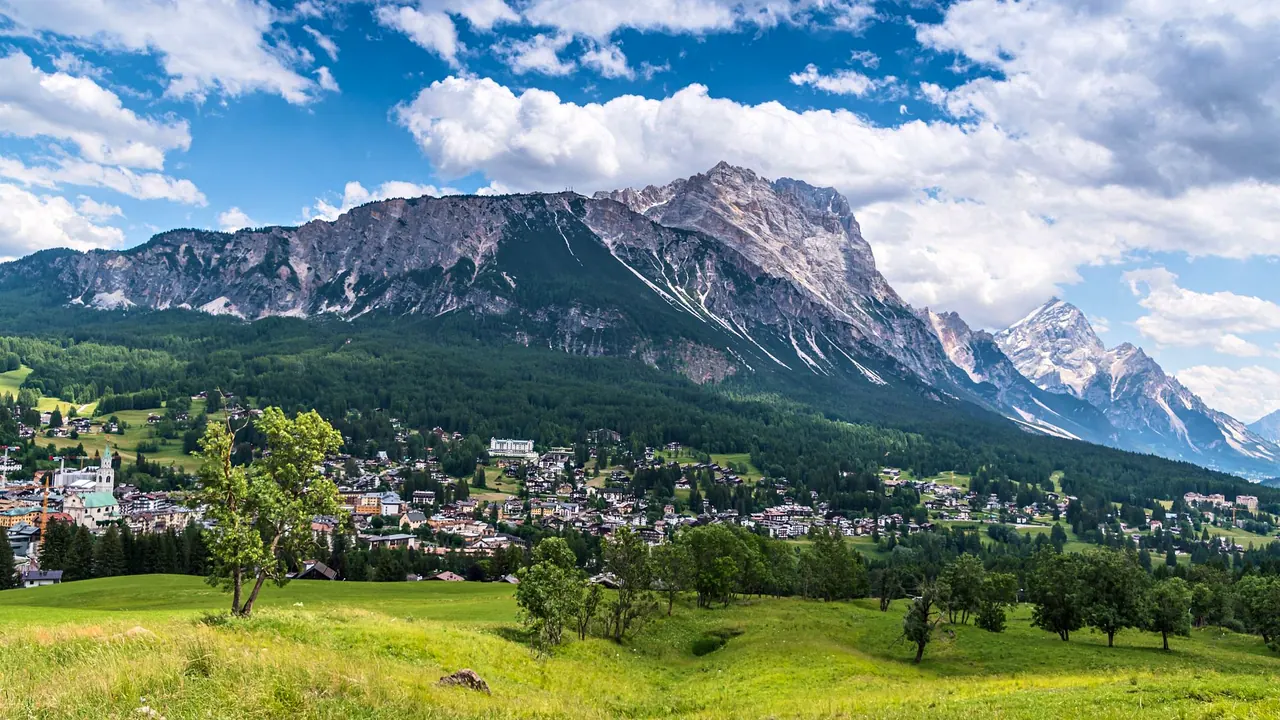
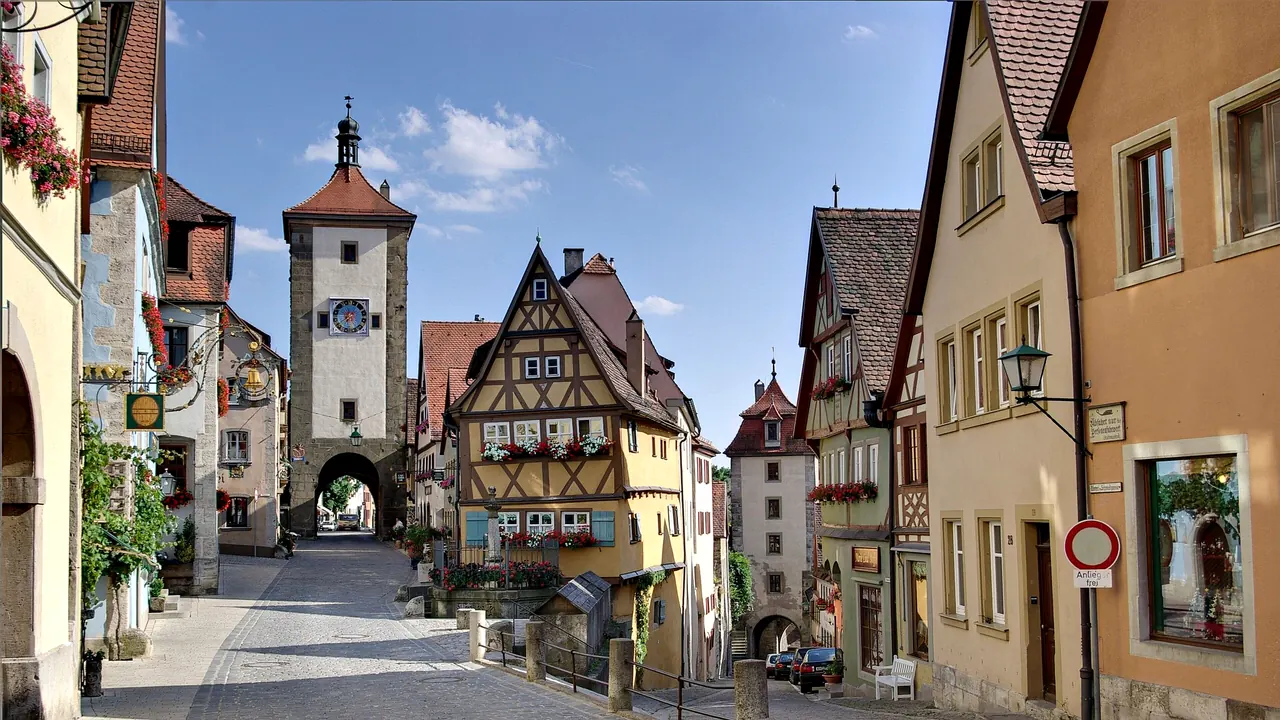
Photos: Cortina d'Ampezzo by Andreas Neubauer, Pexels License; Rothenburg ob der Tauber by Berthold Werner, Public domain.
Cortina d'Ampezzo or Rothenburg ob der Tauber?
Our verdict in twelve categories, each scored against the same fixed benchmark cities, and the climate month by month, so you can choose for your trip.
Choose Cortina d'Ampezzo for
- nature and the outdoors
- food and drink
- shopping
Pick Cortina d'Ampezzo if the mountains are the reason for going. Lifts rise from the town straight into the Dolomites. In winter it plugs into the Dolomiti Superski area, and in summer there is hut-to-hut hiking and via ferrata, with long lunches on rifugio terraces between the peaks. It suits active travellers with a generous budget who want days outdoors rather than a list of sights.
Choose Rothenburg ob der Tauber for
- culture and sights
- prices
- day trips
Rothenburg ob der Tauber is the better choice for someone who wants history they can walk through: the walls, the Plönlein, Riemenschneider's altar and lanes with almost nothing modern in them. Dinkelsbühl, Nördlingen and Würzburg are all within easy reach for touring. It costs far less than Cortina and makes a good base for a few days along the Romantic Road, although its own countryside is gentle valley walking rather than drama.
Scoreboard
Twelve categories on one fixed scale from 0 to 100. The shaded stretch is the gap between the two.
Your match
Pick a travel style or drag the sliders, and both match scores follow your weighting.
Too close to call, level with your weighting
Wins on nature and the outdoors and food and drink with your weighting.
Wins on culture and sights and prices with your weighting.
What matters to you?
Category by category
What the scores mean for a trip.
Beaches & swimming
Neither town is a place for swimming. Cortina sits in a high Alpine valley and Rothenburg on a Franconian hilltop, both far from any coast. The difference is in what is available: Cortina's lakes such as Ghedina and Pianozes are lovely but cold with snowmelt, so swimming usually means a hotel pool. Rothenburg has its own outdoor pool, and the warmer artificial lakes of the Franconian lake district, with their grassy bathing areas, are about an hour away.
Food & drink
Cortina eats better. Its Ampezzan cooking includes casunziei with poppy seeds, polenta with game and barley soup with speck. You find it in a few ambitious valley kitchens and on rifugio terraces high among the peaks, and the wine lists draw on the Veneto and South Tyrol.
Rothenburg's Schäufele, dumplings and bratwurst with dry Silvaner are filling and honest. But many inns around the Marktplatz cook for coach groups, and the better meals are in family guesthouses and Tauber valley wine taverns. Neither town has much international food.
Culture & sights
Here Rothenburg is far ahead, because the town itself is the monument. It has an intact ring of walls with a covered walkway along the top, gabled lanes, the Plönlein and the view from the Rathaus tower. St Jakob's holds Riemenschneider's Holy Blood Altar, a major work of late Gothic carving.
Cortina's centre is pleasant, with the basilica's tall bell tower and the 1956 Olympic ice stadium, and the Rimoldi art collection fills a wet afternoon. Its most striking history, the First World War tunnels on Lagazuoi and the Cinque Torri, takes a day on the mountain to reach.
Nightlife
Neither is a nightlife town, but Cortina has more going on after dark, at least in winter. Après-ski drinks, the evening passeggiata on the Corso Italia and a few late bars and clubs in the peak weeks give its evenings a smart, social feel. Rothenburg is mostly silent by eleven, with wine taverns and the night watchman's tour as the main evening outings, and anyone wanting a real night out has to go to Würzburg or Nuremberg.
Nature & outdoors
This is Cortina's great strength. The pale Dolomites ring the town, lifts climb straight onto the peaks, and the Tre Cime di Lavaredo and Lago di Misurina are under an hour away. The year divides between skiing and a summer of hiking, climbing, mountain biking and via ferrata.
Rothenburg's countryside is soft by comparison. Paths drop from the walls into the Tauber valley past mills and meadows, and the riverside cycle path is a lovely family ride through vineyards. It makes a pleasant afternoon, not a reason to travel.
Day trips
Rothenburg is the better base for excursions. Along the Romantic Road, the walled town of Dinkelsbühl is about 45 minutes away and the crater town of Nördlingen a little further. Würzburg's Residenz and Nuremberg's castle are each about an hour's drive, so several days can go on distinct, worthwhile places.
From Cortina, most outings lead into the mountains rather than to towns. South Tyrol is the best of it, with San Candido, Brunico's castle and Bolzano's Iceman. Venice is possible but makes a long day by coach.
Good for families
Cortina works better for families who ski or hike. It has ski schools for every age, beginner slopes at Socrepes and public skating at the Olympic stadium. In summer there are easy lake walks, meadows by the huts and a forest rope park. The drawbacks are the cost and long rainy days.
Rothenburg delights children for a day or two. They can walk the ramparts, climb the Rathaus tower and follow the night watchman's lantern, and older ones are gripped by the Crime Museum. After that it runs thin, and the cobbles are hard work with a pushchair.
Getting around
Both centres are small enough to cross on foot, but Rothenburg is easier to reach and to manage. Its station is a short walk from the gates, though most journeys mean a change at Steinach. Cars are kept outside the walls, so the old town is pleasant to walk, despite the cobbles and the steep climb back from the valley.
Cortina has had no railway since 1964, so arriving means a coach from Venice or a long drive. Buses up to the passes and the Tre Cime are limited, and in both places a hire car is the practical way to see the wider region.
Shopping & style
Cortina has more worth buying, though it is all on one street. The Corso Italia has luxury fashion, jewellers and upmarket mountain wear, anchored by the Cooperativa di Cortina, a multi-storey store founded in 1893. There are also shops for local wood carving and filigree.
Rothenburg's Herrngasse and Schmiedgasse sell mostly to visitors: Christmas ornaments, nutcrackers, cuckoo clocks and pewter all year round. Its Christmas market on the Marktplatz is one of Germany's most atmospheric. It is good for souvenirs and little else.
Affordability
Rothenburg costs far less. It charges a tourist premium over ordinary Franconian towns, but beer and wine in the inns are fairly priced, the sights charge little, and a room just outside the walls cuts the bill further.
Cortina is among the most expensive places to stay in Italy. Rooms and restaurants charge luxury prices in the winter peak and August, and lift passes and equipment hire add to the bill. Meals at the rifugi and visits in early summer or late September soften the cost but do not change the picture.
Live music & performing arts
Neither town has a theatre season or a regular concert venue, so most evenings in both end at the dinner table. In Cortina the music arrives with the summer festivals: chamber and classical concerts are put on in churches and halls, sometimes with the Dolomites as a backdrop, and there are a few more around Christmas and New Year. In any other week there is almost nothing to go to.
Rothenburg comes out slightly ahead because its performances grow out of the town itself. The costumed Meistertrunk play retells the town's Thirty Years' War legend with processions and encampments, so the medieval streets become the stage, and the church music at St Jakob's sounds fitting under Riemenschneider's altar. It has more local character than Cortina's festivals, but it is just as seasonal. If live performance matters to you, time your visit for one of these moments in either town.
Wellness & relaxation
Both towns are restful for their calm rather than for any bathing culture, but the calm comes in different forms. Cortina's comfort is in its Alpine hotel spas, with saunas, hay baths and indoor pools after a day on the slopes. It also has quiet June and September afternoons on a hut terrace in clear mountain air.
Rothenburg's peaceful hours come early in the morning and in the evening, once the coach groups have gone and the walls and valley paths empty. Its hotel spas are small, but proper thermal pools at Bad Windsheim and Bad Mergentheim are within an hour's drive.
When should you go?
Pick your month. The climate figures are measured averages, not a forecast.
Cortina d'Ampezzo in July
Rothenburg ob der Tauber in July
Daytime high, °C
Rainfall in the month, mm
Where the figures come from
Rothenburg ob der Tauber's sunshine is measured 27 km from the centre, at Feuchtwangen-heilbronn.
Temperature and rainfall are climate normals, averaged over the years shown. Cortina d'Ampezzo: 1991-2020 normals, Dobbiaco (22.5 km from centre). Rothenburg ob der Tauber: 1991-2020 normals, Rothenburg ob der Tauber (0.9 km from centre).
Cortina has two distinct seasons. From December to February daytime highs sit around freezing and these are also its driest months, which makes them the time for skiing. Summer is warm enough for walking at altitude, at about 22°C in July and August, but this is also when most of the rain falls, with July bringing around 130mm, and June is nearly as wet. September is the best month for hiking: it is still mild and much drier at 76mm. April and November are cool, damp months between the two seasons.
Rothenburg is a few degrees warmer all year and reaches 25°C in high summer. Its rain is spread evenly, so no month is especially wet. The real change through the year is in the light. Long sunny days from May to September suit the walls and the Tauber valley, while December has only about 41 hours of sunshine and the lanes are grey and cold for strolling. Neither town is warm enough for the beach in any month.
Which traveller are you?
On an outdoors trip, Cortina wins easily. Lifts leave from town for the Tofane and Cristallo, the Alta Via 1 and some of the oldest via ferrata routes are close by, and winter brings the Dolomiti Superski area. Rothenburg offers gentle valley walks instead.
For a culture and arts trip, Rothenburg is the clear pick. The whole walled town is the sight, with its rampart walkway, the Holy Blood Altar in St Jakob's and the Medieval Crime Museum, and Würzburg's Residenz is an hour away. Cortina's small museums fill an afternoon.
On a trip on a tight budget, Rothenburg is far kinder. Rooms just outside the walls, reasonably priced beer and wine, and modest entry fees keep costs sensible. Cortina charges luxury-resort prices, and budget visitors often sleep in cheaper valleys and drive in.
Before you go
| Measure | Cortina d'Ampezzo | Rothenburg ob der Tauber |
|---|---|---|
| Official language | Italian | German |
| Currency | Euro (EUR) | Euro (EUR) |
| Sockets | CFL230 V, 50 Hz | CF230 V, 50 Hz |
| Driving side | Right | Right |
| Time zone | UTC+1, UTC+2 in summer | UTC+1, UTC+2 in summer |
| Emergency number | 112 | 112 |
| Elevation | 1,224 m | 430 m |
| Main airport | Venice Marco Polo Airport (VCE)116 km from centre103 non-stop destinations | Nuremberg Airport (NUE)66 km from centre56 non-stop destinations |
| Public holidays this year | 13 days | 12 days |
By the numbers
| Measure | Cortina d'Ampezzo | Rothenburg ob der Tauber |
|---|---|---|
| City population | 5,546 | 11,331 |
| People per km² | 22 | 272 |
| Museums within 10 km | 3 | 6 |
| UNESCO World Heritage sites within 50 km | 1 | 2 |
Where else could you go?
Every comparison below shares a destination with this one, so you can follow Cortina d'Ampezzo or Rothenburg ob der Tauber somewhere new.
- Nurembergvs Rothenburg ob der Tauber
- Bambergvs Rothenburg ob der Tauber
- Stuttgartvs Rothenburg ob der Tauber
- Innsbruckvs Cortina d'Ampezzo
- Heidelbergvs Rothenburg ob der Tauber
- Venicevs Cortina d'Ampezzo