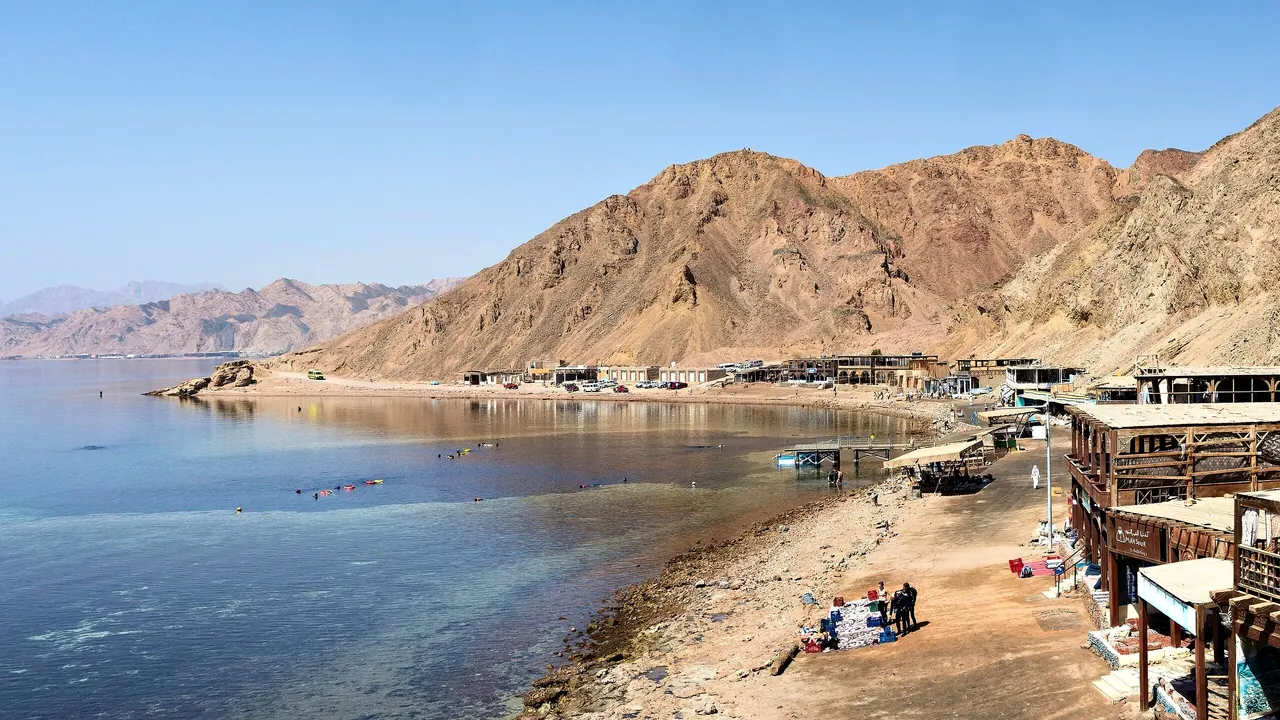
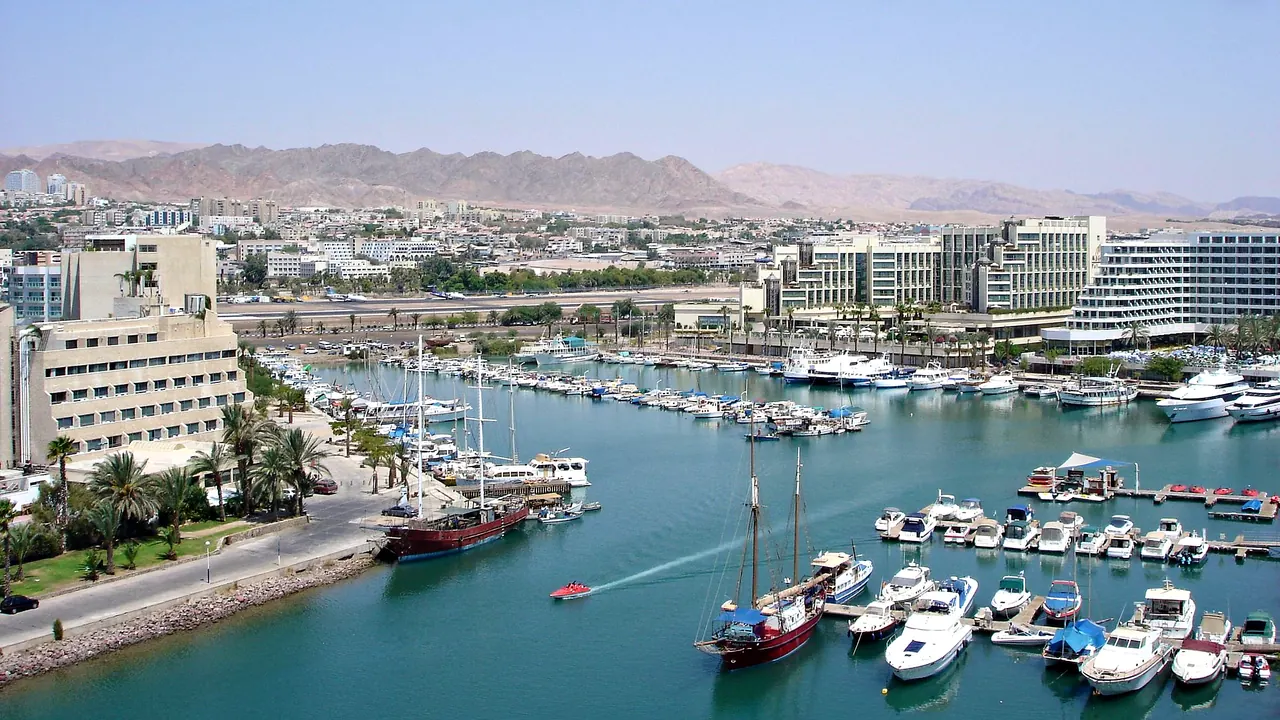
Photos: Dahab by Petar Milošević, CC BY-SA 4.0, cropped; Eilat by Tango7000, Public domain.
Dahab or Eilat?
Our verdict in twelve categories, each scored against the same fixed benchmark cities, and the climate month by month, so you can choose for your trip.
Choose Dahab for
- prices
- nature and the outdoors
- wellness
Dahab is the choice for divers, freedivers and anyone who wants a slow, cheap stay by the reef with the Sinai mountains behind. The Blue Hole and the Canyon start just off the shore, the Lagoon's steady wind suits kitesurfers, and the night climb up Mount Sinai gives it the stronger outdoor life. Simple guesthouses and Egyptian meals in Assala make it easy to stay for weeks. You give up nightlife, shopping and anything built for young children.
Choose Eilat for
- getting around
- nightlife
- families
Families and travellers who want a working resort will be happier in Eilat. The hotel pools, kids' clubs, North Beach loungers and late bars around the lagoon are a short walk apart, while Coral World and the reef beaches are a quick bus or taxi ride south down the coast road. Petra makes a long but memorable day trip across the Jordanian border. The cost is high, and during school breaks the crowds take away any sense of escape.
Scoreboard
Twelve categories on one fixed scale from 0 to 100. The shaded stretch is the gap between the two.
Your match
Pick a travel style or drag the sliders, and both match scores follow your weighting.
Wins on prices and nature and the outdoors with your weighting.
Wins on getting around and nightlife with your weighting.
What matters to you?
Category by category
What the scores mean for a trip.
Beaches & swimming
Both stretches of Red Sea coast work the same way: you step off a jetty onto a coral reef, so a swim usually becomes a snorkel. Eilat has the edge for a conventional beach day, because North Beach has loungers, watersport rentals and a sociable town crowd, and Coral Beach adds the reef.
In Dahab, most of the shore is rock and reef rather than sand. The Lagoon is the place for sand and shallow water, and elsewhere cushioned cafés with ladders into the sea stand in for sunbeds. Eilat's sand is coarse and its central beaches crowd at weekends, but it still gives you more of a classic beach.
Food & drink
Neither town is a reason to travel for food, and they fall short in different ways. In Dahab, you pick fish from the ice at a low table by the bay, or eat foul, koshary and fresh bread in Assala's small Egyptian places. Beyond that come pizza and smoothie bowls, and alcohol is found only in tourist bars.
Eilat's eating is shaped by hotel buffets and promenade steakhouses, sushi and fish restaurants. The better meals are at hummus counters and shawarma stands in the older neighbourhoods. It has more choice of restaurants, Dahab has more local character, and in both you soon run out of new places to try.
Culture & sights
Neither town has museums or monuments worth planning around, so culture here means what lies outside town. Dahab at least has its Bedouin roots, seen in Assala and at the tea stops. Eilat is a modern grid of hotel towers and malls, and its history lies out in the desert at the ancient copper workings or across the border.
Nightlife
Eilat is the place for a night out. On summer weekends and in the school breaks, the promenade and the lagoon fill with pubs, beach parties and a handful of clubs that keep going well after midnight. The music is mainstream pop and dance, and midweek in the quieter months the crowds thin out.
Dahab has nothing like it. A beer or a shisha on cushions by the water, a few promenade bars full of dive instructors, and the odd late party are about all there is. Because the town rises early to dive, it is mostly asleep before midnight.
Nature & outdoors
Both towns put a coral reef and red granite mountains side by side, but Dahab does more with them. The Blue Hole and the Canyon drop into deep water just off the shore, the town is one of the world's centres for freediving, and the Lagoon's steady wind brings in windsurfers and kitesurfers. Behind it, camel and jeep trips head into the wadis and the Coloured Canyon, Ras Abu Galum's protected coast is reached on foot or by camel, and Mount Sinai is a classic climb to watch the sunrise.
Eilat's strengths are easier to use on your own. The Eilat Mountains reserve has marked trails through the Red Canyon with views over four countries, Timna Park adds sandstone formations half an hour north, and diving centres along the coast road make introductory and night dives routine. The resident dolphins at the Dolphin Reef and the spring and autumn bird migrations, which draw birders from far away, have no equal in Dahab.
Day trips
Eilat has the better day trip by far: Petra, about two hours beyond the Jordanian crossing. Organised tours make it a long but very rewarding day, and Aqaba's fort and souk make a shorter outing. Timna's copper mines and rock formations are closer still.
From Dahab there is one great outing, St Catherine's Monastery at the foot of Mount Sinai, usually paired with the night climb. After that, the options are Sharm el-Sheikh's resort hotels and the quiet port of Nuweiba, so most excursions head into the desert instead.
Good for families
Eilat is built for family vacations, and it shows. Big hotels have pools, kids' clubs and family rooms, and the Coral World observatory shows children the reef through glass, with shark and turtle tanks. Glass-bottom boats and an ice rink fill the rest of the time.
Dahab suits older children who swim well. They can snorkel from shore, paddle in the Lagoon's sheltered shallows and go on a camel ride, but nothing is designed for them, reef shoes are essential and serious medical care is in Sharm el-Sheikh. In summer, the heat is very hard on small children in both towns.
Getting around
In Dahab, life stays on the 2km promenade from the Lighthouse through Masbat to Mashraba, much of it free of cars and pleasant to walk. Anything further, whether the Lagoon, the Blue Hole or Assala's back streets, means a taxi, a pickup or a dive-centre transfer, because there is no public transport. Arriving usually means a road transfer of about an hour from Sharm el-Sheikh airport.
Eilat is easier. The hotels around the lagoon, North Beach, the promenade and the malls are a short walk apart, and local buses as well as taxis cover the several kilometres south to the reef beaches and dive centres. The airport lies outside town to the north and is reached by bus or taxi, though Timna and the mountain trails still need a hire car or a tour.
Shopping & style
Eilat is a VAT-free zone, and its malls by the lagoon sell fashion, electronics and cosmetics, plus jewellery set with the local blue-green Eilat stone. For a visitor from abroad it is still mostly chain stores.
Dahab has only promenade stalls with Bedouin embroidery, scarves, spices and souvenirs, where you are expected to haggle. The one thing worth buying is dive and freediving gear.
Affordability
This is the widest gap between the two towns. Dahab is among the cheapest places for a Red Sea beach and diving vacation: simple guesthouses, very cheap Egyptian meals in Assala, cheap taxis and inexpensive dive courses. Many visitors stay for months.
Eilat costs more than a typical European resort for rooms, meals, drinks, diving and tours, and its prices rise during the Jewish festivals and school breaks. Midweek stays, self-catering apartments and meals at falafel stands help, but it will never be a budget trip.
Live music & performing arts
Neither town has a theatre or a concert season, but Eilat has a little more to plan around. Its jazz festival by the Red Sea has a long history, and Israeli headliners sometimes play during the festivals and the summer season. In Dahab, live music means a band in a promenade bar or Bedouin music around a fire at a desert camp.
Wellness & relaxation
Dahab is the more restful of the two, mostly because of its pace. Long-stay travellers gather around yoga, breathwork and freediving, massages are cheap and easy to find, and days end with sunset over the Sinai mountains from a cushioned café.
Eilat has the proper spas: hotel treatment rooms with hammam-style steam and Dead Sea mineral treatments, and resorts built around pools and gardens. Midweek in the quiet months it is peaceful, but during festivals and school breaks the crowds make it far less relaxing.
When should you go?
Pick your month. The climate figures are measured averages, not a forecast.
Dahab in July
Eilat in July
Daytime high, °C
Rainfall in the month, mm
Where the figures come from
Dahab has no weather station within reach, so its figures come from a gridded climate model rather than a measured record, and read a broad area rather than the city itself.
Temperature and rainfall are climate normals, averaged over the years shown. Dahab: 1991-2020 normals, TerraClimate 4 km grid at the town, no weather station within 90 km. Eilat: 1991-2020 normals, Eilat (0.9 km from centre).
The two towns share almost the same desert climate, and rain hardly falls in either. Winter is mild in both, with days of about 21°C in January, warm enough to sit outside, and a sea that stays swimmable all year, at its coolest in early spring and reaching about 28°C in August. Eilat also has reliable sun right through the winter, which is why so many foreign visitors come then.
Summer is where they part. Dahab peaks at about 37°C, while Eilat climbs to around 40°C from June to August, so midday walking and hiking are hard in both and harder in Eilat. For walking, hiking and swimming together, March to April and October to November suit both. December to February suits a quieter beach stay, especially in Dahab, where the sea stays a little warmer through the winter.
Which traveller are you?
On a tight budget, Dahab wins easily. Guesthouses and camps cost very little, meals in Assala cost less still, and dive courses are cheap. Eilat charges more than most European resorts, so even a careful budget there runs out fast.
For a food and nightlife trip, Eilat is the better bet. The food in both towns is ordinary, but Eilat has bars, beach parties and clubs that run past midnight on summer weekends. Dahab's evenings are shisha by the water and an early night.
On a family trip with children, choose Eilat. It has calm sea, hotel pools, kids' clubs, the Coral World underwater observatory and glass-bottom boats. Dahab offers the shallow Lagoon and camel rides but nothing built for children, and serious medical care is an hour away.
Before you go
| Measure | Dahab | Eilat |
|---|---|---|
| Official language | Arabic | Hebrew |
| Currency | Egyptian Pound (EGP) | New Israeli Sheqel (ILS) |
| Sockets | CF220 V, 50 Hz | CHM230 V, 50 Hz |
| Driving side | Right | Right |
| Time zone | UTC+2, UTC+3 in summer | UTC+2, UTC+3 in summer |
| Emergency number | Police 122, ambulance 123, fire 180 | Police 100, fire 102 |
| Elevation | 21 m | 16 m |
| Main airport | Sharm El Sheikh International Airport (SSH)58 km from centre116 non-stop destinations | Ramon International Airport (ETM)20 km from centre2 non-stop destinations |
| Public holidays this year | 15 days | - |
By the numbers
| Measure | Dahab | Eilat |
|---|---|---|
| City population | 4,479 | 51,935 |
| People per km² | - | 612 |
| Museums within 10 km | 0 | 6 |
| UNESCO World Heritage sites within 50 km | 0 | 2 |
| Swim season, months above 21 °C | 12 months | 12 months |
Where else could you go?
Every comparison below shares a destination with this one, so you can follow Dahab or Eilat somewhere new.
- Aqabavs Eilat
- Sharm el-Sheikhvs Dahab
- Petravs Eilat
- Aqabavs Dahab
- Hurghadavs Dahab
- Sharm el-Sheikhvs Eilat