Denmark
Aarhus
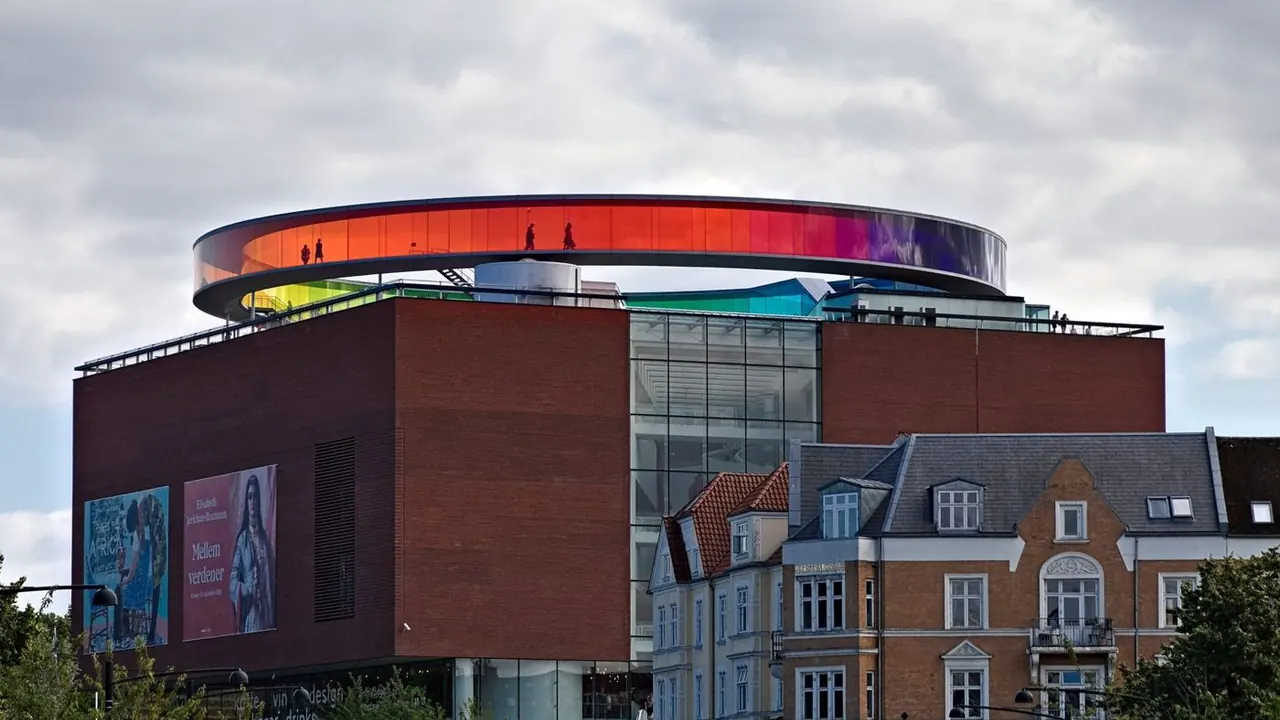
Your rainbow panorama on top of ARoS
- Getting around75
- Families70
- Day trips63
Photo: Mozzihh, CC BY-SA 4.0, cropped
Match
52
Every category weighted equally
- Beach & sun48
- Culture & arts56
- Food & nightlife52
- Family trip53
- Outdoors53
- Relax & unwind50
- Shopping & style54
- On a budget49
Aarhus in twelve categories
Our verdict on each, scored 0 to 100 against the same fixed benchmark cities, so a score means the same thing on every page.
Beaches & swimming. Scores 34 out of 100.
Food & drink. Scores 57 out of 100.
Culture & sights. Scores 61 out of 100.
Nightlife. Scores 45 out of 100.
Nature & outdoors. Scores 56 out of 100.
Day trips. Scores 63 out of 100.
Good for families. Scores 70 out of 100.
Getting around. Scores 75 out of 100.
Shopping & style. Scores 47 out of 100.
Affordability. Scores 22 out of 100.
Live music & performing arts. Scores 55 out of 100.
Wellness & relaxation. Scores 44 out of 100.
Aarhus category by category
Beaches & swimming
34Aarhus sits on a sheltered bay, and its beaches are close. North of the centre, in the beech woods of Risskov, are Den Permanente, an old bathing pier and beach, and the longer sandy stretch of Bellevue. To the south, Moesgaard Strand lies below the forest. All of them are an easy bike ride or bus trip away, and there is also a sea bath out on the harbour. The sand is fine and the water is calm, clean and shallow.
But this is the Kattegat, which reaches only about 17-19°C in a good summer, and the swimming season lasts a few weeks in July and August. The wider sandy beaches of Djursland, under an hour away, have the same cool water. Locals swim with real enthusiasm, but for most visitors a swim is a bracing extra, not the reason they came.
Food & drink
57For a city its size, Aarhus eats well, and it is best at the top end. Several tasting-menu kitchens work in the New Nordic style, cooking with Jutland produce, foraged herbs and fish from the bay. Everyday Danish food is good too: open rye sandwiches at lunch, cinnamon and cardamom pastries from neighbourhood bakeries, and good coffee in the Latin Quarter. Covered street-food halls near the centre give you cheaper, varied meals under one roof. What the city lacks is depth and a cheap end. There are only so many good mid-range places, there is little street food in the true sense, and eating out costs Danish prices.
Culture & sights
61Aarhus has three museums that would stand out in a much bigger city. ARoS is a large art museum topped by a circular rainbow-coloured walkway with views over the rooftops. Den Gamle By is an open-air museum of rebuilt townhouses, workshops and shops that take you from the 1600s through to the 1970s. Moesgaard, set in woods south of the city, is an archaeology museum built into a grassed hillside, and it holds the Grauballe bog body and strong Viking-age collections.
The historic fabric is thinner. The Latin Quarter's crooked lanes and the long Gothic cathedral make a pleasant old core, but it is small. Aarhus University's yellow-brick campus and the waterfront architecture of the harbour district fill out a good two or three days.
Nightlife
45Students are a big share of Aarhus's population, and that shapes the night. On Fridays and Saturdays the riverside bars along Åboulevarden, the cellar bars of the Latin Quarter and a handful of clubs near the centre stay busy well past midnight. There are cosy wine bars and craft-beer places for a slower evening. Midweek the city is quiet, the scene is small enough to see in two nights, and drinks cost Danish prices. It is a fun night out if you are visiting anyway, but not a reason to come.
Nature & outdoors
56The city's green edge is beech forest that runs down to the bay. The Marselisborg woods in the south have a deer park where tame sika and fallow deer come right up to you, and there are long coastal paths and cycle routes through the trees. Riis Skov in the north is smaller and closer to the centre. Mols Bjerge national park, under an hour away, has heath-covered glacial hills and coastal walks. Inland, the Silkeborg lake district is good for canoeing on the Gudenå river and for walking up Himmelbjerget. It is all soft, rolling country with no high ground. It is best from late spring to early autumn, and winters are grey and short of daylight.
Day trips
63Central Jutland is full of small towns with something worth seeing, and the trains and roads make them easy to reach. Silkeborg, about forty minutes away, has the Tollund Man and a museum of Asger Jorn's art. Ebeltoft has a cobbled old town and a historic sailing frigate, and Randers has a covered tropical zoo. Jelling, about an hour and a quarter away, has the Viking-age runestones and burial mounds where Denmark's history as a nation begins.
Odense and its Hans Christian Andersen sites are about an hour and a half away by train, and Ribe, Denmark's oldest town, is at the edge of a day trip. Billund's Lego House is also within reach, as are the Renaissance manors and castle ruins of Djursland. Everything is pleasant, but none of it is a first-rank destination.
Good for families
70Aarhus is an easy city to bring children to, even though there is not much in the city itself made for them. Den Gamle By lets them walk into old shops, kitchens and workshops. Tivoli Friheden, in the woods south of the centre, is a small, old-fashioned amusement park suited to younger children. In the Marselisborg deer park they can feed the deer by hand, and Moesgaard's dramatic displays work well for older children. Playgrounds are everywhere, bike paths are kept apart from traffic, and restaurants and museums take buggies and small children for granted.
The big days out are outside the city. Djurs Sommerland, the country's largest amusement park, is under an hour away, and there is a large aquarium at Grenaa. Legoland in Billund is about an hour and a quarter away. Families who want a theme park or an aquarium should plan on a car or a long bus ride. In summer, the calm, shallow bay beaches are easy for small children.
Getting around
75The centre is small and flat. From the station to the Latin Quarter, ARoS, Den Gamle By and the harbour front is a short walk, and cycling is the local way to get everywhere, on wide, separated lanes. Buses and the light rail reach Moesgaard, the southern woods, the beaches and the university without trouble. The light rail also runs out along the coast towards Djursland. You need a car only for the scattered manors and smaller sights in the countryside. A visitor based in the centre can get by entirely on foot, bike and buses.
Shopping & style
47Shopping in Aarhus mostly means a long pedestrian street running from the station to the river, lined with Scandinavian chains and a couple of department stores. The more interesting finds are in the Latin Quarter, where small independent fashion, vintage and homeware shops sell Danish design: ceramics, lighting, textiles and clean-lined clothing. There is very little luxury and no market of note, so a visitor who loves Nordic design will enjoy a morning here, and anyone else will find it ordinary.
Affordability
22Aarhus is an expensive place to visit, as Danish cities are. Hotel rooms cost a little less than in the capital, but restaurant meals, beer, coffee and taxis all cost high Nordic prices, and the major museums charge full admission. Street-food halls, bakeries and supermarket picnics keep daily costs down. Walking and cycling cost nothing, and the city is compact enough to make them the default.
Live music & performing arts
55Musikhuset, the large glass-fronted concert hall by the city park, is the centre of the city's performing arts. It is home to the Aarhus Symphony Orchestra and the Danish National Opera, and it hosts touring musicals and ballet. Aarhus Teater, an ornate stage from around 1900, does Danish-language drama. The city's music academy and its students feed a good circuit of rock, indie and jazz venues in the old railway yards and around the centre. The calendar is busiest during the long-established summer jazz festival and Aarhus Festuge, a citywide arts week each late summer. Outside these, the programme is solid but small.
Wellness & relaxation
44Aarhus has no thermal springs or historic baths. Its own bathing culture is Nordic: winter swimming clubs, wood-fired saunas by the harbour and at Den Permanente, and a cold plunge into the bay between rounds. All year a visitor can join in at the public saunas. Beyond that, wellness means a handful of hotel spas. The city is calm and unhurried, with green parks and slow coffee breaks, and it is easy to unwind here, but nobody comes to Aarhus for a spa break.
When should you go?
Pick a month to see what it is like. The climate figures are measured averages, not a forecast.
Aarhus in July
Daytime high, °C
Rainfall in the month, mm
The whole year
Shaded against this city’s own year: the deepest cell is its best month for that figure and the palest its weakest.
Where the figures come from
Aarhus's temperatures are measured 30 km from the centre, at Tirstrup.
Aarhus has no rain gauge within 25 km of the centre, so its rainfall comes from a gridded climate dataset read at the city rather than from a gauge further away.
Temperature and rainfall are climate normals, averaged over the years shown. Aarhus: 1991-2020 normals, Tirstrup (29.8 km from centre).
Before you go
| Measure | Aarhus |
|---|---|
| Official language | Danish |
| Currency | Danish Krone (DKK) |
| Sockets | CEFK230 V, 50 Hz |
| Driving side | Right |
| Time zone | UTC+1, UTC+2 in summer |
| Emergency number | 112 |
| Elevation | 6 m |
| Main airport | Aarhus Airport (AAR)30 km from centre15 non-stop destinations |
| Public holidays this year | 14 days |
By the numbers
| Measure | Aarhus |
|---|---|
| City population | 290,598 |
| People per km² | 3,193 |
| Museums within 10 km | 17 |
| UNESCO World Heritage sites within 50 km | 0 |
| Swim season, months above 21 °C | None |
Compare Aarhus with
Every comparison with a written verdict behind it.