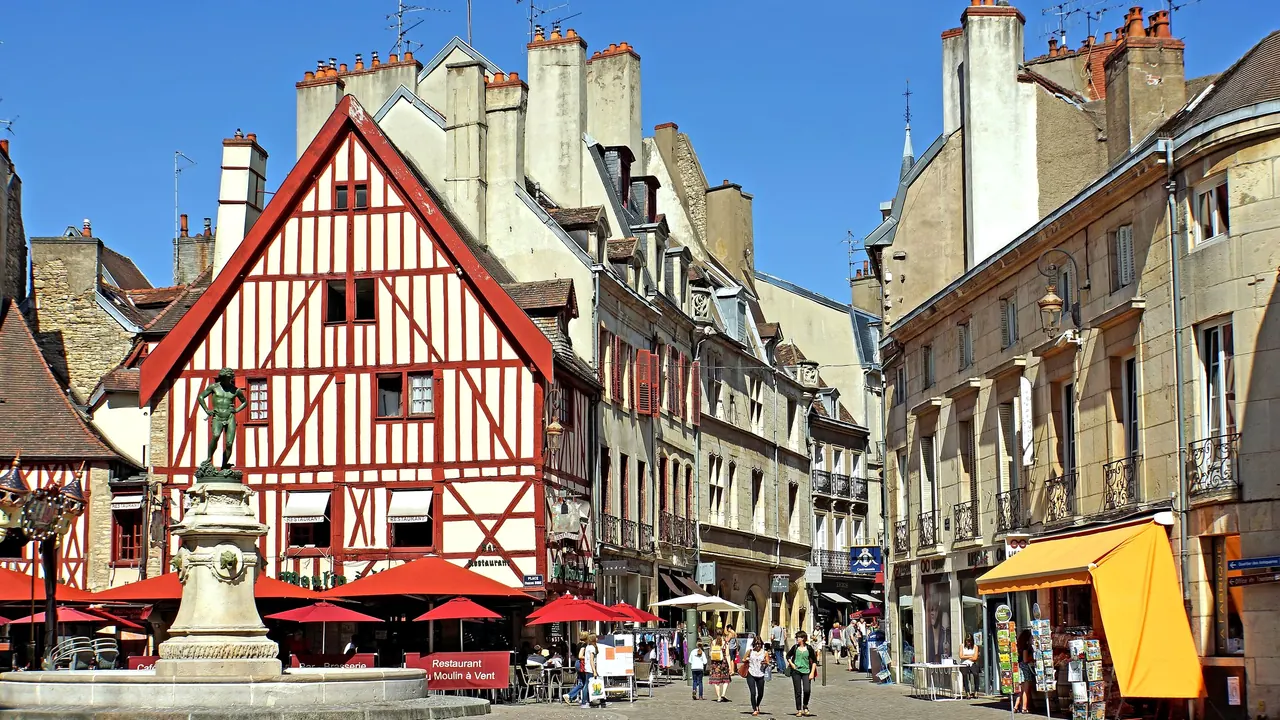
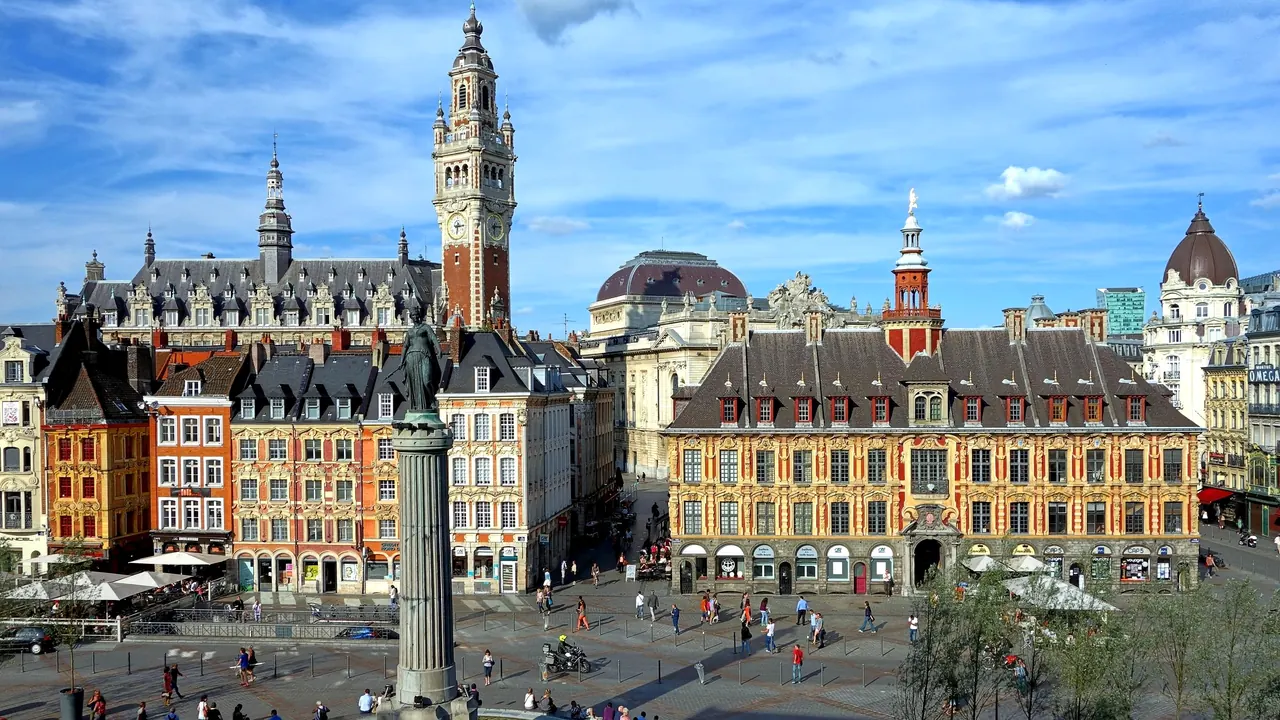
Photos: Dijon by Dennis G. Jarvis, CC BY-SA 2.0, cropped; Lille by Velvet, CC BY-SA 3.0, cropped.
Dijon or Lille?
Our verdict in twelve categories, each scored against the same fixed benchmark cities, and the climate month by month, so you can choose for your trip.
Choose Dijon for
- nature and the outdoors
- food and drink
- prices
Choose Dijon if your days revolve around the table and the vineyard. Burgundian cooking, the stalls of Les Halles and wine bars pouring village wines by the glass are the core of a stay, and the Côte de Nuits begins at the edge of town. The limestone combes and canal towpaths add gentle walking and cycling. It suits a slow, unhurried trip better than one built around evenings out.
Choose Lille for
- nightlife
- shopping
- day trips
Lille is the better base for travellers who want more happening after dark and more places to reach by train. Its large student population keeps the bars busy, the shopping goes well beyond food, and Brussels, Ghent, Bruges and Paris are all easy day trips from stations beside the old town. Families will also find a little more to fill the days, from the Citadel park zoo to the attractions just over the Belgian border.
Scoreboard
Twelve categories on one fixed scale from 0 to 100. The shaded stretch is the gap between the two.
Your match
Pick a travel style or drag the sliders, and both match scores follow your weighting.
Wins on nature and the outdoors and food and drink with your weighting.
Wins on nightlife and shopping with your weighting.
What matters to you?
Category by category
What the scores mean for a trip.
Beaches & swimming
Neither city is a beach destination, but Lille at least has the sea within reach. The wide, windy sand at Malo-les-Bains near Dunkirk is about an hour away by train, and the dune beaches of the Opal Coast lie further on, though the North Sea stays cool even in August. Dijon is hours from any coast, so swimming there means the supervised lawn-and-sand area at Lac Kir or a pool.
Food & drink
Dijon eats better, and it does so through wine and classic Burgundian cooking. Boeuf bourguignon, snails and jambon persillé come with village Burgundies by the glass. Les Halles is a proper produce market with Bresse poultry and Époisses, and the city has a serious fine-dining tier.
Lille's table is heartier and more Flemish: carbonnade cooked in beer, potjevleesch and Maroilles in the wood-panelled estaminets of Vieux-Lille, with ales rather than wine. It has a sweet tooth too, with vanilla-filled waffles and the multi-ethnic Sunday market at Wazemmes, but its top restaurants run less deep than Dijon's.
Culture & sights
The two are evenly matched, and the difference is in their history. Dijon is the old capital of the Dukes of Burgundy: the ducal palace with the carved Valois tombs, half-timbered streets, the gargoyles of Notre-Dame and Sluter's Well of Moses give it a medieval and Renaissance character.
Lille is Flemish baroque brick and carved stone around the Vieille Bourse and the Grand Place, and its Palais des Beaux-Arts is the larger collection, with Flemish masters and Goya. It also has more art beyond the centre, with La Piscine in Roubaix and the LaM reached by metro or tram.
Nightlife
Lille is the livelier night out. Its students pack the loud bars of Rue Masséna and Rue Solférino on Thursdays, Vieux-Lille adds beer cafés and cocktail bars in brick cellars, and Belgium's later clubs are close by.
Dijon's evenings mostly mean a late dinner, wine bars and the pubs along Rue Berbisey. Outside term time the streets are quiet by around midnight.
Nature & outdoors
Dijon has far more on its doorstep. The Combe à la Serre and Combe de Lavaux cut wooded valleys with cliffs and viewpoints just west of town, the Burgundy Canal towpath and the vineyard cycle route make for long rides, and the Morvan's lakes and granite hills are about an hour and a half away.
Around Lille the land is flat and farmed. Outdoor time there means the Citadel park loop along the Deûle and short walks on the low Monts de Flandre, while the chalk cliffs of Cap Blanc-Nez are a long day away.
Day trips
Both make excellent bases, but Lille's reach is wider. Brussels is about half an hour by fast train, Ghent and Bruges around an hour, and Paris about an hour by TGV. Arras, Amiens Cathedral, the Louvre-Lens and the First World War battlefields fill the French side.
Dijon's day trips are concentrated and more rural. They run down the Grand Cru villages to walled Beaune, out to Fontenay Abbey and Semur-en-Auxois, and on to Besançon. Much of that is easier by car or bike than by train.
Good for families
Lille gives children a bit more to do. The Citadel park combines a small zoo, playgrounds and fairground rides, the Forum des Sciences is a hands-on science centre, and Pairi Daiza and the Nausicaá aquarium are within reach for a bigger outing. The cobbles of Vieux-Lille are hard going with a pushchair, though.
Dijon is calm and safe, with the planetarium at the Jardin de l'Arquebuse and paddling at Lac Kir. Its vineyards and tastings are aimed at adults, however.
Getting around
Both have compact, walkable centres where a car is unnecessary, and Lille has a slight edge for anyone who travels a lot. Its two main stations stand side by side near the old town, and the automated VAL metro and the tram reach Roubaix and Tourcoing. Dijon covers its outskirts with two tram lines and runs trains to Beaune, but the wine villages away from the railway call for a hire car, a bike or a tour.
Shopping & style
Lille is the better place to shop. International chains on Rue Neuve and the Euralille mall sit alongside independent fashion, design and delicatessens in the lanes of Vieux-Lille. Every September, the Braderie turns the streets into one vast flea market.
Dijon's shopping is mostly edible: mustard in many flavours, pain d'épices, cassis and Burgundy from the wine merchants. Rue de la Liberté offers little beyond a department store and French chains.
Affordability
Costs are much the same, and comfortable rather than cheap in both. What differs is what pushes the bill up. In Dijon, set lunches and wine by the glass are good value, but cellar tastings, wine tours and good bottles add up fast. In Lille, estaminet meals, beer and the metro cost little, while hotels get dearer during the Braderie and the big trade fairs.
Live music & performing arts
Lille has the fuller programme. Its grand opera house, a resident national orchestra, the Théâtre du Nord, the contemporary dance in Roubaix and Tourcoing and the touring bands at the Zénith and Aéronef give more choice on a given evening.
Dijon offers opera, concerts and dance at the Grand Théâtre and at the Auditorium, which is known for its acoustics. Its season thins out in summer.
Wellness & relaxation
Neither city is a place to go for spa treatments, and both rely on hotel spas and a gentle pace. Lille does have a real thermal bath a short train ride away at Saint-Amand-les-Eaux. Dijon's version of rest is long lunches and slow afternoons in the vineyards, with grape-based treatments at a few village hotels.
When should you go?
Pick your month. The climate figures are measured averages, not a forecast.
Dijon in July
Lille in July
Daytime high, °C
Rainfall in the month, mm
Temperature and rainfall are climate normals, averaged over the years shown. Dijon: 1991-2020 normals, Dijon (7 km from centre). Lille: 1991-2020 normals, Lille (7.8 km from centre).
Both cities have cold, grey winters, with daytime highs of about 6°C to 7°C from December to February and short days. They part ways in summer. Dijon gets properly warm, reaching around 27°C in July, and it is clearly the sunnier of the two from spring to early autumn. Lille stays milder, at around 24°C at its peak, which makes July and August comfortable for long days on foot but rarely hot. Neither has summer heat that gets in the way of sightseeing.
Rain is spread fairly evenly through the year in both. Dijon's wettest spells come in May and again in October and November, while in Lille the rain builds through the autumn to its heaviest in December, at around 76mm. For walking the streets and getting out into the countryside, May to September is the best stretch in both. Dijon has the edge in June and September for vineyard days in sunshine, and Lille's cooler summer suits those who dislike the heat.
Which traveller are you?
On an outdoors trip, Dijon is the stronger base. You can spend a morning walking or climbing in the hills above town, then an afternoon cycling between wine villages. In Lille, being outdoors means park strolls and level rides, and real scenery is a long day out.
On a shopping trip, Lille is the clear choice. In Dijon, shopping is a morning spent picking up things to eat and drink at home, not a day out. Lille can fill whole afternoons with big-name stores and independent labels, and there is a citywide flea market each September.
On a wine trip, Dijon has no rival here. The vineyards start at the city's southern edge, so you can spend the day tasting in village cellars and the evening drinking Burgundies by the glass in town. Lille drinks beer, and nothing there compares.
Before you go
| Measure | Dijon | Lille |
|---|---|---|
| Official language | French | French |
| Currency | Euro (EUR) | Euro (EUR) |
| Sockets | CE230 V, 50 Hz | CE230 V, 50 Hz |
| Driving side | Right | Right |
| Time zone | UTC+1, UTC+2 in summer | UTC+1, UTC+2 in summer |
| Emergency number | 112 | 112 |
| Elevation | 220 m | 17 m |
| Main airport | Lyon Saint-Exupéry Airport (LYS)178 km from centre141 non-stop destinations | Lille Airport (LIL)8 km from centre61 non-stop destinations |
| Public holidays this year | 11 days | 11 days |
By the numbers
| Measure | Dijon | Lille |
|---|---|---|
| City population | 161,830 | 238,246 |
| People per km² | 3,890 | 6,846 |
| Museums within 10 km | 8 | 23 |
| UNESCO World Heritage sites within 50 km | 1 | 6 |
Where else could you go?
Every comparison below shares a destination with this one, so you can follow Dijon or Lille somewhere new.