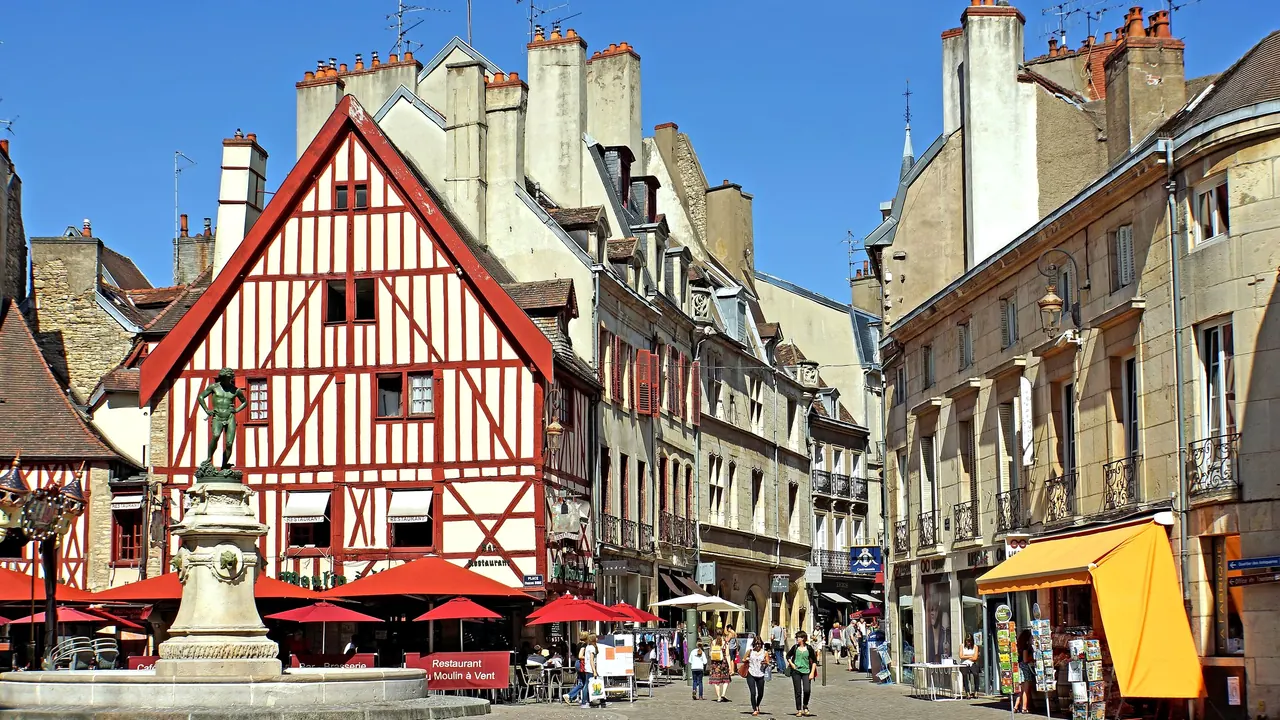
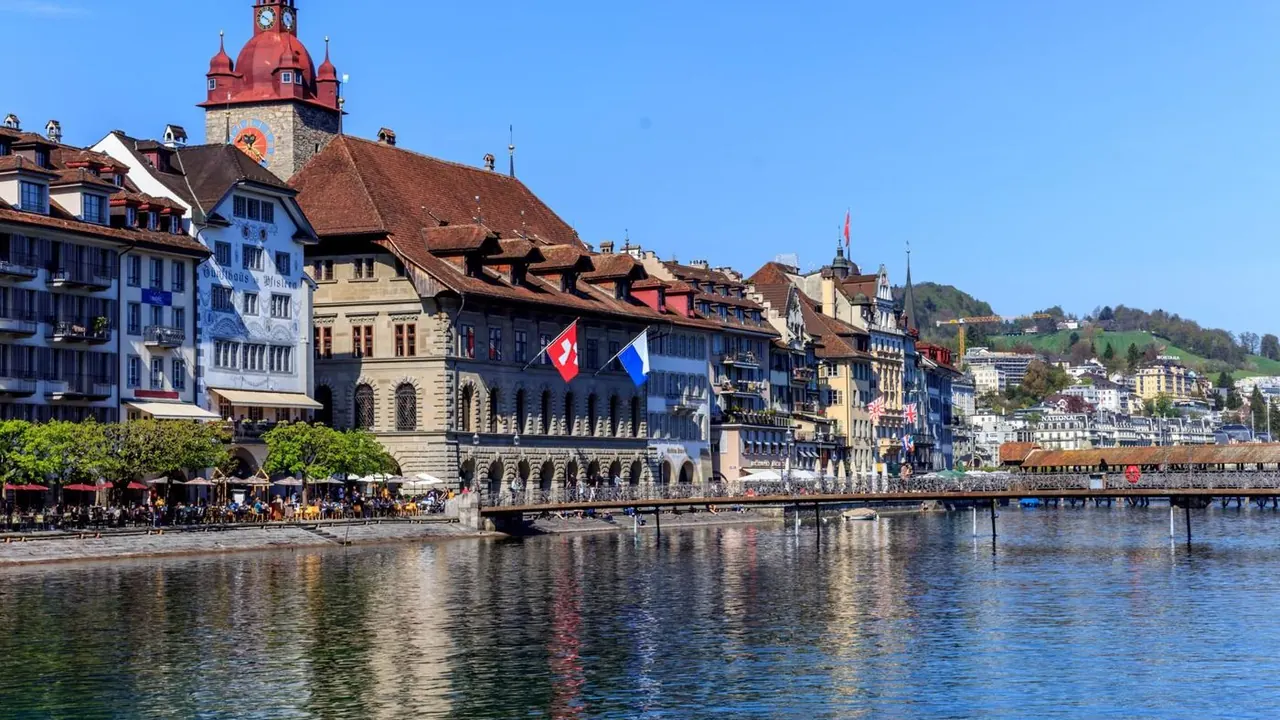
Photos: Dijon by Dennis G. Jarvis, CC BY-SA 2.0, cropped; Lucerne by ILOVESwitzerland, Pexels License.
Dijon or Lucerne?
Our verdict in twelve categories, each scored against the same fixed benchmark cities, and the climate month by month, so you can choose for your trip.
Choose Dijon for
- prices
- food and drink
- culture and sights
Dijon is the pick if you travel to eat and drink. It sits at the top of the Burgundy wine country, with Les Halles market, village wines poured by the glass and the vineyard road to Beaune starting at the edge of town. The old capital of the dukes adds a little more history than Lucerne has, and the whole trip costs a good deal less. It suits couples and food lovers who are happy with gentle countryside and quiet evenings.
Choose Lucerne for
- nature and the outdoors
- families
- beaches
Choose Lucerne when the scenery matters most. Mountains, lake steamers and cogwheel railways are minutes from the station, and all of them run on one easy public transport system. Families get more to do, classical music lovers get a world-class concert hall, and walkers get real peaks. Be ready to pay heavily for it, and expect simpler food than you would find in Burgundy.
Scoreboard
Twelve categories on one fixed scale from 0 to 100. The shaded stretch is the gap between the two.
Your match
Pick a travel style or drag the sliders, and both match scores follow your weighting.
Wins on prices and food and drink with your weighting.
Wins on nature and the outdoors and families with your weighting.
What matters to you?
Category by category
What the scores mean for a trip.
Beaches & swimming
Neither city is anywhere near the sea, but Lucerne gives you far better swimming. In summer, people swim in the clean, calm lake from the Lido, the old wooden lake baths and the lawns at Ufschötti, with mountains behind them, and the boats call at villages that have their own bathing spots.
Dijon has only Lac Kir, a reservoir on the western edge of town with a supervised patch of sand and grass, plus the municipal pools. That is enough for a hot afternoon, not a reason to choose the city.
Food & drink
This is where Dijon pulls clearly ahead. You get boeuf bourguignon, snails, jambon persillé and Époisses cheese, the market hall at Les Halles, and village Burgundies by the glass, because the vineyards start at the city's southern edge. The Cité de la Gastronomie in the old hospital and a serious fine-dining scene add more.
Lucerne serves hearty Swiss food, such as Chügelipastete, fondue, rösti and perch from the lake, often in guild-house taverns that feed the tour groups. It is well made but costly, and it has little depth. Neither city offers much international variety.
Culture & sights
Dijon has a little more to see. The Palace of the Dukes holds one of France's oldest fine-art museums, with the carved tombs of the Valois dukes. The half-timbered streets lead to Notre-Dame's gargoyles and lucky owl, and Sluter's Well of Moses is a medieval masterpiece. It fills two or three days.
Lucerne has fewer sights, but famous ones: the Chapel Bridge and Water Tower, the towers of the Musegg Wall and the Lion Monument. The Rosengart Collection of Picasso and Klee is the strongest art. Most visitors see it all in a day or two.
Nightlife
Both cities are quiet at night, and most evenings end around midnight. The difference is in the setting. Dijon's evenings are student bars and pubs on Rue Berbisey, wine bars and late dinners on the terraces around Place Émile Zola. In Lucerne, you have a drink by the lake or the Reuss, and there are a few cocktail bars in the Neustadt. The one big exception is Fasnacht, when the whole Old Town stays out in costume until dawn.
Nature & outdoors
Lucerne is in another league. It sits on a branching lake hemmed in by mountains. You can ride the steep cogwheel railway up Pilatus, walk the ridges of Rigi, or reach Titlis and its glacier in about an hour. In winter, the same mountains offer skiing and sledging.
Dijon's countryside is gentle. There are climbing cliffs and trails in the Combe à la Serre and Combe de Lavaux, a flat towpath along the Burgundy Canal, and the cycle route through the Côte de Nuits vineyards. The granite hills of the Morvan are the wildest country within reach.
Day trips
Both make excellent bases, but the trips are very different. From Dijon, you head into wine and monastery country: the Route des Grands Crus through Gevrey-Chambertin and Vougeot to walled Beaune, then Fontenay Abbey, Semur-en-Auxois and the battlefield at Alésia.
From Lucerne, the outings are towns and the lake. Bern, Basel and Zurich are each under an hour by train. The steamers carry you to the Rütli meadow and Altdorf, where the story of William Tell and the founding of Switzerland is set, and a scenic line runs over the Brünig Pass to Interlaken.
Good for families
Lucerne works better with children. The Swiss Museum of Transport, with its trains, planes and planetarium, can fill a whole day. After that, the paddle steamers, cogwheel trains and the summer toboggan run on Pilatus feel like adventures, although they cost a lot and depend on the weather.
Dijon is safe and relaxed, with its pedestrian centre, the planetarium at the Jardin de l'Arquebuse and paddling at Lac Kir. But its wine tastings and fine-art museums are made for parents, and children will run out of things to do sooner.
Getting around
Both centres are compact and easy to walk. Lucerne's advantage is that the excursions use the same system. Lake boats leave from in front of the station, and one integrated ticket system takes you up to the cogwheel railways and cable cars, so you never need a car.
Dijon has two tram lines, and the TGV reaches Paris in well under two hours. Regional trains also run to Beaune. Many wine villages away from the railway, though, mean hiring a car or a bike, or booking a tour.
Shopping & style
Dijon's best buys are the ones you eat and drink. Mustard comes in dozens of flavours, and there is crème de cassis, pain d'épices, cheese from Les Halles and Burgundy from the wine merchants and cellars. Rue de la Liberté has a department store and French chains, but there is not much for fashion.
Lucerne comes out slightly ahead because of one trade, watches. The big watch and jewellery houses on Schwanenplatz and the lakefront stand next to shops selling army knives, chocolate and cuckoo clocks, and the Old Town lanes have a few independent boutiques. Beyond that, there are about as few clothes and design shops as in Dijon.
Affordability
The gap here is wide. Dijon costs what a French regional city usually does: hotels are moderate, set bistro lunches are a good way to eat well, and wine by the glass is cheap. Your bill only climbs with the serious restaurants and cellar tastings.
Lucerne is one of the costliest places you could choose. Central hotels, ordinary meals and the mountain railways that make the stay worthwhile all add up fast. A Swiss travel pass and supermarket picnics by the lake soften the cost, but they do not change it.
Live music & performing arts
Lucerne is the stronger city for classical music. The Lucerne Festival brings leading orchestras to Jean Nouvel's lakefront hall, mainly in late summer, and the hall's acoustics are famous. The Lucerne Symphony Orchestra and the city theatre fill the rest of the year.
Dijon's opera company works in two venues, the old Grand Théâtre and the Auditorium, which also has fine acoustics. It is a good season for the city's size, but it follows the academic year and thins out in summer, the same months when Lucerne is at its busiest.
Wellness & relaxation
Neither city has a tradition of thermal baths. Lucerne makes up for it with resort spas on the slopes and a Mario Botta mineral bath high on the Rigi, where you soak with a mountain view. Afternoons on the steamers and lakeside promenades are restful too, as long as you avoid the Old Town at midday.
In Dijon, relaxing means long lunches, quiet squares and slow hours in the vineyards. Spa time is limited to a few hotels, some of them offering grape-based treatments.
When should you go?
Pick your month. The climate figures are measured averages, not a forecast.
Dijon in July
Lucerne in July
Daytime high, °C
Rainfall in the month, mm
Where the figures come from
Lucerne has no rain gauge within 25 km of the centre, so its rainfall comes from a gridded climate dataset read at the city rather than from a gauge further away.
Lucerne's sunshine is measured 42 km from the centre, at Zurich Town / Ville..
Temperature and rainfall are climate normals, averaged over the years shown. Dijon: 1991-2020 normals, Dijon (7 km from centre). Lucerne: 2005-2025 (sunshine 1991-2020, rainfall 1991-2020) normals, Emmen (4.2 km from centre).
Dijon has the warmer, drier and sunnier summer. July reaches about 27°C there against 24°C in Lucerne, and Lucerne's wettest months are the summer ones, with around 141mm in July and August, about twice Dijon's 65mm. Both cities are pleasant for walking from May to September. Lucerne's lake is only warm enough for most swimmers in July and August, and low cloud can hide the peaks on wet days, so its brighter summer weeks are worth aiming for.
Spring and early autumn are good in both, and September is especially fine for the Burgundy vineyards and for mountain walks above Lucerne. Winters are cold and grey in both places, falling to about 4°C in Lucerne, where the cold at least brings skiing and sledging nearby. In Dijon, winter is a season for museums and long lunches.
Which traveller are you?
For an outdoors trip, Lucerne wins easily. Pilatus, Rigi and the Stanserhorn are a boat or train ride away, Titlis keeps its snow all year, and you can link steamer, railway and hike in a single day. Dijon's wooded combes and canal paths are pleasant but tame.
On a trip on a tight budget, go to Dijon. Hotels cost what they do in any French regional city, set lunches in the bistros are good value, and wine is cheap by the glass. In Lucerne even simple meals and the mountain railways strain a budget.
For a food and nightlife trip, Dijon is the better base. Burgundian cooking, Les Halles and village wines give it a real food culture, and the student bars along Rue Berbisey keep evenings going a little later than Lucerne's quiet waterfront does.
Before you go
| Measure | Dijon | Lucerne |
|---|---|---|
| Official language | French | French, German, Italian, Romansh |
| Currency | Euro (EUR) | Swiss Franc (CHF) |
| Sockets | CE230 V, 50 Hz | CJ230 V, 50 Hz |
| Driving side | Right | Right |
| Time zone | UTC+1, UTC+2 in summer | UTC+1, UTC+2 in summer |
| Emergency number | 112 | 112 |
| Elevation | 220 m | 436 m |
| Main airport | Lyon Saint-Exupéry Airport (LYS)178 km from centre141 non-stop destinations | Zürich Airport (ZRH)49 km from centre226 non-stop destinations |
| Public holidays this year | 11 days | 12 days |
By the numbers
| Measure | Dijon | Lucerne |
|---|---|---|
| City population | 161,830 | 86,234 |
| People per km² | 3,890 | 2,963 |
| Museums within 10 km | 8 | 14 |
| UNESCO World Heritage sites within 50 km | 1 | 1 |
Where else could you go?
Every comparison below shares a destination with this one, so you can follow Dijon or Lucerne somewhere new.