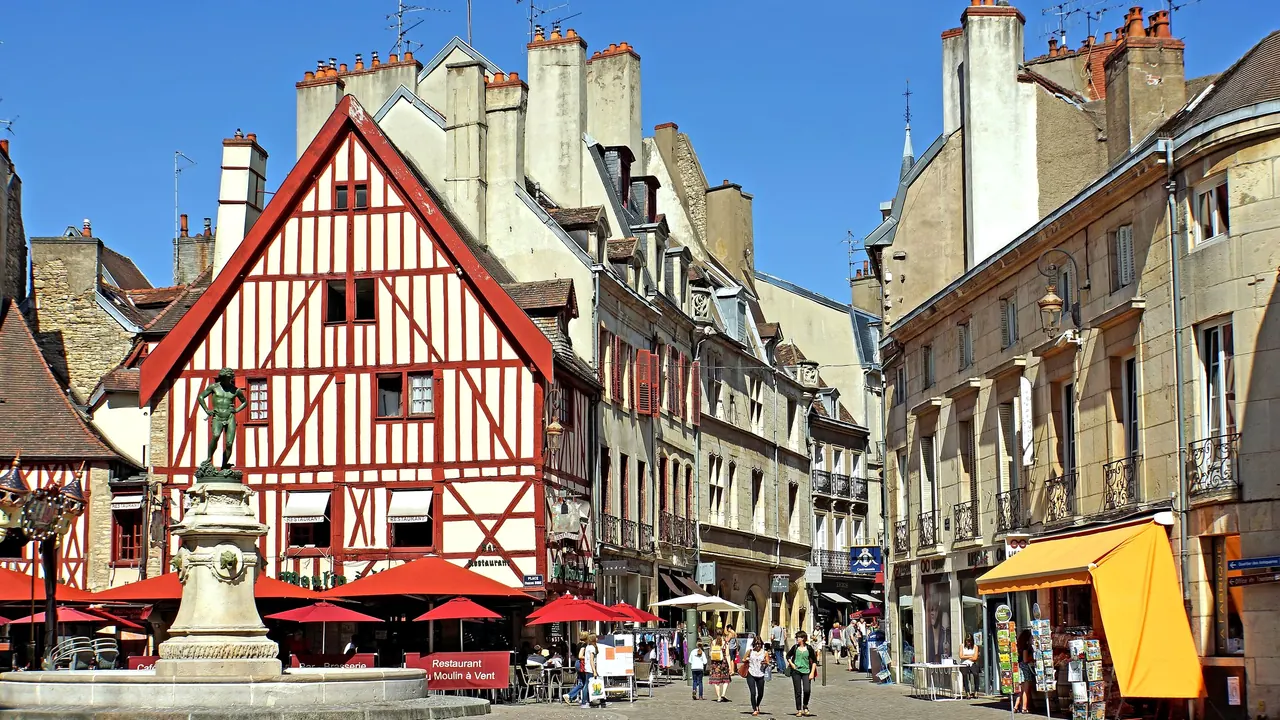
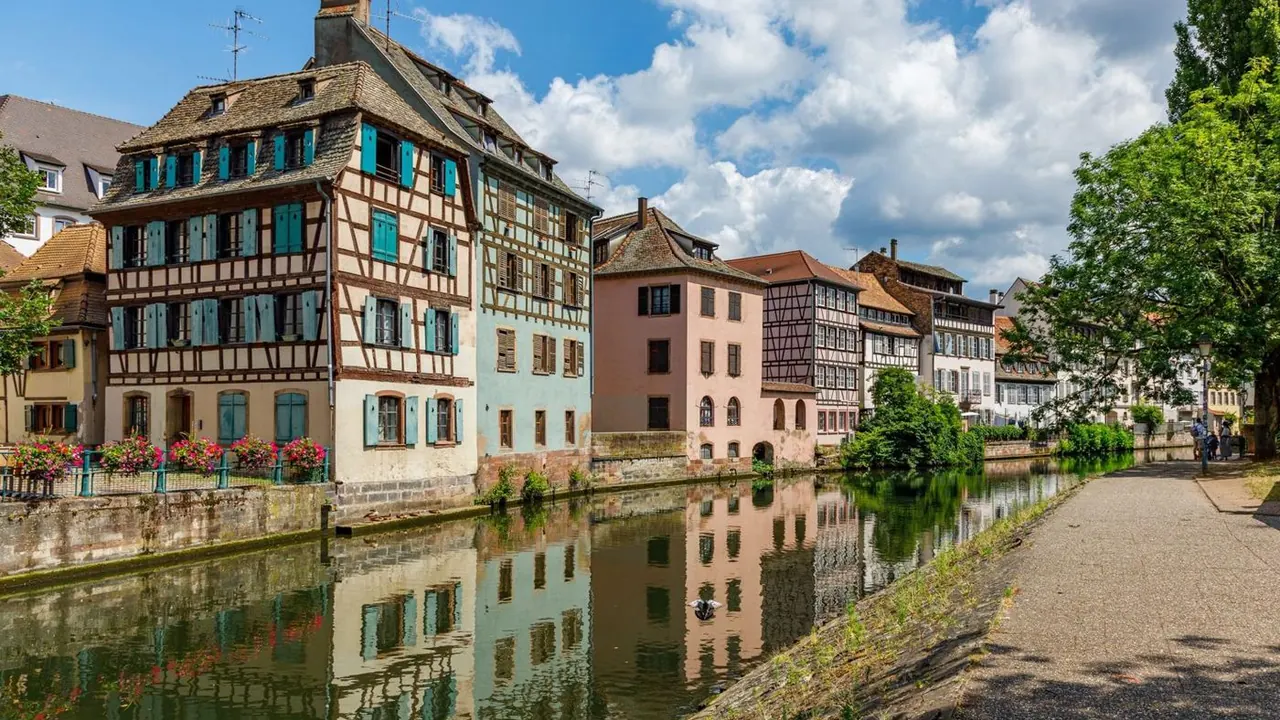
Photos: Dijon by Dennis G. Jarvis, CC BY-SA 2.0, cropped; Strasbourg by Edoardo Colombo, Pexels License.
Dijon or Strasbourg?
Our verdict in twelve categories, each scored against the same fixed benchmark cities, and the climate month by month, so you can choose for your trip.
Choose Dijon for
- prices
- food and drink
Dijon suits a slower trip built around Burgundy's table and cellars. Bistros line the iron market hall, wine bars pour village Burgundies by the glass, and the Route des Grands Crus starts at the edge of town. Day to day it costs a little less than Strasbourg, and its evenings are quieter. Couples and food-minded travellers who want long lunches, cellar visits and a compact ducal old town will get the most from it.
Choose Strasbourg for
- wellness
- families
- shopping
Strasbourg is the broader choice, and the better one if the party has more than one kind of interest. Its cathedral quarter, Neustadt and museums give it more depth. Its opera, theatre and music seasons are stronger, and it has a real bathhouse with Baden-Baden's thermal baths close by. Families do much better here, with boat trips, a science centre and Europa-Park in reach. The Vosges, the Black Forest and German cities just over the Rhine add a lot to a week's stay.
Scoreboard
Twelve categories on one fixed scale from 0 to 100. The shaded stretch is the gap between the two.
Your match
Pick a travel style or drag the sliders, and both match scores follow your weighting.
Wins on prices and food and drink with your weighting.
Wins on wellness and families with your weighting.
What matters to you?
Category by category
What the scores mean for a trip.
Beaches & swimming
Neither city is anywhere near the sea, so swimming means freshwater on a hot afternoon. Dijon has a single option, the supervised lawn-and-sand area at Lac Kir on the western edge of town. Strasbourg has several lifeguarded gravel-pit lakes with grassy banks, and the best known, the Baggersee, is reachable by tram.
Food & drink
Both are serious food cities with fine-dining tables and good markets, but the cooking differs. Dijon's is classic Burgundy: boeuf bourguignon, snails, Époisses and Bresse poultry from Les Halles. It also has its mustard and cassis, and wine bars pour village Burgundies from vineyards that begin at the city's southern edge.
Strasbourg's cooking leans German. Expect choucroute, baeckeoffe and tarte flambée, eaten in wood-panelled winstubs with a pichet of Riesling, plus plenty of local beer. Watch out for the tourist menus around the cathedral and Petite France. Neither city offers much beyond its own regional cuisine.
Culture & sights
Strasbourg has the deeper set of sights. The pink sandstone cathedral with its astronomical clock anchors a UNESCO ensemble that runs from the timber-framed lanes of Petite France to the imperial avenues of the Neustadt. The Palais Rohan holds three museums, and there is a large modern art museum and the European institutions as well.
Dijon's highlights gather around the Palace of the Dukes of Burgundy. Inside it, the Musée des Beaux-Arts keeps the Valois tombs and their sculpted mourners. Add Notre-Dame's gargoyles and lucky owl and Sluter's Well of Moses, and you have a fine two days rather than a longer stay.
Nightlife
Both are student towns where a night out means bars rather than clubs, but Strasbourg has more of them and stays out a little later. Its Krutenau quarter and the streets around Place Saint-Étienne are full of beer cellars and student bars, and in summer the riverside terraces stay busy.
In Dijon an evening more often means a late dinner and a glass of Burgundy. It might move on to the small bars of Rue Berbisey, and outside term time the streets go quiet by midnight.
Nature & outdoors
Strasbourg has more serious outdoors within reach. Within about an hour you can be on forest trails and castle ruins in the Vosges or on the higher fir-covered ridges of the Black Forest. Closer in, the Rhine forests shelter storks, herons and beavers, and level cycle routes run into Germany.
Dijon's countryside is gentler. There are climbing cliffs and walking trails in the combes just west of town, a flat towpath along the Burgundy Canal, and the vineyard cycle route to Beaune. The granite hills of the Morvan are the wildest landscape nearby, and they are further away.
Day trips
Both are excellent bases, and both have a famous wine route on their doorstep. Dijon's trips are mostly Burgundy itself: the grand cru villages down to Beaune, Fontenay Abbey, Semur-en-Auxois and the battlefield at Alésia. Most of these are easiest by car.
Strasbourg has the Alsace wine villages and Colmar, and it adds a second country. Freiburg, Baden-Baden, Heidelberg and Basel are all within a day, mostly by train, which gives a week there more variety of cities.
Good for families
Strasbourg is much better set up for children. Boat trips through Petite France, the storks and rowing boats in the Orangerie, the Le Vaisseau science centre and the moving figures of the astronomical clock fill a few days. Europa-Park is the big outing across the border.
Dijon is just as safe and easy to walk, with a planetarium in the Jardin de l'Arquebuse, play areas in the Parc de la Colombière and paddling at Lac Kir. Beyond those, most of what the city offers is wine and fine art aimed at parents.
Getting around
Both centres are compact and mostly pedestrian, so neither needs a car until you head for the vineyards. Strasbourg is the easier city to move around. Its tram network reaches the European quarter and runs across the Rhine to Kehl, and its separated bike lanes often make cycling the quickest option.
Dijon gets by with two tram lines and short walks. Its real strength is rail: trains run straight down the wine route to Beaune, and the TGV reaches Paris in under two hours.
Shopping & style
Strasbourg gives a shopper more ground to cover. Chains and a department store fill the area around Place Kléber, independent shops and bookshops sit near the cathedral, and there are regional crafts such as Soufflenheim pottery and printed linens. In December the Christmas market adds stalls of decorations.
Dijon's shopping is mostly edible: mustard in dozens of flavours, cassis, pain d'épices and wine from the cellars, with Rue de la Liberté for everyday chains. Neither city has much for fashion or luxury.
Affordability
Dijon is the somewhat cheaper stay. Hotel rooms are moderate, the bistro set lunches are a good-value way to eat, and wine by the glass costs less than elsewhere in France. The bill rises only if you book serious restaurants and guided cellar tours.
In Strasbourg, the free cathedral and old town and cheap trams help. But hotel rooms are the main expense and get much dearer during the Christmas market and Parliament weeks, so the dates you choose matter more there.
Live music & performing arts
Strasbourg has the fuller calendar. The Opéra national du Rhin and the Philharmonic both run full seasons, and the Théâtre National de Strasbourg is among the country's leading stages. The Musica festival makes the city a centre for contemporary music each autumn, and there is a jazz festival too.
Dijon holds its own for its size. The Opéra de Dijon stages opera, concerts and dance in the old Grand Théâtre and in the Auditorium, which is known for its acoustics. In both cities the programme follows the academic year and thins out in summer.
Wellness & relaxation
Strasbourg is the place for a proper soak. The early twentieth-century Bains municipaux has tiled pools, a hammam and saunas, and Baden-Baden's Friedrichsbad and Caracalla baths are under an hour away. The Black Forest has more spa towns besides.
Dijon has no bathing tradition, only a few hotel spas, some offering grape-based treatments in the wine villages. Its calm comes instead from long lunches and quiet afternoons among the vines.
When should you go?
Pick your month. The climate figures are measured averages, not a forecast.
Dijon in July
Strasbourg in July
Daytime high, °C
Rainfall in the month, mm
Temperature and rainfall are climate normals, averaged over the years shown. Dijon: 1991-2020 normals, Dijon (7 km from centre). Strasbourg: 1991-2020 normals, Strasbourg (9.1 km from centre).
The two cities have much the same year, so the weather rarely decides between them. Winters are cold and grey in both, with highs around 6°C from December to February. That suits museums and short walks, but it is chilly for long days outdoors. Spring warms through April. From late May to early September both are pleasantly warm, peaking at about 27°C in Dijon in July and a degree less in Strasbourg. That is warm enough for an afternoon at the lakes and rarely too hot for the streets. September is a good month in both, still mild and drier than May.
The differences are in sun and rain. Dijon is a little sunnier in every month, but its wettest spells are May and late autumn, with October and November each bringing about 77mm. Strasbourg's rain falls mostly from May to July, and its winters are clearly drier, so its cold months bring more dull days than wet ones.
Which traveller are you?
On a family trip with children, Strasbourg is the clear pick. Children get whole days planned around them, and a theme-park outing over the border can anchor the week. In Dijon, a day or two in, the plans turn to things that mostly please the parents.
For a relaxing and wellness trip, Strasbourg again. Here you can build proper spa days into the stay, both in town and in the thermal towns across the Rhine. Dijon offers a gentler kind of rest, slow meals and quiet vineyards, but little real pampering.
On a tight budget, Dijon goes further. The everyday basics of a stay, a bed, a meal and a glass of wine, come out lower, and your dates matter less. In Strasbourg, keeping costs down means planning carefully around its busiest weeks.
Before you go
| Measure | Dijon | Strasbourg |
|---|---|---|
| Official language | French | French |
| Currency | Euro (EUR) | Euro (EUR) |
| Sockets | CE230 V, 50 Hz | CE230 V, 50 Hz |
| Driving side | Right | Right |
| Time zone | UTC+1, UTC+2 in summer | UTC+1, UTC+2 in summer |
| Emergency number | 112 | 112 |
| Elevation | 220 m | 132 m |
| Main airport | Lyon Saint-Exupéry Airport (LYS)178 km from centre141 non-stop destinations | Strasbourg Airport (SXB)10 km from centre43 non-stop destinations |
| Public holidays this year | 11 days | 11 days |
By the numbers
| Measure | Dijon | Strasbourg |
|---|---|---|
| City population | 161,830 | 293,771 |
| People per km² | 3,890 | 3,752 |
| Museums within 10 km | 8 | 21 |
| UNESCO World Heritage sites within 50 km | 1 | 1 |
Where else could you go?
Every comparison below shares a destination with this one, so you can follow Dijon or Strasbourg somewhere new.