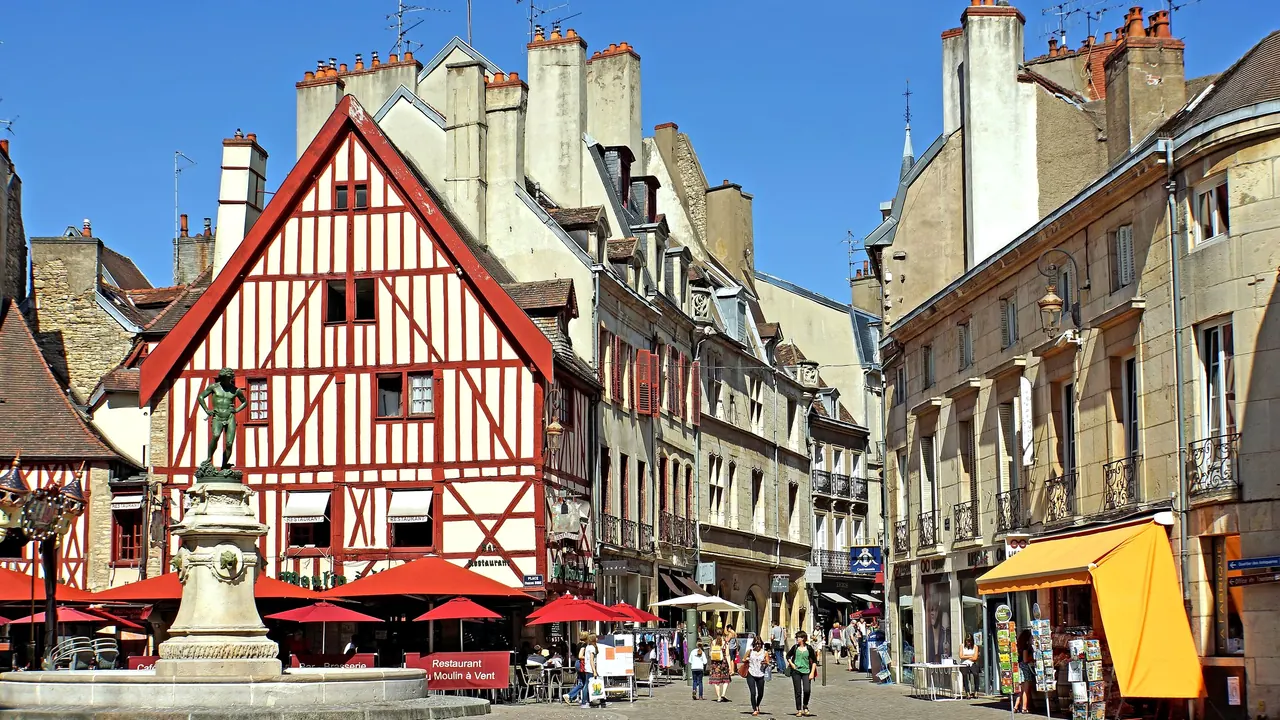
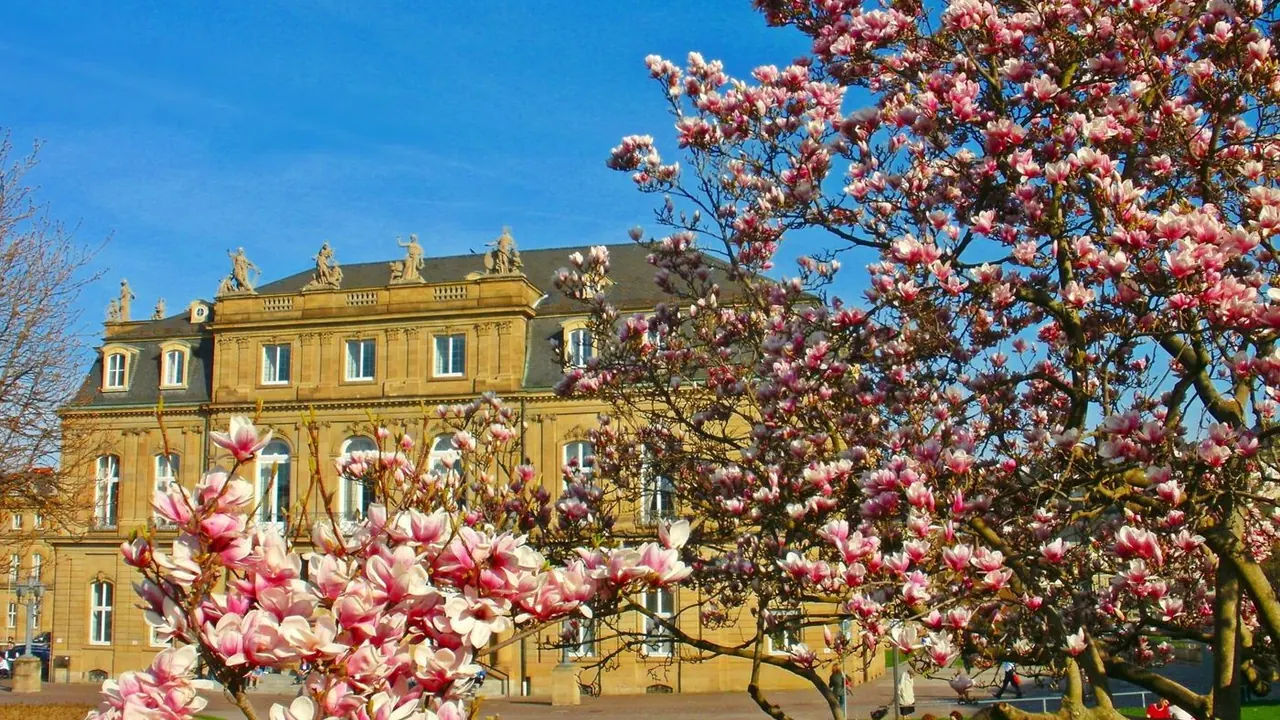
Photos: Dijon by Dennis G. Jarvis, CC BY-SA 2.0, cropped; Stuttgart by Baden de, CC BY 3.0, cropped.
Dijon or Stuttgart?
Our verdict in twelve categories, each scored against the same fixed benchmark cities, and the climate month by month, so you can choose for your trip.
Choose Dijon for
- prices
- food and drink
- beaches
Dijon suits travellers whose trip is built around the table and the vineyard. Burgundian cooking, the market hall at Les Halles, village wines poured by the glass and the Route des Grands Crus starting at the edge of town make it the better choice for food and wine lovers. Couples and slow travellers will also like the compact medieval centre around the ducal palace and the somewhat gentler bill.
Choose Stuttgart for
- wellness
- live music and the arts
- families
Stuttgart is the more rounded city. Families get Wilhelma and the hilltop parks, theatre-goers get one of Europe's most respected ballet companies and a bold opera house, and anyone who wants to unwind can soak in the warm mineral baths at Bad Cannstatt. The Swabian Jura and the Black Forest are close for walkers, and the rail network makes castles and university towns easy to reach. It costs more, but it gives you more to do once dinner is over.
Scoreboard
Twelve categories on one fixed scale from 0 to 100. The shaded stretch is the gap between the two.
Your match
Pick a travel style or drag the sliders, and both match scores follow your weighting.
Wins on prices and food and drink with your weighting.
Wins on wellness and live music and the arts with your weighting.
What matters to you?
Category by category
What the scores mean for a trip.
Beaches & swimming
Neither city is a beach destination. Both lie hours from any coast, so this is not a reason to pick either.
The difference is small but practical. Dijon has Lac Kir, a reservoir with a supervised lawn-and-sand bathing area where you can actually swim in summer. Stuttgart's lake is for boating rather than bathing, so swimming there means the outdoor pools, some of them fed by mineral springs, or a trip of more than two hours to Lake Constance.
Food & drink
Dijon has the stronger reputation for food. It sits at the head of Burgundy, so boeuf bourguignon, snails, jambon persillé, Époisses and Bresse poultry are all local, along with the city's own mustard, pain d'épices and cassis. Les Halles is the centre of it all on market days, and the grand cru villages next door mean you can try wines by the glass that are rarely sold that way anywhere else.
Stuttgart's Swabian cooking is just as distinctive, but heartier and less celebrated: Maultaschen, Käsespätzle and Zwiebelrostbraten in wine taverns, with Trollinger from vineyards inside the city limits. Its seasonal Besen taverns, which growers open in their own homes, are a charming local tradition. Both cities have a serious fine-dining tier and not much international variety.
Culture & sights
The two are about equal for sightseeing, but the history is very different. Dijon is a medieval ducal capital, with the palace, the Valois tombs in one of France's oldest museums, half-timbered streets, the gargoyles and lucky owl of Notre-Dame, and Sluter's Well of Moses.
Stuttgart's sights are modern and industrial: the Mercedes-Benz and Porsche museums, the Staatsgalerie and its postmodern wing, and Le Corbusier's houses at the Weissenhof Estate. Wartime bombing left only pockets of the old city, around Schlossplatz. Choose Dijon for walking through an intact old town and Stuttgart for design and engineering.
Nightlife
Neither city is a big night out, but Stuttgart has more going on. Theodor-Heuss-Strasse fills with bars and lounges at weekends, clubs in basements and old industrial spaces cater to electronic music fans, and the Cannstatter Volksfest beer tents and the summer wine village bring real crowds.
Dijon's evenings are smaller and depend on the students. Expect wine bars and pubs along Rue Berbisey and terraces around Place Émile Zola, with a late dinner as the main event. Outside term time things are usually quiet by midnight.
Nature & outdoors
Stuttgart offers more outdoors. Wooded hills and vineyard trails start at the edge of its basin, the Rotwildpark and Schönbuch forests are close by, and within about an hour you reach both the cliffs and caves of the Swabian Jura and the fir-covered ridges of the northern Black Forest.
Dijon's countryside is gentler. There are climbing cliffs and trails in the combes just west of town, a flat canal towpath, and the signed bike route through the Côte de Nuits vineyards. The Morvan's granite hills and lakes, its wildest scenery, are about an hour and a half away.
Day trips
Both make excellent bases, and the difference is in the type of trip. From Dijon, the outings are mostly about wine and monasteries: Gevrey-Chambertin, Vougeot and Beaune along the Route des Grands Crus, Fontenay Abbey, and hilltop Flavigny and Semur-en-Auxois. Apart from Beaune, most of these are easiest by car, bike or small tour.
Stuttgart's choices are wider and easier by train: Ludwigsburg palace and Esslingen by S-Bahn, Tübingen and Heidelberg in under an hour, then Hohenzollern Castle, Ulm Minster, Maulbronn and Baden-Baden. Strasbourg is a long day across the border.
Good for families
Stuttgart is far better for children. Wilhelma, the zoological and botanical garden among Moorish-style pavilions, is a full day on its own. Killesberg adds a narrow-gauge railway and animal enclosures, and Ludwigsburg has a fairy-tale garden. Outdoor pools, beer gardens with playgrounds and the rack railway fill the gaps.
Dijon is safe and relaxed with a pushchair-friendly pedestrian centre. Still, beyond the planetarium at the Jardin de l'Arquebuse, the Colombière lawns and paddling at Lac Kir, it offers little made for children.
Getting around
Both are easy to get around, but in different ways. Dijon is small and flat. You can walk from the station to the market, palace and cathedral in minutes, two tram lines cover the rest, and fast trains reach Paris in well under two hours.
Stuttgart's centre is also walkable, but the city climbs steeply up the sides of its basin. You rely more on the integrated Stadtbahn, S-Bahn, rack railway and funicular, or on the Stäffele stairways if you are on foot. In both cities a car only matters for the countryside.
Shopping & style
Stuttgart is the better place for shopping. Königstrasse is one of Germany's longest pedestrian streets, Breuninger covers designer and luxury fashion, and the Metzingen outlet village is about half an hour away for brand bargains.
Dijon's shopping is mostly about food and drink. Look for mustard in dozens of flavours, cassis, pain d'épices, cheese around Les Halles and Burgundy from the wine merchants, plus antiques in the lanes off Rue de la Liberté. It has little for anyone shopping for clothes.
Affordability
Dijon is the cheaper of the two, with the prices of a French regional city. Hotels are moderate and bistro lunches and wine by the glass are good value, although tastings and good bottles add up quickly.
Stuttgart is a wealthy city where business travel sets hotel rates, and they rise sharply during big trade fairs. Weekends and quieter months are cheaper, and tavern meals and day tickets are reasonable, but overall a stay costs more.
Live music & performing arts
Stuttgart has much more to offer on stage. The Stuttgart Ballet, famous since the Cranko era, and an adventurous opera company share the state theatre beside the palace gardens. The Liederhalle hosts orchestras and a strong Bach tradition, and the Möhringen theatres run long seasons of big musicals, with jazz on through the week.
Dijon's Opéra uses two venues, the old Grand Théâtre and the Auditorium with its fine acoustics, and there is a national drama centre. It is a good season for a regional city, but it slows down in summer, just when most visitors arrive.
Wellness & relaxation
Stuttgart is clearly ahead here, thanks to its mineral springs, which are among the most productive in Europe. At the Mineralbad Cannstatt and the Leuze you can spend an afternoon in warm, naturally carbonated pools and saunas, although the city's everyday pace is businesslike.
Dijon has no baths, only a handful of hotel spas, some offering grape-based treatments. Its restfulness comes from long lunches and quiet afternoons in the vineyards, not from treatments.
When should you go?
Pick your month. The climate figures are measured averages, not a forecast.
Dijon in July
Stuttgart in July
Daytime high, °C
Rainfall in the month, mm
Temperature and rainfall are climate normals, averaged over the years shown. Dijon: 1991-2020 normals, Dijon (7 km from centre). Stuttgart: 1991-2020 normals, Stuttgart / Neckartal (2.8 km from centre).
The two cities have almost the same climate, so the seasons line up closely. Both are cold and grey from December to February, with highs around 6°C, and both are most pleasant for walking from May to September. July and August bring highs in the mid-20s, warm enough for an afternoon at a lake or outdoor pool but rarely too hot for sightseeing. Dijon gets slightly more sunshine through the summer, and the vineyard months of September and early October are mild in both.
The rain falls at different times. Stuttgart is notably dry in winter and early spring, with around 35mm in January, but its wettest stretch is high summer, at close to 80mm in July. Dijon is steadier in summer and turns wetter in autumn, with October and November its rainiest months at about 77mm. So late spring and early autumn favour Stuttgart slightly for staying dry, while a Burgundy harvest trip should allow for some showery days.
Which traveller are you?
On a family trip with children, Stuttgart is the better choice. Day trips from Dijon mostly mean tastings and abbeys. Stuttgart's work for children too: Hohenzollern Castle on its hilltop, punting on the Neckar at Tübingen and boating on the Max-Eyth-See.
For a relaxing and wellness trip, pick Stuttgart. In Dijon, rest means long lunches and quiet squares, with nowhere to soak. Stuttgart's warm spring pools at Berg are pleasant outdoors even in a 6°C January, and the spa town of Baden-Baden is close enough for a day out.
On a tight budget, Dijon gets you further. Much of what it offers is free: touching the owl on Notre-Dame, browsing Les Halles, a picnic of market cheese in the Parc de la Colombière and cycling the canal towpath. Stuttgart charges more for the same few nights.
Before you go
| Measure | Dijon | Stuttgart |
|---|---|---|
| Official language | French | German |
| Currency | Euro (EUR) | Euro (EUR) |
| Sockets | CE230 V, 50 Hz | CF230 V, 50 Hz |
| Driving side | Right | Right |
| Time zone | UTC+1, UTC+2 in summer | UTC+1, UTC+2 in summer |
| Emergency number | 112 | 112 |
| Elevation | 220 m | 245 m |
| Main airport | Lyon Saint-Exupéry Airport (LYS)178 km from centre141 non-stop destinations | Stuttgart Airport (STR)10 km from centre124 non-stop destinations |
| Public holidays this year | 11 days | 12 days |
By the numbers
| Measure | Dijon | Stuttgart |
|---|---|---|
| City population | 161,830 | 609,365 |
| People per km² | 3,890 | 2,938 |
| Museums within 10 km | 8 | 42 |
| UNESCO World Heritage sites within 50 km | 1 | 3 |
Where else could you go?
Every comparison below shares a destination with this one, so you can follow Dijon or Stuttgart somewhere new.