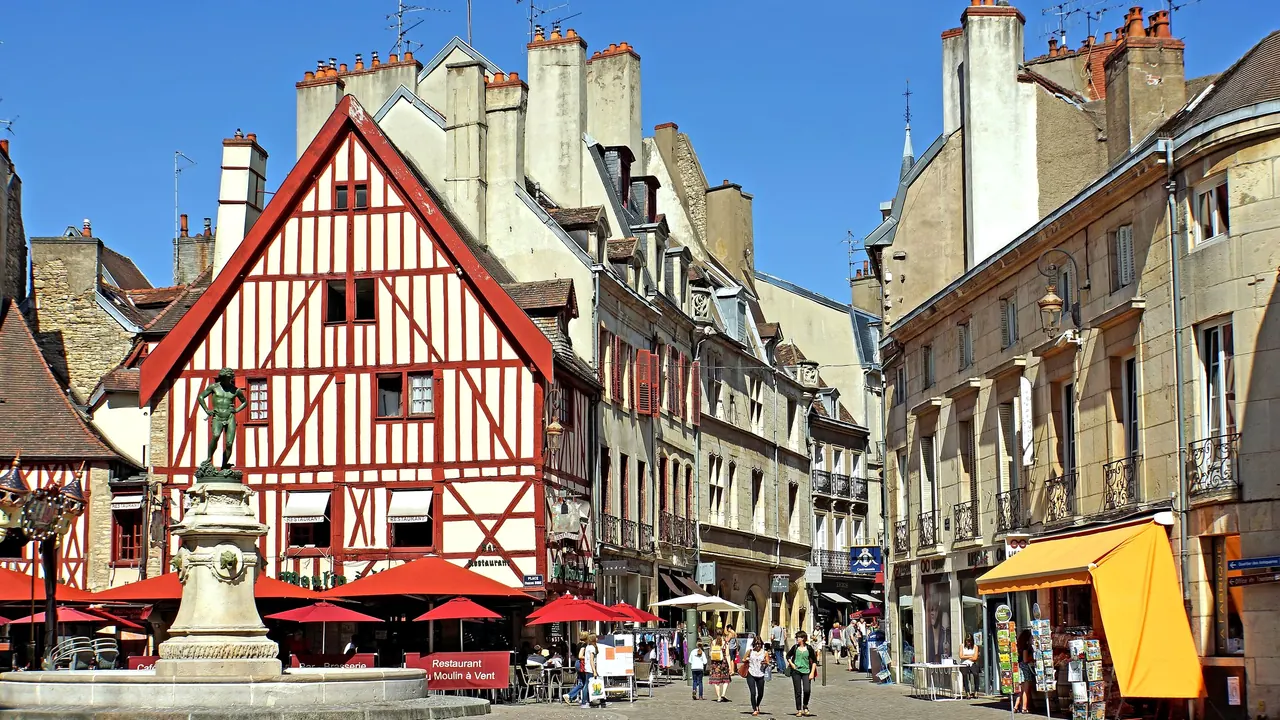
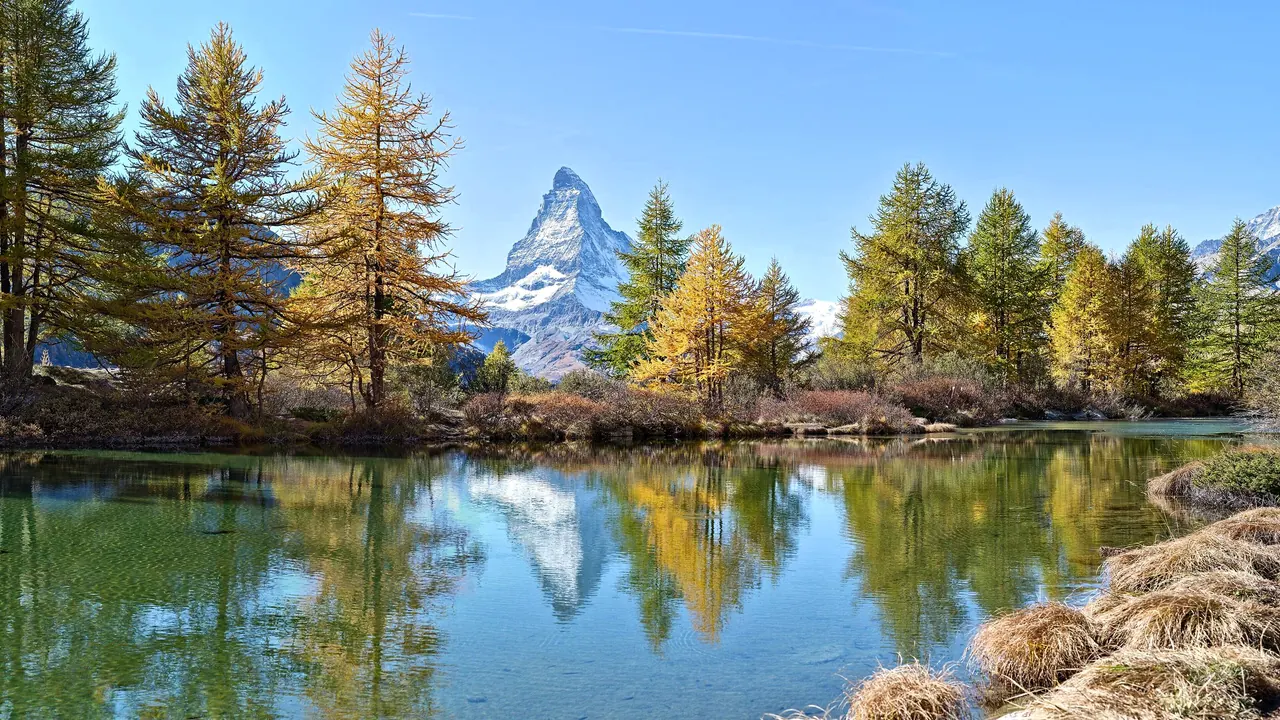
Photos: Dijon by Dennis G. Jarvis, CC BY-SA 2.0, cropped; Zermatt by Roy Egloff, CC BY-SA 4.0, cropped.
Dijon or Zermatt?
Our verdict in twelve categories, each scored against the same fixed benchmark cities, and the climate month by month, so you can choose for your trip.
Choose Dijon for
- prices
- culture and sights
- day trips
Dijon suits travellers who plan their days around the table and the past. Burgundian cooking at Les Halles, the ducal palace and its museum, and the wine villages of the Côte de Nuits a short ride south all make it a good base for several days of outings. It costs far less than an Alpine resort and is a quick train ride from Paris.
Choose Zermatt for
- nature and the outdoors
- wellness
- families
Zermatt is for anyone who comes for the mountains themselves. The Matterhorn stands over a car-free village, lifts climb to glaciers and high ridges, and the same terrain serves skiers in winter and hikers in summer, with excellent hotel spas for the evenings. Expect to pay heavily for it, and to find little to do indoors once the weather closes in.
Scoreboard
Twelve categories on one fixed scale from 0 to 100. The shaded stretch is the gap between the two.
Your match
Pick a travel style or drag the sliders, and both match scores follow your weighting.
Wins on prices and culture and sights with your weighting.
Wins on nature and the outdoors and wellness with your weighting.
What matters to you?
Category by category
What the scores mean for a trip.
Beaches & swimming
Neither city is a beach destination. Dijon at least has Lac Kir on its western edge, a reservoir with a supervised bathing area of sand and lawn for hot summer afternoons. In Zermatt the mountain lakes are fed by meltwater far too cold to swim in, so a swim means a hotel pool.
Food & drink
Dijon is the much stronger place to eat. It sits at the heart of classic Burgundian cooking, from boeuf bourguignon and snails to Époisses and Bresse poultry. The iron market hall of Les Halles is the city's larder, and the wine bars pour village Burgundies by the glass that are hard to find anywhere else.
Zermatt eats well for a mountain village, but its best meals are long lunches at the chalets above Findeln and Furi, which you reach on skis or on foot. The food is raclette, fondue and air-dried beef with Valais wines. The choice is narrow, and in the gaps between seasons many kitchens close.
Culture & sights
Dijon was the capital of the Dukes of Burgundy, and it shows. The ducal palace holds one of France's oldest fine-art museums, with the tombs of the Valois dukes, and together with Notre-Dame's gargoyles and a well-kept centre of half-timbered houses it fills two or three days.
Zermatt's heritage is the story of mountaineering, told in the underground Matterhorn Museum and the climbers' cemetery, along with the old larch barns of the Hinterdorf. That takes a morning, and after that the mountains are the attraction.
Nightlife
Both are fairly quiet after dark, in different ways. Dijon's evenings depend on its university: small bars along Rue Berbisey, terraces around Place Émile Zola, and a night of wine, beer and a late dinner that winds down outside term time.
Zermatt's lively hours come earlier, and mainly in winter. Après-ski starts at the slope-side bars in the late afternoon and carries on later in a few bars and small clubs on the main street. In summer the hikers are in bed early.
Nature & outdoors
This is where Zermatt is in another league. The Matterhorn rises straight above the village, and lifts reach glacier terrain at over 3,800m. The skiing crosses into Italy, and in summer there are hundreds of kilometres of marked trails past lakes, ibex and suspension bridges.
Dijon's countryside is gentle by comparison. There are limestone combes with trails and climbing cliffs just west of town, the flat towpath of the Burgundy Canal, the vineyard cycle route towards Beaune and, further out, the granite hills of the Morvan. It is good walking and cycling country, but nothing like high mountains.
Day trips
Dijon is the better base for days out. Beaune is about twenty minutes away by train, the Grands Crus villages line the road south, and Fontenay Abbey, Semur-en-Auxois and Besançon all make easy excursions.
From Zermatt, every outing starts with the long train ride down the valley. Sion, with its two castle hills, is the best of them, and Brig and Saas-Fee are within reach. Still, most visitors would rather spend a spare day up on the mountain.
Good for families
Both are calm and safe with children, and neither has a zoo or theme park. Zermatt has the edge because the outdoors keeps children busy: car-free streets, ski schools and nursery slopes in winter, and in summer marmots, easy lake walks and the novelty of cog railways and gondolas. The thin, cold air at the highest viewpoints can be too much for small children.
Dijon has a small pedestrian centre, the planetarium at the Jardin de l'Arquebuse, play areas in the Parc de la Colombière and paddling at Lac Kir. Its tastings and fine-art museums, though, are mainly for the parents.
Getting around
You can leave the car behind in both, but Zermatt makes it easier still. Ordinary cars are banned outright, so once you arrive by train everything is on foot or by small electric taxi. The Gornergrat cog railway, the underground funicular and the gondolas all start within walking distance of the centre and take you straight up the mountains. The drawbacks are a steep walk with luggage to the hotels on the slopes, and a journey of over an hour to leave the valley.
Dijon's compact, mostly pedestrian centre is just as easy to walk, and the city is better connected to the rest of the country. It has two tram lines, regional trains to Beaune and a fast TGV link to Paris. The wine villages away from the railway, though, need a car, a bike or a tour.
Shopping & style
Neither is a place for fashion, but Dijon has more to browse. There is mustard in dozens of flavours, pain d'épices, cassis, wine merchants, cheese at Les Halles, and a department store, chains and antique dealers on and around Rue de la Liberté. Zermatt's one main street sells luxury watches, good ski and climbing gear and Matterhorn souvenirs, and little else.
Affordability
The difference in cost is large. Dijon is a mid-priced French regional city where bistro set lunches and wine by the glass are fair value. The bill only climbs once serious restaurants and cellar tastings come into it.
Zermatt is among the most expensive resorts in the Alps. Rooms are steep even in plain hotels, meals on the terraces are costly, and every visitor needs lift and railway tickets. Self-catering, supermarket picnics and staying down the valley in Täsch help, but they do not make it cheap.
Live music & performing arts
For a night at the opera or the theatre, Dijon is far the better choice. From autumn through to early summer there is usually something on. The Opéra de Dijon puts on opera, concerts and dance in two halls: the ornate nineteenth-century Grand Théâtre in the old centre, and the larger Auditorium, which is admired for its sound. A national drama centre and a city-run venue for touring bands add plays and gigs. In high summer the indoor season pauses and the programme moves outdoors.
Zermatt has no permanent stage, so how your evenings go depends on when you visit. If your dates fall during Zermatt Unplugged in spring, or the chamber music weeks in late summer when classical players perform in the church, there is a real event to plan around. At any other time the music is whatever the après-ski bars are playing, and dinner is the main event of the evening.
Wellness & relaxation
Neither has thermal baths, so it comes down to hotels and atmosphere. Zermatt has a large number of excellent hotel spas with pools, saunas and mountain views, some of them open to day visitors. The car-free streets make it restful, though in the peak weeks the mood is active rather than slow.
Dijon has only a few hotel spas, some offering grape-based treatments. Its calm comes instead from long lunches, quiet squares and slow afternoons among the vines.
When should you go?
Pick your month. The climate figures are measured averages, not a forecast.
Dijon in July
Zermatt in July
Daytime high, °C
Rainfall in the month, mm
Where the figures come from
Zermatt has no weather station within reach, so its figures come from a gridded climate model rather than a measured record, and read a broad area rather than the city itself.
Temperature and rainfall are climate normals, averaged over the years shown. Dijon: 1991-2020 normals, Dijon (7 km from centre). Zermatt: 1991-2020 normals, TerraClimate 4 km grid at the town, no weather station within 90 km.
Dijon is best in the warm half of the year. From May to September the days suit walking the old centre and cycling through the vineyards, and July is the peak, at around 27°C with the most sunshine of the year. Rain falls fairly evenly all year, with the wettest spells in May and again in October and November, when the days also turn short and grey. December and January are cold and dark, better for museums and long lunches than for being outdoors.
Zermatt has two seasons. From December to March the days stay around freezing or below, and that cold is what keeps the skiing going. In June, July and August, highs of 12-14°C open up the trails and passes, cool enough for long climbs and never hot. September is cooler, at about 10°C, but still good for walking. November is the wettest month, at 130mm, and spring and late autumn fall between the two seasons. Neither place works for a beach trip in any month.
Which traveller are you?
For an outdoors trip, Zermatt is the clear pick. Skiers get glacier pistes and runs across into Italy, hikers get hundreds of kilometres of trails past lakes and huts, and climbers can hire guides for the four-thousanders, all reached by lift from the village.
On a culture and arts trip, Dijon suits far better. The ducal palace and its fine-art museum, Notre-Dame, the Romanesque crypt and Sluter's Well of Moses fill several days, and the Opéra de Dijon gives the evenings a programme that Zermatt cannot match.
On a trip on a tight budget, choose Dijon. Bistro set lunches, inexpensive wine by the glass, moderate hotels and a walkable centre keep costs reasonable. Zermatt charges heavily for beds and meals, and for the lifts that every visitor ends up using.
Before you go
| Measure | Dijon | Zermatt |
|---|---|---|
| Official language | French | French, German, Italian, Romansh |
| Currency | Euro (EUR) | Swiss Franc (CHF) |
| Sockets | CE230 V, 50 Hz | CJ230 V, 50 Hz |
| Driving side | Right | Right |
| Time zone | UTC+1, UTC+2 in summer | UTC+1, UTC+2 in summer |
| Emergency number | 112 | 112 |
| Elevation | 220 m | 1,624 m |
| Main airport | Lyon Saint-Exupéry Airport (LYS)178 km from centre141 non-stop destinations | Geneva International Airport (GVA)128 km from centre150 non-stop destinations |
| Public holidays this year | 11 days | 9 days |
By the numbers
| Measure | Dijon | Zermatt |
|---|---|---|
| City population | 161,830 | 6,023 |
| People per km² | 3,890 | 25 |
| Museums within 10 km | 8 | 2 |
| UNESCO World Heritage sites within 50 km | 1 | 2 |
Where else could you go?
Every comparison below shares a destination with this one, so you can follow Dijon or Zermatt somewhere new.
- Chamonixvs Zermatt
- Interlakenvs Zermatt
- Luganovs Zermatt
- Lausannevs Zermatt
- Turinvs Zermatt
- Bernvs Zermatt