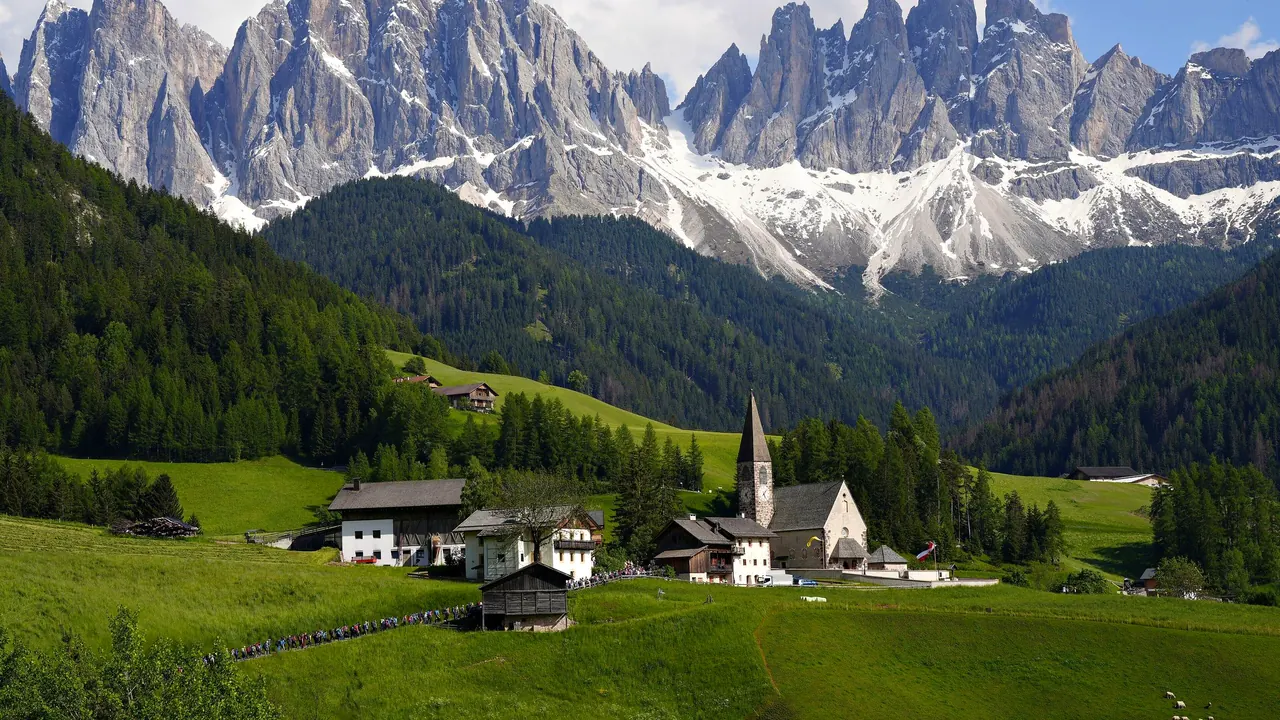
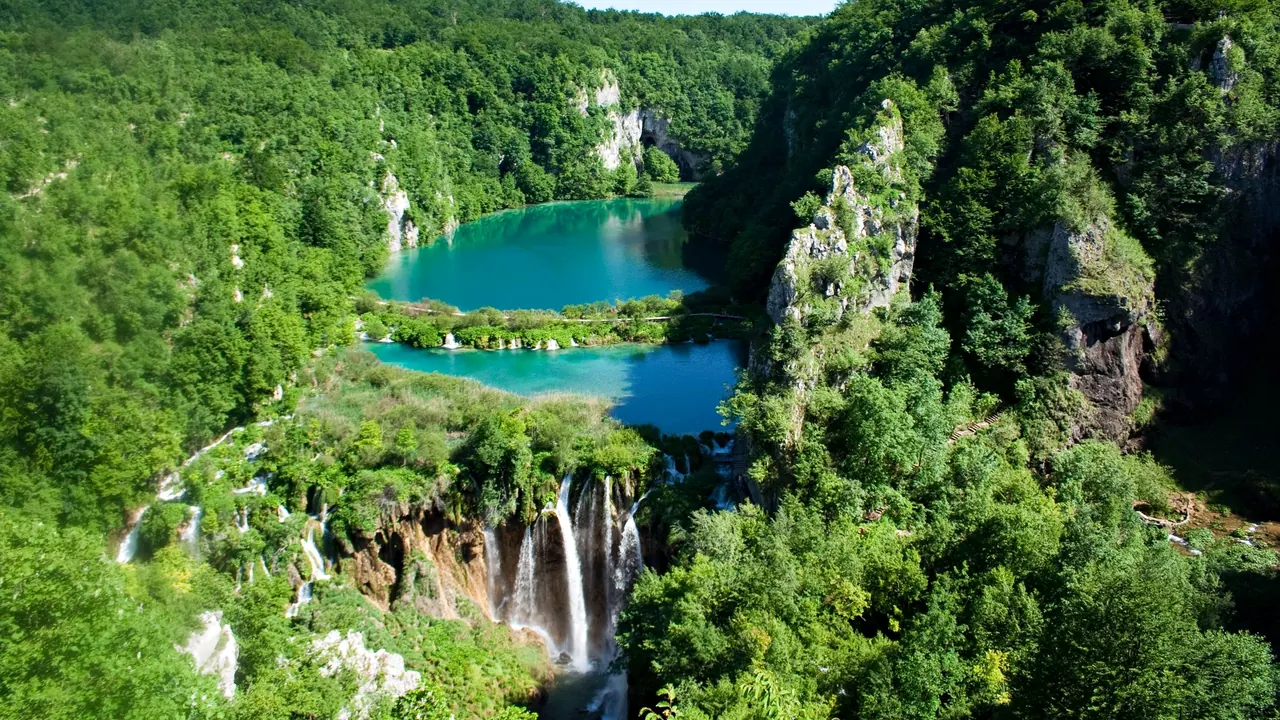
Photos: Dolomites by Chensiyuan, CC BY-SA 4.0, cropped; Plitvice Lakes by Pablo BM from London, England, CC BY 2.0, cropped.
Dolomites or Plitvice Lakes?
Our verdict in twelve categories, each scored against the same fixed benchmark cities, and the climate month by month, so you can choose for your trip.
Choose Dolomites for
- food and drink
- shopping
- culture and sights
The Dolomites suit a full mountain vacation of a week or more. Lifts lift you onto the high rock from almost every village, there is skiing in winter and hut-to-hut walking in summer, and the valley towns of Bolzano, Trento and Merano supply the food, wine, spas and old centres that fill the evenings and the wet days. You pay for all this, especially in Cortina and Alta Badia, but you get far more to do.
Choose Plitvice Lakes for
- prices
Plitvice Lakes is a single natural wonder rather than a region to settle into: terraced lakes and waterfalls you can walk in a day or two, with farmhouse guesthouses around the entrances. It costs less and fits neatly into a Croatian road trip between Zagreb and the coast. Anyone hoping for good restaurants, sights or a night out will find almost nothing beyond the trails.
Scoreboard
Twelve categories on one fixed scale from 0 to 100. The shaded stretch is the gap between the two.
Your match
Pick a travel style or drag the sliders, and both match scores follow your weighting.
Wins on food and drink and shopping with your weighting.
Wins on prices with your weighting.
What matters to you?
Category by category
What the scores mean for a trip.
Beaches & swimming
Neither place is for a swimming vacation, but the Dolomites at least give you somewhere to swim. Lake Caldaro on the wine route warms up enough for long swims in midsummer, with lidos and lawns. The north end of Lake Garda is about an hour from Trento, and valley towns have outdoor pools in summer.
At Plitvice the lakes are off limits to bathers, and the nearest swim is the cool, clear Korana river below the park. The Adriatic is two hours away over the mountains.
Food & drink
Eating is one of the best parts of a Dolomites trip. Alpine and Italian cooking meet here: dumplings and strudel followed by a proper espresso, Ladin dishes in Gardena and Badia, and autumn Törggelen evenings with chestnuts and farmhouse wine. Alta Badia and the Puster Valley also have more serious restaurants than villages that size would usually support.
Plitvice offers one good thing done well: Lika lamb and suckling pig from the spit, trout and dishes cooked under the iron bell. Beyond that the choice is narrow, and much of it is cooked for tour groups.
Culture & sights
Both places are on the World Heritage list for their landscape, but the Dolomites have far more history and architecture in their valley towns. Bolzano's arcaded centre and Ötzi the Iceman, Trento's cathedral and frescoed Castello del Buonconsiglio, Bressanone and Novacella Abbey, castles such as Runkelstein and the First World War tunnels on the passes can easily fill several days.
Around Plitvice, the mill village of Rastoke and the ruins of Drežnik fortress fill an afternoon, along with the memorials to the first deaths of the 1990s war.
Nightlife
Winter evenings in the Dolomites have some life at the foot of the slopes, with après-ski in Selva, Ortisei, Canazei and Cortina, and wine bars and student bars in the old centres of Bolzano and Trento. It is mostly early drinks, though, and summer villages go quiet by eleven.
Around Plitvice the villages fall silent soon after dark, and the evening goes no further than a brandy after dinner at your guesthouse.
Nature & outdoors
Both are outstanding, but the Dolomites give you more to do over a longer stay. The pale towers of the Tre Cime, Sella and Seceda, the easy high pasture of the Alpe di Siusi, the Alta Via routes and the via ferrata cables cover a whole range, and the Sella Ronda turns the same mountains into a ski circuit in winter.
Plitvice is a water landscape rather than a mountain one: sixteen turquoise lakes, travertine falls and boardwalks over the cascades, in beech and fir forest. It is spectacular but compact and crowded by mid-morning in summer. The Korana and Una rivers, the Barać caves and Velebit extend it for rafters and hikers.
Day trips
Stay in the Adige valley and the Dolomites give you plenty of outings. Merano, Bressanone, Trento and the wine villages are under an hour from Bolzano, Verona is easy by train, and Innsbruck and Lake Garda are within a day. The high villages are less convenient, since every trip starts on a pass road.
Plitvice has a shorter list: Rastoke, Bihać and the Una falls across the Bosnian border, and the Tesla birthplace at Smiljan. Zadar and Zagreb are long days at two hours each way.
Good for families
For children the Dolomites are the easier choice. Lifts take the climbing out of walks on flat meadows such as the Alpe di Siusi and Armentara, huts have playgrounds and animals, summer toboggan runs and adventure parks fill the afternoons, and family hotels come with pools and children's clubs. Ski schools take over in winter.
Plitvice delights children for a day, with fish in the clear water, the electric boat and the little train. But the narrow boardwalks are mostly without railings, pushchairs struggle, swimming is banned and there is little else to do.
Getting around
The Dolomites are better served, though it depends on which side you stay. In South Tyrol, trains run up the Adige and Puster valleys and buses climb to most resorts and over the main passes on one regional pass. On the Belluno side the railway stops at Calalzo di Cadore, and Cortina, with no station, relies on buses from there or from Dobbiaco.
Within a valley, lifts do much of the work, but crossing between valleys on slow hairpin passes is where a car becomes necessary. Plitvice is simple inside the park, with signed circuits, boats and trains, and many guesthouses are walking distance from an entrance. Outside it, intercity buses only stop in passing, so Rastoke and the countryside need a car.
Shopping & style
The Dolomites have a real shopping culture of their own, based on craft and produce. Val Gardena's woodcarvers in Ortisei, the old shops under Bolzano's arcades, Cortina's boutiques and the famous Advent markets in Bolzano, Merano and Bressanone give you real browsing.
Around Plitvice there are souvenir kiosks and farmers' stalls, and their cheese, honey and brandy are the only things worth buying.
Affordability
Plitvice is the cheaper stay. Family guesthouses in the outlying villages are reasonable and portions are large, though the summer entrance fee is steep and hotels at the gates charge for their location. Spring and autumn are cheaper on both counts.
The Dolomites cost a good deal more in ski season and in July and August, with Cortina and Alta Badia among Italy's priciest resorts and lift passes adding up. Staying in Val di Fassa, Fiemme or Bressanone, or coming in June or September, brings the cost down a little.
Live music & performing arts
Neither place is for a culture-led trip, but the Dolomites at least have a concert calendar you can plan around. Bolzano's regional orchestra plays a season through the year, and in summer musicians perform on alpine meadows and hut terraces, which turns a day's walk into an evening concert you won't easily find anywhere else.
Plitvice has nothing comparable. At most you might hear Lika folk music at a village festival, and for a concert or a play you would have to go to Zagreb or Zadar.
Wellness & relaxation
South Tyrol takes wellness seriously, and the Dolomites offer real pampering. Mountain hotels have saunas facing the rock walls and heated outdoor pools in the snow, Völs am Schlern keeps up the old farmers' hay bath, and Merano has public thermal baths by its river promenade.
Plitvice offers calm rather than treatment: a few hotel saunas, then fir forest, clean air and silent evenings in a village guesthouse. The boardwalks themselves are anything but restful at midday in summer.
When should you go?
Pick your month. The climate figures are measured averages, not a forecast.
Dolomites in July
Plitvice Lakes in July
Daytime high, °C
Rainfall in the month, mm
Where the figures come from
Plitvice Lakes has no weather station within reach, so its figures come from a gridded climate model rather than a measured record, and read a broad area rather than one spot.
Temperature and rainfall are climate normals, averaged over the years shown. Dolomites: 1991-2020 normals, Dobbiaco (22.3 km from centre). Plitvice Lakes: 2001-2020 normals, NASA POWER reanalysis grid, no weather station within 90 km.
The Dolomites have two distinct seasons. From June to September the days are mild enough for long walks, peaking at about 22°C in July and August where most visitors stay. Summer is also the wettest time, with July bringing around 130mm, often as afternoon storms, so start early on the high trails. June and September are a little cooler and noticeably drier than midsummer. From December to February daytime highs hover around freezing, and these are the driest months of the year, which suits the ski season.
Plitvice is warmer and wetter overall, and its rain falls the other way round. July and August reach about 27°C, and July is the driest month at around 69mm, so July is the most reliable time for the boardwalks, with August close behind. From September the rain sets in hard, at around 140mm, and the rest of autumn and winter stay wet and cold. Spring is mild but damp, though it is when the falls carry the most water.
Which traveller are you?
On a food and nightlife trip, the Dolomites win easily. Speck, canederli, hut lunches at altitude, Lagrein from the slopes south of Bolzano and the high-end kitchens of Alta Badia beat Plitvice's roadside lamb, and there is at least après-ski and wine bars.
For a relaxing and wellness trip, the Dolomites have the edge. South Tyrol's hotel spas, the hay baths around Völs am Schlern and Merano's thermal baths are a real tradition. Plitvice offers quiet guesthouses and clean air, but very few spa facilities.
On a trip on a tight budget, Plitvice Lakes is the easier choice. Village guesthouses and country inns cost less than the Dolomites' resorts, where lift passes and half-board hotels add up. Coming outside summer also brings down the park entrance fee.
Before you go
| Measure | Dolomites | Plitvice Lakes |
|---|---|---|
| Official language | Italian | Croatian |
| Currency | Euro (EUR) | Euro (EUR) |
| Sockets | CFL230 V, 50 Hz | CF230 V, 50 Hz |
| Driving side | Right | Right |
| Time zone | UTC+1, UTC+2 in summer | UTC+1, UTC+2 in summer |
| Emergency number | 112 | 112 |
| Main airport | Venice Marco Polo Airport (VCE)103 non-stop destinations | Zagreb Franjo Tuđman International Airport (ZAG)66 non-stop destinations |
| Public holidays this year | 13 days | 14 days |
Where else could you go?
Every comparison below shares a destination with this one, so you can follow Dolomites or Plitvice Lakes somewhere new.
- Austrian Alpsvs Dolomites
- Krkavs Plitvice Lakes
- Lake Gardavs Dolomites
- Bavariavs Dolomites
- Bračvs Plitvice Lakes
- Hvarvs Plitvice Lakes