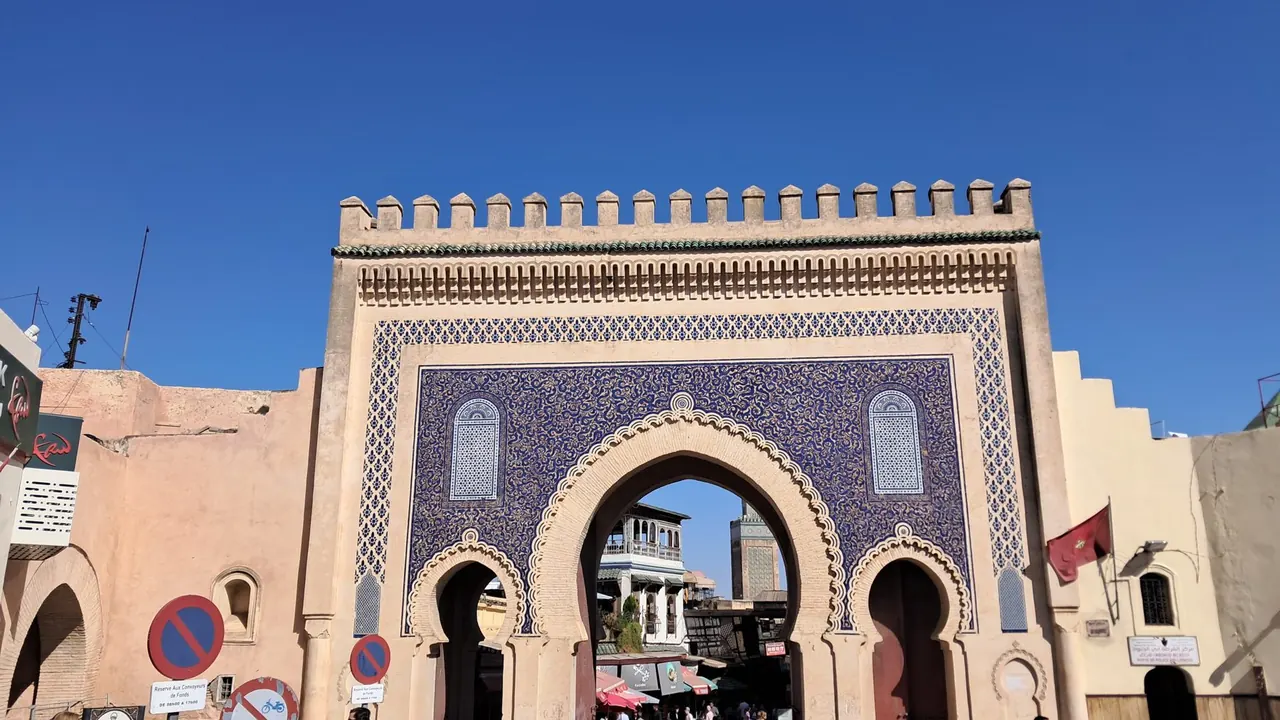
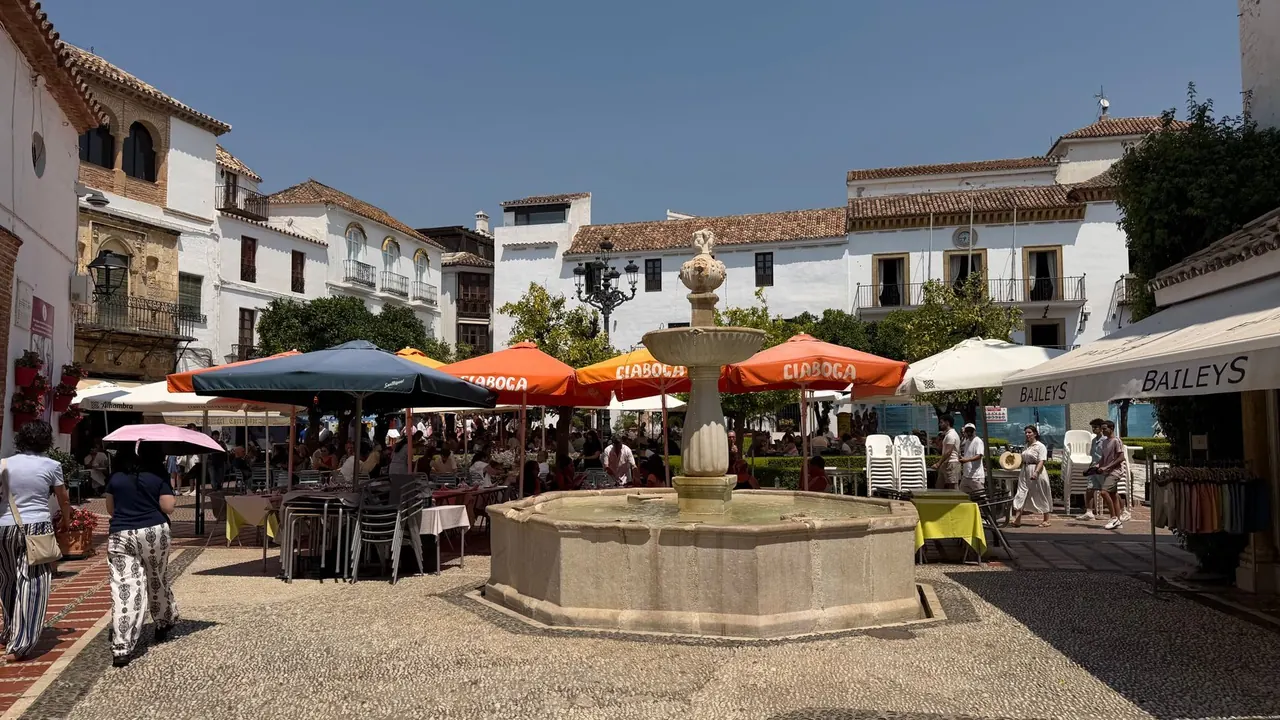
Photos: Fes by Ideophagous, CC BY-SA 4.0, cropped; Marbella by Décio Franchini, Pexels License.
Fes or Marbella?
Our verdict in twelve categories, each scored against the same fixed benchmark cities, and the climate month by month, so you can choose for your trip.
Choose Fes for
- prices
- culture and sights
- wellness
Fes suits travellers who want a city to explore on foot and in depth. There is the car-free medieval medina, the carved Marinid madrasas, and workshops where leather, copper and tiles are still made. It is cheap, it has a long bathing tradition in its hammams and it goes quiet at night. That makes it right for a slow, absorbing trip of a few days, not for a party or a beach.
Choose Marbella for
- beaches
- nightlife
- families
Choose Marbella for sun, sea and an easy pace. It has a long shore of sand, summer nights that run until dawn, beaches and a promenade that work well for children, and Ronda, Málaga and the white villages within about an hour. It costs a good deal more and its old town takes only an afternoon, so it is better for a beach vacation with outings than for a sightseeing trip.
Scoreboard
Twelve categories on one fixed scale from 0 to 100. The shaded stretch is the gap between the two.
Your match
Pick a travel style or drag the sliders, and both match scores follow your weighting.
Wins on prices and culture and sights with your weighting.
Wins on beaches and nightlife with your weighting.
What matters to you?
Category by category
What the scores mean for a trip.
Beaches & swimming
On beaches, Marbella wins easily. Fes is around three hours from either coast, so swimming means a hotel or riad pool, and in the summer heat it is worth choosing accommodation that has one.
Marbella has more than two dozen beaches along its shore, from La Venus and El Fuerte in town to the dunes at Cabopino. The sand is fine and greyish, chiringuitos grill fish along the shore, and the calm water stays warm enough to swim until early autumn.
Food & drink
Both cities eat well, in very different ways. Fes goes deep into one tradition: pastilla, tagines with quince or preserved lemon, and harira, often served as long dinners in riad dining rooms, with bissara and sfenj in the medina in the morning. It offers little beyond Moroccan cooking, and alcohol is hard to find.
Marbella offers range instead. You can eat sardine skewers on the beach, tapas in the Casco Antiguo, tasting menus along the Golden Mile and plenty of international cooking, with local wine from the Ronda hills. Its weak spot is the expensive, forgettable cooking along the seafront and near the port.
Culture & sights
Fes is worth the journey for its sights alone. The UNESCO-listed Fes el-Bali, the Marinid madrasas, the Chouara tannery, the Nejjarine fountain and the Mellah add up to days of exploring. The city itself is the main sight, more than its modest museums.
Marbella's heritage is pleasant but small: the whitewashed Casco Antiguo around the Plaza de los Naranjos, a museum of Spanish prints and a Roman villa at Río Verde. For the great monuments of Andalusia you drive to Málaga, Ronda or Granada.
Nightlife
An evening in Fes means a rooftop dinner, then tea, then quiet. Apart from a few hotel bars in the Ville Nouvelle, alcohol is scarce and nothing stays open late. Marbella in summer is the opposite: champagne bars and clubs at Puerto Banús, and beach clubs whose parties carry on into the night along the Golden Mile until dawn, though from November to March most of this shuts down.
Nature & outdoors
Marbella has the mountains on its doorstep. Sierra Blanca rises behind the town, the climb to La Concha gives views to Gibraltar and the Rif, and the Sierra de las Nieves is under an hour away. There is also the coastal path and time on the water, and the mild winters make walking possible all year.
Fes takes more effort. The cedar forests around Azrou, with their wild macaques, and the caves and ridges of Tazekka are rewarding, but you can only reach them by car or with a driver, and the summer heat leaves spring and autumn as the seasons to go.
Day trips
Fes has one outstanding day out to the west: Meknes by train, then the Roman mosaics of Volubilis and the holy town of Moulay Idriss, often covered together with a driver. Ifrane and Sefrou to the south add contrast, but Chefchaouen and Rabat are too far for a day.
Marbella has more within reach. Ronda's gorge, the Alcazaba and Picasso Museum in Málaga, Gibraltar, and white villages such as Casares and Mijas are all close, and the Alhambra is possible on a long day. A car makes it much easier, since Marbella has no train.
Good for families
Fes is hard going with small children, and the usual advice is about easing the strain. Stay in a riad or hotel with a pool, keep trips into the medina short, and hire a guide for the maze and the persistent touts. Older children are a different matter: those who like getting lost, watching coppersmiths at work and trying street snacks can find it a real adventure.
Marbella is far easier, and Spanish restaurants are happy to have children at the table late into the evening. The bigger outings are along the coast rather than in town, such as the marine park and the cable car around Benalmádena. They are simple by car but awkward by bus. With very young children, the heat of July and August is worth avoiding, and Puerto Banús after dark is for adults.
Getting around
Neither is easy, for opposite reasons. Fes is compact but tangled: the medina is entirely on foot, porters carry luggage from the gates, and the lanes twist and dead-end. Outside the walls, petit taxis link the gates, the Ville Nouvelle and the station.
Marbella is simple to follow but spread out. The old town and central seafront are walkable, but hotels and beach clubs stretch along the motorway from San Pedro to Cabopino, so buses, taxis or a hire car do most of the work. Fes at least has a train to Meknes, while Marbella has no railway at all.
Shopping & style
For anything handmade, Fes is the better place to shop. The medina is where the goods are made: tannery leather, copper from the Seffarine, blue Fassi pottery, zellige tiles and carved cedar, often with the workshop right behind the counter. Expect to bargain, and watch for guides steering you to shops that pay them.
Marbella is about big labels, with fashion and jewellery boutiques at Puerto Banús, a department store and malls. Beyond that there are a few old-town lanes selling linen, leather and ceramics, and little in the way of local craft.
Affordability
Most of what you do in Fes costs little: street food, taxis, entry to the madrasas and modest riads. The money goes on grand riads, private drivers and alcohol. Marbella is expensive by Spanish standards, especially in July and August around Puerto Banús and the Golden Mile. Old-town tapas, buses and visits out of season bring the costs down, but a stay there still costs far more than one in Fes.
Live music & performing arts
Neither city has much of a regular programme, and in both the main events come in festival season. In Fes the music comes from tradition: Andalusian classical and Sufi music, with the Festival of World Sacred Music held in palace gardens and at old gates, and music at riad dinners the rest of the year.
Marbella's summer offers big pop and rock acts in a quarry amphitheatre, DJs at the beach clubs and flamenco shows staged for visitors, plus a small municipal theatre. For serious flamenco or opera, people go to Málaga.
Wellness & relaxation
Fes has the stronger bathing tradition. Every medina quarter has a public hammam for steam and black-soap scrubs, riads run quieter ones of their own, and the hot springs of Moulay Yacoub are about half an hour away. After the noise of the lanes, a riad courtyard is where you rest.
Marbella's wellness is based in resorts, with spa hotels, retreats and detox clinics along the Golden Mile and a few Arab-style baths, but no public bathing culture. It is most restful from October to May, when the promenade and golf courses are calm.
When should you go?
Pick your month. The climate figures are measured averages, not a forecast.
Fes in July
Marbella in July
Daytime high, °C
Rainfall in the month, mm
Where the figures come from
Fes's station stands 171 m above the city centre, so the centre is likely a little warmer than the figures say.
Fes has no rain gauge within 25 km of the centre, so its rainfall comes from a gridded climate dataset read at the city rather than from a gauge further away.
Fes's sunshine is measured 52 km from the centre, at Meknes.
Marbella's temperatures are measured 40 km from the centre, at Malaga / Aeropuerto.
Marbella has no rain gauge within 25 km of the centre, so its rainfall comes from a gridded climate dataset read at the city rather than from a gauge further away.
Temperature and rainfall are climate normals, averaged over the years shown. Fes: 1999-2020 (sunshine 1991-2020, rainfall 1991-2020) normals, Fes-Sais (12.4 km from centre). Marbella: 1991-2020 normals, Malaga / Aeropuerto (39.7 km from centre).
Fes is inland and runs hotter. July and August reach 36°C on the plain, which is too hot for long walks through the medina, and those months are almost rainless. The best times for walking the lanes and getting into the Middle Atlas are April and May, and again from late September through October. The rain comes back in late autumn and is heaviest in November and December, though winter days stay mild and fairly sunny for sightseeing.
In Marbella the sea sets the season. The water is warm enough to swim from June to early October and peaks around 22°C in August, while summer daytime highs stay a few degrees below those in Fes. Winter is the wet season, with December the rainiest month at 115mm. Spring and autumn are mild and sunny, which makes them good for walking and quieter stays.
Which traveller are you?
For a culture and arts trip, Fes is the clear choice. Its car-free medina, the Bou Inania and Al-Attarine madrasas and its working craft quarters can fill several days. In Marbella, the old town and the Dalí sculptures take an afternoon.
On a family trip with young children, Marbella is much easier. It has sheltered, lifeguarded beaches, a flat promenade for buggies, apartments built around pools and animal parks along the coast. Fes has steep, crowded lanes shared with donkeys, and its summer afternoons are very hot.
On a tight budget, money goes much further in Fes. Street food, mint tea, petit taxis, madrasa entry and small riads with plenty of character all cost little. In Marbella, summer room rates, beach clubs and dinners by the port push spending up unless you stay in a neighbouring town.
Before you go
| Measure | Fes | Marbella |
|---|---|---|
| Official language | Arabic, Standard Moroccan Tamazight | Spanish |
| Currency | Moroccan Dirham (MAD) | Euro (EUR) |
| Sockets | CE50 Hz | CF230 V, 50 Hz |
| Driving side | Right | Right |
| Time zone | UTC+1 | UTC+1, UTC+2 in summer |
| Emergency number | Police 19/112, ambulance 15, fire 15 | 112 |
| Elevation | 408 m | 22 m |
| Main airport | Fes Saïss International Airport (FEZ)13 km from centre35 non-stop destinations | Málaga-Costa del Sol Airport (AGP)39 km from centre166 non-stop destinations |
| Public holidays this year | 11 days | 12 days |
By the numbers
| Measure | Fes | Marbella |
|---|---|---|
| City population | 1,167,842 | 159,786 |
| People per km² | 3,650 | 1,398 |
| Museums within 10 km | 2 | 6 |
| UNESCO World Heritage sites within 50 km | 1 | 0 |
| Swim season, months above 21 °C | - | 3 months |
Where else could you go?
Every comparison below shares a destination with this one, so you can follow Fes or Marbella somewhere new.