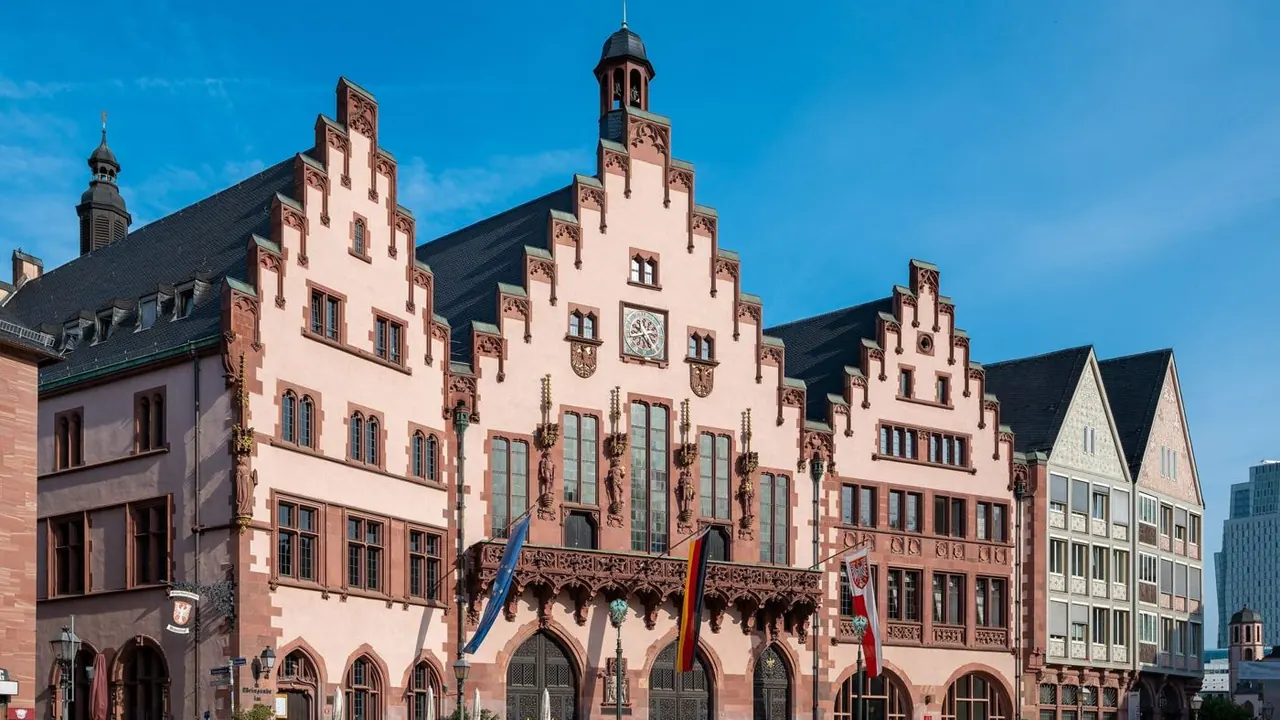
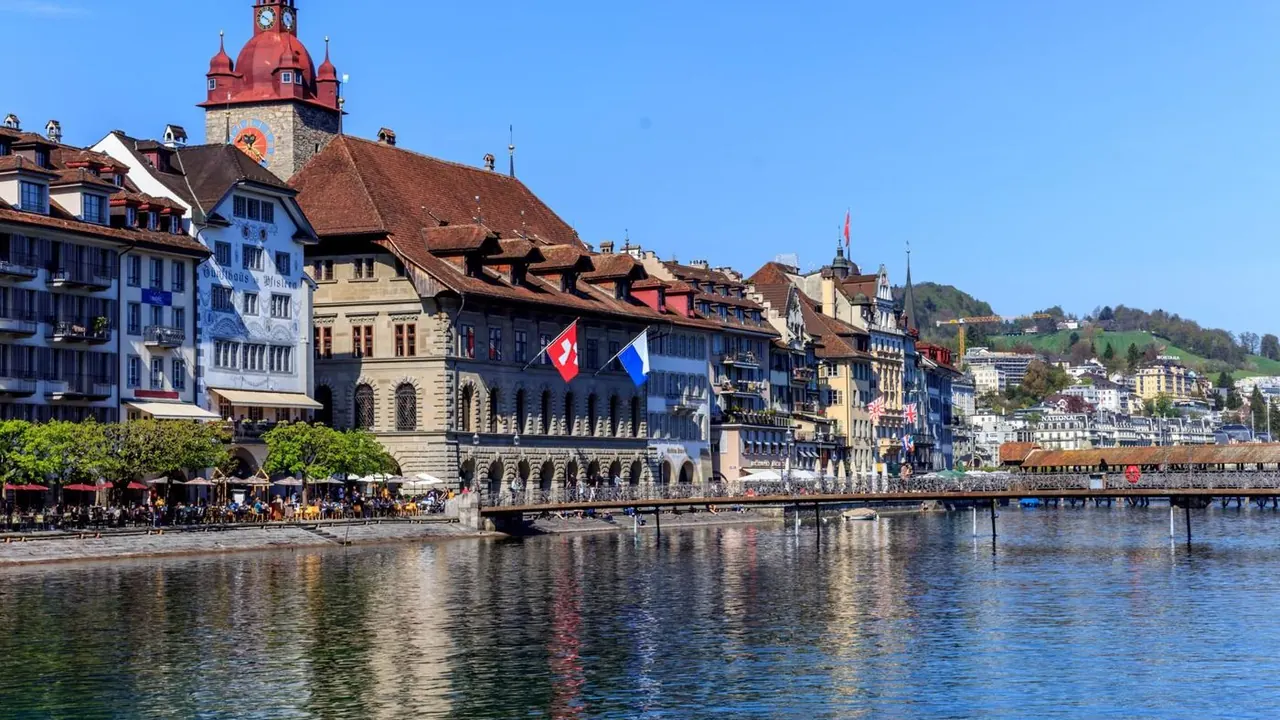
Photos: Frankfurt by Thomas Wolf, CC BY-SA 3.0 DE, cropped; Lucerne by ILOVESwitzerland, Pexels License.
Frankfurt or Lucerne?
Our verdict in twelve categories, each scored against the same fixed benchmark cities, and the climate month by month, so you can choose for your trip.
Choose Frankfurt for
- prices
- nightlife
- food and drink
Frankfurt suits the traveller who wants a proper city to use as a base. Its museums along the Main, its apple-wine taverns and club nights, and its place at the hub of Germany's fast trains give you a full week of evenings out and outings to Heidelberg, Cologne and the Rhine Gorge. It is also the cheaper of the two, as long as you avoid the trade-fair dates.
Choose Lucerne for
- nature and the outdoors
- beaches
- getting around
Lucerne is the choice when the landscape is the point of the trip. Lake steamers, cogwheel railways up Pilatus and Rigi and a medieval Old Town you can walk round in an afternoon make for a slow, scenic stay with quiet evenings. You pay heavily for it, and the food and nightlife are thin, but no German city offers mountains this close.
Scoreboard
Twelve categories on one fixed scale from 0 to 100. The shaded stretch is the gap between the two.
Your match
Pick a travel style or drag the sliders, and both match scores follow your weighting.
Too close to call, 2 points apart
Wins on prices and nightlife with your weighting.
Wins on nature and the outdoors and beaches with your weighting.
What matters to you?
Category by category
What the scores mean for a trip.
Beaches & swimming
Neither city has a sea, but Lucerne at least has a lake you can swim in right by the centre. In July and August locals swim from the old wooden lake baths, the Lido and the lawns at Ufschötti, with mountains across the water, and boats run to small bathing spots in the lakeside villages.
Frankfurt's swimming happens out of town, at gravel-pit lakes such as the Langener Waldsee, which has the sandy shore Lucerne's lawns and jetties lack. Getting there is an outing in itself, though, whereas in Lucerne you can swim between sights.
Food & drink
Frankfurt gives you more to eat and a stronger local character. Sitting at a shared table in a Sachsenhausen apple-wine tavern with Grüne Soße and a stoneware jug is a meal you will remember, and the Kleinmarkthalle and the cheap international kitchens of the Bahnhofsviertel add range.
Lucerne's cooking is good Swiss comfort food, with Chügelipastete, rösti and perch from the lake served in guild-house dining rooms and on terraces along the Reuss. The choice is narrow, though, prices are high, and many tables near the Chapel Bridge cater to tour groups.
Culture & sights
The two are about level, but they offer different kinds of sightseeing. Frankfurt is a museum city: the Städel and a dozen other institutions along the Museumsufer, around a rebuilt Römer and a skyline of towers. Lucerne's appeal is the townscape itself, with the medieval Chapel Bridge, frescoed squares, the Musegg towers and the carved Lion Monument, plus Picasso and Klee at the Rosengart. Go to Frankfurt for galleries and to Lucerne for an old town that survived intact.
Nightlife
Frankfurt is the place for a night out. It has a serious techno and house tradition shared with Offenbach, rough-edged cocktail bars in the Bahnhofsviertel, neighbourhood bars along Berger Straße, and crowds drinking on the Main banks on summer evenings, even if the week starts quietly.
Lucerne's evenings usually end with a drink by the river, and the lakefront is nearly empty by midnight. The exception is Fasnacht, when the whole Old Town stays out in costume until dawn.
Nature & outdoors
This is Lucerne's great advantage. Pilatus rises above the lake on the world's steepest cogwheel railway, Rigi offers broad ridge walks, and Titlis keeps snow all year, all reached by steamer, train and cable car. Low cloud can hide the views, but the setting is in a different league.
Frankfurt's countryside is green and gentle: the Taunus beech woods and the Großer Feldberg just north of town, the huge Stadtwald, and flat cycle paths along the Main. It is good for an easy walk or a bike ride, not for a mountain day.
Day trips
Frankfurt has the deeper list of day trips, because high-speed trains put very different places within an hour or so: Heidelberg's castle, Cologne Cathedral, the Rhine Gorge with its castles and wine villages, and Würzburg's Residenz. Mainz, Wiesbaden, Speyer and Worms fill any spare days.
Lucerne reaches Zurich, Bern and Basel in under an hour and has the lake as an outing in its own right, with boats to the Rütli meadow and the William Tell country at Altdorf. The choice is good but smaller, and many of its best days out are the mountains rather than other towns.
Good for families
Both work well with children, though in different ways. Frankfurt has more for a wet day, with the Senckenberg's dinosaur hall, a central zoo and the Palmengarten glasshouses. Lucerne has the Swiss Museum of Transport, which can fill a whole day, and then the journeys themselves: paddle steamers, cogwheel trains and the summer toboggan run on Pilatus. Those depend on the weather and add a lot to the cost, and with no zoo a rainy stretch can leave you short of ideas.
Getting around
Lucerne is the easier of the two. The station, the steamer piers and the Old Town sit side by side on the lakefront, most sights are a flat walk along the river, and the mountain railways run on the same Swiss tickets.
Frankfurt's centre is also compact, but its U-Bahn, S-Bahn and tram network, with many lines and zones, takes more learning. In return it has an airport only a quarter of an hour from town by train and direct links to the high-speed network.
Shopping & style
Frankfurt has more range. The Zeil handles department stores and chains, Goethestraße the luxury houses, and Berger Straße and Schweizer Straße the independent delis and design shops, with the Saturday flea market on the Main adding some character.
Lucerne is a one-subject shopping town. The watch and jewellery houses on Schwanenplatz are worth a look if a Swiss watch is on your list, alongside army knives and chocolate, but there is little for clothes or homeware.
Affordability
Neither is cheap, but Frankfurt is much more manageable. Its high hotel rates come from the business trade, so weekends and summer often cost noticeably less, and tavern meals, Turkish grills and the museum pass keep daily spending moderate as long as you avoid fair weeks.
Lucerne stays expensive whatever you do. Rooms, ordinary restaurant meals and the cable cars and mountain railways that are the reason to come all cost a great deal. A Swiss travel pass and picnics by the lake soften it but do not change it.
Live music & performing arts
The two are broadly level, and their calendars complement each other. Frankfurt offers depth through the season, from autumn to early summer, with an opera company known for bold productions, concerts at the Alte Oper, serious drama at the Schauspiel and jazz in cellar clubs. Lucerne peaks in late summer, just as Frankfurt goes quiet, when the Lucerne Festival brings the world's leading orchestras to Jean Nouvel's lakefront hall, though for the rest of the year its programme is that of a small town.
Wellness & relaxation
Frankfurt has the edge here, though the spas lie outside the city. Wiesbaden's Art Nouveau Kaiser-Friedrich-Therme and the thermal baths at Bad Homburg are both easy trips, and the old spa towns of Bad Nauheim and Bad Soden carry on the tradition of taking the waters.
Lucerne has no thermal baths of its own. Its rest comes from quiet evenings, a steamer trip with nothing to do, or the Botta-designed mineral bath high on the Rigi, while the tour-group crowds in the Old Town at midday are best avoided.
When should you go?
Pick your month. The climate figures are measured averages, not a forecast.
Frankfurt in July
Lucerne in July
Daytime high, °C
Rainfall in the month, mm
Where the figures come from
Lucerne has no rain gauge within 25 km of the centre, so its rainfall comes from a gridded climate dataset read at the city rather than from a gauge further away.
Lucerne's sunshine is measured 42 km from the centre, at Zurich Town / Ville..
Temperature and rainfall are climate normals, averaged over the years shown. Frankfurt: 1991-2020 normals, Frankfurt Westend (2 km from centre). Lucerne: 2005-2025 (sunshine 1991-2020, rainfall 1991-2020) normals, Emmen (4.2 km from centre).
Both cities are cold and grey from November to February, with daytime highs only in single figures and little sunshine. Winter in Frankfurt means museums and concert halls, while in Lucerne the attraction moves up into the snow. Spring warms both at much the same rate, and April and early May are pleasant for walking either town.
Summer is where they part. Frankfurt is the warmer and sunnier of the two, reaching 26°C in July and August and staying fairly dry. Lucerne peaks around 24°C, which is warm enough for swimming in the lake in high summer, but May to August is its wettest stretch, with about 141mm a month against roughly 81mm in Frankfurt, so expect showers and cloud over the peaks. September suits both, with highs near 20°C and less rain in Lucerne for hiking.
Which traveller are you?
For an outdoors trip, Lucerne is the clear pick. Pilatus, Rigi and the Titlis glacier are all within a short ride, and steamers and mountain railways let you combine boat, train and hike in one day. Frankfurt's Taunus forests are pleasant but gentle by comparison.
On a trip on a tight budget, Frankfurt is far easier. Weekend hotel rooms drop once the business crowd leaves, cider taverns and Turkish grills are cheap, and one museum pass covers the Museumsufer. In Lucerne even simple meals and the mountain excursions eat steadily into a budget.
For a food and nightlife trip, choose Frankfurt. You can spend evenings at long tables in Sachsenhausen's apple-wine taverns, at Bahnhofsviertel cocktail bars or at a weekend techno club. Lucerne offers fondue, lake fish and a quiet drink by the water, and little after midnight.
Before you go
| Measure | Frankfurt | Lucerne |
|---|---|---|
| Official language | German | French, German, Italian, Romansh |
| Currency | Euro (EUR) | Swiss Franc (CHF) |
| Sockets | CF230 V, 50 Hz | CJ230 V, 50 Hz |
| Driving side | Right | Right |
| Time zone | UTC+1, UTC+2 in summer | UTC+1, UTC+2 in summer |
| Emergency number | 112 | 112 |
| Elevation | 101 m | 436 m |
| Main airport | Frankfurt Main Airport (FRA)13 km from centre281 non-stop destinations | Zürich Airport (ZRH)49 km from centre226 non-stop destinations |
| Public holidays this year | 10 days | 12 days |
By the numbers
| Measure | Frankfurt | Lucerne |
|---|---|---|
| City population | 760,656 | 86,234 |
| People per km² | 3,063 | 2,963 |
| Museums within 10 km | 53 | 14 |
| UNESCO World Heritage sites within 50 km | 4 | 1 |
Where else could you go?
Every comparison below shares a destination with this one, so you can follow Frankfurt or Lucerne somewhere new.