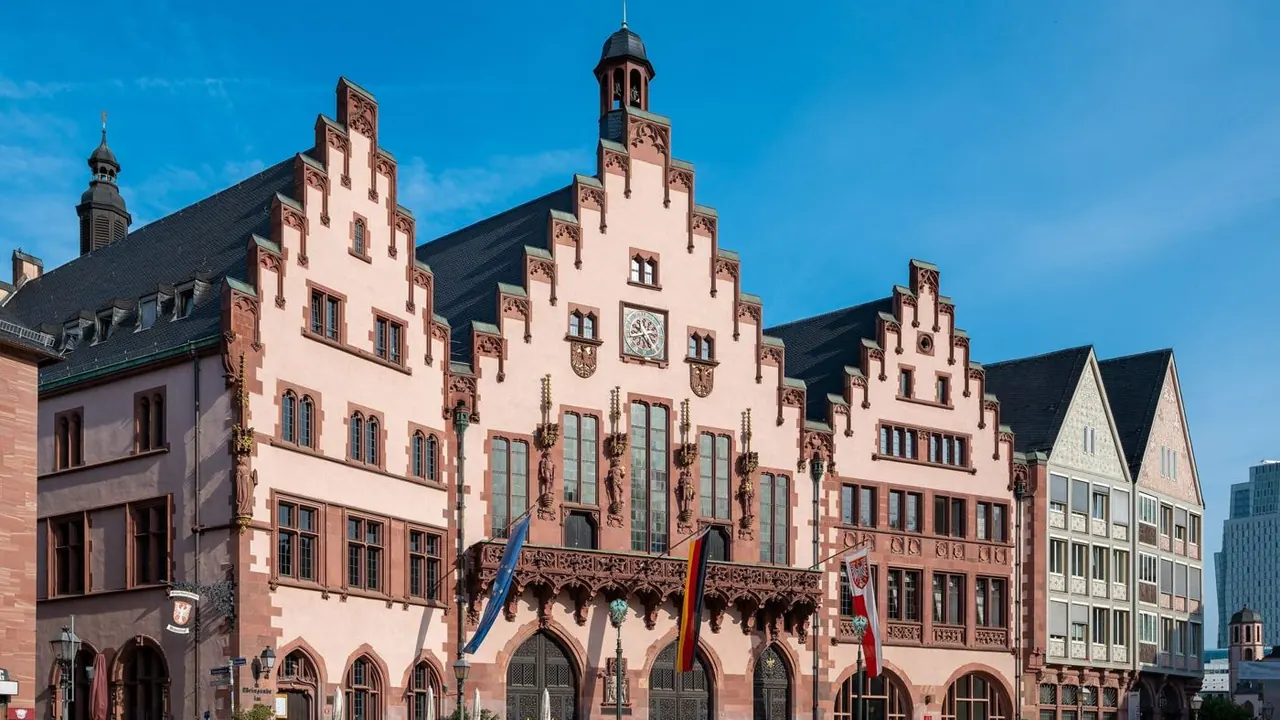
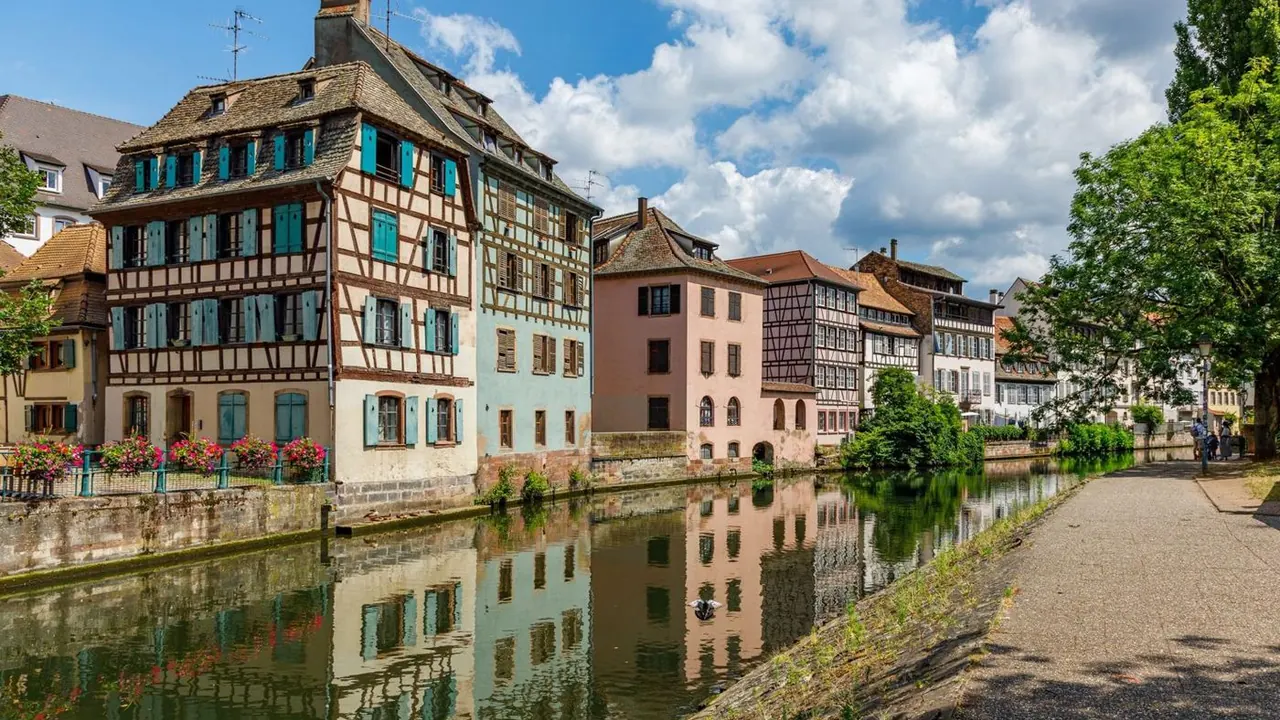
Photos: Frankfurt by Thomas Wolf, CC BY-SA 3.0 DE, cropped; Strasbourg by Edoardo Colombo, Pexels License.
Frankfurt or Strasbourg?
Our verdict in twelve categories, each scored against the same fixed benchmark cities, and the climate month by month, so you can choose for your trip.
Choose Frankfurt for
- nightlife
- live music and the arts
- day trips
Frankfurt suits the traveller who wants a base to move around from. Fast trains put Heidelberg, the Rhine Gorge and Cologne within easy reach, and in the evenings there is a respected opera house, a concert hall and a techno tradition that still fills clubs at weekends. Choose it if your trip is a mix of museums, music and a different town each day, and you don't mind an old centre that is mostly rebuilt.
Choose Strasbourg for
- food and drink
- culture and sights
- prices
Strasbourg is the place for an unhurried stay in a beautiful old town. The cathedral, Petite France and the canal-lined Grande Ile have survived intact, the winstub cooking and Alsace wine are a real reason to go, and the wine villages and Colmar are close by. Nights end earlier, but a couple who want good food, half-timbered streets and slow afternoons will be happier here, and spend a little less doing it.
Scoreboard
Twelve categories on one fixed scale from 0 to 100. The shaded stretch is the gap between the two.
Your match
Pick a travel style or drag the sliders, and both match scores follow your weighting.
Too close to call, 1 point apart
Wins on nightlife and live music and the arts with your weighting.
Wins on food and drink and culture and sights with your weighting.
What matters to you?
Category by category
What the scores mean for a trip.
Beaches & swimming
Neither city has a sea anywhere nearby, and both swim in old gravel-pit lakes in July and August. Frankfurt's Langener Waldsee has sandy shores in the forest to the south. Strasbourg has several lifeguarded lakes with grassy banks, and the tram goes all the way to the Baggersee, so a swim needs less planning there.
Food & drink
Strasbourg is the better place to eat. Alsatian cooking takes in choucroute, baeckeoffe, tarte flambée and foie gras, there is a strong fine-dining tier, and the wine comes from vineyards just to the south. A meal in a wood-panelled winstub is one of the main reasons to go, as long as you avoid the tourist menus around the cathedral.
Frankfurt's local cooking is narrower: Grüne Soße, Handkäs and tart Apfelwein at the long tables of Sachsenhausen. It does better on variety, though, with Turkish, Italian and Asian kitchens and cheap food from around the world in the Bahnhofsviertel, where Strasbourg offers little beyond its own cuisine.
Culture & sights
Strasbourg's old town is the real thing. The pink sandstone cathedral, the timber-framed houses of Petite France and the imperial Neustadt survived largely intact, and walking through them is the main sight. Frankfurt's Römer and old-town lanes were rebuilt after 1944, and they are pleasant without having the same depth.
Frankfurt's strength is its museums. The Museumsufer packs more than a dozen of them along the Main, and the Städel carries more international weight than anything in the Palais Rohan. Add the tower skyline and the Paulskirche, and it suits a museum lover more than someone who has come for streets and buildings.
Nightlife
Frankfurt is the better city for a late night. Together with Offenbach it has a real place in techno and house history, and its clubs still carry that on at weekends. The Bahnhofsviertel cocktail bars and late kiosks give it a rougher edge that Strasbourg doesn't have.
Strasbourg's evenings are about bars rather than clubs: student cellars in the Krutenau, drinks around Place Saint-Étienne and riverside terraces in summer. It is pleasant, but most of the city is quiet by midnight.
Nature & outdoors
Both are flat cities with hills about an hour away. The difference is in how high those hills go and how easy they are to reach. Frankfurt's Taunus, the Großer Feldberg and the large Stadtwald are all reachable by S-Bahn and bus, and the walking is gentle.
From Strasbourg there are two ranges: the Vosges above the vineyards and the higher Black Forest across the Rhine, which together give more serious hiking, though a car helps. Closer in, storks and beavers live in the Rhine-plain forests, and the cycling routes cross into Germany.
Day trips
Both are excellent bases, but Frankfurt has more range because it sits on Germany's high-speed network. Heidelberg and the castles of the Rhine Gorge are about an hour away, Cologne cathedral is the same, and Würzburg, Mainz and the Rheingau are easy by train, all without a car.
Strasbourg's best trips are closer and more alike: Colmar half an hour south, and the half-timbered wine-route villages such as Riquewihr and Eguisheim, which are much easier with a car or bike. Baden-Baden and Freiburg across the border add variety.
Good for families
Frankfurt's best things for children are in the city itself. There are the dinosaur skeletons in the Senckenberg, a zoo you can walk to from the centre, and boat trips past the towers. The Taunus adds the wildlife park at Kronberg and a small fairy-tale park for easy outings.
Strasbourg's flat, mostly car-free island is gentler with a pushchair, and children like the storks nesting in the Orangerie and the hands-on Le Vaisseau science centre. Its trump card is Europa-Park, about an hour away across the border, which is a bigger day out than anything near Frankfurt.
Getting around
Frankfurt runs on a full rail system. U-Bahn, S-Bahn, trams and buses share one network that reaches the Taunus, Wiesbaden and Mainz, and trains take about a quarter of an hour to reach one of Europe's best-connected airports. The lines and zones take some learning.
Strasbourg is smaller and simpler. You can cross its old town island on foot in twenty minutes, trams run out to the edges and over the Rhine to Kehl, and the separated cycle lanes often make a bike the quickest way about.
Shopping & style
The two are about even, but you would shop in them for different things. Frankfurt has the department stores and malls of the Zeil and the luxury fashion and jewellery houses around Goethestraße. Strasbourg has almost no luxury, but it does better on regional things to take home: Alsace wine, Soufflenheim pottery, printed linens and kougelhopf moulds, with the Christmas market making December its busiest season.
Affordability
Strasbourg is the somewhat cheaper stay, though neither is a budget city. In both, hotels are the main cost, and timing matters most. In Frankfurt, rooms are priced for business travellers and soar during trade fairs, so weekends and summer are the better choice.
In Strasbourg, avoid December and the weeks when the European Parliament sits. Beyond that, winstub meals, wine by the pichet and free sights like the cathedral and old town go a long way.
Live music & performing arts
Frankfurt has more to offer in the evenings. Its opera company is one of Germany's most respected, the Alte Oper brings in the radio symphony orchestra and touring ensembles, and cellar clubs still keep up the city's post-war jazz. Like Strasbourg, it goes quiet in summer.
Strasbourg is strong for its size. The Opéra national du Rhin and the Théâtre National de Strasbourg are serious stages, and the Musica festival makes autumn the best time for contemporary music.
Wellness & relaxation
Both cities send you out of town to relax, Frankfurt to Wiesbaden's Art Nouveau Kaiser-Friedrich-Therme or the spa park at Bad Homburg, and Strasbourg across the Rhine to the Friedrichsbad in Baden-Baden. Strasbourg has the edge in town, with its tiled Bains municipaux and an easier pace of canal walks and long winstub lunches. Frankfurt's calm is limited to the Palmengarten and the quieter riverbanks.
When should you go?
Pick your month. The climate figures are measured averages, not a forecast.
Frankfurt in July
Strasbourg in July
Daytime high, °C
Rainfall in the month, mm
Temperature and rainfall are climate normals, averaged over the years shown. Frankfurt: 1991-2020 normals, Frankfurt Westend (2 km from centre). Strasbourg: 1991-2020 normals, Strasbourg (9.1 km from centre).
The two cities have almost the same temperatures through the year, so the choice is not about warmth. June to August are the warm months, with highs around 26°C, which is good for lake swimming and evenings outside by the river. May, June and September are the most comfortable for long days of walking. From November to February the highs sit around 5°C, which is cold for sightseeing but fine for museums and, in Strasbourg, the December market.
Rain is where they differ. Strasbourg has a drier winter, with about 35mm in January against Frankfurt's 52mm, but its late spring is wetter, and May is its wettest month at 77mm. Frankfurt gets noticeably more sunshine in April, so it is the better choice for an early spring trip. Strasbourg has the edge in midwinter.
Which traveller are you?
On a culture and arts trip, Strasbourg is the better pick for sights. Its cathedral, the Grande Ile and the Neustadt make up a UNESCO-listed old town that survived intact. Frankfurt answers with the Städel and a stronger opera and concert season.
For a short city break, Frankfurt is easier. The airport is a quarter of an hour from the centre by train, the Museumsufer fills a day, and on Friday and Saturday the Bahnhofsviertel bars and techno clubs keep going long after Strasbourg has gone quiet.
On a trip with a tight budget, Strasbourg goes further. Its hotels are cheaper outside the Christmas market and Parliament weeks, winstub meals and wine by the pichet are fair value, and the cathedral and old town streets cost nothing to enjoy.
Before you go
| Measure | Frankfurt | Strasbourg |
|---|---|---|
| Official language | German | French |
| Currency | Euro (EUR) | Euro (EUR) |
| Sockets | CF230 V, 50 Hz | CE230 V, 50 Hz |
| Driving side | Right | Right |
| Time zone | UTC+1, UTC+2 in summer | UTC+1, UTC+2 in summer |
| Emergency number | 112 | 112 |
| Elevation | 101 m | 132 m |
| Main airport | Frankfurt Main Airport (FRA)13 km from centre281 non-stop destinations | Strasbourg Airport (SXB)10 km from centre43 non-stop destinations |
| Public holidays this year | 10 days | 11 days |
By the numbers
| Measure | Frankfurt | Strasbourg |
|---|---|---|
| City population | 760,656 | 293,771 |
| People per km² | 3,063 | 3,752 |
| Museums within 10 km | 53 | 21 |
| UNESCO World Heritage sites within 50 km | 4 | 1 |
Where else could you go?
Every comparison below shares a destination with this one, so you can follow Frankfurt or Strasbourg somewhere new.