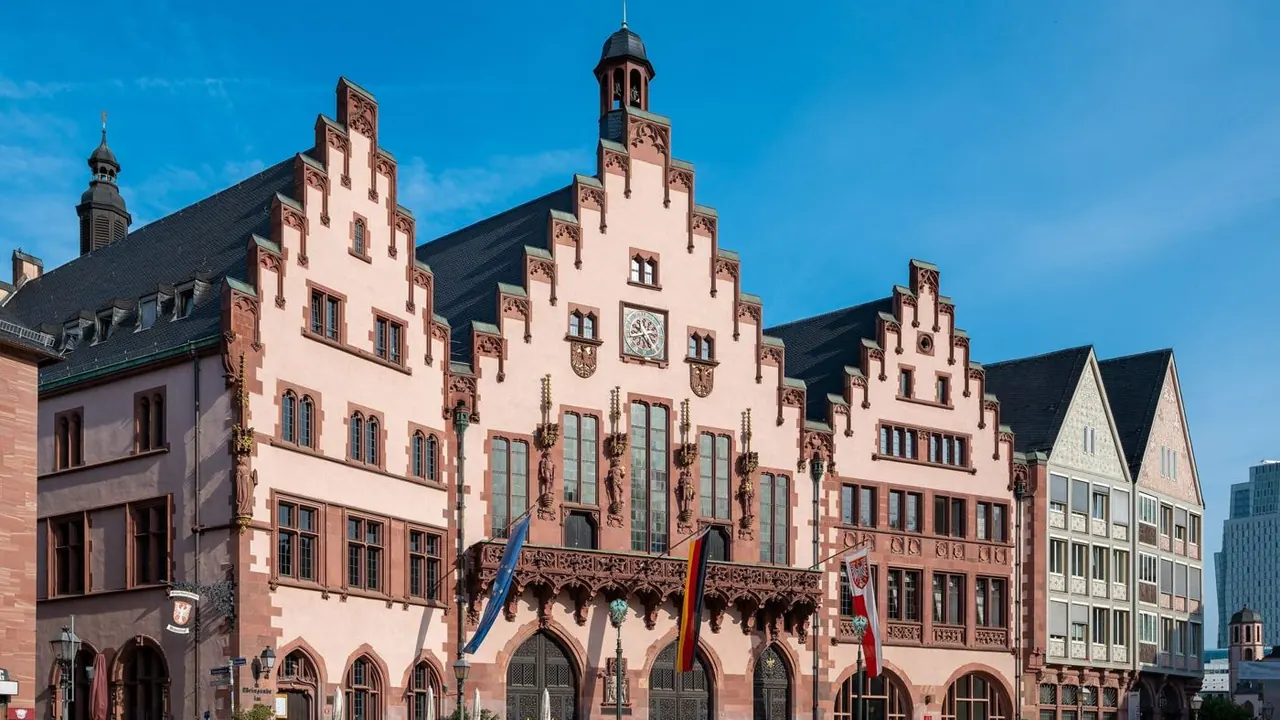
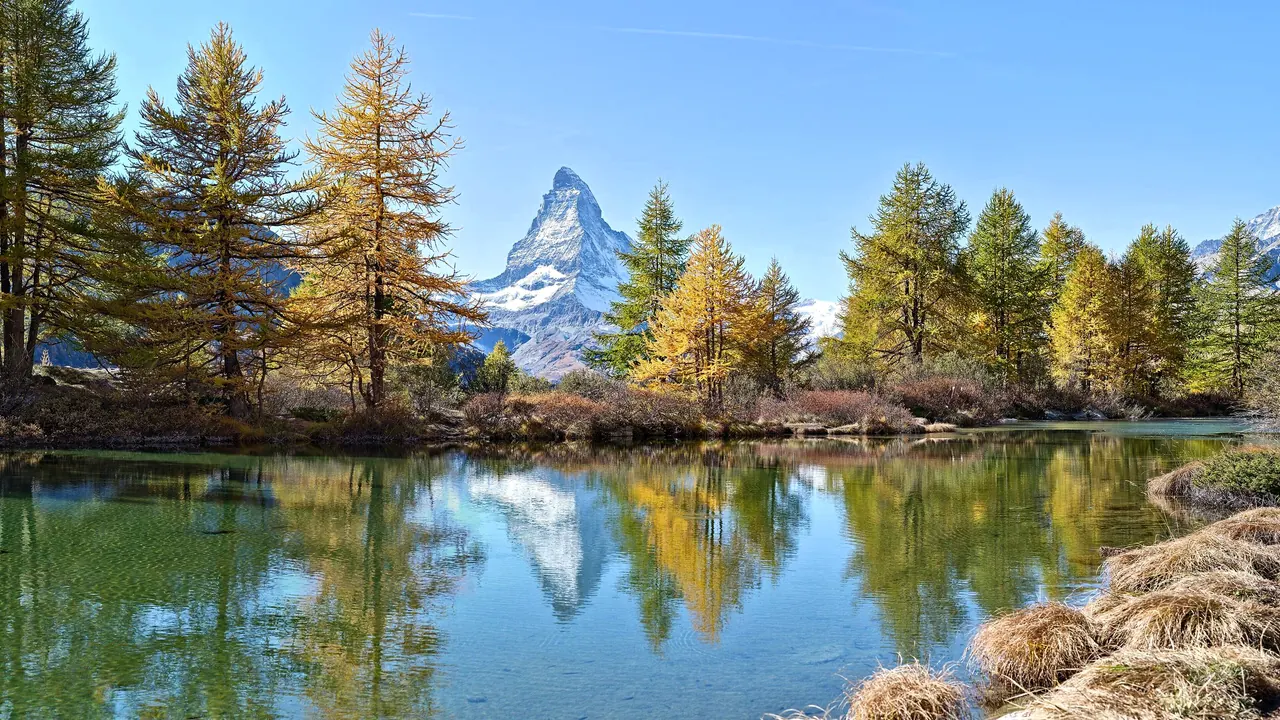
Photos: Frankfurt by Thomas Wolf, CC BY-SA 3.0 DE, cropped; Zermatt by Roy Egloff, CC BY-SA 4.0, cropped.
Frankfurt or Zermatt?
Our verdict in twelve categories, each scored against the same fixed benchmark cities, and the climate month by month, so you can choose for your trip.
Choose Frankfurt for
- day trips
- live music and the arts
- culture and sights
Frankfurt is the choice for a trip built around cities rather than scenery. Its Museumsufer, a respected opera company and the rebuilt old town around the Römer give you several full days, and the rail hub on its doorstep puts Heidelberg, Cologne and the Rhine Gorge within easy reach. It is also the cheaper of the two by a wide margin, especially if you avoid the big trade-fair weeks, and it eats and drinks with more range.
Choose Zermatt for
- nature and the outdoors
Pick Zermatt if the mountains are the point. The Matterhorn stands over a car-free village, and lifts climb to glaciers and high ridges, so skiing in winter and hiking in summer start at the hotel door. Very little else competes with that. Culture, shopping and evenings out are thin, and the costs are among the steepest in the Alps, so it rewards active travellers who will spend their days outdoors and can pay for it.
Scoreboard
Twelve categories on one fixed scale from 0 to 100. The shaded stretch is the gap between the two.
Your match
Pick a travel style or drag the sliders, and both match scores follow your weighting.
Wins on day trips and live music and the arts with your weighting.
Wins on nature and the outdoors with your weighting.
What matters to you?
Category by category
What the scores mean for a trip.
Beaches & swimming
Neither place works for a beach trip, and both are a long way from the sea. The difference is the kind of summer swimming each one has. Frankfurt has outdoor pools and sandy-shored gravel-pit lakes such as the Langener Waldsee, which warm up nicely in July and August. In Zermatt, the tarns stay snowmelt-cold, so a dip means a hotel pool.
Food & drink
Frankfurt gives you more variety and more cheap meals. You get Grüne Soße and tart Apfelwein at shared tables in Sachsenhausen, the Kleinmarkthalle for sausages and cheese, and Turkish, Italian and Asian kitchens across the city, including the inexpensive spots of the Bahnhofsviertel.
Zermatt's best meals are a matter of setting. Long lunches of raclette, air-dried beef and Valais wine are served on chalet terraces in Findeln, Furi and Zum See, with the Matterhorn in view. Down in the village the choice is narrow and expensive, and many kitchens close between seasons.
Culture & sights
Frankfurt has two or three days of real sightseeing. The Städel heads the Museumsufer, the Senckenberg is one of Germany's largest natural history museums, and the Römer, the cathedral and the Paulskirche are a short walk apart beneath the tower skyline.
Zermatt's heritage is all about climbing. It covers the Matterhorn Museum's story of the 1865 first ascent, the mountaineers' graves by the church and the larch barns of the Hinterdorf. It is absorbing, but you will see it all in a morning.
Nightlife
Frankfurt has the deeper night out, and it peaks at weekends. Its techno and house clubs carry on a long electronic music tradition, the Bahnhofsviertel has cocktail bars and a mixed late crowd, and Berger Straße and the summer riverbanks are good for an easier drink.
Zermatt's evenings depend on the season. Winter brings loud, cheerful après-ski in slope-side bars and a few late spots on the main street. In summer the hikers turn in after dinner, and between seasons there is almost nothing open.
Nature & outdoors
This is where Zermatt is in a different class. The Matterhorn rises right over the village, a ring of four-thousand-metre peaks and the Gorner Glacier surround it, and lifts reach above 3,800m. In winter the skiing crosses into Italy. In summer you get trails such as the Five Lakes walk and the Europaweg, with marmots and ibex along the way.
Frankfurt's green spaces are gentle by comparison. The Taunus rises to about 880m at the Großer Feldberg, the Stadtwald and the Main cycle paths are inside the city, and the Rheingau vineyard paths are lovely, but this is walking and cycling country, not high mountains.
Day trips
Frankfurt is one of the best bases in Germany for day trips. Heidelberg and the castles of the Rhine Gorge are about an hour away, high-speed trains reach Cologne cathedral just as quickly, and Mainz, Wiesbaden and Darmstadt are closer still. You could fill a week this way.
From Zermatt, every outing starts with the long train ride down the valley. Sion's castle hills and Brig's Stockalper Palace are worth seeing, but most visitors would rather spend a spare day up on the mountains.
Good for families
Children tend to remember Frankfurt for the hall of dinosaur skeletons in the Senckenberg. Around it there is a central zoo, the Palmengarten glasshouses and boat trips past the skyline, with a wildlife park at Kronberg in the Taunus for an easy day out, so it is simpler to fill several days with children.
Zermatt's appeal for families is calm. The streets are car-free, ski schools and nursery slopes are on the Sunnegga side, and summer brings marmot spotting and novelty railways. Rainy days are hard to fill, though, and the high viewpoints can be too cold and thin-aired for small children.
Getting around
Both are easy to get around without a car, but in very different ways. Frankfurt's compact centre is linked to the whole region by a single network of U-Bahn, S-Bahn and trams, and the airport is about a quarter of an hour from the centre by train.
Zermatt is a car-free strip you cover on foot, with electric taxis to the outer lift stations and a funicular, cog railway and gondolas leaving from the centre. The catch is that getting there means changing at Täsch, and leaving the valley takes more than an hour.
Shopping & style
Frankfurt is the better place to shop. There are department stores and malls along the Zeil, luxury houses on Goethestraße, and independent delis and design shops on Berger Straße and Schweizer Straße, plus a Saturday flea market by the river.
Zermatt has one main street of watch boutiques, souvenir cowbells and chocolate. Its strength is mountaineering and ski equipment, which is good if you need kit.
Affordability
Neither is cheap, but Frankfurt is far easier on the wallet. Its high prices come mostly from hotels during the trade fairs, so a weekend or summer stay, cheap tavern and grill meals and fairly priced transport can bring it down to moderate.
Zermatt is expensive across the board, from plain hotel rooms and terrace drinks to the lift passes nearly every visitor needs. Self-catering and staying in Täsch help, but only so much.
Live music & performing arts
For an evening at the opera or a concert, Frankfurt is far ahead. Its opera company is known for adventurous productions and the Alte Oper hosts the radio symphony orchestra. From autumn to early summer there is also serious drama at the Schauspiel, contemporary dance at the Mousonturm and jazz in cellar clubs, though the programme thins out in summer.
There is no hall or theatre in Zermatt, so its calendar rests on two festivals: Zermatt Unplugged in spring and chamber music in the village church in late summer. Outside those weeks, live music means an après-ski band.
Wellness & relaxation
Neither place has a bathing tradition of its own, so the difference is where you go to relax. From Frankfurt you take a short trip out to the spa towns: Wiesbaden's Art Nouveau Kaiser-Friedrich-Therme and the thermal baths of Bad Homburg are both close.
Zermatt keeps it in the village, with a dense cluster of hotel spas looking onto the peaks and clear, quiet, car-free air. Its mood is more active than restful, though, and for hot springs you have to go down the valley.
When should you go?
Pick your month. The climate figures are measured averages, not a forecast.
Frankfurt in July
Zermatt in July
Daytime high, °C
Rainfall in the month, mm
Where the figures come from
Zermatt has no weather station within reach, so its figures come from a gridded climate model rather than a measured record, and read a broad area rather than the city itself.
Temperature and rainfall are climate normals, averaged over the years shown. Frankfurt: 1991-2020 normals, Frankfurt Westend (2 km from centre). Zermatt: 1991-2020 normals, TerraClimate 4 km grid at the town, no weather station within 90 km.
Frankfurt is at its best from May to September, when afternoons reach about 26°C in high summer, the days are long and sunny, and the riverbanks and lakes fill up. Rain is spread evenly through the year with no real wet season. Winter is grey and short on sunshine, but still mild enough for walking between museums, and spring and autumn are comfortable for sightseeing on foot.
Zermatt follows a different calendar. From December to February daytime highs stay below freezing, around -2°C, which is the cold that keeps the ski season going. July and August are the hiking months, but even then the village only reaches about 14°C, so pack layers. November is the wettest month, at about 130mm, and the shoulder months of late spring and autumn are cool, damp and quiet. A summer visit suits Frankfurt and Zermatt equally well. In winter Zermatt is the one at its peak, while Frankfurt is at its least appealing.
Which traveller are you?
On a culture and arts trip, Frankfurt is the clear pick. The Städel and a dozen more museums line the Main, the opera company and Alte Oper fill the evenings, and Goethe's birthplace sits near the Römer. Zermatt offers a mountaineering museum and little more.
For an outdoors trip, Zermatt has the stronger case. Lifts and a cog railway carry you straight up among glaciers and high peaks, with hundreds of kilometres of marked trails and lift-served skiing. Frankfurt's Taunus hills are pleasant, but they are gentle country by comparison.
On a trip with a tight budget, Frankfurt is the realistic option. Cider taverns, Turkish grills and a multi-museum pass keep costs down, and weekends bring cheaper rooms. Zermatt charges heavily for beds, meals and lifts alike, and even Täsch only softens the bill.
Before you go
| Measure | Frankfurt | Zermatt |
|---|---|---|
| Official language | German | French, German, Italian, Romansh |
| Currency | Euro (EUR) | Swiss Franc (CHF) |
| Sockets | CF230 V, 50 Hz | CJ230 V, 50 Hz |
| Driving side | Right | Right |
| Time zone | UTC+1, UTC+2 in summer | UTC+1, UTC+2 in summer |
| Emergency number | 112 | 112 |
| Elevation | 101 m | 1,624 m |
| Main airport | Frankfurt Main Airport (FRA)13 km from centre281 non-stop destinations | Geneva International Airport (GVA)128 km from centre150 non-stop destinations |
| Public holidays this year | 10 days | 9 days |
By the numbers
| Measure | Frankfurt | Zermatt |
|---|---|---|
| City population | 760,656 | 6,023 |
| People per km² | 3,063 | 25 |
| Museums within 10 km | 53 | 2 |
| UNESCO World Heritage sites within 50 km | 4 | 2 |
Where else could you go?
Every comparison below shares a destination with this one, so you can follow Frankfurt or Zermatt somewhere new.
- Chamonixvs Zermatt
- Interlakenvs Zermatt
- Heidelbergvs Frankfurt
- Luganovs Zermatt
- Lausannevs Zermatt
- Turinvs Zermatt