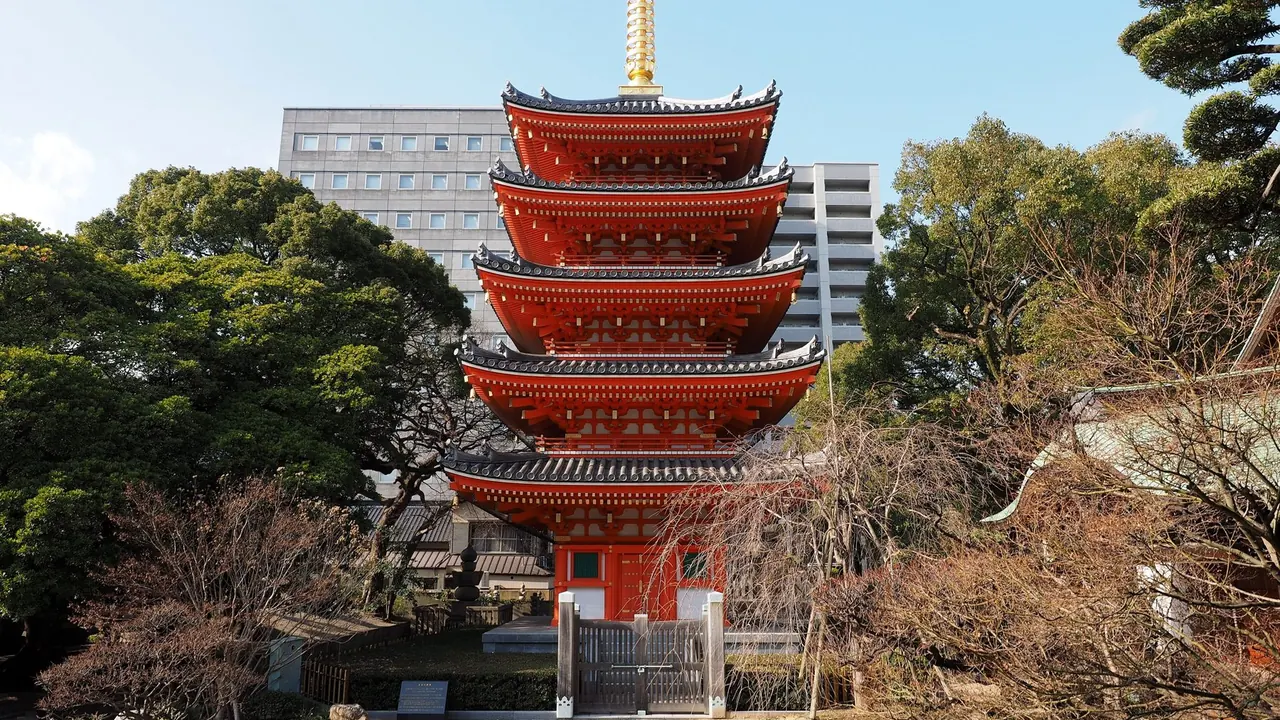
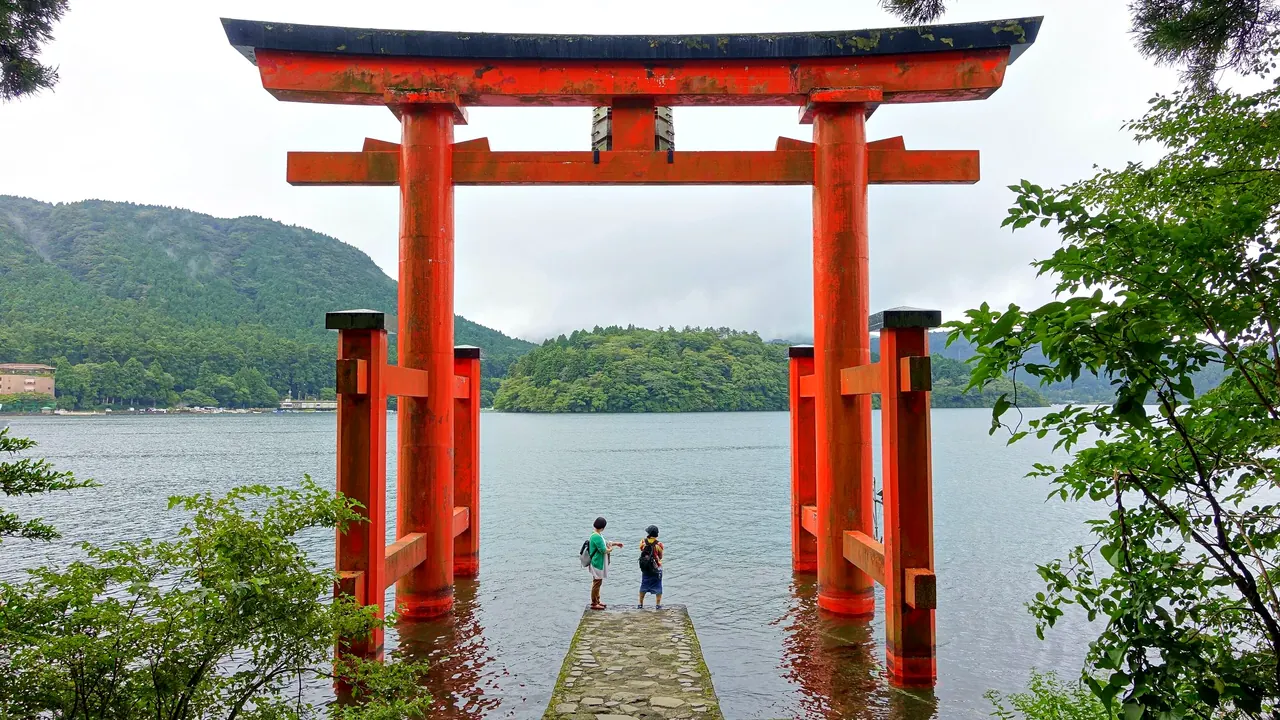
Photos: Fukuoka by Nick-D, CC BY-SA 4.0, cropped; Hakone by Daderot, CC0.
Fukuoka or Hakone?
Our verdict in twelve categories, each scored against the same fixed benchmark cities, and the climate month by month, so you can choose for your trip.
Choose Fukuoka for
- nightlife
- food and drink
- live music and the arts
Fukuoka suits travellers who want a city that revolves around eating and evenings out: ramen counters in Hakata, yatai stalls along the river in Nakasu, bar-hopping in Daimyo, and a flat, compact centre reached by subway straight from the airport. It is also the easier and cheaper choice with children, and from Hakata Station you can reach Nagasaki, Kumamoto or Hiroshima as a day out.
Choose Hakone for
- wellness
- nature and the outdoors
Choose Hakone for slowing down. A stay here is built around the hot-spring bath, a long kaiseki dinner at a ryokan and an early night, with the volcanic caldera, Lake Ashi and, on clear days, Mount Fuji right outside. It suits couples, walkers and anyone tired of cities far better than people looking for a lively evening, and the inns that make it special also make it the dearer stay.
Scoreboard
Twelve categories on one fixed scale from 0 to 100. The shaded stretch is the gap between the two.
Your match
Pick a travel style or drag the sliders, and both match scores follow your weighting.
Wins on nightlife and food and drink with your weighting.
Wins on wellness and nature and the outdoors with your weighting.
What matters to you?
Category by category
What the scores mean for a trip.
Beaches & swimming
Fukuoka has a city beach at Momochi Seaside Park, handy for an evening paddle, and much better sand under an hour west on the Itoshima peninsula, with Nokonoshima and Shikanoshima as quieter options. In July and August a swim fits easily into a city stay.
Hakone has nowhere to swim. Lake Ashi is off limits and the shore at Odawara is steep pebble, so the nearest proper sand is at Atami, a summer excursion rather than part of the stay.
Food & drink
Fukuoka is one of Japan's best eating cities: tonkotsu ramen in Hakata and Nagahama, the yatai stalls in Nakasu and Tenjin, mentaiko, motsunabe, and very fresh fish from the Genkai Sea. You can eat cheaply or well on every block, and the yatai give it a street-food life rare in Japan.
In Hakone the meal that matters is the kaiseki served at your ryokan, often superb but eaten where you sleep. Beyond that it comes down to soba and tofu shops in Hakone-Yumoto and black eggs at Owakudani, and little is open outside the inns after early evening.
Culture & sights
The two are not far apart, though Fukuoka edges ahead on history. Its old Hakata temple quarter puts Shofukuji, Tochoji's wooden Buddha and the Kushida Shrine within a short walk of each other, and the City Museum holds the ancient gold seal from China.
Hakone's strength is art set in landscape, from sculpture on the lawns of the Open-Air Museum to the Pola Museum in beech forest, along with relics of the Tokaido road such as the Sekisho checkpoint and the torii standing in Lake Ashi. Its sights are scattered around the caldera rather than grouped together.
Nightlife
Fukuoka is known in Japan as a drinking city. Evenings start at the riverside yatai under the Nakasu neon and move on to standing bars, craft beer and whisky bars in Tenjin and Daimyo. Clubs are few, so think long dinners and bar-hopping.
Hakone has almost nothing after dinner beyond a handful of izakaya in Hakone-Yumoto. The night means a last bath and an early bed, which is exactly what most visitors come for.
Nature & outdoors
Hakone is the stronger pick, because the landscape is the destination. You stay inside a volcanic caldera in a national park, with steaming vents at Owakudani, Lake Ashi on the crater floor, Fuji behind it on clear days, and trails to Mount Kintoki and through the Sengokuhara pampas grass.
Fukuoka's nature means going out from a city: Ohori Park's pond loop, flower fields on Uminonakamichi and Nokonoshima, the rocky Itoshima coast and day hikes on Mount Homan. Pleasant, but less dramatic.
Day trips
Both make good bases, but they look in different directions. From Hakata Station fast trains cover Kyushu and beyond: Dazaifu in half an hour, Kumamoto's castle, Nagasaki's layered port history and Hiroshima with Miyajima.
Hakone looks towards Tokyo and the Izu coast. Kamakura's Great Buddha, Yokohama and Tokyo itself are all within reach, along with Odawara Castle and the Fuji lakes over the ridge, though the journeys are generally slower than on Fukuoka's shinkansen.
Good for families
Fukuoka is the easier place with children. It is compact and calm, with nursing rooms in stations and stores, and has Marine World's dolphin show, a city zoo, the Anpanman Children's Museum and Fukuoka Tower for rainy days. The summer heat is the main drawback.
Hakone's fun for children lies in getting about: the zigzag railway, the ropeway over Owakudani and the pirate ship on Lake Ashi, plus the seal shows at Hakone-en. Formal inns, nude communal baths and steep paths unsuited to pushchairs limit it to a short stay.
Getting around
Fukuoka is about as simple as cities get. The airport is a few subway stops from Hakata and Tenjin, the centre is flat and walkable, and three subway lines plus buses cover the rest.
In Hakone one regional pass covers the mountain railway, cable car, ropeway, lake boats and buses, and the loop they form is a sight in itself. It is slow, though. The villages are kilometres apart on winding roads, and at weekends and in the autumn-colour season the queues at the ropeway and on the buses build up.
Shopping & style
Fukuoka is Kyushu's main shopping city. Tenjin has department stores such as Iwataya above a long underground arcade, Daimyo and Imaizumi have vintage and independent shops, and Canal City covers the big brands. Hakata-ori silk, Hakata dolls, Arita porcelain and boxed mentaiko make good gifts.
Hakone offers one real craft, yosegi-zaiku wood marquetry from the Hatajuku workshops, plus souvenir streets in Yumoto and good museum shops. For anything more you have to go to the outlet mall over the ridge at Gotemba.
Affordability
Fukuoka is easier on the budget. Business hotels near Hakata and Tenjin are good value, ramen and yatai food cost little, and most temples and parks are free, so a modest budget still gets you the best of the city. Costs climb mainly with serious sushi and nights in Nakasu.
In Hakone the thing you come for, a ryokan night with dinner, breakfast and a private bath, is the expensive part, especially at weekends and in autumn. Simple inns in Hakone-Yumoto, public day-bathhouses and the transport pass keep costs down.
Live music & performing arts
Fukuoka has a proper regional stage: touring kabuki and musicals at Hakataza, the Kyushu Symphony Orchestra in the Acros building, and small jazz and band venues around Tenjin. Its festivals are the most memorable performances, with the dawn float races of the Hakata Gion Yamakasa in July and the Dontaku parade in May.
Hakone has no theatre or concert hall at all, only the odd museum concert or show laid on at an inn.
Wellness & relaxation
This is Hakone's great strength. Seventeen hot-spring areas, from riverside Hakone-Yumoto to the milky sulphur waters of Sengokuhara, offer outdoor baths under maples and cedars, private baths on many inn balconies and day-bathhouses in the woods. A midweek stay in winter or autumn is the most restful.
Fukuoka is calm for its size, with neighbourhood sento and bath complexes on the city's edge, and Futsukaichi Onsen half an hour away. For Beppu or Yufuin you need a long day out.
When should you go?
Pick your month. The climate figures are measured averages, not a forecast.
Fukuoka in July
Hakone in July
Daytime high, °C
Rainfall in the month, mm
Where the figures come from
Hakone's temperatures are measured 43 km from the centre, at Kawaguchiko.
Hakone has no rain gauge within 25 km of the centre, so its rainfall comes from a gridded climate dataset read at the city rather than from a gauge further away.
Temperature and rainfall are climate normals, averaged over the years shown. Fukuoka: 1991-2020 normals, Fukuoka (1.9 km from centre). Hakone: 1971-2000 (rainfall 1991-2020) normals, Kawaguchiko (42.9 km from centre).
Fukuoka is the warmer of the two all year. Its beach season is July and August, when the sea reaches 27°C, but those months are also hot and sticky for sightseeing, and July is the wettest month at about 300mm, with June not far behind. April, May and October are the comfortable months for walking, May being the sunniest, and winter stays mild enough for city sightseeing.
Hakone sits up in the mountains and runs several degrees cooler. Even August peaks at about 27°C, which keeps summer walking pleasant, though often misty. In January highs of 5°C make the outdoor baths at their most appealing. Its rain comes later than Fukuoka's, heaviest in September and October at over 200mm a month, so the drier days of November, with the autumn colour, and the months of April and May are the safest times to go.
Which traveller are you?
On a relaxing and wellness trip, Hakone is the clear choice. Seventeen hot-spring areas, inns with private outdoor baths and quiet evenings with nothing to do but soak and eat make rest the whole point, while Fukuoka's onsen are a side trip from a city stay.
For a food and nightlife trip, Fukuoka wins easily. Tonkotsu ramen, riverside yatai, Genkai seafood and late bar-hopping through Daimyo and Tenjin fill every evening, whereas in Hakone dinner is the kaiseki at your inn and the villages go dark soon afterwards.
On an outdoors trip, Hakone puts you inside a volcanic caldera, with ridge walks to Mount Kintoki, the cedar-lined Old Tokaido Road and Lake Ashi below Fuji. Fukuoka has parks, islands and wooded hills nearby, but Kyushu's great volcanic scenery at Aso is a long day away.
Before you go
| Measure | Fukuoka | Hakone |
|---|---|---|
| Official language | Japanese | Japanese |
| Currency | Yen (JPY) | Yen (JPY) |
| Sockets | AB100 V, 50 and 60 Hz depending on the region | AB100 V, 50 and 60 Hz depending on the region |
| Driving side | Left | Left |
| Time zone | UTC+9 | UTC+9 |
| Emergency number | Police 110, fire 119 | Police 110, fire 119 |
| Elevation | 8 m | 734 m |
| Main airport | Fukuoka Airport (FUK)5 km from centre46 non-stop destinations | Tokyo Haneda International Airport (HND)71 km from centre98 non-stop destinations |
| Public holidays this year | 16 days | 16 days |
By the numbers
| Measure | Fukuoka | Hakone |
|---|---|---|
| City population | 1,603,043 | 10,925 |
| People per km² | 4,715 | 118 |
| Museums within 10 km | 23 | 16 |
| UNESCO World Heritage sites within 50 km | 2 | 2 |
| Swim season, months above 21 °C | 4 months | 5 months |
Where else could you go?
Every comparison below shares a destination with this one, so you can follow Fukuoka or Hakone somewhere new.
- Yokohamavs Hakone
- Tokyovs Hakone
- Hiroshimavs Fukuoka
- Busanvs Fukuoka
- Kanazawavs Hakone
- Gyeongjuvs Fukuoka