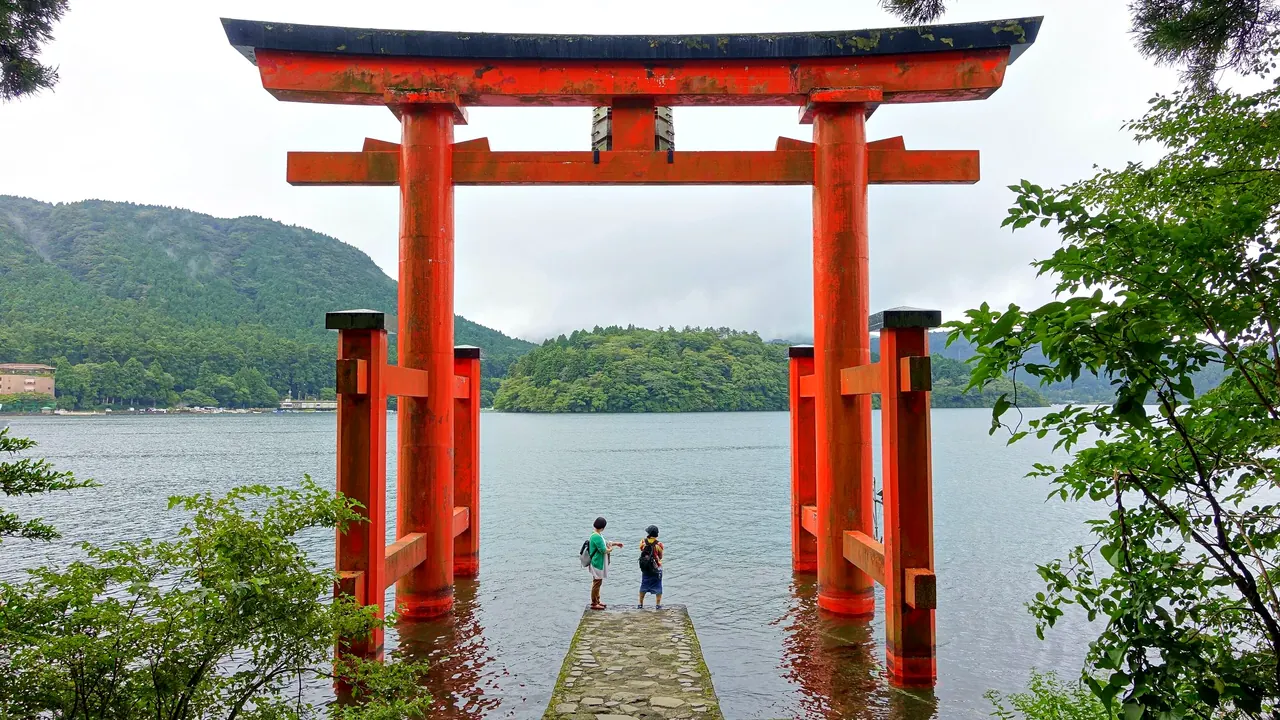
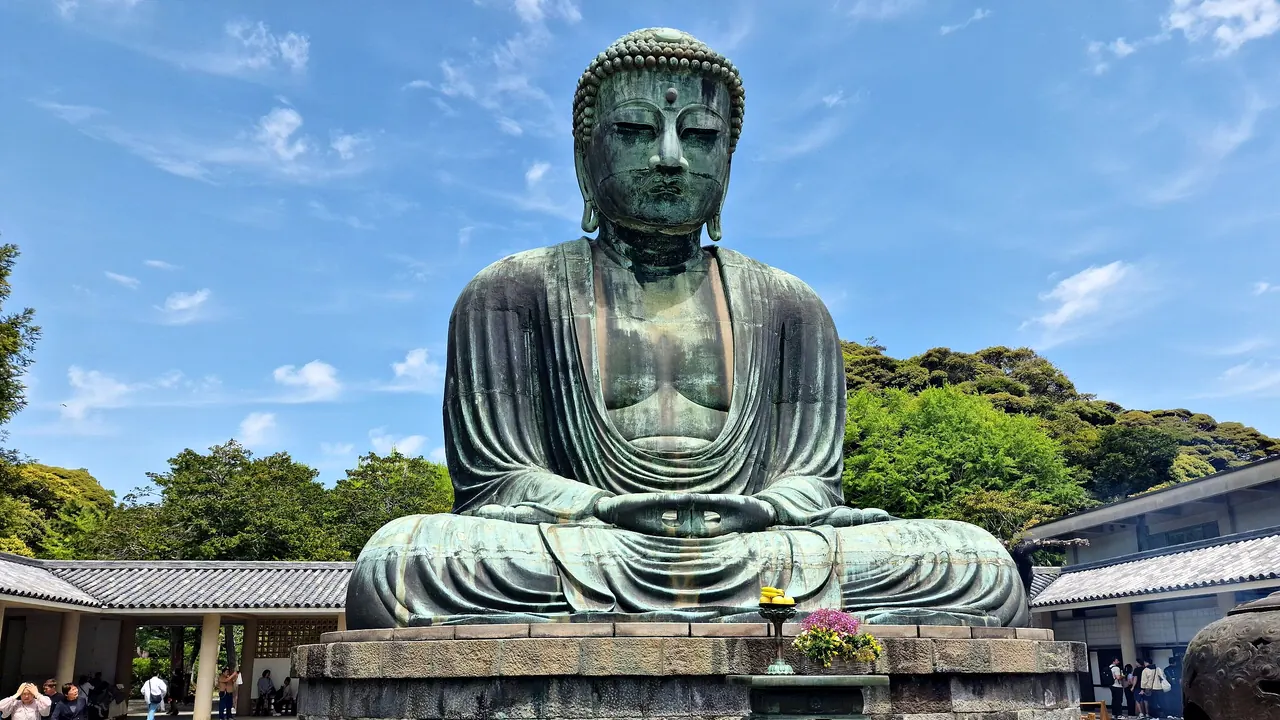
Photos: Hakone by Daderot, CC0; Kamakura by Anagoria, CC BY-SA 4.0, cropped.
Hakone or Kamakura?
Our verdict in twelve categories, each scored against the same fixed benchmark cities, and the climate month by month, so you can choose for your trip.
Choose Hakone for
- wellness
- nature and the outdoors
Hakone is the place for a slow stay built around hot water and mountain scenery. A night or two in a ryokan, with a kaiseki dinner, an outdoor bath under the cedars and a morning walk above Lake Ashi, is something Kamakura cannot give you. The steaming slopes of Owakudani and the ridge paths around the caldera also make it the stronger choice for anyone who wants to be out on foot in real landscape.
Choose Kamakura for
- beaches
- culture and sights
- food and drink
For temples, history and a town you can walk around, choose Kamakura. The Great Buddha, Tsurugaoka Hachimangu and the Zen temples of Kita-Kamakura give it far more to see. Its food reaches beyond the inn dining room, and in summer there is a sandy beach a short walk from the station. It keeps a little more life after dark too, though neither town is for a night out.
Scoreboard
Twelve categories on one fixed scale from 0 to 100. The shaded stretch is the gap between the two.
Your match
Pick a travel style or drag the sliders, and both match scores follow your weighting.
Wins on wellness and nature and the outdoors with your weighting.
Wins on beaches and culture and sights with your weighting.
What matters to you?
Category by category
What the scores mean for a trip.
Beaches & swimming
Kamakura is the only one of the pair where you can walk to the sea and swim. The long curve of Yuigahama and Zaimokuza fills with beach houses in high summer, Katase and Koshigoe are a short Enoden ride west, and Zushi and Hayama are calmer to the east. The sand is dark and volcanic and the water is rarely clear, so this is a beach to add to a temple stay rather than a reason to come.
In Hakone you cannot swim in Lake Ashi, and the shore down at Odawara is steep and pebbly. Bathing there means a summer trip to Atami.
Food & drink
In Hakone the meal that matters is the kaiseki dinner at your inn, with mountain vegetables, river fish and tofu. Outside the inns you will find little beyond soba and tofu shops in Hakone-Yumoto, black eggs at Owakudani and set-meal places by the lake, most of them shut by early evening.
Kamakura gives you more reason to go out and eat. You can have shirasu whitebait over rice near the beach, refined shojin ryori by the Zen temples, snacks along Komachi-dori and vegetables from the Renbai market. Even so, its evenings are thin, and for sushi or izakaya hopping people take the train to Yokohama.
Culture & sights
Kamakura was Japan's capital of warrior rule for about a century and a half, and you can see it everywhere. The open-air bronze Great Buddha, the long avenue up to Tsurugaoka Hachimangu and the gates and rock gardens of Engaku-ji and Kencho-ji are among the most important sights in the country. Smaller places such as Hase-dera and the bamboo at Hokoku-ji fill out two or three days.
Hakone's strength is art more than religious heritage. The sculpture lawns of the Open-Air Museum and the Pola Museum's Impressionists are better than anything in Kamakura's modest museums. Its history is mainly the Old Tokaido, with the rebuilt checkpoint and the shrine gate standing in Lake Ashi.
Nightlife
Kamakura has slightly more going on after dark. There are a few izakaya and small bars between the station and the beach, and summer evenings by the sea have some life, though nothing runs late. In Hakone the evening is dinner, a last soak and bed in a yukata. Only Hakone-Yumoto has a handful of bars, and both towns send anyone wanting a night out to Tokyo.
Nature & outdoors
Hakone has the bigger landscape. It is a volcanic caldera with sulphur vents steaming at Owakudani, Lake Ashi on the crater floor and Fuji rising behind it on clear days. Ridge walks climb Mount Kintoki and Komagatake, and the pampas grass of Sengokuhara turns gold in autumn. The drawback is mist, which can hide Fuji for days.
Kamakura's nature is gentler and closer to the sea. You get low wooded hills with trails such as the Daibutsu route linking the temples, surf at Shichirigahama and paddling in the bay. Kamakura's own visitors go to Hakone for proper mountain hiking.
Day trips
Both towns are good bases, and each is a day out from the other. Kamakura looks towards the cities: Yokohama is under half an hour away, Tokyo about an hour by direct train, and Enoshima's shrines and caves sit at the end of the Enoden line.
Hakone looks the other way, towards Atami, the temple town of Shuzenji on the Izu Peninsula and the lakes at the foot of Fuji. Odawara's castle is close by, and the Romancecar still gets you to Tokyo in under two hours.
Good for families
Both work about equally well with children, but in different ways. In Hakone, getting around is the fun: the zigzag railway, the ropeway over the steaming vents and the pirate ship on the lake, plus seal shows at Hakone-en and an onsen theme park where families bathe in swimsuits. Formal inns and nude communal baths can be awkward with children, though.
Kamakura's highlights are climbing inside the Great Buddha, the seaside Enoden, gentle summer swimming and the big aquarium at Katase. The hard parts are long temple staircases, packed weekend lanes and small hotel rooms.
Getting around
Kamakura is easier. Its centre is walkable from the station, Kita-Kamakura is one JR stop away, and the Enoden covers the Great Buddha and the coast. Weekend gridlock and crowded trains are the main nuisances, and a bicycle helps on the flat run to the beach.
Hakone's villages are kilometres apart on winding roads. A single pass covers a loop of mountain railway, cable car, ropeway, boat and bus that is part of the sightseeing, but it is slow, and ropeway queues build at weekends and in autumn.
Shopping & style
Each town has one craft worth carrying home. In Kamakura it is Kamakura-bori, carved and lacquered woodwork, found in the quieter shops along Wakamiya-oji alongside ceramics and good knives, while Komachi-dori handles the sweets and tenugui. That gives Kamakura a pleasanter afternoon of browsing.
Hakone's craft is yosegi-zaiku marquetry, which you can watch being made around Hatajuku. Beyond that there are souvenir shops in Hakone-Yumoto and good museum shops, and the outlet mall near Gotemba is a bus ride over the ridge.
Affordability
Neither is cheap, and in both the cost is mainly the bed. In Hakone the price of a ryokan includes dinner, breakfast and the hot-spring bath, and it climbs fast for a room with a private outdoor bath. Simple inns in Hakone-Yumoto, public day-bathhouses and the transport pass keep things down.
In Kamakura you pay mainly for scarce rooms near the sea or in old houses. Many visitors avoid that by staying in Yokohama or Fujisawa, and temple fees, trains and set lunches cost little.
Live music & performing arts
Kamakura at least has something to attend now and then. A small Noh theatre gives occasional performances, the Ofuna arts hall hosts touring concerts, and the shrine festivals bring traditional dance in spring and yabusame horseback archery in autumn. Hakone has no theatre or concert hall, only the odd museum concert or show put on at an inn.
Wellness & relaxation
This is Hakone's great strength. Hot-spring areas are spread all round the caldera, from riverside Hakone-Yumoto to the milky sulphur water of Sengokuhara, and the routine of washing, soaking outdoors under maples and resting in a yukata sets the pace of a stay. A midweek visit in autumn or winter avoids the Tokyo crowds.
Kamakura offers a quieter kind of calm, without any baths. You can join zazen sessions at Engaku-ji and Kencho-ji or sit in the moss gardens of Kita-Kamakura early in the morning, before the crowds arrive.
When should you go?
Pick your month. The climate figures are measured averages, not a forecast.
Hakone in July
Kamakura in July
Daytime high, °C
Rainfall in the month, mm
Where the figures come from
Hakone's temperatures are measured 43 km from the centre, at Kawaguchiko.
Hakone has no rain gauge within 25 km of the centre, so its rainfall comes from a gridded climate dataset read at the city rather than from a gauge further away.
Kamakura's sunshine is measured 45 km from the centre, at Tokyo.
Temperature and rainfall are climate normals, averaged over the years shown. Hakone: 1971-2000 (rainfall 1991-2020) normals, Kawaguchiko (42.9 km from centre). Kamakura: 1991-2020 normals, Yokosuka Fwf (11.6 km from centre).
Hakone lies high in the mountains and is much colder than Kamakura. Winter days there reach only about 5°C, against 11°C on the coast. That cold suits a hot-spring stay, and winter brings the clearest views of Fuji. Rain builds through spring and stays heavy from June to October, passing 200mm in several of those months, so mist often hides the mountain. For walking the trails, late spring and the crisp days of November are the most comfortable.
Kamakura is milder all year, and its winters are dry and sunny, which makes December to February good for temple walks. It warms to about 30°C in August, when Sagami Bay reaches 26°C and the beaches are at their best, but the heat makes the temple steps hard work. September and October are its wettest months, so spring and late autumn suit sightseeing best.
Which traveller are you?
On a relaxing and wellness trip, Hakone is the clear choice. Its seventeen hot-spring areas, ryokan with private balcony baths and early, quiet evenings are made for rest. Kamakura has zazen sessions and moss gardens, but no onsen of its own.
For a culture and arts trip, Kamakura has much more to see. The Great Buddha, Tsurugaoka Hachimangu and the great Zen temples of Engaku-ji and Kencho-ji tell the story of Japan's first warrior government. Hakone's art museums and Tokaido relics fill two gentle days.
On a beach and sun trip, Kamakura is the one with sand on its doorstep. Yuigahama and Zaimokuza are a short walk from the station, and the water is warm in high summer. Hakone has no swimming at all, and its nearest good beach is at Atami.
Before you go
| Measure | Hakone | Kamakura |
|---|---|---|
| Official language | Japanese | Japanese |
| Currency | Yen (JPY) | Yen (JPY) |
| Sockets | AB100 V, 50 and 60 Hz depending on the region | AB100 V, 50 and 60 Hz depending on the region |
| Driving side | Left | Left |
| Time zone | UTC+9 | UTC+9 |
| Emergency number | Police 110, fire 119 | Police 110, fire 119 |
| Elevation | 734 m | 17 m |
| Main airport | Tokyo Haneda International Airport (HND)71 km from centre98 non-stop destinations | Tokyo Haneda International Airport (HND)34 km from centre98 non-stop destinations |
| Public holidays this year | 16 days | 16 days |
By the numbers
| Measure | Hakone | Kamakura |
|---|---|---|
| City population | 10,925 | 172,929 |
| People per km² | 118 | 4,356 |
| Museums within 10 km | 16 | 18 |
| UNESCO World Heritage sites within 50 km | 2 | 1 |
| Swim season, months above 21 °C | 5 months | 5 months |
Where else could you go?
Every comparison below shares a destination with this one, so you can follow Hakone or Kamakura somewhere new.