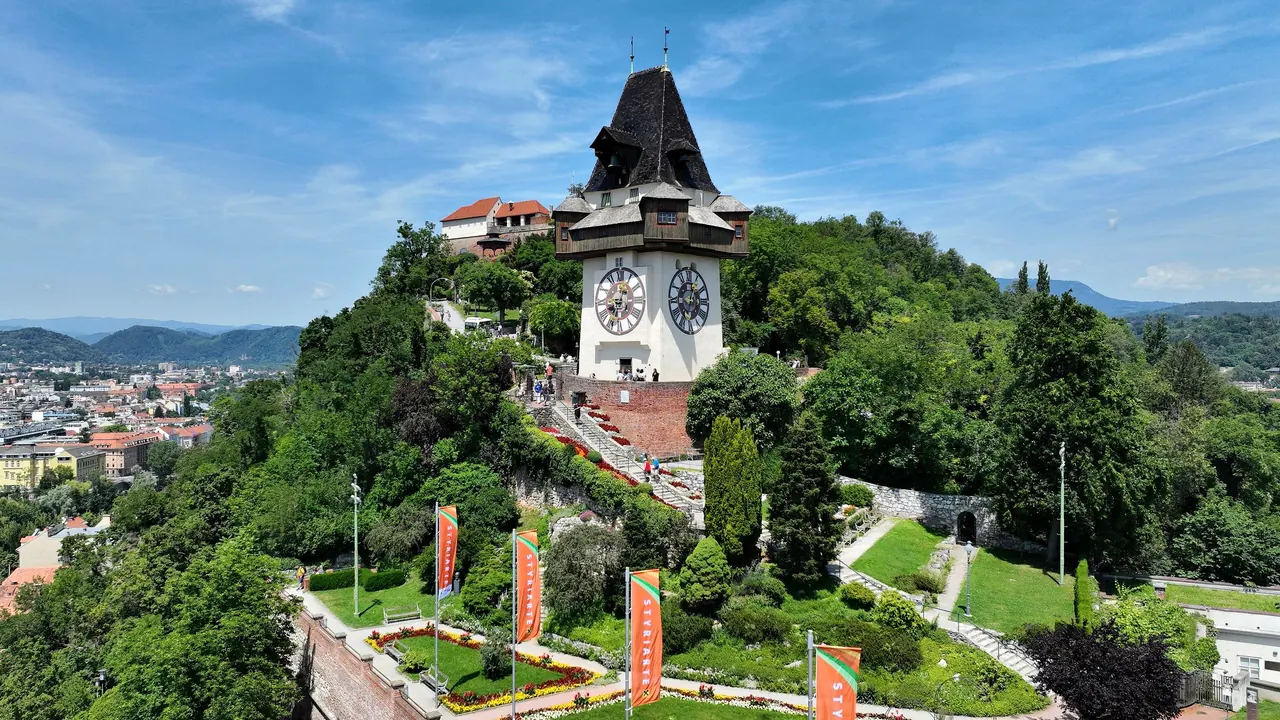
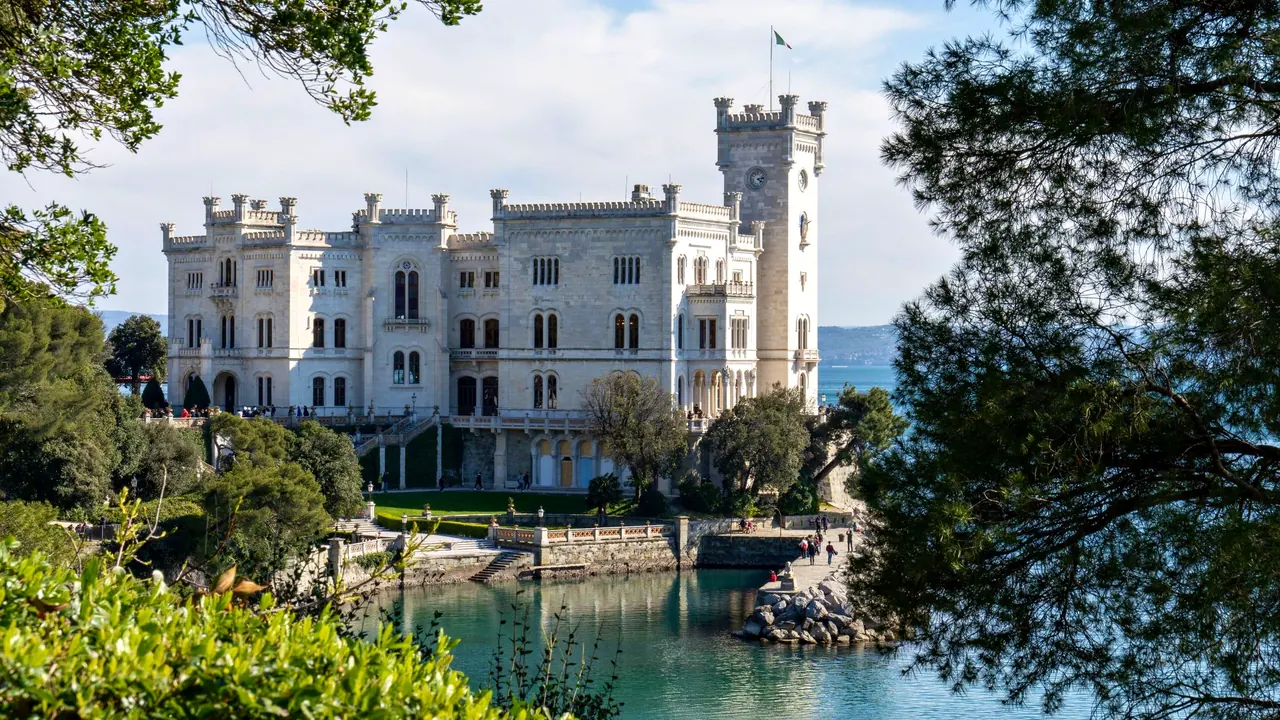
Photos: Graz by C.Stadler/Bwag, CC BY-SA 4.0, cropped; Trieste by Tibor Szabo, Pexels License.
Graz or Trieste?
Our verdict in twelve categories, each scored against the same fixed benchmark cities, and the climate month by month, so you can choose for your trip.
Choose Graz for
- getting around
- shopping
- wellness
Graz suits travellers who want a compact, easy city with the countryside close by. The red-roofed old town is flat and largely car-free, the trams do the rest, and Styria's wine taverns and thermal spa villages are an hour or less away. A student crowd keeps the bars busy, and there is a full opera and festival calendar. It works best for a relaxed few days of walking, eating, drinking local wine and spending an afternoon in warm pools.
Choose Trieste for
- beaches
- day trips
- prices
Trieste is the choice if you want the sea and want to travel beyond the city. You swim off the Barcola promenade or from the rocky coves towards Duino through the summer, and Aquileia, Piran, Ljubljana and even Venice all make realistic day trips. Evenings are an aperitivo by the water rather than a night out. The city also costs a little less day to day, which helps on a longer stay.
Scoreboard
Twelve categories on one fixed scale from 0 to 100. The shaded stretch is the gap between the two.
Your match
Pick a travel style or drag the sliders, and both match scores follow your weighting.
Wins on getting around and shopping with your weighting.
Wins on beaches and day trips with your weighting.
What matters to you?
Category by category
What the scores mean for a trip.
Beaches & swimming
This is Trieste's clearest advantage. People swim there every day in summer, off the stepped platforms and pine-shaded lawns of Barcola, at the old bathing establishments with their cabins, or in the pebble coves under the cliffs at Sistiana and Duino. There is almost no sand, so it suits confident swimmers more than toddlers.
Graz is far from the coast, and the Mur is not for swimming. On a hot afternoon you can go to the Schwarzlsee or another former gravel pit south of town, with jetties and grassy banks. That makes a pleasant break, but it is not a reason to choose the city.
Food & drink
The two are evenly matched at the table, and they share more than you might expect. Both serve boiled pork with horseradish, and both have a farm-tavern tradition: the Buschenschank on the South Styrian vineyard slopes outside Graz, and the osmiza on the Karst above Trieste, which opens only a few weeks at a time.
Graz cooks from the Styrian larder, with dark pumpkin seed oil on salads and even on ice cream, morning farmers' markets at Kaiser-Josef-Platz and Lendplatz, and crisp Sauvignon Blanc. Trieste mixes Italian, Austrian and Slavic cooking: jota soup, sardoni (the local anchovies) fried or marinated, meat carved from steaming pots at its buffets, and a coffee culture with its own vocabulary. Neither city offers much range beyond its regional food.
Culture & sights
The two are evenly matched, but the experience is different. Graz is about one well-preserved old town: arcaded Renaissance courtyards, the Schlossberg clock tower and the armoury still full of armour. There is also a Baroque palace at Eggenberg and the blob-shaped Kunsthaus across the river.
Trieste shows its history as a port. The grand square of Piazza Unità opens onto the sea, the Borgo Teresiano grid lines the canal, and there is a Roman theatre below San Giusto. The white Miramare Castle stands on the coast, and the Risiera di San Sabba memorial gives a visit a heavier side.
Nightlife
Neither is a clubbing city, but Graz has more going on after dark thanks to its students. Bars crowd the lanes of the Bermuda Triangle, Lend has artier bars, and a few clubs stay open late at weekends.
Trieste's evening is an aperitivo of spritz on Piazza Unità or along the canal, and on winter weeknights the streets are quiet by midnight. The seasons also cut opposite ways. Graz goes quiet in the long summer break when the students leave, while summer is when Trieste's Barcola kiosks stay open late.
Nature & outdoors
Both have the outdoors close at hand, but the terrain is very different. From Graz you head up into green hills and mountains: the Schöckl with its cable car and paragliders, the waterfall ladders of the Bärenschützklamm, and proper alpine hiking in the Gesäuse within about two hours.
Trieste has limestone and sea. There are clifftop paths such as the Strada Napoleonica and the Rilke Path, climbing in Val Rosandra, huge caves under the Karst, and snorkelling and kayaking in the Miramare marine reserve. The gulf is also good sailing water. In winter, the cold Bora wind can sour a day outside.
Day trips
Trieste has the wider choice, with Italy, Slovenia and Croatia all within reach. You can go to Aquileia's mosaics, star-shaped Palmanova, Piran on its peninsula, Ljubljana or the Postojna cave, and Venice works as a long day out by train. Many of these can be done without a car.
Graz's outings stay mostly in Styria: the South Styrian Wine Road, Riegersburg on its volcanic crag, the monastic library at Admont, and Maribor across the Slovenian border. They are rewarding, but most are easier with a car.
Good for families
Both are safe, calm cities, and Graz has a little more built for children. Families ride up the Schlossberg and come down by the underground slide, then take the Märchenbahn fairytale train through the rock. There is also the FRida & freD children's museum in the Augarten.
Trieste's best outings for children are the Grotta Gigante cave, the small aquarium and the Miramare gardens. Its steep stepped streets and swimming off rocks make it better for older children than for buggies and toddlers.
Getting around
Graz is easier. The centre is small, flat and mostly pedestrianised, trams run through the middle on one simple ticket, a lift and a funicular climb the castle hill, and cycling along the Mur is easy.
Trieste's waterfront and canal district are flat, but the climb to San Giusto means long flights of steps. Buses take you along the coast and up onto the Karst, and you can also cross the bay to Muggia by boat, which Graz has nothing like.
Shopping & style
Neither city is a shopping destination, but Graz has more to browse. There are the high-street and traditional shops of the Herrengasse and Sporgasse, a grand nineteenth-century department store with a rooftop terrace, design and vintage shops in Lend, and specialists in loden and traditional costume.
In Trieste the most interesting browsing is in the antique shops of the old town. In both cities the best souvenirs are edible: pumpkin seed oil and Schilcher rosé from Graz, coffee from Trieste's roasters and Karst honey.
Affordability
Graz is the dearer of the two over a day, and the difference shows in where your money goes. Its large student population keeps lunchtime cheap, with set menus and bakeries all over the old town, so the midday meal is where you save. The headline sights are another matter: the armoury and the state rooms at Eggenberg are paid visits, while the best of Trieste's waterfront costs nothing. Rooms in Graz get tight when a festival or trade fair is on, not because of the season.
Trieste is cheaper overall, and it saves you money at different points. A buffet counter does the job of Graz's student menus, and an evening can be a stroll out along the Molo Audace or a seat on Piazza Unità rather than a ticketed sight. Where it costs more is timing. Rooms fill around the Barcolana in autumn and in high summer, just when a swimming trip would bring you, and a seafood dinner by the water costs what it would in any Italian city.
Live music & performing arts
Both cities take opera seriously, and Graz offers slightly more over a season. Its opera house, the second largest in Austria, stages a full programme. It also has early music at Styriarte, avant-garde work at steirischer herbst in autumn, and a jazz scene fed by the music university.
Trieste's Teatro Verdi on the waterfront keeps up an operetta tradition that is rare in Italy, and there is a Slovenian-language theatre. In summer, concerts move into the castle courtyard on San Giusto. Away from the theatres, though, there is little live music most nights.
Wellness & relaxation
Graz has the real thermal bathing, even though it is out of town. The spa villages about an hour east, including Bad Blumau with its Hundertwasser architecture and its grass roofs, and Bad Radkersburg, have large warm pools and saunas open to day visitors.
Trieste relaxes you in other ways: long hours in old coffee houses and a sunset walk out along the Molo Audace pier. For proper thermal baths you would have to leave the city.
When should you go?
Pick your month. The climate figures are measured averages, not a forecast.
Graz in July
Trieste in July
Daytime high, °C
Rainfall in the month, mm
Temperature and rainfall are climate normals, averaged over the years shown. Graz: 1991-2020 normals, Graz Airport (7.9 km from centre). Trieste: 1991-2020 normals, Trieste (1.6 km from centre).
Graz has the harder winters. January highs are around 3°C, against roughly 9°C in Trieste, so winter street walking is chilly in both and raw in Graz. Both warm up through May. Graz's best walking months are May, June and September. Its summers are pleasantly warm but also its wettest time, with around 125mm a month from June to August. Winter there is dry, though cold.
Trieste runs warmer and sunnier, and its rain comes in autumn, heaviest in November at about 125mm. The sea is warm enough for swimming from June to September and peaks at about 25°C in July and August, when the city also gets the most sun. July and August are hot for climbing to San Giusto, so for sightseeing late May, June and September are better. Graz's lakes are only worth a dip in high summer.
Which traveller are you?
On a beach and sun trip, Trieste wins easily. The Adriatic is clear and warm from June to September, Barcola is a short bus ride from the centre, and there are prettier coves at Sistiana and Grignano. Graz only has gravel-pit lakes on the plain outside town.
For a relaxing and wellness trip, Graz is the better base. The thermal villages of eastern Styria, including Hundertwasser's Bad Blumau and Loipersdorf, are about an hour away for day visits. Trieste has only hotel spas, the sea and its slow coffee-house pace.
On a trip with a tight budget, Trieste goes further. A buffet plate or a coffee standing at the bar costs little, and swimming at Barcola, the cathedral hill and walks on the Karst are free. Graz is fair value, but its sit-down dinners and wine cost what you would pay elsewhere in Austria.
Before you go
| Measure | Graz | Trieste |
|---|---|---|
| Official language | German, Austrian Sign Language | Italian |
| Currency | Euro (EUR) | Euro (EUR) |
| Sockets | CF230 V, 50 Hz | CFL230 V, 50 Hz |
| Driving side | Right | Right |
| Time zone | UTC+1, UTC+2 in summer | UTC+1, UTC+2 in summer |
| Emergency number | 112 | 112 |
| Elevation | 353 m | 2 m |
| Main airport | Graz Airport (GRZ)9 km from centre26 non-stop destinations | Trieste Airport (TRS)31 km from centre32 non-stop destinations |
| Public holidays this year | 16 days | 13 days |
By the numbers
| Measure | Graz | Trieste |
|---|---|---|
| City population | 306,971 | 198,417 |
| People per km² | 2,406 | 2,332 |
| Museums within 10 km | 29 | 33 |
| UNESCO World Heritage sites within 50 km | 1 | 5 |
| Swim season, months above 21 °C | - | 4 months |
Where else could you go?
Every comparison below shares a destination with this one, so you can follow Graz or Trieste somewhere new.