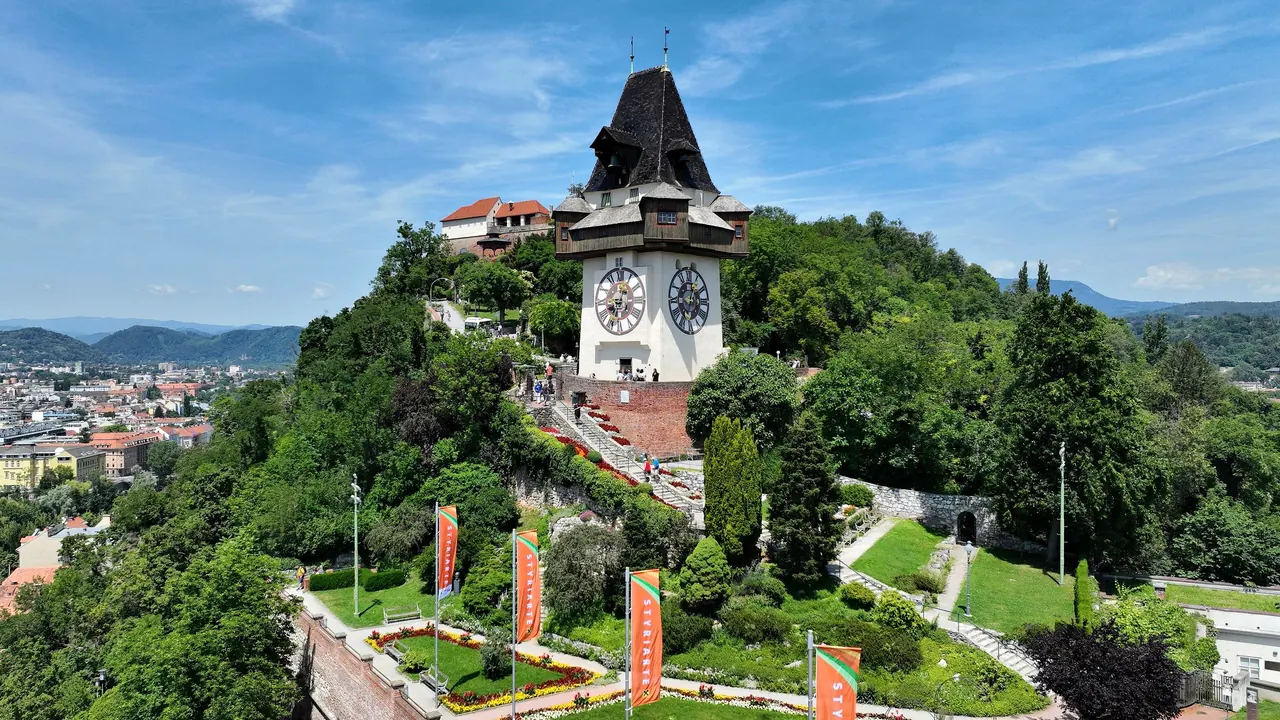
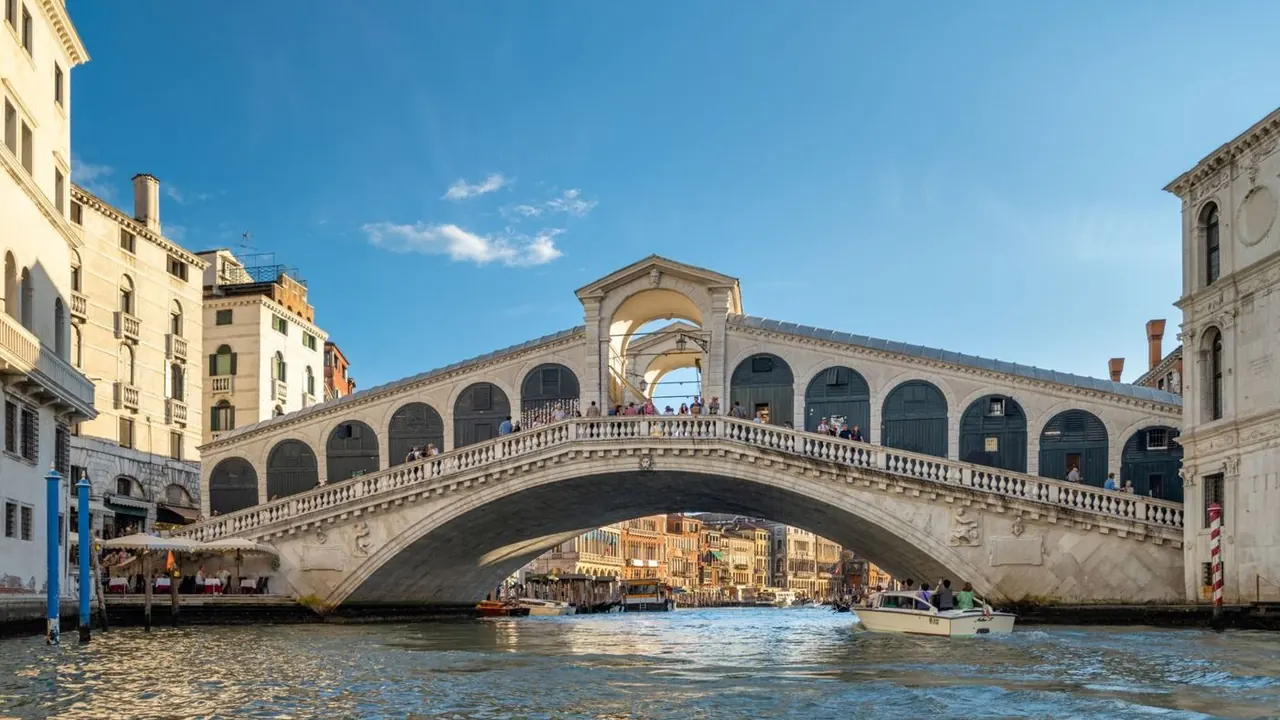
Photos: Graz by C.Stadler/Bwag, CC BY-SA 4.0, cropped; Venice by David Vives, Pexels License.
Graz or Venice?
Our verdict in twelve categories, each scored against the same fixed benchmark cities, and the climate month by month, so you can choose for your trip.
Choose Graz for
- nature and the outdoors
- prices
- families
Graz suits travellers who want a handsome old town they can manage on foot in a day or two, with mountains, wine hills and spa villages close by. It costs less, is easier with small children and has more going on after dark, so it works best as a slower stay that mixes town days with the Styrian countryside.
Choose Venice for
- beaches
- culture and sights
- day trips
If art and architecture come first, Venice is in a different league: a whole city of palaces on water, with Titian, Tintoretto and the Biennale, plus Padua, Verona and the lagoon islands as easy outings. Accept the cost, the crowds on the main routes and the early nights, and it repays every hour you spend walking it.
Scoreboard
Twelve categories on one fixed scale from 0 to 100. The shaded stretch is the gap between the two.
Your match
Pick a travel style or drag the sliders, and both match scores follow your weighting.
Too close to call, 1 point apart
Wins on nature and the outdoors and prices with your weighting.
Wins on beaches and culture and sights with your weighting.
What matters to you?
Category by category
What the scores mean for a trip.
Beaches & swimming
Graz is a long way from the sea, and summer swimming means the old gravel-pit lakes south of town, such as the Schwarzlsee, with grassy banks and water around 23°C. That is fine for a hot afternoon but not much more.
Venice has proper sand within reach. The Lido is a short vaporetto ride away and runs for kilometres along the open Adriatic, with shallow, warm water that suits children, though the water is greenish rather than clear. Pellestrina is quieter, and Jesolo has a full resort strip. Still, few people visit either city for the beach.
Food & drink
The two eat equally well but very differently. Graz cooks from the farm and the hills: pumpkin seed oil on almost everything, boiled pork with horseradish and cold fried chicken salad. You eat sitting down in old town inns, and you drink white wine at the Buschenschank taverns south of the city. Its weakness is a narrow range beyond Austrian cooking.
Venice eats from the lagoon, and often standing up. Cicchetti and a spritz at a bacaro counter near the Rialto, cuttlefish risotto and lagoon shellfish are the reasons to come. The problem is the many poor tourist restaurants around San Marco, so good meals take more searching than in Graz.
Culture & sights
Graz has a fine, intact old town under the Schlossberg and its clock tower. Its standouts are the Landeszeughaus armoury, still stacked with thousands of suits of armour, and the Baroque Schloss Eggenberg, while the Kunsthaus adds a modern touch. Two or three days covers it comfortably.
Venice is on another scale. The whole city is the monument, from the Basilica of San Marco and the Doge's Palace to the palazzi along the Grand Canal. Behind that comes one of Europe's great concentrations of painting, in the Accademia, the Frari, San Rocco and dozens of smaller churches. A week here still leaves things unseen.
Nightlife
Graz has the livelier evenings, thanks to its students. The bars in the old town lanes around Mehlplatz, known as the Bermuda Triangle, fill on summer nights, Lend across the river has arty bars, and a few clubs stay open late at weekends, though things go quiet in the university's summer break.
Venice's evening peaks early, at aperitivo time along the Fondamenta della Misericordia and in the bacari. Campo Santa Margherita stays busy a little longer, but the canals fall silent around midnight, and anyone wanting a club night has to head for the mainland or Jesolo.
Nature & outdoors
Graz has real hills on its doorstep. The Schöckl offers a cable car, trails and paragliding, the Mur cycle path runs straight through the city, and gorges, wine-hill walks and proper alpine hiking in the Gesäuse and Hochschwab are within a couple of hours.
Around Venice, nature means the lagoon: salt marshes near Torcello and Sant'Erasmo with herons and flamingos, explored by kayak or on a rowing lesson. The land is flat. The gentle Euganean and Prosecco hills are the nearest walking, and the Dolomites are too far for a comfortable day out.
Day trips
Venice has the better spread of outings, and most need no car. Fast trains reach Padua's Scrovegni Chapel in about half an hour, and Vicenza and Verona soon after, while the vaporetto takes you to the glass furnaces of Murano, the painted houses of Burano and the lonely cathedral of Torcello.
From Graz the outings are rural rather than grand: the South Styrian Wine Road, Riegersburg on its volcanic crag, the Lipizzaners at Piber and the library at Admont Abbey. Maribor is an easy train ride, but most of the rest is much easier with a hire car.
Good for families
Graz is the easier city with young children. The trams take buggies, the parks have playgrounds, and the Schlossberg provides a whole day out, with a lift up, a long underground slide down and the fairytale train in the rock tunnels. The FRida & freD children's museum and summer toboggan runs on the Schöckl add to it.
Children love the idea of Venice, with boats instead of buses and no traffic, and Murano glass-blowing and the Lido go down well. In practice, the stepped bridges make pushchairs a struggle and playgrounds are scarce, so it suits a short stay with older children better.
Getting around
Graz is the more effortless city. The centre is flat and largely pedestrianised, trams and buses run on one simple ticket, and cycling along the Mur is easy. The catch comes outside town, where country buses are thin.
Venice is also walked, but it is harder going. The alleys twist and dead-end at canals, hundreds of bridges have steps that defeat wheeled luggage, and the vaporetto lines are slow and crowded. Arriving by train at Santa Lucia, though, is easy.
Shopping & style
Venice has more worth hunting for, chiefly crafts made in the city: Murano glass, Burano lace, papier-mâché masks, marbled paper and velvet furlane slippers, along with the big fashion names near San Marco. The skill lies in avoiding the imported fakes on the main routes and finding workshops where the work is done on site.
Graz is more modest: high-street shops in the old buildings of the Herrengasse and Sporgasse, a grand old department store with a roof terrace, and small design shops in Lend. Its best souvenirs are edible, such as pumpkin seed oil, Schilcher rosé and craft chocolate from the markets.
Affordability
Graz is clearly the cheaper stay. Its hotels are fair by Austrian standards, student lunch menus and bakeries keep daytime eating cheap, and the walkable centre means you spend little on transport.
Venice is among the dearest places to stay in Italy, especially around San Marco and in summer. Boats are priced for visitors and most churches charge for entry. Standing at a bacaro counter, sleeping in Mestre or coming in late autumn softens the bill but does not close the gap.
Live music & performing arts
Both cities take the stage seriously, but in different ways. Graz has a broader season: a large opera house with ballet and musicals, the Styriarte early-music festival, the avant-garde steirischer herbst, and a strong jazz scene fed by its music university.
Venice has the grander single stage in La Fenice, where Verdi and Rossini premiered works. Its signature evening is Vivaldi played in churches and scuole grandi, and the Biennale adds contemporary music and dance. Jazz and rock are scarce in Venice, so for anything beyond classical music, Graz has more on.
Wellness & relaxation
Graz has the better spas within reach. A string of thermal villages lies about an hour east, from Hundertwasser's wavy Bad Blumau to Loipersdorf and Bad Radkersburg, and back in town the pace is unhurried, with long coffee-house afternoons and shady paths on the Schlossberg.
From Venice, the mud baths of Abano Terme are a similar distance away, and in the city itself there are hotel spas in old palazzi. Calm in Venice depends on timing: early mornings in Castello or on Giudecca are restful, while daytime around the Rialto is anything but.
When should you go?
Pick your month. The climate figures are measured averages, not a forecast.
Graz in July
Venice in July
Daytime high, °C
Rainfall in the month, mm
Temperature and rainfall are climate normals, averaged over the years shown. Graz: 1991-2020 normals, Graz Airport (7.9 km from centre). Venice: 1991-2020 (sunshine 1971-2000, rainfall 1981-2010) normals, Venezia / Tessera (6.7 km from centre).
Graz has the sharper seasons. Winter is dry but cold, with January highs around 3°C, and summer peaks near 27°C but is also the wettest time, with heavy rain through June, July and August. May and September bring warm, sunny days for the old town and the hills, though showers are common then too. April and October are drier and cooler, and October is good walking weather in the wine hills.
Venice is milder in winter and slightly warmer in summer. The Adriatic off the Lido is warm enough for swimming from June to September and peaks around 26°C in August. July is the hottest and sunniest month, near 29°C, which makes the crowded alleys tiring around midday, so spring and September suit walking better. Venice gets its rain through summer and autumn, with June the wettest month and October close behind, unlike Graz, where the wettest months are all in summer.
Which traveller are you?
On a culture and arts trip, Venice is the clear choice. The Accademia, the Frari, the Scuola Grande di San Rocco and the Biennale give you a week of serious art, and Padua, Vicenza and Verona are each a short train ride away.
For an outdoors trip, Graz is the one to pick. You can be on a mountain trail in the morning and back in the old town by evening, and a week can mix hiking, cycling and town days without long transfers. From Venice, active days mostly mean paddling the lagoon.
On a tight budget, Graz lets the same money buy more nights, and in the old town rather than on its edge. Its best pleasures, the markets, the parks and the views from the castle hill, cost little or nothing. In Venice, saving usually means sleeping on the mainland.
Before you go
| Measure | Graz | Venice |
|---|---|---|
| Official language | German, Austrian Sign Language | Italian |
| Currency | Euro (EUR) | Euro (EUR) |
| Sockets | CF230 V, 50 Hz | CFL230 V, 50 Hz |
| Driving side | Right | Right |
| Time zone | UTC+1, UTC+2 in summer | UTC+1, UTC+2 in summer |
| Emergency number | 112 | 112 |
| Elevation | 353 m | 2 m |
| Main airport | Graz Airport (GRZ)9 km from centre26 non-stop destinations | Venice Marco Polo Airport (VCE)7 km from centre103 non-stop destinations |
| Public holidays this year | 16 days | 13 days |
By the numbers
| Measure | Graz | Venice |
|---|---|---|
| City population | 306,971 | 250,369 |
| People per km² | 2,406 | 602 |
| Museums within 10 km | 29 | 52 |
| UNESCO World Heritage sites within 50 km | 1 | 5 |
| Swim season, months above 21 °C | - | 4 months |
Where else could you go?
Every comparison below shares a destination with this one, so you can follow Graz or Venice somewhere new.