Hakone or Nagasaki?
Our verdict in twelve categories, each scored against the same fixed benchmark cities, and the climate month by month, so you can choose for your trip.
Choose Hakone for
- wellness
- nature and the outdoors
- day trips
Hakone suits a slow mountain stay built around hot water. Think a night or two in a ryokan with an outdoor bath and a kaiseki dinner in your room, and days crossing the caldera by railway, ropeway and boat while Fuji shows itself over Lake Ashi when the weather allows. It is also the better base for walkers, and for anyone who wants Tokyo, Kamakura and Yokohama within reach, as long as they accept quiet evenings and inn prices.
Choose Nagasaki for
- food and drink
- nightlife
- culture and sights
Travellers who want a city with a story should pick Nagasaki. The atomic bomb sites, Dejima, Glover Garden and the Chinese temples give it a history no other Japanese city shares, and it adds champon, harbour fish and evenings in Shianbashi. Daily costs are lower, the trams make it easy to get around, and the onsen towns of Obama and Unzen are close enough for a night of bathing at the end.
Scoreboard
Twelve categories on one fixed scale from 0 to 100. The shaded stretch is the gap between the two.
Your match
Pick a travel style or drag the sliders, and both match scores follow your weighting.
Wins on wellness and nature and the outdoors with your weighting.
Wins on food and drink and nightlife with your weighting.
What matters to you?
Category by category
What the scores mean for a trip.
Beaches & swimming
Hakone sits in a mountain caldera, and Lake Ashi is not for swimming. The sea means a trip down to Atami's sheltered sand, under an hour away, because the shore at Odawara is steep and pebbly. Here the water worth getting into is hot and comes up from the ground.
Nagasaki is not a beach city either, but a swim fits more easily into a stay. Takahama's clean sandy bay on the Nomo coast and the small resort beach on Iojima, a short ferry ride from the harbour, make a simple summer break from sightseeing between July and early September.
Food & drink
In Hakone, eating revolves around the ryokan. A kaiseki dinner of mountain vegetables, river fish and local tofu can be superb. Outside the inns there are only Yumoto's soba shops, the black eggs at Owakudani and set meals around the lake, and little stays open into the evening.
Nagasaki has a cuisine of its own, shaped by Portuguese, Dutch and Chinese contact: champon, sara udon, castella and the shared shippoku banquet. With excellent local fish in the Shianbashi izakaya and buns in Chinatown, you can eat well at any meal out in town, not only at your inn's table.
Culture & sights
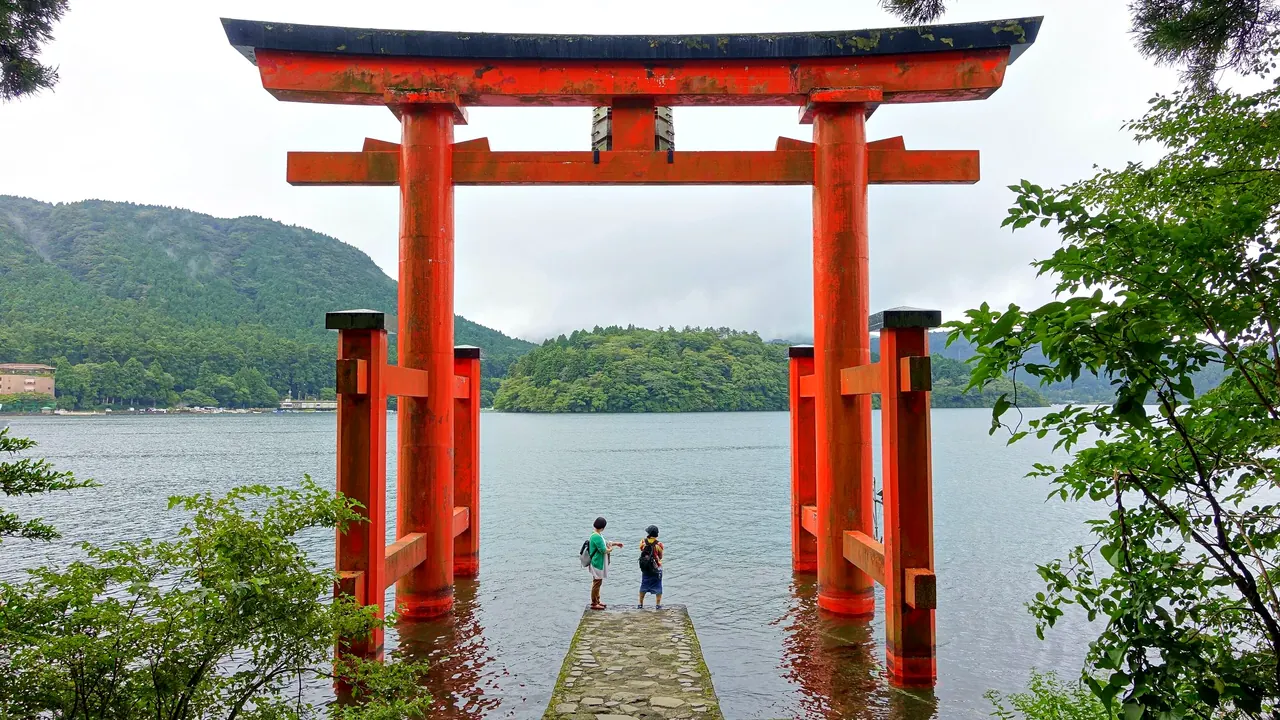
Hakone's culture is mostly art set in landscape. There are the sculpture lawns of the Open-Air Museum, the Pola Museum's paintings in beech forest, and pieces of the old Tokaido road, including the rebuilt checkpoint and the torii standing in Lake Ashi. It makes for pleasant, scattered visits rather than one connected story.
Nagasaki's sights carry far more weight. The Atomic Bomb Museum and the Peace Park are reason enough to come. Around them, Dejima, Glover Garden, Oura Cathedral and Sofukuji trace four centuries of Japan's contact with Europe and China, a history you cannot see anywhere else in the country.
Nightlife
Hakone has no nightlife in any real sense. Evenings mean a last bath, a yukata and bed, with only a few small izakaya in Yumoto staying open a little later. Nagasaki offers a modest but real night out in Shianbashi, with counter bars, karaoke and grilled fish, though there are hardly any clubs and the streets empty before midnight. The other evening plan is the ropeway up Mount Inasa for the night view.
Nature & outdoors
Hakone's landscape is the main event. You stay inside a volcanic caldera, with sulphur steaming at Owakudani, Lake Ashi on the crater floor and Fuji behind it on clear days. Walks on the cedar-lined Tokaido road or up Mount Kintoki start right from the villages.
In Nagasaki, nature is mostly the city's setting: steep green hills around a deep harbour and the view from Mount Inasa. Its volcanic scenery at Unzen is about two hours away, and the islands of Kujukushima are a separate outing, so getting out into the countryside here takes a proper journey.
Day trips
Hakone is within easy reach of some of Japan's best-known places. Kamakura and Yokohama are each about an hour and a half away, Tokyo is under two hours on the Romancecar, and Odawara's castle, Atami and the Izu Peninsula are closer still.
Nagasaki's outings are more unusual but more spread out. The highlight is the boat to the concrete ruins of Hashima, if the weather allows a landing. Shimabara's samurai street, Huis Ten Bosch and the porcelain towns of Arita and Imari fill other days, though several of them take most of the day once you count the journey.
Good for families
Hakone has slightly more to keep children busy, because getting around is the fun: the zigzag railway, the ropeway over Owakudani and a pirate ship across Lake Ashi. Add the seal shows at Hakone-en and the net sculptures to climb at the Open-Air Museum. Nude communal baths and formal inns can puzzle children, but private family baths and the swimsuit onsen park help.
Nagasaki wins children over with its trams, the Inasa ropeway and the Penguin Aquarium, where the birds walk out onto a small beach, and Huis Ten Bosch makes a big day out. Its stairway streets are hard work with a pushchair, and the Atomic Bomb Museum needs some thought with younger ones.
Getting around
Hakone needs no car, as one pass covers the mountain railway, cable car, ropeway, lake boats and buses. Still, the villages are far apart on winding roads, and weekend queues at the ropeway slow everything down.
Nagasaki is quicker and simpler. A few flat-fare tram lines along the valley floor link the station, the Peace Park, Dejima, Chinatown and Glover Garden, and most sights are a tram stop or a short walk apart. The effort starts when you leave the valley floor, where the hillside lanes turn into steep stairways.
Shopping & style
Hakone's one craft is yosegi-zaiku marquetry, which you can watch being made in the Hatajuku workshops. Beyond that there are souvenir sweets in Yumoto and the outlet mall at Gotemba, over the ridge.
Nagasaki gives you more to browse, though neither is a shopping destination. The Hamanomachi arcade and the station mall cover everyday needs, and the gifts are good: boxed castella, local glass, Chinatown sweets and porcelain from Hasami, Mikawachi and Arita.
Affordability
Hakone is the dearer stay, because the reason to come is a ryokan night with dinner and a hot-spring bath. The better inns with private outdoor baths get expensive quickly, especially at weekends and in autumn. Simple inns around Yumoto, the public day-bathhouses and the good-value transport pass keep costs down.
Nagasaki is easier on a moderate budget. Spotless business hotels near the station, cheap champon and set lunches, and a low-cost day on the trams keep the basics down. Only the Hashima boats, the ropeway and long evenings of sake and sashimi add up.
Live music & performing arts
Hakone has no stage at all, with no theatre or concert hall, and the evening's entertainment is the bath. Nagasaki's highlights are festivals: the Kunchi at Suwa Shrine every October, with dragon dances and ship floats, and the Lantern Festival in Chinatown around Chinese New Year. At other times a municipal concert hall and a few live-music bars give it a little more than Hakone, though not much to plan a trip around.
Wellness & relaxation
Hakone is built around bathing. It has seventeen hot-spring areas, from riverside Yumoto to the milky sulphur water of Sengokuhara, with outdoor baths under maples, private baths on room balconies and day-bathhouses in the woods. A midweek stay in winter or autumn is the most restful.
Nagasaki has neighbourhood sento and a few hotel baths, but its real onsen are on the Shimabara peninsula at Obama and Unzen, best enjoyed with a night there. The city itself offers an unhurried pace instead, with quiet hillside temples and evening walks by the harbour.
When should you go?
Pick your month. The climate figures are measured averages, not a forecast.
Hakone in July
Nagasaki in July
Daytime high, °C
Rainfall in the month, mm
Where the figures come from
Hakone's temperatures are measured 43 km from the centre, at Kawaguchiko.
Hakone has no rain gauge within 25 km of the centre, so its rainfall comes from a gridded climate dataset read at the city rather than from a gauge further away.
Temperature and rainfall are climate normals, averaged over the years shown. Hakone: 1971-2000 (rainfall 1991-2020) normals, Kawaguchiko (42.9 km from centre). Nagasaki: 1991-2020 normals, Nagasaki (2.2 km from centre).
Hakone is in the mountains and stays cool. In winter the daytime high is around 5°C. That is cold for walking, but the air is dry and it is the clearest time for Fuji. November brings the autumn colour as the rain eases. From early summer to October it is wet, with September near 216mm, and mist often hides the mountain. July and August reach about 27°C, which is comfortable for walking, and the sea at Atami is warm enough to swim then.
Nagasaki is warmer all year, and its rain comes in one heavy burst. June brings about 334mm, the wettest month in either place. August reaches 32°C and is humid, but it is also sunny and the best time for the beaches, when the sea is warmest. April, May, October and November are the months for climbing the hills, mild and fairly bright. Its winters are clearly gentler than Hakone's.
Which traveller are you?
On a relaxing and wellness trip, Hakone is the clear choice. Soaking, resting in a yukata and early, silent nights are the purpose of the place, not an extra. In Nagasaki proper bathing means travelling out to Unzen or Obama and staying the night.
For an outdoors trip, Hakone puts the landscape on your doorstep: the Owakudani vents, Lake Ashi, ridge walks to Mount Kintoki and the Old Tokaido Road. Nagasaki has its harbour hills, but its best volcanic hiking, at Unzen, is two hours away.
On a food and nightlife trip, Nagasaki wins easily. Champon, sara udon, castella and fresh fish fill the day, and the izakaya and counter bars of Shianbashi fill the evening. In Hakone dinner is at the inn, and the villages go dark soon after.
Before you go
| Measure | Hakone | Nagasaki |
|---|---|---|
| Official language | Japanese | Japanese |
| Currency | Yen (JPY) | Yen (JPY) |
| Sockets | AB100 V, 50 and 60 Hz depending on the region | AB100 V, 50 and 60 Hz depending on the region |
| Driving side | Left | Left |
| Time zone | UTC+9 | UTC+9 |
| Emergency number | Police 110, fire 119 | Police 110, fire 119 |
| Elevation | 734 m | 105 m |
| Main airport | Tokyo Haneda International Airport (HND)71 km from centre98 non-stop destinations | Nagasaki Airport (NGS)19 km from centre10 non-stop destinations |
| Public holidays this year | 16 days | 16 days |
By the numbers
| Measure | Hakone | Nagasaki |
|---|---|---|
| City population | 10,925 | 404,656 |
| People per km² | 118 | 996 |
| Museums within 10 km | 16 | 26 |
| UNESCO World Heritage sites within 50 km | 2 | 2 |
| Swim season, months above 21 °C | 5 months | 6 months |
Where else could you go?
Every comparison below shares a destination with this one, so you can follow Hakone or Nagasaki somewhere new.