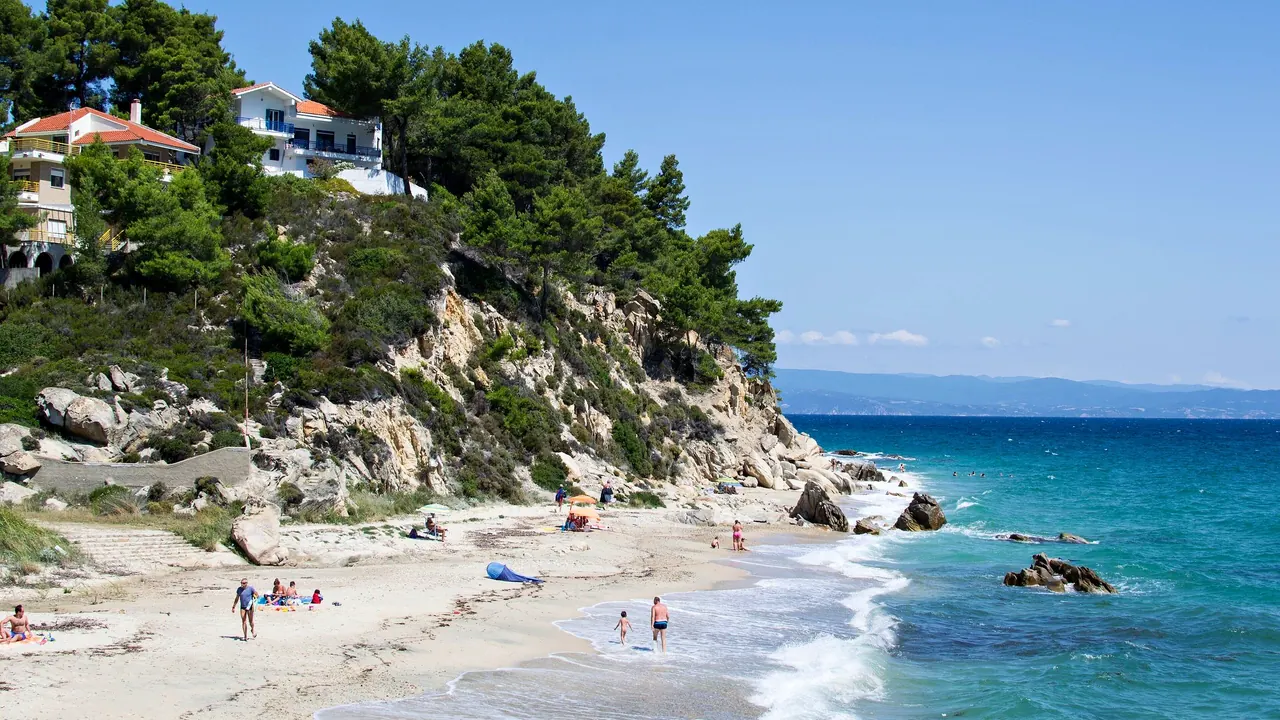
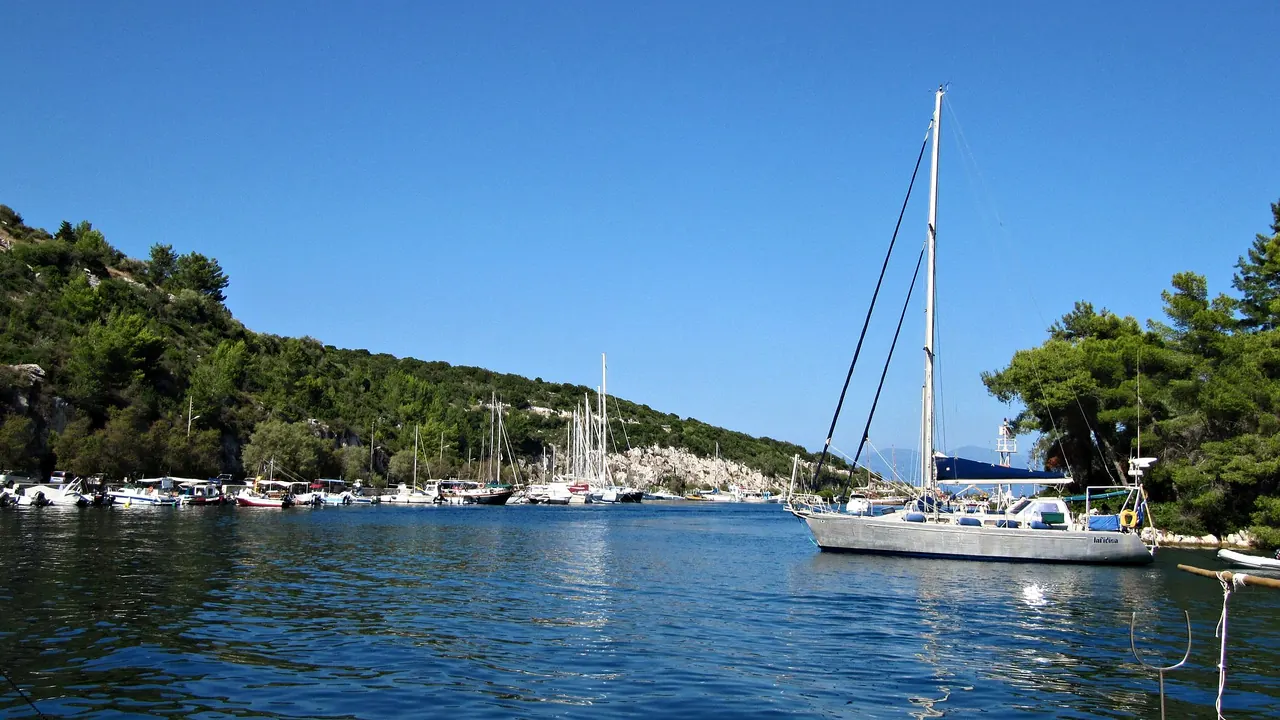
Photos: Halkidiki by Sprint28, CC BY-SA 3.0, cropped; Paxos by Poiesia, CC BY-SA 4.0, cropped.
Halkidiki or Paxos?
Our verdict in twelve categories, each scored against the same fixed benchmark cities, and the climate month by month, so you can choose for your trip.
Choose Halkidiki for
- nightlife
- prices
- families
Halkidiki is the better choice for most beach trips. It has more of everything a seaside stay draws on: long sandy shores, organised beaches that suit small children, tavernas in real fishing villages, clubs on Kassandra for those who want them, and Thessaloniki within reach for a day of churches and food. It also costs less. The price is distance: three long peninsulas mean a car and real driving time, and the busy Kassandra resorts can feel crowded and repetitive in high summer.
Choose Paxos for
- getting around
Paxos gives up range for intimacy. It suits couples, villa groups and families with older children who want a small, slow island where days are spent swimming from pebble coves and moving between them by hired boat, with Antipaxos and its pale sand a short hop away. Evenings end with dinner on the harbour. It costs more, has little to see or do beyond the sea, and depends on ferries, but that quiet, self-contained island life is the reason people come.
Scoreboard
Twelve categories on one fixed scale from 0 to 100. The shaded stretch is the gap between the two.
Your match
Pick a travel style or drag the sliders, and both match scores follow your weighting.
Wins on nightlife and prices with your weighting.
Wins on getting around with your weighting.
What matters to you?
Category by category
What the scores mean for a trip.
Beaches & swimming
Both are true swimming destinations with very clear water, but Halkidiki has more of it and more sand. Its three peninsulas give hundreds of kilometres of shore, from the organised sunbed beaches of Kassandra to the granite coves of Sithonia at Kavourotrypes and Karydi, and the long sweep at Kalamitsi.
Paxos is smaller and mostly pebble, with sheltered coves such as Kipiadi and Monodendri on the east coast and sandy shallows only in Lakka bay. Its finest sand is across the water on Antipaxos at Voutoumi and Vrika, so the best beach days here mean a hired boat.
Food & drink
Halkidiki eats better and more widely. Fishing villages such as Nikiti, Toroni and Ouranoupoli and the inland hill villages cook for Greek visitors, and there are local wines from Athos and the slopes above Neos Marmaras to go with them. The weak spot is the package-resort menus on Kassandra.
Paxos has fewer kitchens, mainly in Gaios, Lakka and Loggos. The cooking can be careful, with Ionian dishes such as bourdeto and sofrito and the island's own olive oil, but the menus are similar from one taverna to the next and many close once summer ends.
Culture & sights
Neither is a sightseeing destination, but Halkidiki has more to fill a day. A cruise from Ouranoupoli along the monasteries of Mount Athos is a striking outing, and ancient Olynthos, Aristotle's Stagira and the Petralona cave make good half-days.
On Paxos, the sights are what you see from Gaios harbour: the Venetian fort and the small monastery on its two islets, plus a little museum of island life. Anyone wanting serious history takes the boat to Corfu Town.
Nightlife
In summer, Halkidiki has a real night out. Kallithea's open-air clubs stay open latest, and Pefkohori, Hanioti and Polychrono have cocktail-bar strips that fill after midnight, with young crowds driving in from Thessaloniki at weekends. To avoid all that, base yourself on Sithonia.
Paxos has almost nothing comparable. An evening means a long dinner and a drink beside the moored yachts in Gaios or Lakka, with only a little dancing in high summer.
Nature & outdoors
Halkidiki has the wider outdoors. Sithonia combines pine forest, granite headlands and the wooded slopes of Mount Itamos, and there is kayaking along its coves, boat trips to the Diaporos lagoon and diving over rocky seabeds.
The scenery on Paxos is gentler and more compact: ancient olive groves crossed by stone mule tracks and a waymarked trail running the length of the island. Its high point is the west coast, with the Erimitis cliffs, the Tripitos arch and sea caves best seen by kayak, but there is no high ground behind them.
Day trips
Halkidiki is attached to the mainland, and that gives it more options. Thessaloniki is about an hour or so by road, and the royal tombs at Vergina, ancient Pella, Kavala and Amphipolis are all possible in a day, as is a drive up to the weaving village of Arnea.
From Paxos, every outing depends on a boat. Corfu Town's Venetian old town is about an hour away by fast ferry, and excursions go to Parga and the Sivota coves, but rough seas can cancel them and the list soon runs out.
Good for families
Halkidiki is the clear choice for young children. Kassandra and the beaches around Gerakini and Psakoudia have sand and calm water that stays shallow a long way out, and family resorts add pools and kids' clubs.
Paxos has one ideal spot, the sheltered bay at Lakka. Elsewhere, pebble coves with steep paths down to them and villas up among the olive groves make it a better fit for older children who swim and snorkel. Neither has zoos or theme parks.
Getting around
Both need wheels, but for opposite reasons. Halkidiki is easy to reach, with Thessaloniki airport about an hour from Kassandra, but it is big: crossing from one peninsula to the next means driving back up to its base, and the Kassandra road slows at summer weekends.
Paxos is harder to reach, by ferry only and at the mercy of the sea, but once you are there it is only about 10km long. A scooter, the olive-grove footpaths or a small hired boat cover it easily.
Shopping & style
Both are thin for shopping, and serious shoppers end up in a city: Thessaloniki for Halkidiki, Corfu for Paxos. The difference is in what you take home. Halkidiki has the icons, incense and herbal goods of Ouranoupoli at the gate to Athos, while the harbour lanes of Gaios and Lakka sell linen, ceramics and the island's olive oil.
Affordability
Halkidiki is the cheaper trip by a clear margin. Much of its trade comes from Greek and Balkan families driving in, so simple apartments and village tavernas are plentiful, though big Kassandra hotels cost more in high summer.
Paxos is one of the more expensive Greek islands. Villas fill early, harbourside restaurants charge for the view, and ferries and boat or car hire add to the bill. On both, the shoulder months are easier on the budget.
Live music & performing arts
Neither offers much, but Halkidiki has a proper summer programme. The Kassandra Festival stages concerts and theatre in the open-air amphitheatre at Siviri, and the Sani Festival brings jazz and classical evenings to the coast.
Paxos has a small chamber music festival at the end of summer and the August feast of the Panagia in Gaios, with traditional music and dancing late into the night.
Wellness & relaxation
Halkidiki can actually treat you as well as slow you down. On the southern tip of Kassandra, the springs at Agia Paraskevi have warm mineral pools above the sea. The large resorts have full spas with hammam-style rooms, and Sithonia is the place to stay for quiet days in the pine shade.
On Paxos the calm comes from the island itself. There are no baths, and only a few treatment rooms in hotels and villas, though some estates run yoga and retreat weeks. What really relaxes you is the place: hardly any traffic, no high-rise buildings, and harbours that wake up slowly.
When should you go?
Pick your month. The climate figures are measured averages, not a forecast.
Halkidiki in July
Paxos in July
Daytime high, °C
Rainfall in the month, mm
Where the figures come from
Halkidiki's temperatures are measured 64 km from the centre, at Thessaloniki Airport.
Halkidiki has no rain gauge within 25 km of the centre, so its rainfall comes from a gridded climate dataset read at the destination rather than from a gauge further away.
Paxos's temperatures are measured 52 km from the centre, at Kerkyra Airport.
Paxos has no rain gauge within 25 km of the centre, so its rainfall comes from a gridded climate dataset read at the destination rather than from a gauge further away.
Temperature and rainfall are climate normals, averaged over the years shown. Halkidiki: 1991-2020 normals, Thessaloniki Airport (63.7 km from centre). Paxos: 1991-2020 normals, Kerkyra Airport (52.1 km from centre).
Both are summer destinations with almost the same peak. From June to September the sea on both is warm enough for long swims, reaching about 26°C in August, and it is still pleasant into early October. July and August are hot in both places, with afternoons around 32°C, so that is the time to stay by the water rather than walk or drive to sights. May and late September are the gentlest months, sunny and warm without the midsummer heat, and the best time for walking the olive groves of Paxos or the Sithonian hills.
They part ways outside summer. On the Halkidiki resort coasts the weather stays fairly dry all year, but winter is cold, about 10°C in January. Paxos is milder in winter but much wetter: rain returns in September at around 91mm, and November brings about 163mm, so a late-autumn stay there is more of a gamble than in Halkidiki.
Which traveller are you?
On a family trip with young children, Halkidiki makes the days easier. There is gentle sandy water for paddling, there are resorts built around families, and tavernas are happy to feed children late. Paxos is better kept for families whose children can swim confidently and will enjoy a day out on a small boat.
For a food and nightlife trip, Halkidiki is well ahead. You can have dinner at a fishing-village taverna, then drive to Kassandra for drinks and dancing until late, and spend a day eating in Thessaloniki. On Paxos the night usually ends after dinner and one drink by the harbour.
On a trip on a tight budget, Halkidiki makes the money go further. Self-catering apartments and simple family tavernas are easy to find, and you don't need a ferry to get there. On Paxos the costs add up, because villas, crossings and a hired boat are hard to avoid.
Before you go
| Measure | Halkidiki | Paxos |
|---|---|---|
| Official language | Greek | Greek |
| Currency | Euro (EUR) | Euro (EUR) |
| Sockets | CF230 V, 50 Hz | CF230 V, 50 Hz |
| Driving side | Right | Right |
| Time zone | UTC+2, UTC+3 in summer | UTC+2, UTC+3 in summer |
| Emergency number | 112 | 112 |
| Main airport | Thessaloniki Macedonia International Airport (SKG)93 non-stop destinations | Corfu Ioannis Kapodistrias International Airport (CFU)88 non-stop destinations |
| Public holidays this year | 15 days | 15 days |
By the numbers
| Measure | Halkidiki | Paxos |
|---|---|---|
| Population | 110,587 | 2,300 |
| People per km² | 38 | 91 |
| Swim season, months above 21 °C | 5 months | 5 months |
Where else could you go?
Every comparison below shares a destination with this one, so you can follow Halkidiki or Paxos somewhere new.
- Corfuvs Paxos
- Lefkadavs Paxos
- Skiathosvs Halkidiki
- Skopelosvs Halkidiki
- Kefaloniavs Paxos
- Thassosvs Halkidiki