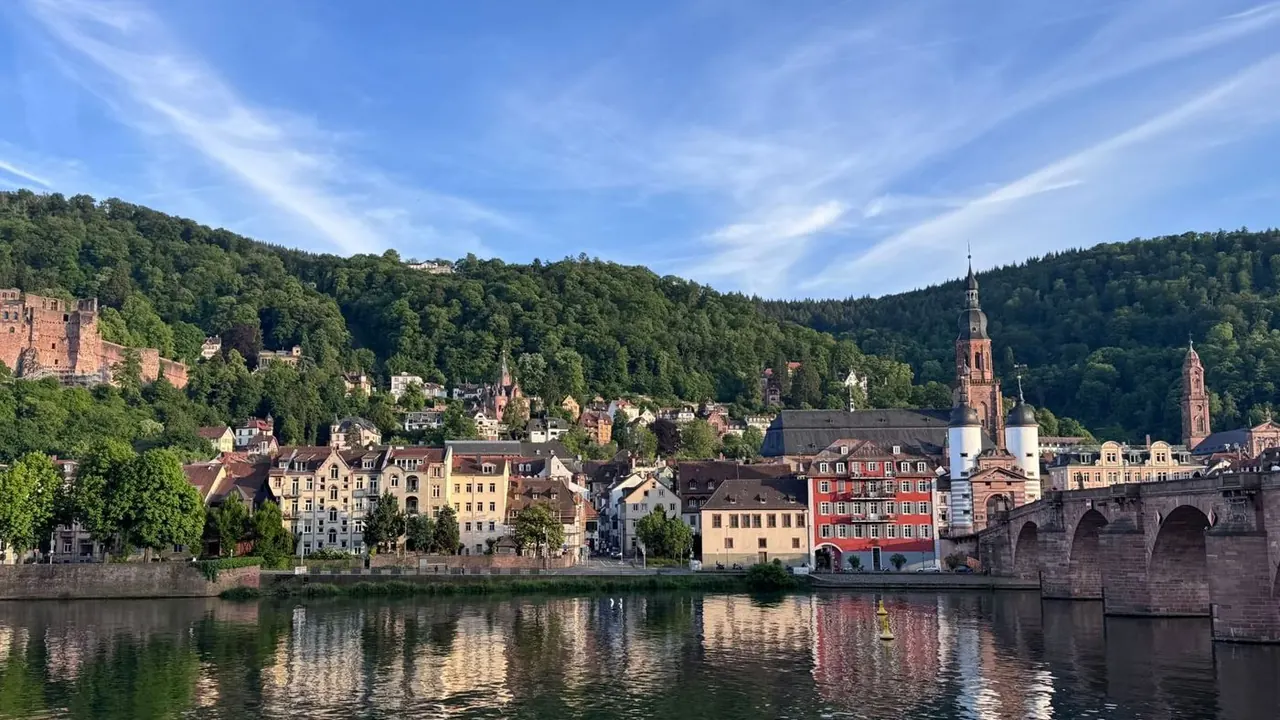
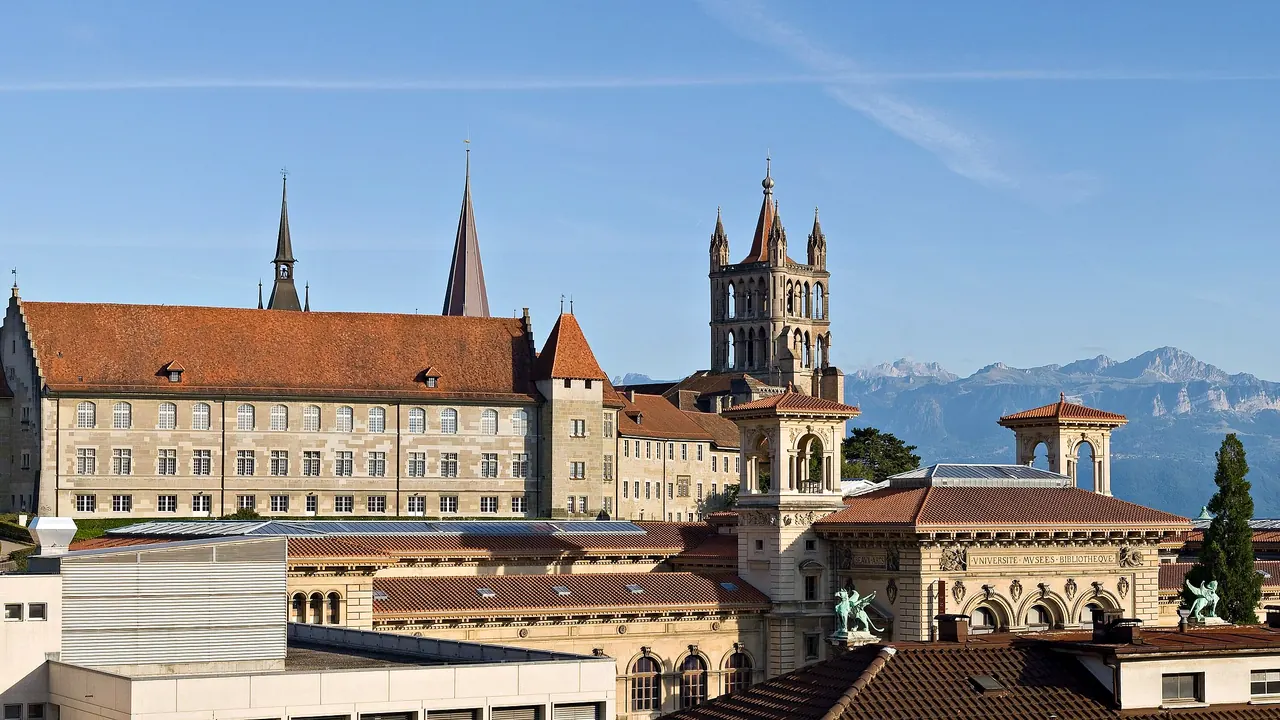
Photos: Heidelberg by Kuanling Chen, Pexels License; Lausanne by Christian Mehlführer, CC BY-SA 3.0, cropped.
Heidelberg or Lausanne?
Our verdict in twelve categories, each scored against the same fixed benchmark cities, and the climate month by month, so you can choose for your trip.
Choose Heidelberg for
- prices
- culture and sights
Heidelberg suits a traveller who wants a classic German old town, with a castle ruin above the river and centuries of university life in the streets, at a cost that is ordinary for western Germany rather than Swiss. It also makes a good base for a week of history on the Upper Rhine, with cathedrals, monasteries and wine villages close by. Its drier weather makes it the safer choice in spring and autumn.
Choose Lausanne for
- beaches
- nature and the outdoors
- food and drink
Lausanne is the better pick for anyone who puts landscape first. It has the lake for swimming and sailing in summer, the Lavaux vineyard terraces on its doorstep, and the Alps and Jura within easy reach. It also has better food and a stronger programme of dance and theatre. It costs much more, so it suits a traveller who thinks the setting is worth paying for.
Scoreboard
Twelve categories on one fixed scale from 0 to 100. The shaded stretch is the gap between the two.
Your match
Pick a travel style or drag the sliders, and both match scores follow your weighting.
Wins on prices and culture and sights with your weighting.
Wins on beaches and nature and the outdoors with your weighting.
What matters to you?
Category by category
What the scores mean for a trip.
Beaches & swimming
Neither city is on a coast, but Lausanne has Lake Geneva right in town, and in summer that matters. From late June to early September you can swim from the lawns of the Bellerive lido, from the piers at Vidy or from small pebble shores towards Lutry.
The Neckar in Heidelberg is not for swimming, so on a hot day you go to an outdoor pool or drive about half an hour to the gravel-pit lakes on the Rhine plain. Neither city makes a beach vacation, but only in Lausanne does a swim fit easily into an ordinary day of sightseeing.
Food & drink
In both cities the local wine is the high point: Riesling and Pinot from the Bergstrasse and the Palatinate in Heidelberg, Chasselas from the Lavaux terraces in Lausanne, tasted with the growers in village caveaux. The food is a different weight. Heidelberg serves pork knuckle, Schäufele and white asparagus in spring, while Lausanne has lake perch, papet vaudois and fondue.
Overall you eat better in Lausanne, with its Saturday market and some of Switzerland's most celebrated restaurants in and around the city. Heidelberg is stronger at the cheap end, where the students keep kebab and pizza places plentiful. The places on the Hauptstrasse aimed at visitors are uneven, and the better meals are in Neuenheim and the side streets.
Culture & sights
The two are evenly matched, but they offer different things. In Heidelberg the appeal is the town itself: the castle ruin above the river, the Old Bridge, the baroque Altstadt, and the university, founded in 1386, with the graffiti of its Student Prison.
Lausanne's old town around the Gothic cathedral is small and steep, and its museums matter more. They include the Olympic Museum at Ouchy, the art, photography and design museums at Plateforme 10, and the Collection de l'Art Brut. Heidelberg is better for streets and views, Lausanne for museums and more unusual collections.
Nightlife
Both are student towns with a small night scene, and neither is a place to go for partying. In Heidelberg the evening centres on the Untere Strasse, a lane of small pubs, and on old student taverns with carved tables. Both are at their busiest in term time.
Lausanne has more clubs, in the converted warehouses of the Flon, which are busiest at weekends, and on summer evenings people fill the waterfront at Ouchy. Drinks cost far more there. From Heidelberg, Mannheim and Frankfurt are a short train ride away for a bigger night out.
Nature & outdoors
Lausanne's setting is far more dramatic. Across the lake the French Alps rise straight from the water, and the Lavaux terraces offer one of Switzerland's loveliest vineyard walks. The Vaud Alps and the Jura are both within an hour for hiking and skiing, and there is a glacier at Glacier 3000. In the warmer months there is sailing, rowing and paddleboarding.
Heidelberg is greener and gentler. Forest walking starts at the edge of town, on the Philosophers' Walk, at the top of the Königstuhl funicular and on the Heiligenberg with its Celtic ramparts. The Neckar cycle path and the Palatinate Forest give you more, but this is walking and cycling country without mountains.
Day trips
Both are excellent bases, and Lausanne is a little ahead because its trains reach so many different places without a car. Montreux and the Château de Chillon are along the lake, Geneva, Bern and Fribourg are an easy ride, Gruyères has its castle and cheese dairies, and boats cross to Évian in France.
Heidelberg's day trips are more about history than scenery: the cathedrals of Speyer and Worms, Lorsch Abbey, the monastery at Maulbronn and the palace gardens at Schwetzingen. There are also castle villages up the Neckar and wine villages in the Palatinate. Frankfurt and Mainz are about an hour away, and Strasbourg is possible as a long day.
Good for families
With children, Heidelberg's best outings go uphill or out of town. The funicular climbs to the Königstuhl, where a small fairy-tale park waits at the top, the compact zoo sits by the Neckar, and about half an hour away the Technik Museum Speyer lets children climb into a space shuttle and a submarine. The cobbled, sloping Altstadt is tiring with a pushchair.
In Lausanne, family days centre on the lake, with paddle steamers and the summer lawns and pools at Bellerive. Add the hands-on Olympic Museum, the aquarium-vivarium and the pedal boats in the Sauvabelin woods. Lausanne has slightly more for children and is just as safe, but its steep streets are just as hard on a pushchair, and eating out as a family costs much more.
Getting around
Lausanne is slightly easier to get around. The city is built in steep layers, and the m2 metro does the hard work, climbing more than 300m from the lake at Ouchy to the upper town. Swiss trains then run fast and on time in every direction.
In Heidelberg the sights are lined up along the pedestrianised Hauptstrasse, so the centre is easy on foot. The station is a tram ride away, though, and the walk up to the castle is steep. One fare system covers the whole Rhine-Neckar area, which keeps day trips simple.
Shopping & style
Neither city is worth a trip for shopping, and the main difference is what you bring home. Heidelberg's long Hauptstrasse mixes German chains with souvenirs, cuckoo clocks and Studentenkuss chocolates. Lausanne's Rue de Bourg is shorter and more expensive, with Swiss watches, jewellery and chocolatiers. In both, a bottle of local wine makes the best souvenir, and from Heidelberg, Mannheim and Frankfurt are close by train for bigger shopping.
Affordability
This is where the two differ most. Heidelberg costs about what you would expect in western Germany. Hotels are the main expense, and many visitors save by staying in Mannheim, while meals in student cafés and simple taverns stay reasonable.
Lausanne is expensive in every way, from rooms and wine to taxis and a simple lunch. Supermarket picnics, the free lakeside promenades and a glass in a Lavaux caveau help a little, but a week there costs far more than a week in Heidelberg.
Live music & performing arts
Lausanne has the more distinguished stage, and dance leads it. It is home to the Béjart Ballet Lausanne and the Prix de Lausanne competition for young dancers, and the Théâtre de Vidy stages contemporary work that tours Europe. There is also a full opera season and a respected chamber orchestra, and in July the Montreux Jazz Festival is a short train ride away.
Heidelberg does well for a small town. Its municipal theatre stages opera and drama, the Heidelberger Frühling brings chamber music in spring, and in summer there are plays and concerts in the castle courtyard. For larger productions people go to Mannheim.
Wellness & relaxation
Both towns are calmer on their edges than in their centres. In Heidelberg the quiet is close at hand: cross the Old Bridge to the riverside lawns of Neuenheim or climb into the woods behind the Philosophers' Walk, and the crowds of the castle and the Hauptstrasse are soon behind you. For warm water, though, you have to leave town, either for the thermal baths of the Kraichgau about half an hour away or for Baden-Baden, about an hour south.
Lausanne is slightly better for a restful stay. Its grand lakeside hotels have more extensive spas than anything in Heidelberg, and an evening on the promenade at Ouchy, looking across the water to the Alps, is hard to match on the Neckar. The thermal water is just as close. Yverdon-les-Bains is under half an hour by train, and Lavey-les-Bains, with the hottest springs in Switzerland, is under an hour up the Rhône valley. The catch is the steep, busy centre, so in Lausanne the calm is something you go out to find.
When should you go?
Pick your month. The climate figures are measured averages, not a forecast.
Heidelberg in July
Lausanne in July
Daytime high, °C
Rainfall in the month, mm
Where the figures come from
Lausanne's temperatures are measured 40 km from the centre, at Payerne.
Lausanne has no rain gauge within 25 km of the centre, so its rainfall comes from a gridded climate dataset read at the city rather than from a gauge further away.
Temperature and rainfall are climate normals, averaged over the years shown. Heidelberg: 1991-2020 (sunshine 1971-2000) normals, Heidelberg (4.5 km from centre). Lausanne: 1991-2020 (sunshine 1961-1990) normals, Payerne (39.7 km from centre).
The two follow a similar year. July and August are the warmest months in both, at around 26°C, and from December to February the days are short, cold and often grey. The real difference is rain. Heidelberg is drier all year, and even its wettest month, July, gets only 80mm. Lausanne gets about twice as much in many months and peaks at 115mm, also in July. In return Lausanne has more sun in high summer, about 240 hours in July.
In Lausanne the lake is warm enough for swimming from late June to early September. Heidelberg warms a little earlier in spring, so April and May are pleasant for walking the Altstadt and the wooded hills. September is mild and fairly bright in both. In the winter months both cities are better for museums than for walking, though from Lausanne you can go up into the mountains, which are often sunny above the fog.
Which traveller are you?
On a trip on a tight budget, Heidelberg is the obvious choice. Hotels are the main cost, but student cafés, bakeries and simple taverns keep meals reasonable. In Lausanne even a simple lunch adds up quickly, and supermarket picnics become a habit.
For an outdoors trip, Lausanne is clearly the better choice. You can walk the Lavaux vineyard terraces, sail or paddleboard on the lake, and reach Alpine and Jura hiking within an hour. Heidelberg's Odenwald forest trails and Neckar cycle path are pleasant but much gentler.
On a beach and sun trip, neither city gives you a real beach, but Lausanne comes closer. From late June to early September you can swim in Lake Geneva from the lawns and pebble shores at Bellerive and Vidy. In Heidelberg there are only pools and gravel-pit lakes.
Before you go
| Measure | Heidelberg | Lausanne |
|---|---|---|
| Official language | German | French, German, Italian, Romansh |
| Currency | Euro (EUR) | Swiss Franc (CHF) |
| Sockets | CF230 V, 50 Hz | CJ230 V, 50 Hz |
| Driving side | Right | Right |
| Time zone | UTC+1, UTC+2 in summer | UTC+1, UTC+2 in summer |
| Emergency number | 112 | 112 |
| Elevation | 114 m | 495 m |
| Main airport | Frankfurt Main Airport (FRA)69 km from centre281 non-stop destinations | Geneva International Airport (GVA)52 km from centre150 non-stop destinations |
| Public holidays this year | 12 days | 9 days |
By the numbers
| Measure | Heidelberg | Lausanne |
|---|---|---|
| City population | 156,092 | 144,873 |
| People per km² | 1,433 | 3,499 |
| Museums within 10 km | 17 | 31 |
| UNESCO World Heritage sites within 50 km | 4 | 3 |
Where else could you go?
Every comparison below shares a destination with this one, so you can follow Heidelberg or Lausanne somewhere new.
- Genevavs Lausanne
- Chamonixvs Lausanne
- Bernvs Lausanne
- Frankfurtvs Heidelberg
- Stuttgartvs Heidelberg
- Baden-Badenvs Heidelberg