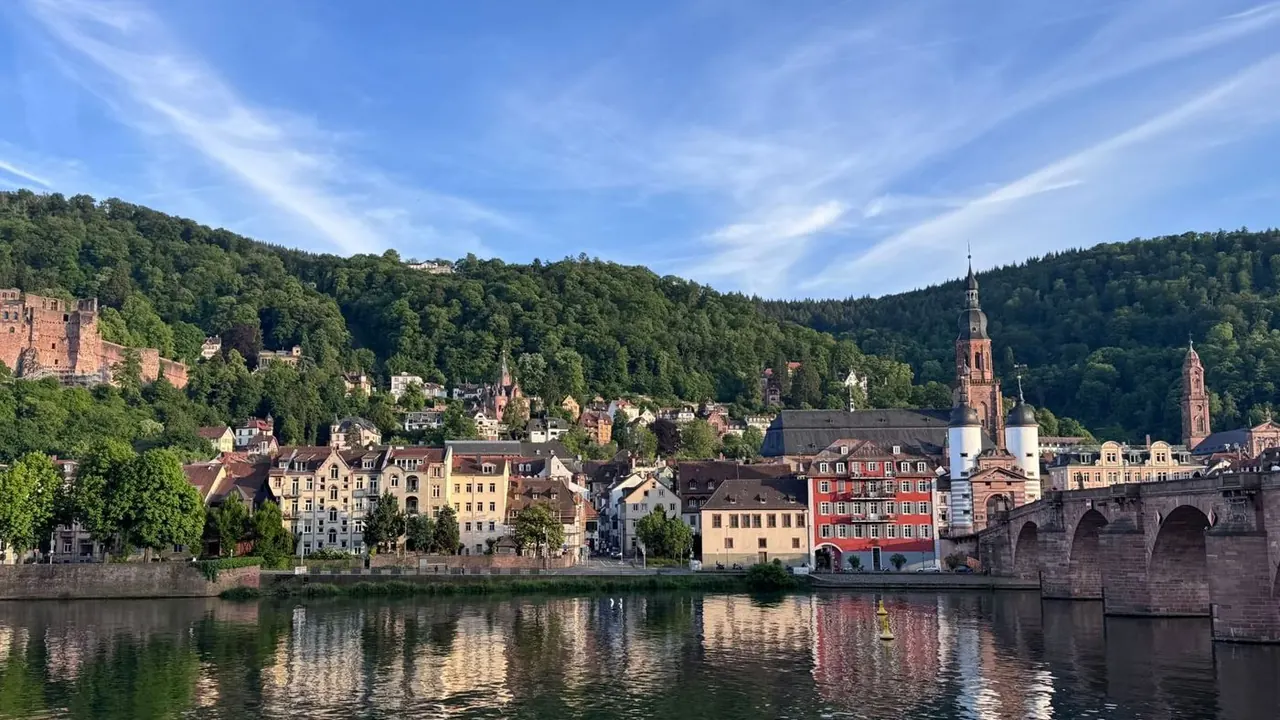
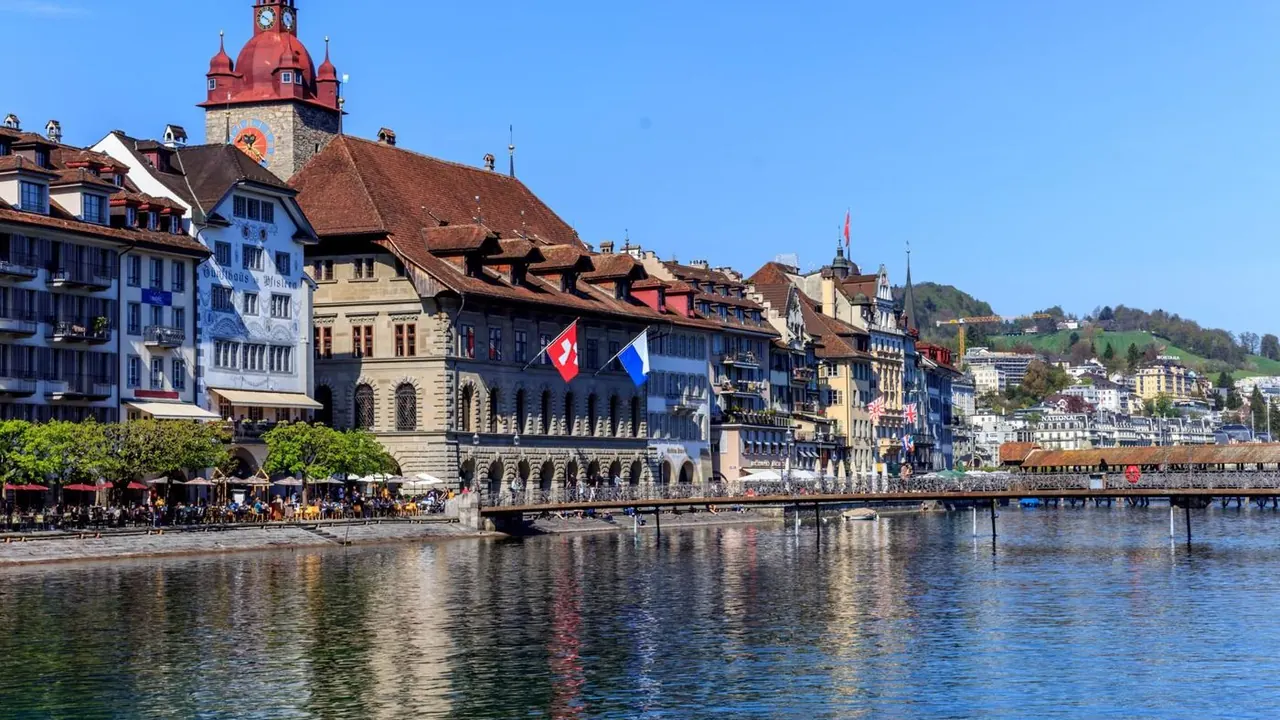
Photos: Heidelberg by Kuanling Chen, Pexels License; Lucerne by ILOVESwitzerland, Pexels License.
Heidelberg or Lucerne?
Our verdict in twelve categories, each scored against the same fixed benchmark cities, and the climate month by month, so you can choose for your trip.
Choose Heidelberg for
- prices
- nightlife
- food and drink
Heidelberg suits travellers who want a historic university town with the wine country of the Upper Rhine around it, and who want their money to go further. The castle ruin, the Altstadt and the student taverns fill a couple of days. After that, the shared regional transport ticket brings cathedrals, palaces and Palatinate wine villages within easy reach. Evenings are livelier than in Lucerne, and the bill at the end is far easier to bear.
Choose Lucerne for
- nature and the outdoors
- beaches
- live music and the arts
Lucerne is the choice when the landscape is the point of the trip. Lake steamers, cogwheel railways and cable cars start almost at the station door and run up Pilatus, Rigi and on towards the glacier on Titlis. In summer you can also swim in the lake. Choose it for mountain days, smooth Swiss connections and a world-class festival concert hall, and accept that it is among the most expensive places in Europe and quiet after dark.
Scoreboard
Twelve categories on one fixed scale from 0 to 100. The shaded stretch is the gap between the two.
Your match
Pick a travel style or drag the sliders, and both match scores follow your weighting.
Wins on prices and nightlife with your weighting.
Wins on nature and the outdoors and beaches with your weighting.
What matters to you?
Category by category
What the scores mean for a trip.
Beaches & swimming
Neither town has a coast, but Lucerne has a real swimming culture. In July and August people swim in the clean, calm lake from the Lido, the old wooden lake baths and the lawns at Ufschötti, with mountains behind them.
Heidelberg's Neckar is not for swimming. On hot days you have to use outdoor pools or drive out to the gravel-pit lakes on the Rhine plain. If a swim matters on your trip, Lucerne is the place, even though it is lawns and jetties rather than sand.
Food & drink
The two towns are broadly level, and neither is a reason to travel in itself. The difference is in the drink. Heidelberg sits among the vineyards of the Bergstrasse and the Palatinate, so local Riesling and village wine taverns are part of the experience. Its large student population also keeps cheap food easy to find.
Lucerne serves Swiss comfort food: Chügelipastete, fondue, rösti and perch from the lake, eaten in guild houses or on terraces along the Reuss. It is reliably good, but expensive. In both towns, eat away from the main tourist streets.
Culture & sights
On sights the two are evenly matched, and each can be seen in a day or two. Heidelberg's appeal is romantic and academic. It has the red sandstone castle ruin above the Neckar, Germany's oldest university with its graffiti-covered Student Prison, and an old town rebuilt in baroque style after 1693.
Lucerne's best-known sights are medieval and set by the water. The Chapel Bridge and Water Tower, the towers of the Musegg Wall and the carved Lion Monument stand out, along with a fine set of Picasso and Klee in the Rosengart Collection.
Nightlife
Heidelberg is the livelier of the two after dark, thanks to its students. In term time the small pubs on the Untere Strasse stay full late, and the old student taverns with carved tables are worth a visit in themselves.
Lucerne's evenings tend to mean one drink by the lake, and the waterfront is mostly empty by midnight. The exception is Fasnacht, when the whole town stays out in costume until dawn. For a proper club night, you would go from Heidelberg to Mannheim or Frankfurt, or from Lucerne to Zurich.
Nature & outdoors
Lucerne wins clearly here. It lies on a branching lake with real mountains close by. Pilatus rises to 2,128m and is climbed by the steepest cogwheel railway in the world, Rigi has long ridge walks, and Titlis keeps snow all year. Winter also brings skiing and sledging.
Heidelberg's countryside is gentler and greener. Forest begins at the edge of the old town, and you can take the funicular up the Königstuhl, walk the Philosophers' Walk, or cycle the Neckar valley past its castles. It is good walking country, but it has no peaks.
Day trips
Both are excellent bases, but for different kinds of outing. From Heidelberg the day trips are mostly about history. The imperial cathedrals of Speyer and Worms, Schwetzingen palace, the monasteries at Lorsch and Maulbronn, and the half-timbered Palatinate wine villages are all close.
From Lucerne the trips mix towns with scenery. Bern, Basel and Zurich are each under an hour by train, and a steamer down the lake takes you to the Rütli meadow and the William Tell country around Altdorf.
Good for families
Both work well with children, and both are small and safe. They differ in what they offer. Heidelberg has more variety: a zoo, a fairy-tale park on the Königstuhl, river boats and the large Technik Museum in Speyer, although the cobbled, sloping Altstadt is hard work with a pushchair.
Lucerne relies on the Swiss Museum of Transport, which can fill a whole day, and on the journeys themselves, such as paddle steamers and the summer toboggan run on Pilatus. These depend on clear weather and cost a good deal.
Getting around
Lucerne is the easier of the two. The station, the boat piers and the Old Town are all together on the lakefront, the walk along the river is flat, and every steamer and mountain railway runs on the same integrated Swiss tickets.
Heidelberg is also easy once you are in the long, pedestrianised Altstadt. The main station is a tram ride away, though, and the cobbles and the steep climb to the castle take some effort. Its regional S-Bahn makes trips across the Rhine-Neckar area simple without a car.
Shopping & style
Neither is a shopping destination, but Lucerne has one real speciality: Swiss watches, sold in the large houses around Schwanenplatz. Outside the watch trade, its fashion and design shops are few.
Heidelberg's Hauptstrasse is long but ordinary, with high-street chains at one end and steins and cuckoo clocks at the other. The best thing to take home is a bottle of Bergstrasse wine. For serious clothes shopping, Mannheim and Frankfurt are a short train ride away.
Affordability
This is the widest gap between the two. Heidelberg costs about what you would expect in western Germany. Hotels are the main expense, and staying in Mannheim helps when rooms are scarce. Meals and the regional transport ticket remain affordable.
Lucerne is expensive at every level. Even a simple meal costs a lot, and the cable cars and cogwheel railways that are the reason for going take a large share of the budget. Supermarket picnics and a Swiss travel pass soften the cost, but they do not make Lucerne cheap.
Live music & performing arts
Lucerne is the stronger choice for classical music. The Lucerne Festival brings leading orchestras to Jean Nouvel's lakefront concert hall, which is known for its acoustics and has a programme all year. Plan a late-summer trip around the festival if you can.
Heidelberg offers more than its size suggests. It has a municipal theatre with opera, the chamber music of the Heidelberger Frühling in spring, and plays and concerts in the castle courtyard in summer, with the bigger house in Mannheim nearby.
Wellness & relaxation
Here the two are level, and neither has thermal baths of its own. Heidelberg's best options are the large saline spa complexes in the Kraichgau and Baden-Baden, about an hour south. Lucerne's best soak is Mario Botta's mineral bath high on the Rigi, with a mountain view.
The calm itself also differs. In Heidelberg it means evenings on the Neckar meadows and wine taverns. In Lucerne it means slow steamer trips and quiet lakeside promenades.
When should you go?
Pick your month. The climate figures are measured averages, not a forecast.
Heidelberg in July
Lucerne in July
Daytime high, °C
Rainfall in the month, mm
Where the figures come from
Lucerne has no rain gauge within 25 km of the centre, so its rainfall comes from a gridded climate dataset read at the city rather than from a gauge further away.
Lucerne's sunshine is measured 42 km from the centre, at Zurich Town / Ville..
Temperature and rainfall are climate normals, averaged over the years shown. Heidelberg: 1991-2020 normals, Heidelberg (4.5 km from centre). Lucerne: 2005-2025 (sunshine 1991-2020, rainfall 1991-2020) normals, Emmen (4.2 km from centre).
Both towns are cold and grey from November to February, with daytime highs only a few degrees above freezing. Spring comes a little sooner in Heidelberg, which is pleasant for walking by April while Lucerne is still cool. Through the summer Heidelberg is a few degrees warmer, reaching about 26°C in July and August, and slightly sunnier. Summer is the wetter half of the year in both towns. Heidelberg's rain stays moderate, peaking at about 80mm in July, while Lucerne gets well over 120mm a month from May to July. There, showers and low cloud can easily spoil a planned mountain day.
Heidelberg is at its best from May to early October. High summer brings warm evenings on the Neckar meadows, and mild September days of around 21°C suit walks through the wine villages. Lucerne's best window is July and August, when the lake is warm enough to swim, and the high trails stay at their best through September. Summer heat does not get in the way of sightseeing in either town.
Which traveller are you?
For an outdoors trip, Lucerne is clearly better. Pilatus, Rigi, the Stanserhorn and Titlis can all be reached by boat, cogwheel railway or cable car, with no car needed. Heidelberg offers pleasant forest walks and river cycling, but nothing on a mountain scale.
On a trip on a tight budget, Heidelberg is the sensible choice. Student cafés, bakeries and simple taverns keep meals reasonable, and one regional ticket covers the day trips. In Lucerne, even a plain meal and the mountain railways quickly add up.
For a food and nightlife trip, Heidelberg has the edge. The Untere Strasse fills with students late into the evening, and the local Riesling and Pinot come from vineyards at the edge of town. Lucerne offers good fondue and lake fish, but its evenings end early.
Before you go
| Measure | Heidelberg | Lucerne |
|---|---|---|
| Official language | German | French, German, Italian, Romansh |
| Currency | Euro (EUR) | Swiss Franc (CHF) |
| Sockets | CF230 V, 50 Hz | CJ230 V, 50 Hz |
| Driving side | Right | Right |
| Time zone | UTC+1, UTC+2 in summer | UTC+1, UTC+2 in summer |
| Emergency number | 112 | 112 |
| Elevation | 114 m | 436 m |
| Main airport | Frankfurt Main Airport (FRA)69 km from centre281 non-stop destinations | Zürich Airport (ZRH)49 km from centre226 non-stop destinations |
| Public holidays this year | 12 days | 12 days |
By the numbers
| Measure | Heidelberg | Lucerne |
|---|---|---|
| City population | 156,092 | 86,234 |
| People per km² | 1,433 | 2,963 |
| Museums within 10 km | 17 | 14 |
| UNESCO World Heritage sites within 50 km | 4 | 1 |
Where else could you go?
Every comparison below shares a destination with this one, so you can follow Heidelberg or Lucerne somewhere new.