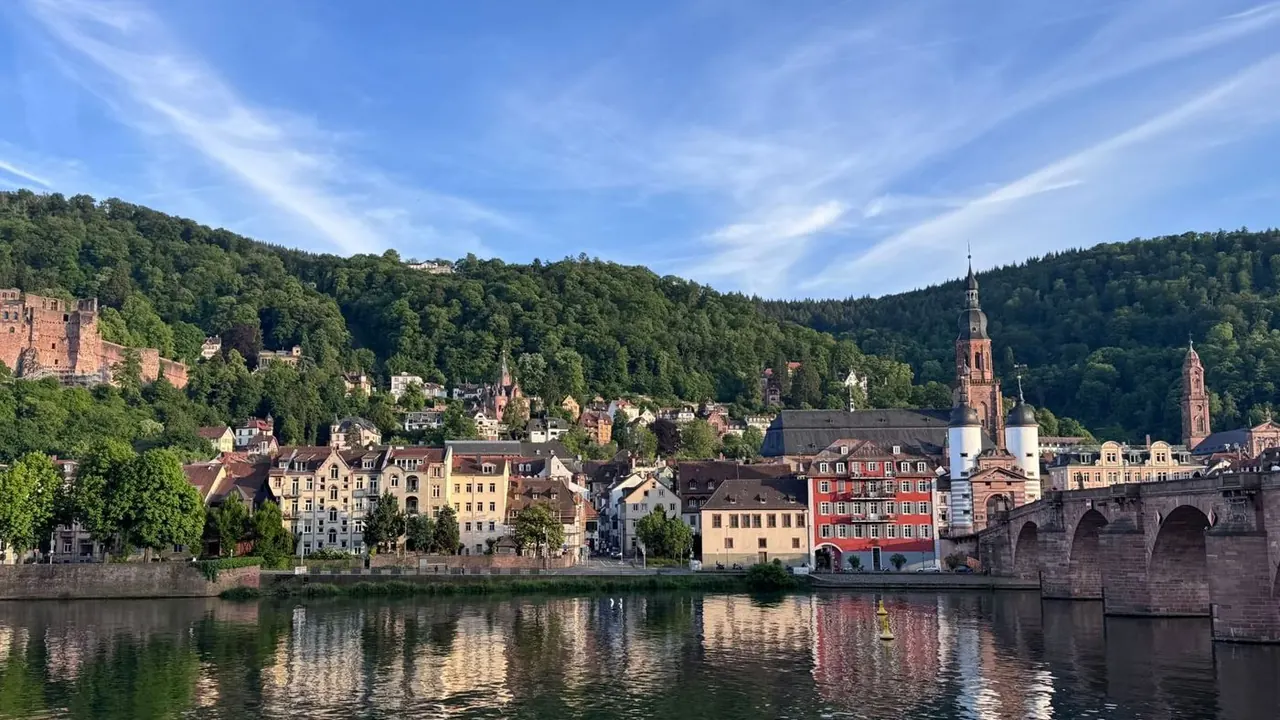
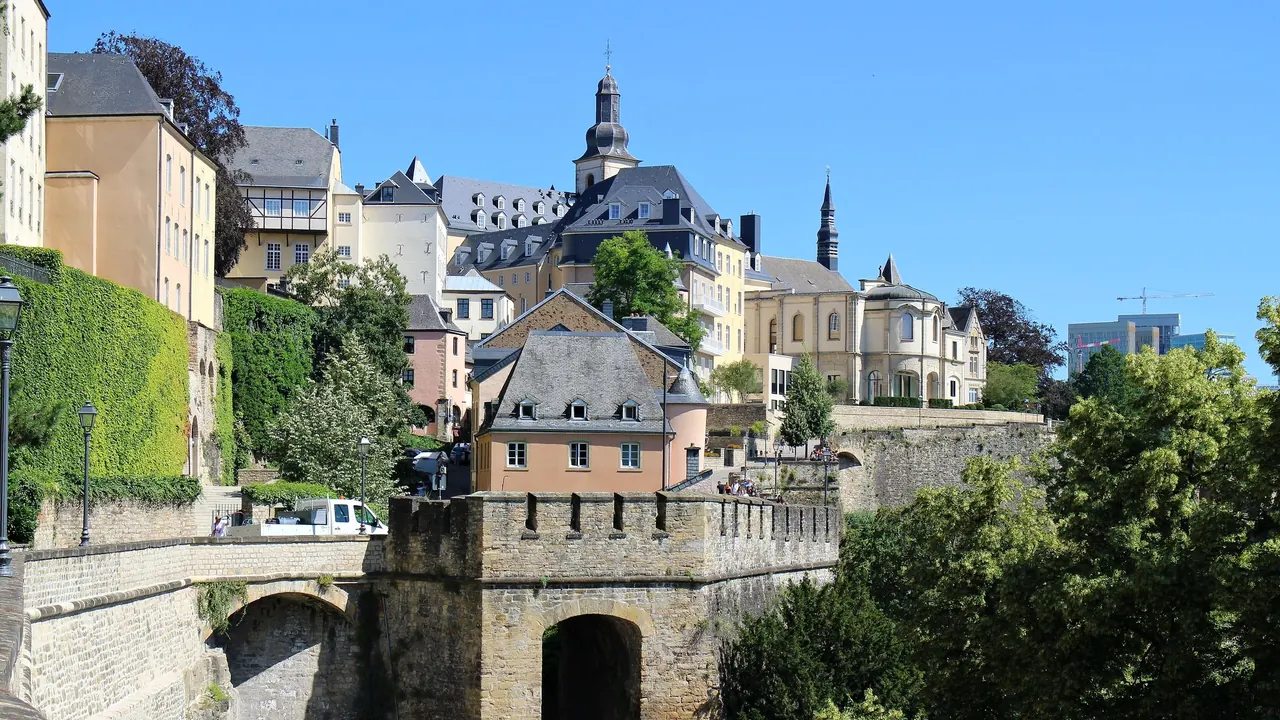
Photos: Heidelberg by Kuanling Chen, Pexels License; Luxembourg by Suicasmo, CC BY-SA 4.0, cropped.
Heidelberg or Luxembourg?
Our verdict in twelve categories, each scored against the same fixed benchmark cities, and the climate month by month, so you can choose for your trip.
Choose Heidelberg for
- prices
- families
- nightlife
Heidelberg suits travellers who want a storybook old town with a student pulse and a bill that stays within reason. It is the stronger choice with children, thanks to the zoo, the funicular up the Königstuhl and the big technical museums nearby. Its shared regional ticket also makes it easy to see Speyer, Worms and the castles of the Neckar valley.
Choose Luxembourg for
- food and drink
- getting around
- beaches
Luxembourg is for a short, polished stay where the fortress gorges are the main sight and dinner matters more than the bar. Free transport across the whole country, serious French-led restaurants and the thermal waters at Mondorf make it easy, as long as the budget can take hotel and restaurant prices that run high even for western Europe.
Scoreboard
Twelve categories on one fixed scale from 0 to 100. The shaded stretch is the gap between the two.
Your match
Pick a travel style or drag the sliders, and both match scores follow your weighting.
Too close to call, level with your weighting
Wins on prices and families with your weighting.
Wins on food and drink and getting around with your weighting.
What matters to you?
Category by category
What the scores mean for a trip.
Beaches & swimming
Neither city is a swimming destination, but Luxembourg has slightly more to offer. The reservoir on the Upper Sûre has bathing spots along wooded shores, so it feels like a proper lake, and the gravel pits at Remerschen are close to the Moselle wine villages.
Heidelberg has outdoor pools and the flooded gravel pits on the Rhine plain about half an hour out. They are fine for cooling off, but nothing more. In either city, a hot-day swim is a side outing, not a reason to choose it.
Food & drink
Luxembourg is the better city for eating out. French cooking sets the standard in its better restaurants, Portuguese and Italian family places add depth, and for a small capital it has a large number of fine-dining kitchens. Heidelberg's cooking is hearty Baden and Kurpfalz fare: Schäufele, Maultaschen, Flammkuchen and white asparagus in spring. The restaurants on the Hauptstrasse are uneven, so the better meals are in Neuenheim and the side streets.
Both are really wine towns: Riesling and Pinot from the Bergstrasse and the Palatinate on one side, and Moselle Riesling and crémant on the other. Where Heidelberg wins is cheap food, because its students keep kebab and pizza places busy. In Luxembourg, the set lunch is the way to eat well for less.
Culture & sights
The two are evenly matched, and each is easy to see in a day or two, but they appeal in different ways. Heidelberg is Romantic Germany at its most familiar: the red sandstone castle ruin with the Great Tun inside, a baroque Altstadt along the river, and the oldest university in the country, whose graffiti-covered Student Prison is a favourite stop.
In Luxembourg, the landscape itself is the main sight. You walk through tunnels cut into the rock at the Bock casemates and look down from the Corniche onto the Grund, all within a UNESCO fortress site. Kirchberg adds something Heidelberg lacks, with MUDAM's contemporary art and the buildings of the European institutions.
Nightlife
Both cities have modest nightlife, and anyone after big club nights in either will end up on a train. In Heidelberg that train goes to Mannheim or Frankfurt. Heidelberg's evenings are student evenings, in packed little pubs on the Untere Strasse and in old student taverns with carved tables. It is lively in term time and quiet outside it.
Luxembourg's crowd is older and more international, mostly finance and EU staff, spread between the Rives de Clausen, riverside pubs in the Grund and later bars in Hollerich. Thursday and Friday are the busy nights there, because many residents leave at weekends.
Nature & outdoors
Both have gentle, green walking country right on the doorstep, and neither has real mountains. From Heidelberg, the forest starts at the edge of the old town. The Philosophers' Walk and the funicular up the 568m Königstuhl lead to long woodland trails, and the Neckar cycle path follows the river past castles.
Luxembourg has wooded gorges running through the city centre itself, and its best outdoor day trip is more dramatic. The Müllerthal, half an hour away, has narrow passages between mossy sandstone rocks. The seasons differ too: Heidelberg's Bergstrasse is known for almond blossom in early spring, while Luxembourg's forests and Moselle vineyards are at their best in autumn.
Day trips
Both make excellent bases for day trips, but they lead in different directions. Heidelberg looks along the Upper Rhine: the great cathedrals of Speyer and Worms, the palace gardens at Schwetzingen, the monastery at Maulbronn, castle villages up the Neckar, and Frankfurt about an hour away.
From Luxembourg, the best trips cross borders. Roman Trier and Metz, with its golden-stone cathedral, are both under an hour by train, and Vianden, Echternach and the Moselle wine villages are within the country. Because trains inside Luxembourg are free, outings there cost less than the city's prices would suggest.
Good for families
Heidelberg is the better place to bring children. The funicular is an outing in itself, with a small fairy-tale park at the top, the zoo by the Neckar is well kept, and the technical museums at Speyer and Sinsheim plus a theme park in the Palatinate can fill a week. The steep, cobbled Altstadt is the main drawback for anyone pushing a buggy.
Luxembourg is calm, safe and easy to get around with a pushchair, thanks to its lifts down to the river quarters, and children love the casemate tunnels. Beyond the natural history museum and the small Parc Merveilleux, though, there is little made for families and no zoo, so it suits a short family stay.
Getting around
Luxembourg is the easier city to get around, mainly because trams, buses and trains are free across the whole country, so there are no tickets to work out. The tram runs from the station to Kirchberg, and public lifts and a funicular connect the different levels of a city built on cliffs.
Heidelberg's sights lie along one long, walkable strip, but the station is some way out, so most arrivals start with a tram ride. A single fare system covers the whole Rhine-Neckar area, which makes day trips simple. The cobbles and the steep climb to the castle take more effort than Luxembourg's lifts.
Shopping & style
Neither is a shopping destination, but they cater to different shoppers. Heidelberg has one very long pedestrian street, with chains at one end and cuckoo clocks, beer steins and Studentenkuss chocolates at the other. For luxury, shoppers head to Frankfurt.
Luxembourg is the other way round. The Grand-Rue has luxury and premium brands for wealthy residents, and souvenir shops are few. Its local buys are Villeroy & Boch porcelain and Moselle crémant. Heidelberg's best souvenir is likewise its wine, here from the Bergstrasse.
Affordability
Heidelberg is clearly the cheaper of the two. Its hotels can be expensive when congresses or summer weekends fill the limited rooms, but eating stays reasonable thanks to the students, and the regional ticket is good value for day trips.
Luxembourg is expensive across the board, with hotels priced for business travellers and restaurants that cost well above the norm. Free transport, free museums, lunch menus and cheaper weekend room rates help. In both cases, budget travellers often stay next door, in Mannheim or in Trier and Metz.
Live music & performing arts
Both cities have a strong programme for their size, but the strengths differ. Heidelberg's comes largely from within: its municipal theatre stages its own opera and drama, it has a resident philharmonic orchestra, and it hosts the spring Heidelberger Frühling festival and summer performances in the castle courtyard, with the ruins as a backdrop.
Luxembourg is the place for top visiting performers. The Philharmonie on Kirchberg is a fine-sounding hall where touring orchestras and soloists stop, and the Grand Théâtre hosts touring opera and dance, sometimes in English. The summer concerts at Neimënster, in the Grund, have an atmosphere similar to Heidelberg's castle stage.
Wellness & relaxation
Luxembourg is slightly better for a restful stay. Mondorf-les-Bains, half an hour away, has been a spa town fed by a warm mineral spring since the nineteenth century. The city empties in the evenings and at weekends, which makes the Pétrusse valley walks especially quiet.
Heidelberg has no thermal baths of its own. The saline pools of the Kraichgau are half an hour out and Baden-Baden is an hour away. Its own calm comes from evenings on the Neckar meadows and wine taverns in the hills, once the midday crowds around the castle have gone.
When should you go?
Pick your month. The climate figures are measured averages, not a forecast.
Heidelberg in July
Luxembourg in July
Daytime high, °C
Rainfall in the month, mm
Temperature and rainfall are climate normals, averaged over the years shown. Heidelberg: 1991-2020 (sunshine 1971-2000) normals, Heidelberg (4.5 km from centre). Luxembourg: 1991-2020 normals, Luxembourg / Luxembourg (6.3 km from centre).
Both cities have cold, grey winters with highs around 5°C, and both are at their best from May to September. Heidelberg, down in the shelter of the Rhine plain, is the warmer of the two, with summer highs near 26°C against Luxembourg's 24°C on its plateau. That makes Heidelberg's July and August the better fit for an afternoon at an outdoor pool or a lake. Luxembourg's milder summer is easier for long walks through the gorges and on the fortress walls.
Rain falls differently. Heidelberg is the drier city overall, and its wettest weather comes as summer showers, peaking at around 80mm in July. Luxembourg gets steady rain all year and is wettest in December at about 89mm, so the darkest months are noticeably damper there. Luxembourg does get more sunshine from spring through summer, though, which helps make May, June and September especially pleasant for exploring on foot.
Which traveller are you?
On a trip on a tight budget, choose Heidelberg. Rooms climb at busy times, but student cafés, bakeries and simple taverns keep meals cheap. Luxembourg charges heavily for hotels and dinners alike, and free transport only offsets part of it.
On a family trip with children, Heidelberg fills more days: a riverside zoo, a fairy-tale park atop the funicular, and a submarine to climb into at Speyer. Luxembourg is easy with children but runs short after two or three days.
For a relaxing and wellness trip, Heidelberg relies on hotel spas and thermal complexes in the Kraichgau, and its centre fills by day. Luxembourg suits better: Mondorf puts pools, saunas and treatments in one landscaped park, and the city goes quiet after dark.
Before you go
| Measure | Heidelberg | Luxembourg |
|---|---|---|
| Official language | German | French, German, Luxembourgish |
| Currency | Euro (EUR) | Euro (EUR) |
| Sockets | CF230 V, 50 Hz | CF230 V, 50 Hz |
| Driving side | Right | Right |
| Time zone | UTC+1, UTC+2 in summer | UTC+1, UTC+2 in summer |
| Emergency number | 112 | 112 |
| Elevation | 114 m | 300 m |
| Main airport | Frankfurt Main Airport (FRA)69 km from centre281 non-stop destinations | Luxembourg-Findel International Airport (LUX)6 km from centre115 non-stop destinations |
| Public holidays this year | 12 days | 12 days |
By the numbers
| Measure | Heidelberg | Luxembourg |
|---|---|---|
| City population | 156,092 | 137,678 |
| People per km² | 1,433 | 2,663 |
| Museums within 10 km | 17 | 19 |
| UNESCO World Heritage sites within 50 km | 4 | 4 |
Where else could you go?
Every comparison below shares a destination with this one, so you can follow Heidelberg or Luxembourg somewhere new.
- Frankfurtvs Heidelberg
- Stuttgartvs Heidelberg
- Baden-Badenvs Heidelberg
- Strasbourgvs Heidelberg
- Maastrichtvs Luxembourg
- Colognevs Luxembourg