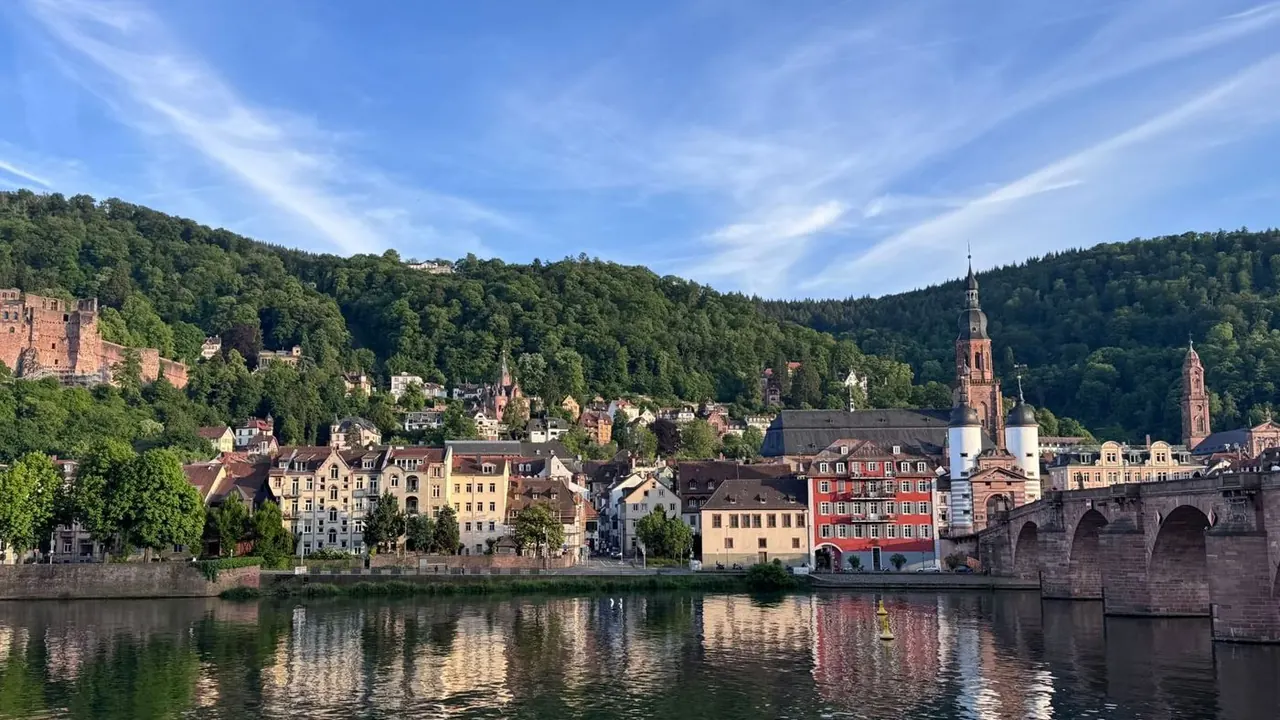
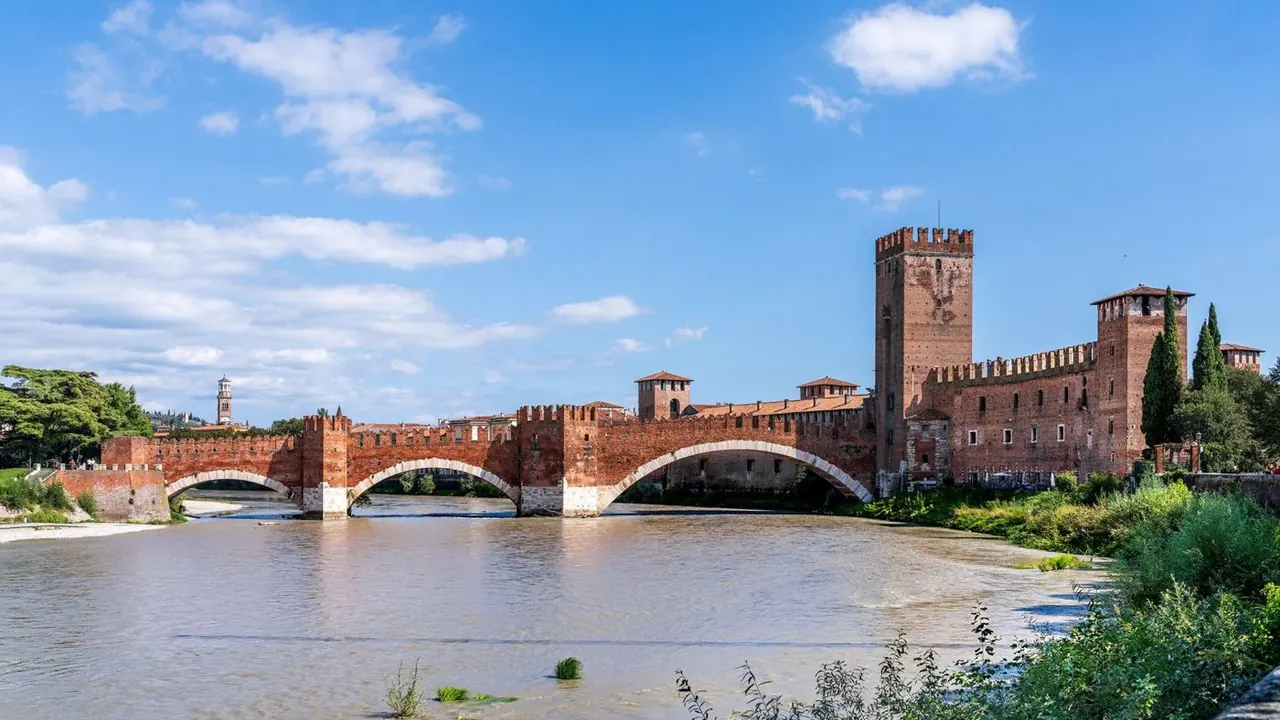
Photos: Heidelberg by Kuanling Chen, Pexels License; Verona by NorbertNagel, CC BY-SA 4.0, cropped.
Heidelberg or Verona?
Our verdict in twelve categories, each scored against the same fixed benchmark cities, and the climate month by month, so you can choose for your trip.
Choose Heidelberg for
- getting around
- nightlife
Heidelberg suits a slower, greener trip: a compact university town beneath its castle ruin, with forest trails starting at the edge of the Altstadt, summers warm enough for walking but rarely too hot, and one transport network that makes Speyer, Schwetzingen and the Neckar valley easy without a car. It works well for a weekend, or as one stop on a longer journey along the Rhine. It also suits travellers who would rather spend the evening over Riesling in a wine tavern than go out late.
Choose Verona for
- beaches
- food and drink
- culture and sights
For most of what people travel for, Verona is the stronger choice. It has a Roman and medieval centre of real depth, opera on summer nights in the Arena, Veneto cooking with Valpolicella on the doorstep, and Lake Garda close enough for a swim. Its location is the other great asset, with Venice, Padua, Vicenza and Mantua all easy by train, so it rewards a stay of several days.
Scoreboard
Twelve categories on one fixed scale from 0 to 100. The shaded stretch is the gap between the two.
Your match
Pick a travel style or drag the sliders, and both match scores follow your weighting.
Wins on getting around and nightlife with your weighting.
Wins on beaches and food and drink with your weighting.
What matters to you?
Category by category
What the scores mean for a trip.
Beaches & swimming
Neither city is on the coast, but only Verona offers a real swim. From Heidelberg the choice is the town's outdoor pools or the gravel-pit lakes on the Rhine plain. They are pleasant for a hot afternoon but not much more.
Verona has Lake Garda about half an hour away, warm and calm by midsummer, with lidos, grassy shores and small pebble beaches at Peschiera, Lazise and Sirmione. It is still a day out rather than a beach vacation, and the shores get crowded on summer weekends.
Food & drink
Both cities cook hearty regional food and both lean on wine, but you eat noticeably better in Verona. In Heidelberg that means Maultaschen, Schäufele, Flammkuchen and spring asparagus with Riesling from the Bergstrasse, and the good meals are in Neuenheim and the village taverns rather than on the Hauptstrasse.
Verona's risotto with Amarone, bigoli with duck and bollito with pearà come from plain osterie around Piazza delle Erbe and in Veronetta. Valpolicella, Soave and Bardolino are all made within a short drive. Neither city has much beyond its own tradition, and both have tired tourist cooking near their main sights.
Culture & sights
Heidelberg's appeal is one very photogenic picture: the red sandstone castle ruin above a baroque Altstadt, the Old Bridge with its gate towers, and Germany's oldest university with its graffiti-covered Student Prison. Verona has far more depth, with Roman, medieval and Renaissance layers packed into one UNESCO-listed loop of the Adige.
The Arena, the Roman theatre, the Scaliger tombs, San Zeno's bronze doors and the Carlo Scarpa galleries in Castelvecchio fill two or three full days, while Heidelberg can be seen in one or two. Verona's Romanesque and Gothic churches alone outclass most of what Heidelberg has to show.
Nightlife
Neither city is made for big nights out, and the difference is in tone. Heidelberg's evenings belong to the students: small pubs packed along the Untere Strasse and old student taverns with carved tables. They are lively in term time and quiet out of it, and for clubbing people take the train to Mannheim or Frankfurt.
In Verona the evening is the aperitivo, a spritz or a glass of Valpolicella at tables on Piazza delle Erbe, and the wine bars in Veronetta stay open later. In summer the opera crowd leaving the Arena near midnight livens up the centre late in the evening, and Heidelberg has nothing like it.
Nature & outdoors
Both cities have green country at the edge of town, but it is of a different character. Heidelberg's is woodland: the Philosophers' Walk, the funicular up the Königstuhl and forest trails over the Odenwald hills. The Neckar cycle path and the Palatinate Forest are within an hour.
Verona looks towards the Alps instead. Valpolicella's vineyard hills begin just north of the city, Lake Garda brings Monte Baldo's ridge walks, paragliding and windsurfing, and the Lessinia plateau has gorges and high pastures. In Heidelberg you can walk into the forest from the hotel door, while Verona's best outdoors usually means a drive.
Day trips
Heidelberg is a good base and Verona an outstanding one. From Heidelberg, Speyer's cathedral, Schwetzingen's palace, Worms, Maulbronn and the castle villages of the Neckar valley are all easy, and Strasbourg is possible for a long day.
From Verona you can reach Venice, Padua's Scrovegni Chapel, Palladio's Vicenza and Mantua by train, and each is a major destination in its own right. Add the harbour towns on Lake Garda and the cellars of Valpolicella and Soave, and a week of outings would hardly repeat itself.
Good for families
The two are about even for children, with different strengths. Heidelberg has more in the town itself: the funicular, the small fairy-tale park on the Königstuhl, the riverside zoo and boat trips. The Technik Museum Speyer, with its space shuttle and submarine, is close by.
Verona's main draws are outside the city: Gardaland, the drive-through safari at Parco Natura Viva and calm lake swimming, all of which need a car or a transfer. On the other hand, its flat pedestrian centre is far easier with a pushchair than Heidelberg's cobbled slopes, although summer afternoons can be very hot.
Getting around
Both centres are made for walking, and the real difference is in how you get further out. Heidelberg's Altstadt is a long strip along the Hauptstrasse below a steep castle hill, and the station is far enough out that you need a tram. One fare system covers trams, buses and the S-Bahn across the Rhine-Neckar area, which makes day trips simple.
Verona's centre is flat and compact inside its river loop, with no trams or metro and no need for them. Its trains to Venice, Milan and Lake Garda are excellent, but the Valpolicella villages and the Lessinia have few buses, so a car helps there.
Shopping & style
Verona's shopping is the smarter of the two, though people rarely visit either city to shop. Heidelberg's long Hauptstrasse runs from German chain stores at one end to cuckoo clocks and beer steins at the other, with a few independent boutiques in the side lanes.
Verona's marble-paved Via Mazzini has Italian fashion and accessory labels, and the streets off it have jewellers and shoe shops. In both cities the best things to take home are edible or drinkable: Bergstrasse wine from Heidelberg, and Amarone, Garda olive oil and pandoro from Verona. Serious shoppers go to Frankfurt or Milan.
Affordability
Expect similar costs, with hotels the main expense in both. Heidelberg has few rooms for its number of visitors, and congresses and graduations fill them, so many people stay in Mannheim and come in by train. Bakeries, student cafés and the regional travel ticket keep everything else reasonable.
In Verona, summer opera nights and trade fairs make rooms in the centre scarce, and staying near the station or in Veronetta softens the bill. Walking around the centre costs nothing, and the local wine is good value.
Live music & performing arts
Heidelberg has a solid programme for a small town: opera and drama at the municipal theatre, the Heidelberger Frühling chamber music festival in spring, and plays and musicals in the castle courtyard in summer.
In summer Verona offers something on another scale: grand opera in the Roman Arena on most evenings from June to early September, performed for thousands of people on the ancient stone tiers. Outside that season the programme at the Teatro Filarmonico is modest, so timing your visit matters far more in Verona than in Heidelberg.
Wellness & relaxation
For a proper soak, both cities send you a short way out of town. From Heidelberg that means the thermal complexes of the Kraichgau, or Baden-Baden about an hour south. From Verona it means the lakeside spa at Sirmione, the spring-fed thermal park near Lazise or the springs at Caldiero, used since Roman times.
The everyday calm differs too. In Heidelberg it is evenings on the Neckar meadows and forest paths above the river. In Verona it is long lunches, the evening passeggiata along the Adige and the terraces of the Giardino Giusti.
When should you go?
Pick your month. The climate figures are measured averages, not a forecast.
Heidelberg in July
Verona in July
Daytime high, °C
Rainfall in the month, mm
Temperature and rainfall are climate normals, averaged over the years shown. Heidelberg: 1991-2020 normals, Heidelberg (4.5 km from centre). Verona: 1991-2020 normals, Verona / Villafranca (11.6 km from centre).
Heidelberg is at its best from late spring to early autumn. From May to September the highs sit in the low to mid twenties and peak around 26°C, comfortable for walking the hills and the old town, although July is also its wettest month at about 80mm. Winters are grey and short of sunshine, with highs of around 5°C in January, so from November to February the town suits a quick look at the museums better than a longer stay.
Verona is warmer in every month and sunnier in all but April, when the two get about the same sun. Late spring and early autumn are the best times for sightseeing. July and August reach about 30°C, too hot for walking in the afternoon but right for swimming in Lake Garda, and the lake is warm enough only from June to September. Its rain comes mostly in autumn, with September to November the wettest stretch, while Heidelberg's falls more in summer. Verona's winters are milder than Heidelberg's but still cool.
Which traveller are you?
For a beach and sun trip, Verona is the clear pick. The southern shore of Lake Garda is about half an hour away, with lidos, lawns and Sirmione's limestone shelves. Heidelberg offers only outdoor pools and gravel-pit lakes, and the sea is hours away.
On a culture and arts trip, Verona gives you more to fill the days: the Arena, San Zeno, Castelvecchio's galleries and summer opera under the stars, with Padua and Vicenza nearby. Heidelberg's castle, university and Altstadt make a fine but smaller set.
For a short city break, Heidelberg fits neatly. The castle, the Old Bridge, the Student Prison and the Philosophers' Walk can all be seen in a day or two from one walkable strip, with a funicular to spare you the climb. Verona deserves two or three days.
Before you go
| Measure | Heidelberg | Verona |
|---|---|---|
| Official language | German | Italian |
| Currency | Euro (EUR) | Euro (EUR) |
| Sockets | CF230 V, 50 Hz | CFL230 V, 50 Hz |
| Driving side | Right | Right |
| Time zone | UTC+1, UTC+2 in summer | UTC+1, UTC+2 in summer |
| Emergency number | 112 | 112 |
| Elevation | 114 m | 59 m |
| Main airport | Frankfurt Main Airport (FRA)69 km from centre281 non-stop destinations | Verona Villafranca Valerio Catullo Airport (VRN)10 km from centre96 non-stop destinations |
| Public holidays this year | 12 days | 13 days |
By the numbers
| Measure | Heidelberg | Verona |
|---|---|---|
| City population | 156,092 | 255,588 |
| People per km² | 1,433 | 1,285 |
| Museums within 10 km | 17 | 18 |
| UNESCO World Heritage sites within 50 km | 4 | 5 |
Where else could you go?
Every comparison below shares a destination with this one, so you can follow Heidelberg or Verona somewhere new.