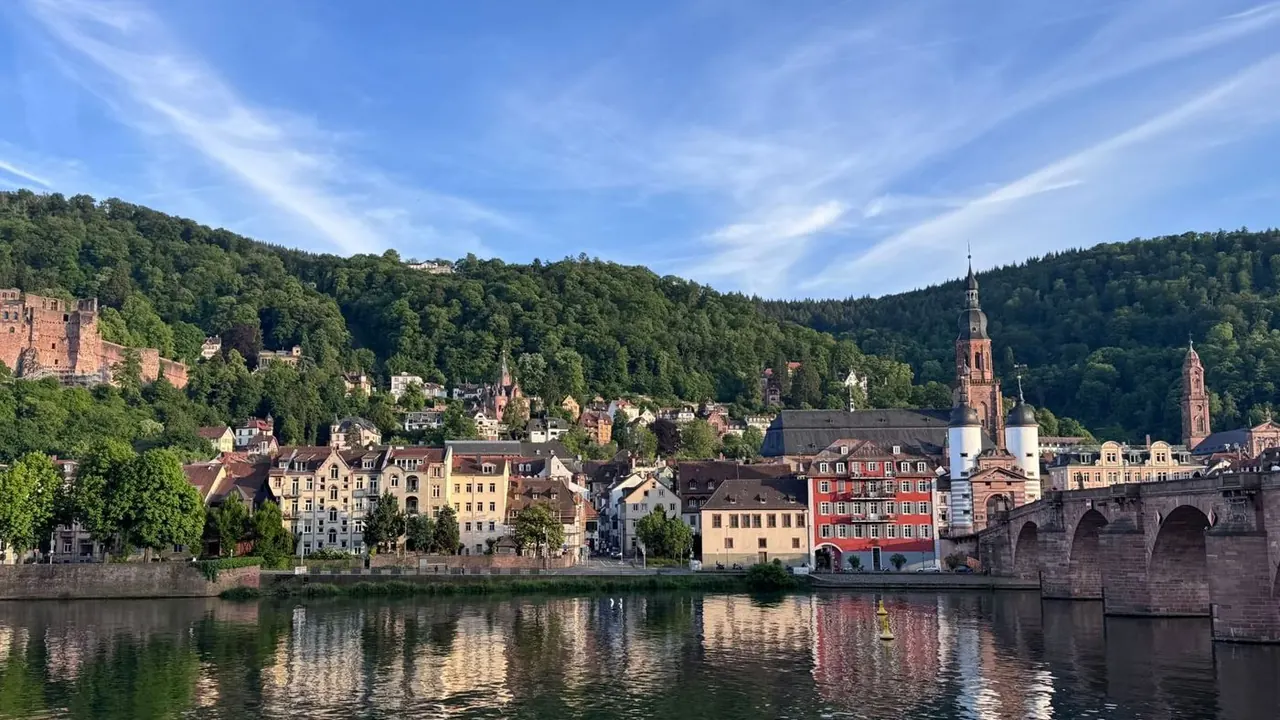
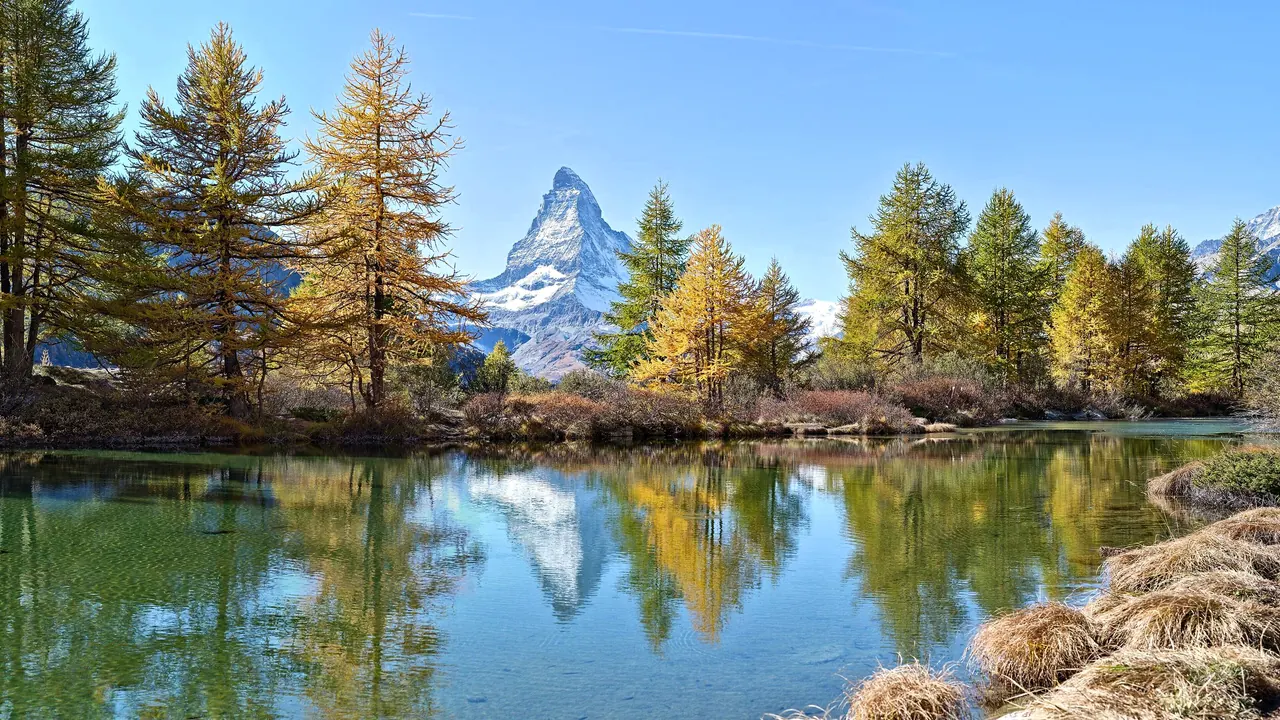
Photos: Heidelberg by Kuanling Chen, Pexels License; Zermatt by Roy Egloff, CC BY-SA 4.0, cropped.
Heidelberg or Zermatt?
Our verdict in twelve categories, each scored against the same fixed benchmark cities, and the climate month by month, so you can choose for your trip.
Choose Heidelberg for
- day trips
- culture and sights
- prices
Heidelberg suits travellers who want a historic town to wander, with a castle ruin, Germany's oldest university, evening concerts and opera, and an easy regional rail network that brings Speyer, Worms and the Palatinate wine villages within reach. It costs far less than Zermatt, and its warm summers along the Neckar make it a comfortable base for a sightseeing trip.
Choose Zermatt for
- nature and the outdoors
- getting around
- wellness
Choose Zermatt if the trip is about the mountains themselves. The Matterhorn stands over a car-free village, and lifts climb to glaciers, high trails and skiing that runs across into Italy. It is expensive and has little to do away from the slopes, so it rewards skiers, hikers and climbers far more than sightseers.
Scoreboard
Twelve categories on one fixed scale from 0 to 100. The shaded stretch is the gap between the two.
Your match
Pick a travel style or drag the sliders, and both match scores follow your weighting.
Wins on day trips and culture and sights with your weighting.
Wins on nature and the outdoors and getting around with your weighting.
What matters to you?
Category by category
What the scores mean for a trip.
Beaches & swimming
Neither town works for swimming. Heidelberg at least has outdoor pools, and the gravel-pit lakes on the Rhine plain about half an hour away make a pleasant hot afternoon, while Zermatt's mountain tarns are glacial meltwater for photographs, leaving hotel pools as the only option. In both cases the sea belongs to another trip.
Food & drink
Both eat well for their size without offering much range. Heidelberg's strength is the hearty cooking of the Kurpfalz and Baden, white asparagus in spring and local Riesling and Pinot from the Bergstrasse and the Palatinate. Students keep cheap food plentiful, and the better meals are in the Altstadt side streets and Neuenheim.
Zermatt serves Valais Alpine food, raclette, fondue and air-dried beef with Petite Arvine or Cornalin, and its best moments are long lunches at chalets around Findeln or Zum See with the Matterhorn in view. It has more ambitious fine dining but almost nothing cheap, and many kitchens close between seasons.
Culture & sights
For sightseeing, Heidelberg is clearly the better choice. The red sandstone castle ruin above the river, the baroque Altstadt, the Old Bridge and the university with its graffitied Student Prison make a rich, compact set that deserves a day or two.
Zermatt's heritage is about mountaineering: the Matterhorn Museum on the 1865 first ascent, the climbers' cemetery and the old larch barns of the Hinterdorf, which together fill a morning. Its most historic attraction, the Gornergrat railway, is really a way up the mountain.
Nightlife
Heidelberg has the livelier evenings, although both places are small. In term time students fill the pubs of the Untere Strasse and the old fraternity taverns, and Mannheim or Frankfurt are a short train ride away for a proper club night.
Going out in Zermatt means winter après-ski, loud and cheerful in the bars on the slopes from late afternoon, with a few late bars along the main street. In summer the hikers and climbers go to bed early.
Nature & outdoors
Here Zermatt is in a different league. The Matterhorn rises over the village, dozens of four-thousand-metre peaks and the Gorner Glacier surround it, and lifts reach above 3,800m. That means skiing across into Italy and, in summer, hundreds of kilometres of high trails such as the Five Lakes walk, with marmots and ibex along the way.
Heidelberg has gentler country to offer: the Philosophers' Walk, forest trails on the Königstuhl and the Heiligenberg, and the Neckar cycle path past riverside castles. It suits easy walking and cycling, not a mountain trip.
Day trips
Heidelberg makes the far better base for outings. Speyer's Romanesque cathedral and the palace gardens at Schwetzingen are about half an hour away, Worms, Lorsch and Maulbronn are easy to reach, and Frankfurt, Mainz and the Palatinate wine villages are around an hour away.
Zermatt sits at the end of a valley, so every outing starts with a long train ride down to the Rhône. Sion, with its two castle hills and its vineyards, is the most rewarding, but most visitors spend their spare days up the mountain instead.
Good for families
Heidelberg gives children more variety: the funicular and fairy-tale park on the Königstuhl, a compact zoo, boats up the river, and the Technik Museum Speyer, where they can climb into a space shuttle and a submarine. The cobbles and slopes of the Altstadt are the main nuisance with a pushchair.
Zermatt's appeal is its car-free calm, its ski schools and nursery slopes, and marmots on summer walks. It has no zoo or theme park, rainy days are hard to fill, and the highest viewpoints can be too cold and thin-aired for small children, so it works best for families who already ski or hike.
Getting around
Both are easy without a car, and Zermatt is slightly the easier. The whole village is car-free and compact, and the cog railway, the underground funicular to Sunnegga and the gondolas are all a short walk from the centre. Leaving the valley, though, takes over an hour by train.
Heidelberg's Altstadt is a long strip to walk along the Hauptstrasse, and you need a tram from the station. Its shared Rhine-Neckar fare system makes travelling around the region far simpler than it is from the Alps.
Shopping & style
Heidelberg has more to browse, with high-street chains and department stores along the long pedestrian Hauptstrasse, independent bookshops and boutiques in the side lanes, and Bergstrasse wine to take home. Zermatt's single main street is mostly watch and jewellery boutiques for wealthy skiers, plus souvenir shops, though its mountaineering outfitters are genuinely useful if you need gear.
Affordability
Heidelberg is much the cheaper of the two. Hotels are the main expense, and many visitors save by staying in Mannheim, while student cafés, bakeries and the regional transport ticket keep everything else modest.
Zermatt is among the most expensive places in the Alps, with steep rooms, costly mountain meals and lift tickets that almost every visitor needs. Self-catering, supermarket picnics and a bed down in Täsch soften the bill, but it stays a splurge.
Live music & performing arts
Heidelberg has a real season. The municipal theatre stages opera, drama and dance, and the town also has a philharmonic orchestra, the Heidelberger Frühling festival in spring and summer performances in the castle courtyard. Mannheim's larger opera house is twenty minutes away.
Zermatt has no theatre or concert hall, so its music depends on when you go: Zermatt Unplugged in spring and a chamber music festival in late summer. The rest of the year, evenings mean dinner and the occasional après-ski band.
Wellness & relaxation
Zermatt has a slight edge for pampering, thanks to its many excellent hotel spas with pools and mountain views, some of which sell day access, and car-free streets that stay quiet at night. Neither town has thermal springs of its own.
Heidelberg's warm pools are in the Kraichgau bath complexes, half an hour away, or in Baden-Baden further south. In town, the calm comes in other forms: long evenings on the Neuenheim meadows, forest paths above the Philosophers' Walk and unhurried wine taverns.
When should you go?
Pick your month. The climate figures are measured averages, not a forecast.
Heidelberg in July
Zermatt in July
Daytime high, °C
Rainfall in the month, mm
Where the figures come from
Zermatt has no weather station within reach, so its figures come from a gridded climate model rather than a measured record, and read a broad area rather than the city itself.
Temperature and rainfall are climate normals, averaged over the years shown. Heidelberg: 1991-2020 (sunshine 1971-2000) normals, Heidelberg (4.5 km from centre). Zermatt: 1991-2020 normals, TerraClimate 4 km grid at the town, no weather station within 90 km.
Heidelberg is a lowland town with a properly warm summer. Highs reach 26°C in July and August, and July is the sunniest month at about 222 hours of sunshine. May to September is the comfortable span for walking the Altstadt and the hill paths, and summer heat is good for the outdoor pools and nearby lakes, though summer also brings the most rain. Winters are cold and grey, with little sun from November to January.
Zermatt follows a different calendar. Daytime highs stay below freezing from December to February, around -2°C, which is the time for skiing, and even in July and August they climb only to about 14°C, good hiking weather but never warm. November is the wettest month at 130mm, and spring and autumn are cool and damp. So Heidelberg is at its best in high summer, and Zermatt in deep winter on skis or midsummer on foot.
Which traveller are you?
On an outdoors trip, Zermatt is the obvious pick. The Matterhorn, glaciers and lift-served terrain give winter skiing that crosses into Italy and summer hiking on high Alpine trails, well beyond Heidelberg's gentle forest walks and riverside cycling.
For a culture and arts trip, Heidelberg wins easily. The castle ruin, the baroque Altstadt and the old university sit alongside a theatre with opera, a philharmonic orchestra and spring and summer festivals, while Zermatt's mountaineering heritage fills a single morning.
On a tight budget, Heidelberg is the only realistic choice. Student cafés, bakeries and a good-value regional transport ticket keep costs reasonable, and staying in Mannheim saves on beds. Zermatt is among the costliest places in the Alps, and that includes its lifts.
Before you go
| Measure | Heidelberg | Zermatt |
|---|---|---|
| Official language | German | French, German, Italian, Romansh |
| Currency | Euro (EUR) | Swiss Franc (CHF) |
| Sockets | CF230 V, 50 Hz | CJ230 V, 50 Hz |
| Driving side | Right | Right |
| Time zone | UTC+1, UTC+2 in summer | UTC+1, UTC+2 in summer |
| Emergency number | 112 | 112 |
| Elevation | 114 m | 1,624 m |
| Main airport | Frankfurt Main Airport (FRA)69 km from centre281 non-stop destinations | Geneva International Airport (GVA)128 km from centre150 non-stop destinations |
| Public holidays this year | 12 days | 9 days |
By the numbers
| Measure | Heidelberg | Zermatt |
|---|---|---|
| City population | 156,092 | 6,023 |
| People per km² | 1,433 | 25 |
| Museums within 10 km | 17 | 2 |
| UNESCO World Heritage sites within 50 km | 4 | 2 |
Where else could you go?
Every comparison below shares a destination with this one, so you can follow Heidelberg or Zermatt somewhere new.
- Chamonixvs Zermatt
- Interlakenvs Zermatt
- Frankfurtvs Heidelberg
- Stuttgartvs Heidelberg
- Baden-Badenvs Heidelberg
- Luganovs Zermatt