India
Amritsar
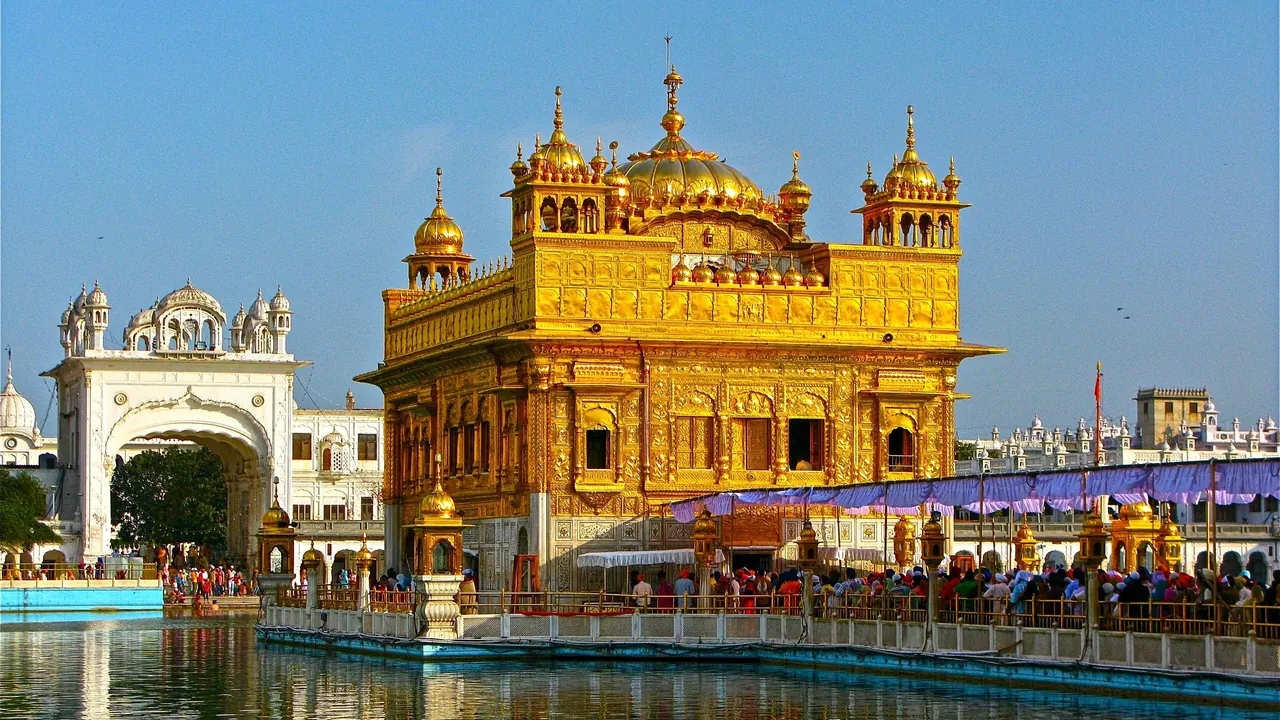
The Golden Temple across the sacred pool
- Affordable cities93
- Food & drink68
- Culture & sights66
Photo: Ken Wieland, CC BY-SA 2.0, cropped
Match
37
Every category weighted equally
- Beach & sun35
- Culture & arts44
- Food & nightlife41
- Family trip39
- Outdoors36
- Relax & unwind35
- Shopping & style41
- On a budget44
Amritsar in twelve categories
Our verdict on each, scored 0 to 100 against the same fixed benchmark cities, so a score means the same thing on every page.
Beaches & swimming. Scores 4 out of 100.
Food & drink. Scores 68 out of 100.
Culture & sights. Scores 66 out of 100.
Nightlife. Scores 12 out of 100.
Nature & outdoors. Scores 16 out of 100.
Day trips. Scores 34 out of 100.
Good for families. Scores 28 out of 100.
Getting around. Scores 36 out of 100.
Shopping & style. Scores 46 out of 100.
Affordability. Scores 93 out of 100.
Live music & performing arts. Scores 28 out of 100.
Wellness & relaxation. Scores 18 out of 100.
Amritsar category by category
Beaches & swimming
4Amritsar is on the flat plains of Punjab, far from any coast, so a beach vacation is not possible here. Swimming means a hotel pool. The only water people enter is the sacred pool around the Golden Temple, and pilgrims bathe there as an act of devotion. It is not a place to swim.
Food & drink
68Food is one of the main reasons people come to Amritsar. The city is known for its own version of Punjabi cooking. Amritsari kulcha is a stuffed bread baked in a tandoor and served with chole and lots of butter. You also find batter-fried river fish, slow-cooked dal and paneer, and thick lassi served in steel tumblers. The lanes around the Golden Temple and the old walled city are full of long-established dhabas and sweet shops. Many of them make one dish all morning, every day.
The langar at the Golden Temple is part of the experience. It is a free community kitchen that feeds huge numbers of people of every background, and visitors sit on the floor in rows and eat dal and roti beside pilgrims. The food scene is narrow, though. Cooking outside Punjabi traditions is mostly found in hotels and malls, there is little fine dining, and drinking happens quietly rather than as a culture of its own. Come hungry for breakfast and lunch rather than for a long evening of tasting menus.
Culture & sights
66Everything here centres on the Golden Temple, Harmandir Sahib, the holiest shrine of Sikhism. Its gilded sanctum sits in the middle of a large sacred pool, surrounded by a marble walkway, and it is open to everyone. It feels very different at dawn, in the midday glare and late at night under lights, and many visitors go back several times. The complex also holds the Akal Takht and a museum of Sikh history.
A short walk away is Jallianwala Bagh, the garden where British troops fired on an unarmed crowd in 1919. Bullet marks are still visible in its walls. The Partition Museum, in the old town hall, tells the story of the 1947 division of Punjab through personal accounts. Gobindgarh Fort, the Durgiana Temple and the Maharaja Ranjit Singh summer palace in Ram Bagh complete the list. It is a small set of sights, but the main one is unforgettable.
Nightlife
12Amritsar has very little nightlife. The old city is a pilgrimage centre, and alcohol is not welcome near the temple. What exists is a few hotel bars and lounges in the newer districts. Most visitors spend the evening on a long dinner, then walk around the temple pool after dark, when it is calmer and lit up. That walk is the best way to spend a night here.
Nature & outdoors
16The country around Amritsar is flat farmland of wheat, rice and mustard fields, pleasant to see from a car but with little to do outdoors. In the city, Ram Bagh and Company Bagh give shade and space for a walk. The best nature outing is the Harike wetland, about an hour and a half away, where the Beas and Sutlej rivers meet. In winter, large numbers of migratory waterbirds gather there. The Himalayan foothills are a long drive north, too far for a day out.
Day trips
34The best-known outing is to the Wagah border with Pakistan, about 30km west. Every evening there is a flag-lowering ceremony, with guards from both sides high-kicking and stamping in front of large, cheering crowds. It takes up most of an afternoon, and the crowds and noise are a big part of the experience.
Beyond that, the trips are mostly for people interested in Sikh history. Tarn Taran Sahib, under an hour away, has a large temple with a vast sacred pool, and Goindwal Sahib and Baba Bakala are close by. Kapurthala, about an hour and a half away, is an old princely capital with a palace modelled on French designs and a Moorish-style mosque. There is no wine country and no historic town of the first rank within easy reach.
Good for families
28Children are welcomed warmly at the Golden Temple. Older children often find the langar kitchens and the Wagah ceremony exciting. Still, very little in the city is made for them. The nearest science centre is in Kapurthala, a long drive away. Summers are fiercely hot and winter mornings bring dense fog. The old city's lanes are crowded and full of traffic, and families need to be careful about water and street food. The city works for a family that wants a short cultural visit with older children, not for a relaxed vacation with young ones.
Getting around
36The heart of a visit is easy. The Golden Temple, Jallianwala Bagh and the Partition Museum sit close together around a pedestrianised heritage street, so they are easy to explore on foot. Outside that area, it gets harder. There is no metro, buses are of little use to a visitor, and the rest of the city is reached by cycle rickshaw, e-rickshaw, auto-rickshaw or ride-hailing car, through crowded and noisy traffic with poor pavements. For Wagah and the towns beyond, most people hire a car with a driver for the day.
Shopping & style
46Shopping here means the bazaars of the old walled city. Hall Bazaar and Katra Jaimal Singh are packed with Punjabi suits, shawls and fabric. Look out for phulkari, Punjab's bright hand-embroidered textiles, and for juttis, the embroidered leather slippers sold by the stack. The lanes near the temple sell steel bangles, kirpans, turban cloth and devotional items. Food shops sell papad and warian, the dried lentil dumplings the city is known for, to take home. Bargaining is normal. Branded fashion is limited to the malls in the newer districts, and there is nothing in the way of luxury or design shopping.
Affordability
93Amritsar is very cheap to visit. Its main sight, the Golden Temple, is free, and so is the food in its community kitchen. Pilgrim rest houses near the temple offer basic beds to visitors too. A filling dhaba meal, a lassi and a rickshaw ride cost very little, and comfortable mid-range hotels are inexpensive. The only real costs are the few upscale hotels and hiring a car for trips out of the city.
Live music & performing arts
28The one great performance in Amritsar is the music that never stops. From before dawn until late at night, musicians in the Golden Temple sing gurbani kirtan, the Sikh hymns, to harmonium and tabla. It is broadcast across the complex, and anyone can sit by the pool and listen. Beyond that there is little. A few cultural centres and hotels put on bhangra and Punjabi folk shows, and there are occasional concerts and festival performances. There is no regular theatre or concert life for a visitor to follow.
Wellness & relaxation
18Amritsar is not a place for spas or slowing down. Wellness is limited to a few hotel spas and massage rooms. Beyond the temple, the city is loud, crowded and full of traffic. Its one source of calm is the Golden Temple itself. Sitting on the cool marble by the pool at dawn or late at night, with hymns in the background, is deeply peaceful. Many visitors find it the most restful part of their stay.
When should you go?
Pick a month to see what it is like. The climate figures are measured averages, not a forecast.
Amritsar in July
Daytime high, °C
Rainfall in the month, mm
The whole year
Shaded against this city’s own year: the deepest cell is its best month for that figure and the palest its weakest.
Temperature and rainfall are climate normals, averaged over the years shown. Amritsar: 1991-2020 normals, Amritsar (1.2 km from centre).
Before you go
| Measure | Amritsar |
|---|---|
| Official language | Hindi, English |
| Currency | Indian Rupee (INR) |
| Sockets | CM230 V, 50 Hz |
| Driving side | Left |
| Time zone | UTC+5:30 |
| Emergency number | 108 or 112 |
| Elevation | 234 m |
| Main airport | Sri Guru Ram Das Ji International Airport (ATQ)12 km from centre17 non-stop destinations |
By the numbers
| Measure | Amritsar |
|---|---|
| City population | 1,159,227 |
| People per km² | 6,819 |
| Museums within 10 km | 3 |
| UNESCO World Heritage sites within 50 km | 1 |
Compare Amritsar with
Every comparison with a written verdict behind it.