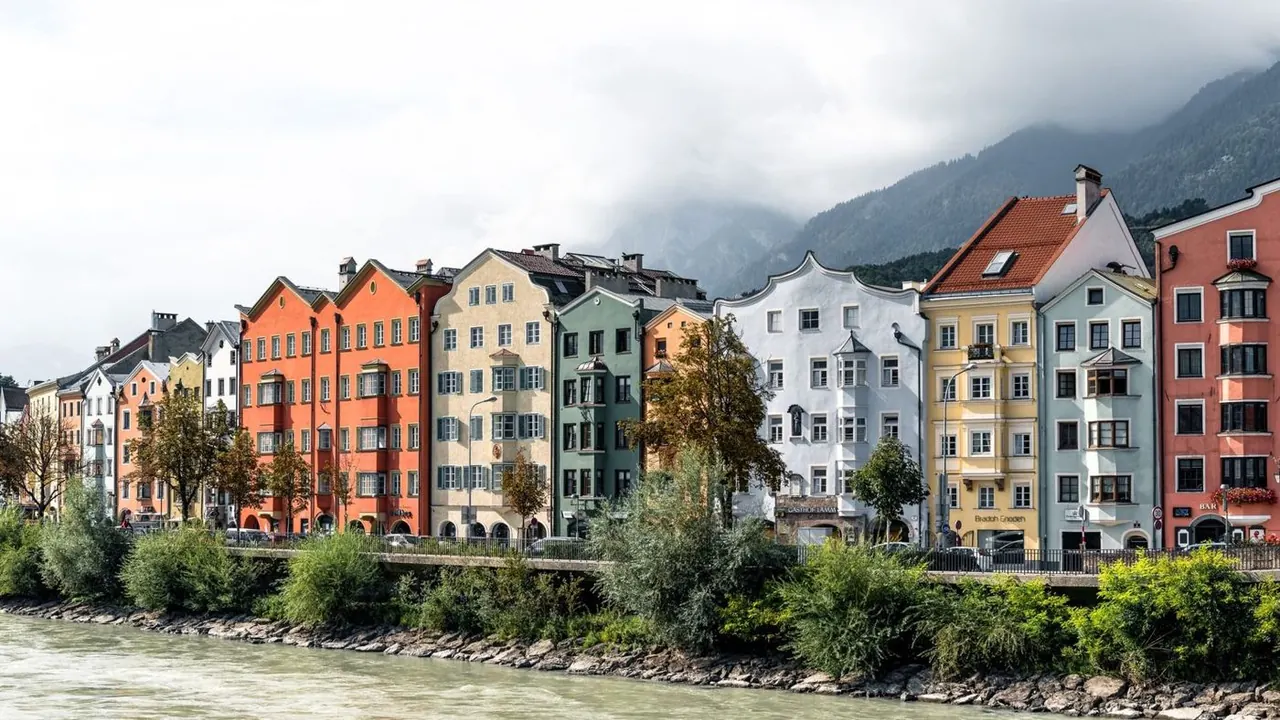
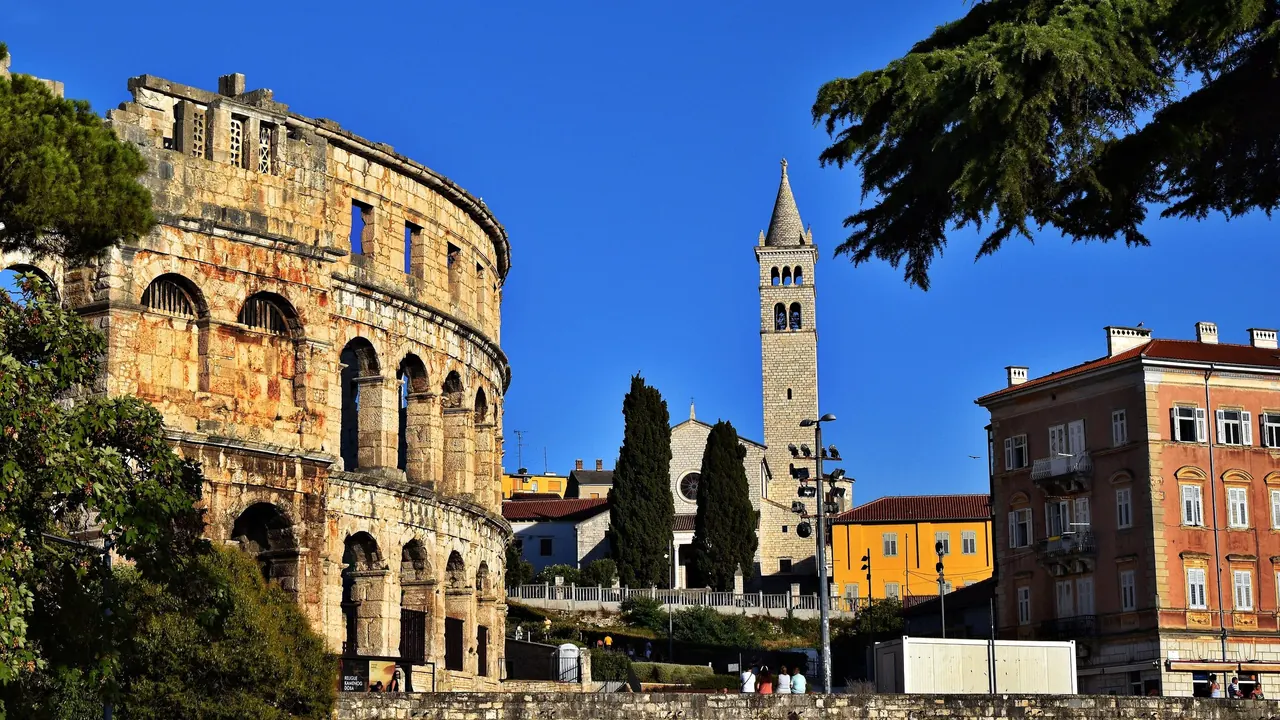
Photos: Innsbruck by Wolfgang Weiser, Pexels License; Pula by Miroslav.vajdic, CC BY-SA 4.0, cropped.
Innsbruck or Pula?
Our verdict in twelve categories, each scored against the same fixed benchmark cities, and the climate month by month, so you can choose for your trip.
Choose Innsbruck for
- nature and the outdoors
- getting around
- wellness
Innsbruck suits travellers who want the mountains at the end of the street: a ridge walk or a ski day in the morning and a Habsburg palace in the afternoon, all without a car. It works in snow and in summer, and it has the edge for evening concerts, a sauna after a long day outdoors and easy rail trips across the Alps.
Choose Pula for
- beaches
- food and drink
- prices
Pula is the choice for a summer by the sea. It has clear water off rocky coves, an Istrian table of truffles, seafood and Malvazija, and a Roman Arena standing over the harbour, which makes for a slower, sunnier trip. It also costs less than Innsbruck, though you will want a car for the coast and the hill towns.
Scoreboard
Twelve categories on one fixed scale from 0 to 100. The shaded stretch is the gap between the two.
Your match
Pick a travel style or drag the sliders, and both match scores follow your weighting.
Too close to call, 1 point apart
Wins on nature and the outdoors and getting around with your weighting.
Wins on beaches and food and drink with your weighting.
What matters to you?
Category by category
What the scores mean for a trip.
Beaches & swimming
Pula wins this easily. The coast south of the centre, around Verudela, Stoja and Medulin, has clear sea from June to late September. You swim from rocks, platforms and pebble coves rather than sand, and Cape Kamenjak has the wildest swimming.
Innsbruck has only the shallow plateau lakes such as the Lanser See, plus the beautiful but cool Achensee. They make a fine afternoon in July or August but are nothing to plan a trip around.
Food & drink
Pula has the more interesting food. Istrian cooking means truffle pasta, scampi buzara, pršut and local olive oil and wine, and there is a market hall to browse, though the best meals are usually in country konobas rather than beside the Arena.
Innsbruck's cooking is narrower and heavier: Gröstl, dumplings and Kaiserschmarrn, at their best in a mountain hut after a walk. There is no market culture to speak of, and the town's real pleasure is its coffee houses with strudel.
Culture & sights
Both have a day or two of first-rate sights, but from different eras. Innsbruck's are Habsburg: the Golden Roof, the Hofburg, Maximilian's tomb ringed by bronzes in the Hofkirche and the cabinet of curiosities at Ambras Castle, with solid museums for a wet afternoon.
Pula's sights are mainly Roman. The Arena, the Temple of Augustus and the Arch of the Sergii all stand in the open, with Venetian and Austro-Hungarian buildings around them. Here you spend your time walking among ruins rather than indoors in collections.
Nightlife
Neither city is worth choosing for nights out, but the evenings differ. Innsbruck's students keep the bars and small clubs in the railway viaduct arches busy late at weekends all year, and winter visitors head to après-ski in the resorts. Pula livens up only in summer, with terraces around the Forum and beach bars on Verudela and in Medulin, and most nights end early out of season.
Nature & outdoors
Innsbruck is in a different league here. A funicular and the Nordkette cable cars take you from the old town to a ridge at about 2,300m in under half an hour, with the Karwendel behind it and the Stubai Glacier, ski areas, via ferratas and hut-to-hut routes all around.
Pula's outdoors are gentler and by the sea: walking and cycling on car-free Kamenjak, sea kayaking, windsurfing and wreck diving. For real hills you have to drive to Učka, and the summer heat limits what you can do at midday.
Day trips
Both make good bases, but in different ways. From Innsbruck the train does the work: Hall in Tirol is ten minutes away, Munich and Salzburg take under two hours, and Bolzano and Merano are just over the Brenner Pass.
Pula's trips stay closer to home and mostly need a car. You can reach Rovinj, the mosaics of Poreč, the hill towns of Motovun and Hum with their truffles and wine, and the boat out to the Brijuni islands.
Good for families
Both are safe and easy with children; the difference is the setting. In Innsbruck, families ride the funicular to the Alpenzoo's ibex and wolves, then try the adventure trails or the ski schools above town, though rainy days need planning.
In Pula, days are spent by the sea in the shallow bays of Medulin and Premantura, with the Verudela aquarium and the Arena's underground passages for a change. In high summer, the heat, the rocky shores and the reliance on a car make it more work.
Getting around
Innsbruck is far easier without a car. The flat centre is walkable, trams and buses reach Igls and the Stubai valley, the funicular to the mountains starts at the old town and regional trains run along the valley.
Pula's centre is just as easy on foot, but beyond it the buses are infrequent and the inland railway is of little use. The coves, Kamenjak and the hill towns really need a car or a scooter.
Shopping & style
Neither is a shopping destination, but Innsbruck offers a little more: high-street chains on Maria-Theresien-Strasse, loden and Tyrolean crafts under the old-town arcades, and excellent outdoor and ski shops. In Pula the best buys are things to eat and drink: olive oil, truffles, wine and rakija from the market hall or straight from producers inland.
Affordability
Innsbruck is the dearer of the two, and its expensive months fall in winter, when ski season and the Christmas markets fill the hotels. A meal in a traditional inn is filling rather than cheap. On the other hand, trams, buses and regional trains are fairly priced and you can manage without a car, so getting around costs little.
Pula is cheaper over a whole trip, and noticeably cheaper than the better-known towns further down the Croatian coast. Its peak is midsummer, when rooms book up and the tables by the Arena and the harbour charge tourist prices. City buses and the Roman sights cost little, but most visitors need a hire car for the coast and the hill towns, and boat trips to the islands, so a good part of the saving goes on these.
Live music & performing arts
Innsbruck has the fuller programme. Opera, operetta and dance run through the season at the Tiroler Landestheater, the Tyrolean Symphony Orchestra plays in the congress hall, and the summer Festival of Early Music uses settings such as the Spanish Hall at Ambras Castle.
Pula has one great stage, the Arena, where a summer concert or film festival screening under Roman arches is hard to beat. The rest of the year offers little beyond Croatian-language drama.
Wellness & relaxation
Innsbruck is the better place to unwind, in the Alpine way: hotel spas with mountain views in Igls, a sauna after a day outdoors, and the large thermal complexes of the Ötztal and Zillertal about an hour away. Pula has only the spas of resort hotels on Verudela and in Medulin. Its calm comes instead from pine-shaded coastal walks and long coffees on the Forum outside high summer.
When should you go?
Pick your month. The climate figures are measured averages, not a forecast.
Innsbruck in July
Pula in July
Daytime high, °C
Rainfall in the month, mm
Where the figures come from
Pula's temperatures are measured 87 km from the centre, at Trieste.
Pula has no rain gauge within 25 km of the centre, so its rainfall comes from a gridded climate dataset read at the city rather than from a gauge further away.
Temperature and rainfall are climate normals, averaged over the years shown. Innsbruck: 1991-2020 normals, Innsbruck-Flughafen (3.3 km from centre). Pula: 1991-2020 normals, Trieste (87 km from centre).
Innsbruck has two seasons to plan around. In winter the ski areas have snow and daytime highs reach only a few degrees above freezing. Summer warms to about 26°C and is the time for hiking and the plateau lakes, but it is also the wettest part of the year, with August rain near 144mm, so expect showers on the trails. May, June, September and early October are the most comfortable months for walking both the town and the mountains.
Pula is at its best in summer. July and August reach 29°C and are its sunniest, driest months, and by August the sea is about 25°C, so June to September is beach season. Middays in high summer can be too hot for touring the ruins, which makes May and late September better for sightseeing. The rain sets in from October and peaks at 107mm in November, and winter is mild but short on sun.
Which traveller are you?
For a beach and sun trip, Pula is the clear choice. The sea warms well through summer, and the coves around Verudela, Medulin and Cape Kamenjak give weeks of swimming. Innsbruck can offer only a dip in a mountain lake during a short summer.
On an outdoors trip, Innsbruck is far ahead. Cable cars take you from the old town to high ridges in under half an hour, with skiing in winter and hut-to-hut hiking, via ferratas and paragliding in summer, all without a car.
On a tight budget, your money goes further in Pula, especially outside July and August, when private apartments and family konobas keep costs down. Innsbruck adds Alpine prices and lift tickets to the bill, though its city cards help a little.
Before you go
| Measure | Innsbruck | Pula |
|---|---|---|
| Official language | German, Austrian Sign Language | Croatian |
| Currency | Euro (EUR) | Euro (EUR) |
| Sockets | CF230 V, 50 Hz | CF230 V, 50 Hz |
| Driving side | Right | Right |
| Time zone | UTC+1, UTC+2 in summer | UTC+1, UTC+2 in summer |
| Emergency number | 112 | 112 |
| Elevation | 574 m | 5 m |
| Main airport | Innsbruck Airport (INN)4 km from centre40 non-stop destinations | Pula Airport (PUY)7 km from centre34 non-stop destinations |
| Public holidays this year | 16 days | 14 days |
By the numbers
| Measure | Innsbruck | Pula |
|---|---|---|
| City population | 132,499 | 52,220 |
| People per km² | 1,263 | 971 |
| Museums within 10 km | 28 | 4 |
| UNESCO World Heritage sites within 50 km | 1 | 1 |
| Swim season, months above 21 °C | - | 4 months |
Where else could you go?
Every comparison below shares a destination with this one, so you can follow Innsbruck or Pula somewhere new.