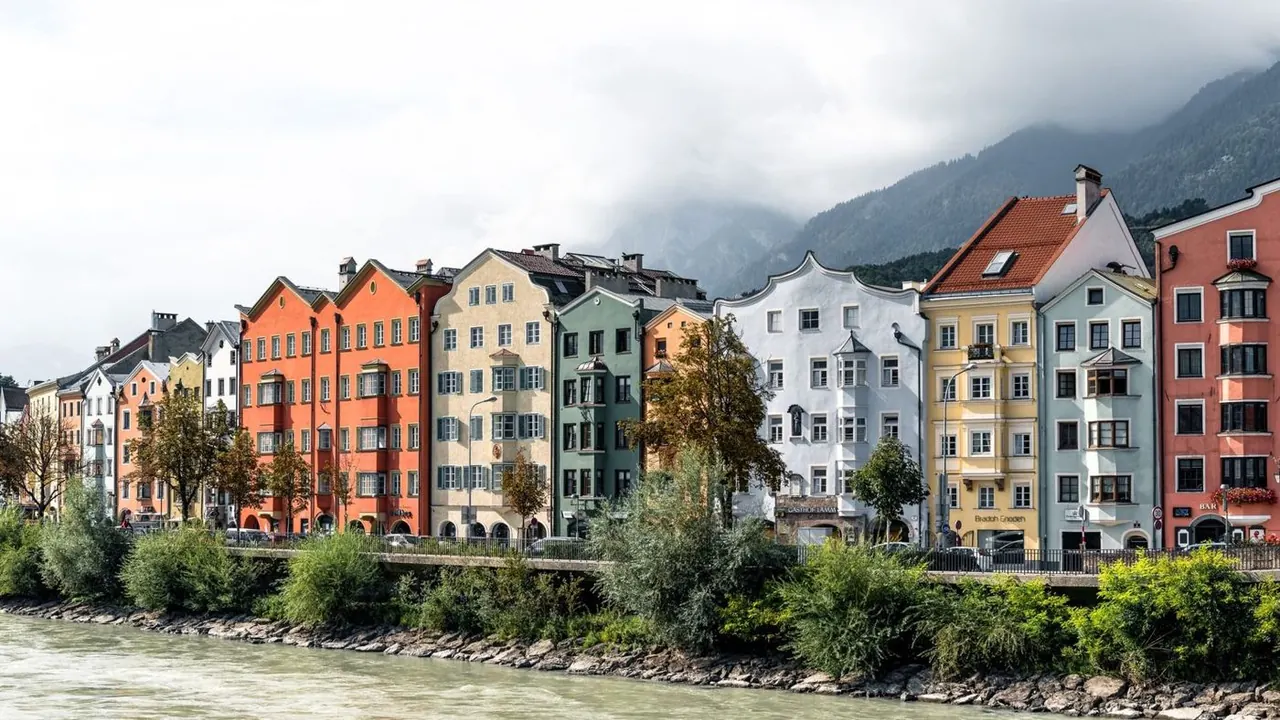
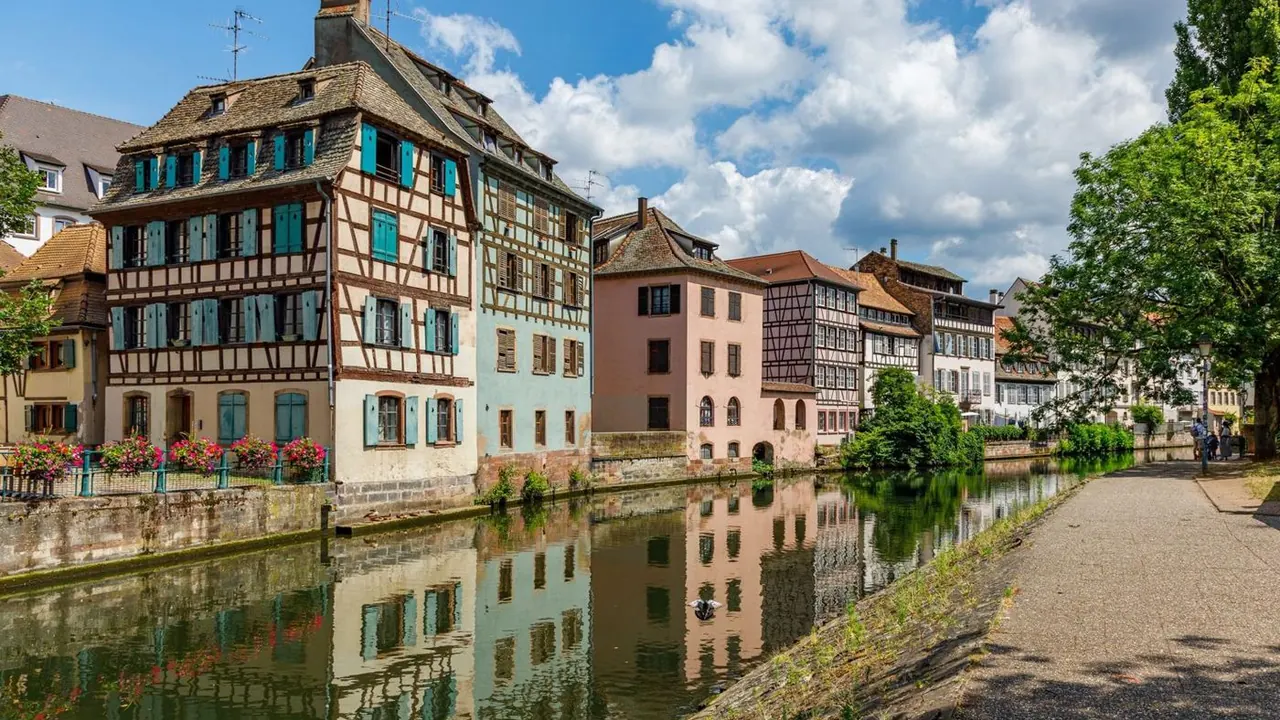
Photos: Innsbruck by Wolfgang Weiser, Pexels License; Strasbourg by Edoardo Colombo, Pexels License.
Innsbruck or Strasbourg?
Our verdict in twelve categories, each scored against the same fixed benchmark cities, and the climate month by month, so you can choose for your trip.
Choose Innsbruck for
- nature and the outdoors
- beaches
Innsbruck is the choice when the mountains are the point of the trip. A funicular from the edge of the old town links to cable cars that reach a high ridge in under half an hour, and the Karwendel, the Stubai Glacier and a ring of ski areas lie close by. The Habsburg old town is a pleasant extra rather than the main event. Come for hiking, skiing or paragliding, and accept that the food is hearty hut cooking and the evenings are quiet.
Choose Strasbourg for
- food and drink
- shopping
- culture and sights
Strasbourg rewards a slower trip built around the city itself. It eats and drinks better, in wood-panelled winstubs with Riesling from the vineyards to the south, and its cathedral, Grande Ile and Palais Rohan museums go deeper than Innsbruck's sights. Add a proper opera and theatre season, Baden-Baden's baths and the Alsace wine villages close by, and it suits travellers who would rather wander, taste and sit through a concert than climb.
Scoreboard
Twelve categories on one fixed scale from 0 to 100. The shaded stretch is the gap between the two.
Your match
Pick a travel style or drag the sliders, and both match scores follow your weighting.
Wins on nature and the outdoors and beaches with your weighting.
Wins on food and drink and shopping with your weighting.
What matters to you?
Category by category
What the scores mean for a trip.
Beaches & swimming
Neither city has a sea, so swimming in both means a summer afternoon at a lake. Innsbruck has a slight edge for setting. The Lanser See and Natterer See on the plateaus above town warm to about 22°C in high summer and come with peaks behind them, while the Achensee further out is lovely to look at but cold to swim in.
Strasbourg's lakes are old gravel pits on a flat plain. The Baggersee is a tram ride away and has grassy banks and lifeguards in July and August. They are practical rather than scenic, and the Rhine itself is off limits.
Food & drink
Strasbourg is clearly the stronger place to eat. Alsatian cooking is richer and more varied, from tarte flambée and baeckeoffe to foie gras, and the winstub tradition pairs it with Riesling, Sylvaner and Pinot Gris grown a short way south. Add a covered market for Munster and charcuterie, a serious fine-dining tier and plenty of local beer.
Innsbruck's Tyrolean food of Gröstl, Kaspressknödel and Kaiserschmarrn is filling and honest, and is at its best in a mountain hut after a hike. In town the choice narrows quickly, with no market culture, wine brought in from elsewhere and tour-group menus around the Golden Roof. Both cities have the same weakness around their famous squares.
Culture & sights
Both cities cover their main sights in two or three days, but Strasbourg packs more into that time. The pink sandstone cathedral with its astronomical clock, the timber-framed lanes of Petite France and the German-built Neustadt form one UNESCO-listed whole. The Palais Rohan alone holds three museums, and a large modern art museum and the European institutions add a twentieth-century side.
Innsbruck's heritage is Habsburg and compact: the Golden Roof, the Hofburg and above all the Hofkirche, with Maximilian I's tomb and its ring of bronze giants. Ambras Castle's cabinet of curiosities is a real treat, but the museum list ends sooner.
Nightlife
Evenings out are modest in both, each kept going by a big university, but the feel differs. Innsbruck has its strip of bars and small clubs in the brick arches under the railway viaduct, which stays open late at weekends, and in winter much of the partying moves out to après-ski in the resorts.
Strasbourg is more about bars than dancing. Student pubs and beer cellars fill Krutenau and Place Saint-Étienne, and summer terraces along the quays stay busy into the evening. With only a handful of clubs, the city is mostly asleep by midnight on weeknights.
Nature & outdoors
This is where Innsbruck pulls furthest ahead. High Alpine terrain starts at the city's edge: the Nordkette ridge at about 2,300m is under half an hour from the old town, the Karwendel nature park lies behind it, and the Stubai Glacier keeps snow for most of the year. Skiing, via ferratas, paragliding and rafting are all close by.
Strasbourg is flat and green, with storks and beavers in the Rhine forests and long level cycle routes into Germany. Its real hills, the Vosges and the Black Forest, are about an hour away and easier to reach with a car.
Day trips
Both make good bases, but Strasbourg's trips are closer together and easier to string along. Colmar is half an hour south by train, the wine route villages of Riquewihr and Eguisheim sit between the two with Haut-Koenigsbourg above them, and across the Rhine are Baden-Baden, Freiburg and, a little further, Heidelberg.
Innsbruck reaches three countries from its spot on the Alpine rail lines. Hall in Tirol and glassblowing Rattenberg are near, but the big names, such as Munich, Salzburg, Bolzano with Ötzi, and Neuschwanstein by car, each take close to two hours.
Good for families
Families do roughly as well in either, in different ways. Innsbruck's appeal is the mountains: the Alpenzoo with its ibex and lynx on the funicular route, adventure trails and hut playgrounds in summer, and ski schools on gentle slopes in winter. The catch is wet weather, when there is little indoors built for children.
Strasbourg copes better with rain, thanks to the hands-on Le Vaisseau science centre, boat trips round the Grande Ile and the clock's moving figures. The Orangerie has storks and rowing boats, and Europa-Park, one of Europe's biggest theme parks, is an hour across the border.
Getting around
Both have small, flat centres you cross on foot, and neither needs a car. What sets Innsbruck apart is how easily public transport reaches the heights, with the Hungerburg funicular, trams to Igls and the Stubai valley, and ski buses in winter.
Strasbourg's strength is the bike. Separated lanes and bike hire make cycling the quickest way round, and the trams run out to the European quarter and over the Rhine to Kehl. In both, a car only pays off for remote valleys or the wine villages.
Shopping & style
Strasbourg gives shoppers more to do. Around Place Kléber and the Rue des Grandes Arcades there are chains and a department store, and the lanes by the cathedral hold bookshops, delicatessens and independents. Soufflenheim pottery, printed linens and kougelhopf moulds make good souvenirs, and December brings the long-running Christmas market.
Innsbruck's Maria-Theresien-Strasse is mostly chains, but the city wins outright on one thing: specialist outdoor and ski shops. Loden jackets, dirndls, Speck and schnapps are the local buys.
Affordability
Neither is cheap, but Strasbourg is a little gentler on the budget. Winstub meals and tarte flambée are fairly priced, wine by the pichet is good value, and the cathedral and old town streets cost nothing. Hotels are the main expense, and they spike during the Christmas market and when the European Parliament sits.
Innsbruck carries an Alpine resort premium, and cable car tickets add up fast on an active trip. Guest cards that bundle lifts and transport soften the blow, and spring and autumn are clearly cheaper than the ski season.
Live music & performing arts
Strasbourg has the fuller programme. The Opéra national du Rhin on Place Broglie, a philharmonic with a complete season and the Théâtre National de Strasbourg, one of France's leading stages, are backed by the Musica contemporary music festival in autumn and a well-regarded jazz festival.
Innsbruck's Landestheater and symphony orchestra make a sound provincial offering, and the summer Festival of Early Music in Ambras Castle's Spanish Hall is a real highlight. It also has something Strasbourg lacks: folk evenings with yodelling and brass bands.
Wellness & relaxation
Strasbourg is the better place for a proper soak. Its early twentieth-century Bains municipaux has tiled pools, a hammam and saunas in town, and Baden-Baden's Friedrichsbad and Caracalla baths are under an hour away. Canal-side walks and long winstub lunches keep the pace slow, though not in December.
Innsbruck has no thermal water of its own. Relaxing there means mountain air and hotel spas in Igls and the plateau villages, often with saunas looking onto the peaks, while the big thermal complexes in the Ötztal and Zillertal are about an hour out.
When should you go?
Pick your month. The climate figures are measured averages, not a forecast.
Innsbruck in July
Strasbourg in July
Daytime high, °C
Rainfall in the month, mm
Temperature and rainfall are climate normals, averaged over the years shown. Innsbruck: 1991-2020 normals, Innsbruck-Flughafen (3.3 km from centre). Strasbourg: 1991-2020 normals, Strasbourg (9.1 km from centre).
The two cities have almost the same temperatures. Both reach about 26°C in July and August, and in midwinter both stay only a few degrees above freezing by day. What sets them apart is the rain. Innsbruck's summer is the wettest part of its year, with rain building from May to a peak of about 144mm in August. Strasbourg's wettest months stay nearer 75mm, so July and August there are reliable for the riverside terraces and the gravel-pit lakes. For drier days on Innsbruck's trails, September is the better pick, still about 21°C in the valley with far less rain than August. Early October stays bright too.
In the colder half of the year, Innsbruck has the better weather. Its skies stay clearly brighter through the ski season, while Strasbourg turns grey from late October to January, with very little sunshine. For walking the streets, May and September suit both cities, warm without being heavy.
Which traveller are you?
On an outdoors trip, Innsbruck is in another league. In winter several ski areas share one pass, and in summer the same slopes offer hut-to-hut hiking, mountain biking and rafting on the Inn. Strasbourg's real hills are an hour away.
For a culture and arts trip, Strasbourg goes deeper. Innsbruck's Habsburg core of the Hofkirche and Ambras Castle is rewarding but brief. Strasbourg has the cathedral and its astronomical clock, Petite France, three museums under one roof and the autumn Musica festival.
On a food and nightlife trip, Strasbourg wins at the table, with winstub baeckeoffe, Riesling by the pichet and a proper covered market. After dark the two are evenly matched: Innsbruck's viaduct bars run late at weekends, while Strasbourg's riverside terraces suit a gentler evening.
Before you go
| Measure | Innsbruck | Strasbourg |
|---|---|---|
| Official language | German, Austrian Sign Language | French |
| Currency | Euro (EUR) | Euro (EUR) |
| Sockets | CF230 V, 50 Hz | CE230 V, 50 Hz |
| Driving side | Right | Right |
| Time zone | UTC+1, UTC+2 in summer | UTC+1, UTC+2 in summer |
| Emergency number | 112 | 112 |
| Elevation | 574 m | 132 m |
| Main airport | Innsbruck Airport (INN)4 km from centre40 non-stop destinations | Strasbourg Airport (SXB)10 km from centre43 non-stop destinations |
| Public holidays this year | 16 days | 11 days |
By the numbers
| Measure | Innsbruck | Strasbourg |
|---|---|---|
| City population | 132,499 | 293,771 |
| People per km² | 1,263 | 3,752 |
| Museums within 10 km | 28 | 21 |
| UNESCO World Heritage sites within 50 km | 1 | 1 |
Where else could you go?
Every comparison below shares a destination with this one, so you can follow Innsbruck or Strasbourg somewhere new.