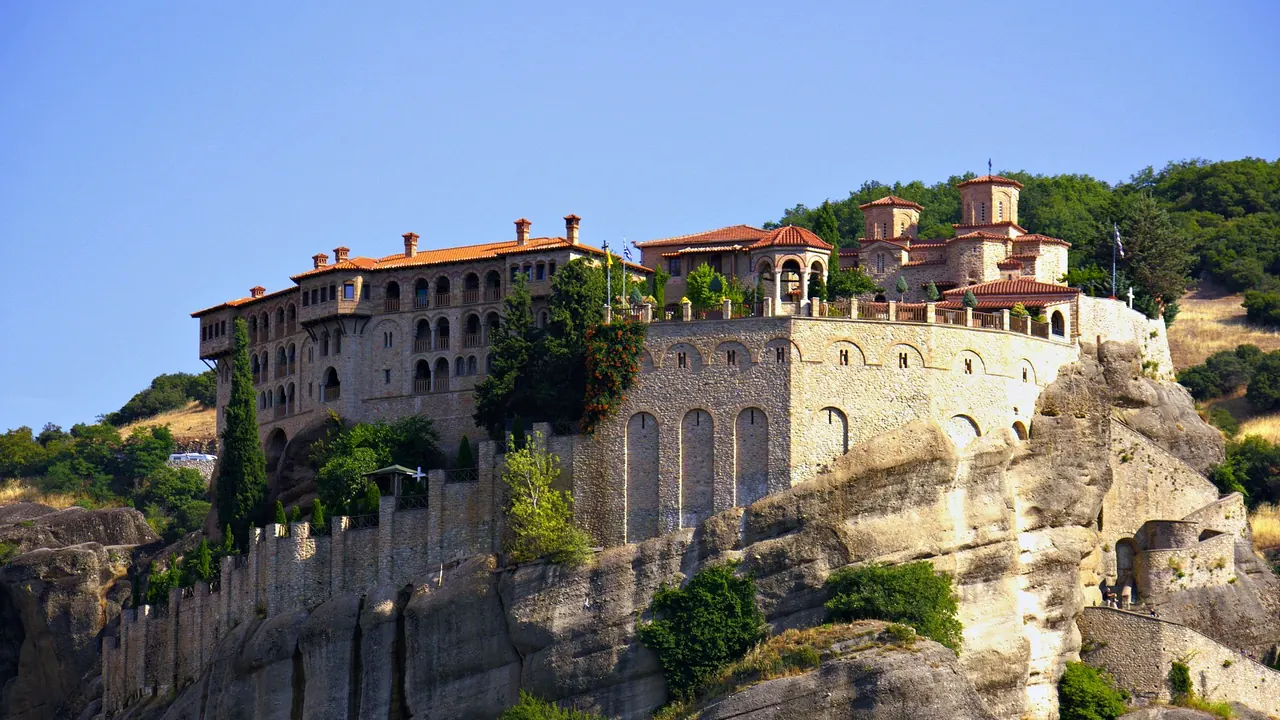
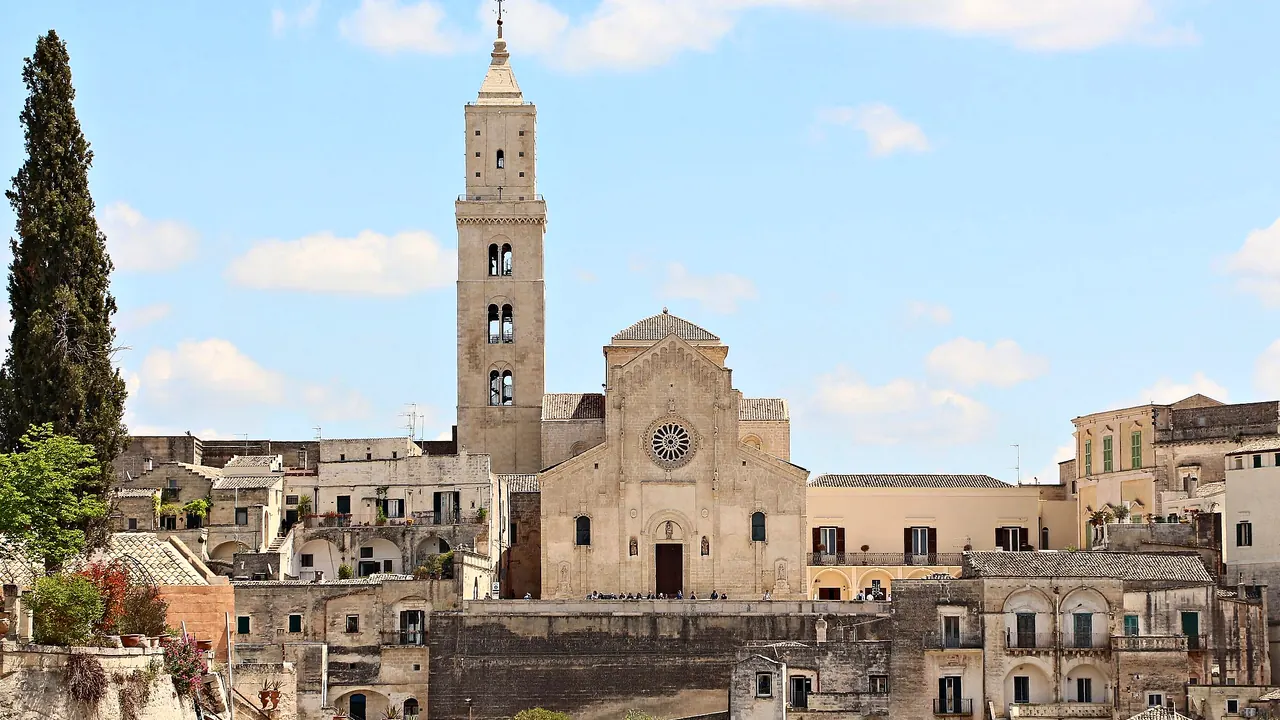
Photos: Kalambaka by José Barbosa, Pexels License; Matera by Bernard Gagnon, CC BY 4.0, cropped.
Kalambaka or Matera?
Our verdict in twelve categories, each scored against the same fixed benchmark cities, and the climate month by month, so you can choose for your trip.
Choose Kalambaka for
- nature and the outdoors
- prices
- families
Kalambaka is for travellers who want landscape first. The Meteora pillars start at the edge of town, monks' footpaths and climbing routes run between them, and the Pindos forests and valleys are a short drive west. It costs less day to day, and two or three quiet nights cover the monasteries well, so it fits best as an active stop on a wider tour of mainland Greece.
Choose Matera for
- beaches
- day trips
- food and drink
Matera gives more to anyone who cares about places to see and a slightly fuller evening. The cave districts of the Sassi, the rock churches and the upper-town museums make a denser set of sights. The cooking has more character, and the border position with Puglia opens up trulli, white towns and the sea. Choose it for a week with a car and a mix of old towns, food and the odd beach day.
Scoreboard
Twelve categories on one fixed scale from 0 to 100. The shaded stretch is the gap between the two.
Your match
Pick a travel style or drag the sliders, and both match scores follow your weighting.
Wins on nature and the outdoors and prices with your weighting.
Wins on beaches and day trips with your weighting.
What matters to you?
Category by category
What the scores mean for a trip.
Beaches & swimming
Neither is a beach destination, but Matera at least puts the sea within reach. The sandy, pine-backed Ionian shore around Metaponto and Policoro is under an hour's drive away, with shallow water that is easy for children, and Puglia's rocky Adriatic coves are a longer outing.
From Kalambaka the coast is well over two hours away, so swimming means a hotel pool or a cold mountain river in the Pindos. Plan the beach days for another part of Greece.
Food & drink
Matera eats better. Its Basilicata cooking has a clear identity: the horn-shaped durum-wheat loaf, fave e cicoria, hand-made cavatelli, crackling dried peppers and Aglianico del Vulture, served in cave rooms in the Sassi or, more fairly priced, in the upper town.
Kalambaka offers hearty central Greek grills, baked meats, bean soups and pies with tsipouro and meze. It is generous and good, but the menus barely change from one taverna to the next, and the sunset view of the rocks is often the best part of dinner.
Culture & sights
Both towns are built around one extraordinary site, but Matera's is larger and lived in. The Sassi are whole districts of cave houses, carved churches with medieval frescoes and stacked dwellings on the Gravina gorge, and the upper town adds the Palombaro Lungo cistern, Carlo Levi's panorama at Palazzo Lanfranchi and sculpture in MUSMA.
Kalambaka's draw is the six active Meteora monasteries on their pillars, with frescoed churches, refectories and icon collections, plus the Dormition church in town. They are unforgettable, but the town around them is plain and modern, so the cultural side of a stay is done in two days.
Nightlife
Neither town is for a night out, though Matera gives a little more to do after dinner. Its passeggiata along Via del Corso, the terraces above the lit Sassi and a few cave wine and cocktail bars that stay open late in summer suit couples well.
In Kalambaka the evening ends with a drink at a café-bar on the central square. Anyone wanting more drives half an hour to Trikala and its student bar street.
Nature & outdoors
Kalambaka is the stronger choice for the outdoors. The Meteora pillars, some rising about 400m, begin at the back streets, with footpaths through oak woods and ravines, famous conglomerate climbing and the Pindos fir forests, the Aspropotamos rafting valley and winter ski slopes near Metsovo beyond.
Matera's nature is on a smaller scale: the Gravina gorge below the Sassi and the stony Murgia plateau opposite, with abandoned rock churches and Neolithic sites along the trails. The Lucanian Dolomites and Pollino forests need a drive of an hour or more.
Day trips
Matera is the better base for day trips. Sitting on the Puglia border, it has Altamura and Gravina close by and the trulli of Alberobello, the white towns of the Valle d'Itria, Bari, Castel del Monte and Polignano a Mare within about an hour, plus Craco, Metaponto's temple and the mountain villages of Basilicata.
From Kalambaka the choice is narrower but still good: Trikala's Varousi quarter and castle, the stone village of Metsovo over the Pindos, and Ioannina's lakeside castle district. Both towns need a car for most of these outings.
Good for families
Both work for a night or two with children rather than a full family vacation. In Kalambaka the thrill is the rocks, with trails and beginner climbing for older children, set against long monastery staircases and dress rules that tire younger ones.
Matera has the caves, the underground cistern and the gorge, but its steep stone steps rule out pushchairs. Its edge for families is the shallow, sandy Ionian beaches within a drive.
Getting around
Getting around is similar in both, and in both a hire car makes the wider region far easier. Kalambaka is small and flat with a rail link to the Athens to Thessaloniki line, but its monasteries sit several kilometres up a winding road with an infrequent bus, so you need taxis, a tour or an hour's hike.
Matera keeps its sights within walking distance, though the Sassi stairways are hard on the legs and cars are kept out. Its weakness is the arrival, as it lies off the national rail network with only a slow narrow-gauge line to Bari.
Shopping & style
Matera has a little more to browse. The Sassi workshops sell painted cuccù whistles, tufa-stone carvings and ceramics, and Via del Corso has ordinary Italian shops. Kalambaka is limited to souvenir icons, carvings, honey and tsipouro, with the monasteries selling religious items. In both, local food and drink make the best things to take home.
Affordability
Kalambaka is the cheaper stay. Family guesthouses are modest in price and taverna meals are filling, with costs rising only at the hotels facing the rocks and over Orthodox Easter and the long weekends around national feast days.
Matera eats cheaply for Italy, but its signature cave hotels in the Sassi are priced as a speciality. Sleeping in the newer town, a short walk away, closes much of the gap.
Live music & performing arts
Kalambaka has no stage of its own, only the odd summer festival of traditional music and dance or a musician in a taverna on a busy night. The Byzantine chant at a monastery service is moving, but it is worship rather than a show.
Matera has a few more fixed points: concerts at the music conservatory, a summer jazz festival and open-air events set against the Sassi. Its big night is the Festa della Bruna, with its procession and the ritual tearing apart of the papier-mâché float.
Wellness & relaxation
Calm in Kalambaka comes from early nights and slow mornings with the dawn light on the pillars, while treatments stop at a few hotel saunas and massage rooms.
Matera offers a little more to sink into, with hotel spas in candlelit cave rooms and pools cut into the rock, and quiet hours in the Sassi before the tour groups arrive.
When should you go?
Pick your month. The climate figures are measured averages, not a forecast.
Kalambaka in July
Matera in July
Daytime high, °C
Rainfall in the month, mm
Where the figures come from
Kalambaka's temperatures are measured 68 km from the centre, at Larissa Airport.
Kalambaka's station stands 164 m below the city centre, so the centre is likely a little cooler than the figures say.
Kalambaka has no rain gauge within 25 km of the centre, so its rainfall comes from a gridded climate dataset read at the city rather than from a gauge further away.
Matera has no rain gauge within 25 km of the centre, so its rainfall comes from a gridded climate dataset read at the city rather than from a gauge further away.
Temperature and rainfall are climate normals, averaged over the years shown. Kalambaka: 1991-2020 normals, Larissa Airport (68.1 km from centre). Matera: 2005-2025, 10 years observed (rainfall 1991-2020) normals, Matera / Martella (4.8 km from centre).
Both towns are inland and share a similar shape to the year, with cool, wet winters and hot, dry summers, but Kalambaka swings harder. It warms faster in spring, reaching 26°C by May, and peaks at around 34°C in July, too hot for the exposed trails between the rocks after mid-morning. Its winters are also the wetter of the two, with December the rainiest month. April, May, late September and October are the best times for walking and climbing there, and summer brings long, very sunny days.
Matera stays a little milder through the year. May and early June are pleasant for the Sassi steps and the Murgia trails, while July and August are hot on the bare plateau but suit beach days, as the Ionian sea reaches about 26°C in August. The autumn rains start in September and peak in November, so late spring and early autumn are the most comfortable months for a mixed trip.
Which traveller are you?
For an outdoors trip, Kalambaka is the stronger choice. You can walk from your room onto monks' paths among the Meteora pillars, climb long bolted routes with local guides, and go rafting or hiking in the Pindos valleys and fir forests to the west.
On a culture and arts trip, Matera has more to give. Two whole cave districts, frescoed rock churches, a walk-through cistern and museums of archaeology, painting and sculpture fill several days, where Kalambaka's monasteries are seen properly in two.
On a trip with a tight budget, Kalambaka goes further. Family guesthouses and generous taverna meals cost little, and the monastery fees are small. In Matera the Sassi cave hotels are the expensive part, so keeping costs down means sleeping in the newer town.
Before you go
| Measure | Kalambaka | Matera |
|---|---|---|
| Official language | Greek | Italian |
| Currency | Euro (EUR) | Euro (EUR) |
| Sockets | CF230 V, 50 Hz | CFL230 V, 50 Hz |
| Driving side | Right | Right |
| Time zone | UTC+2, UTC+3 in summer | UTC+1, UTC+2 in summer |
| Emergency number | 112 | 112 |
| Elevation | 237 m | 401 m |
| Main airport | Thessaloniki Macedonia International Airport (SKG)146 km from centre90 non-stop destinations | Bari Karol Wojtyła International Airport (BRI)54 km from centre104 non-stop destinations |
| Public holidays this year | 15 days | 13 days |
By the numbers
| Measure | Kalambaka | Matera |
|---|---|---|
| City population | 8,372 | 59,685 |
| People per km² | 4,925 | 152 |
| Museums within 10 km | 0 | 8 |
| UNESCO World Heritage sites within 50 km | 1 | 1 |
| Swim season, months above 21 °C | - | 5 months |
Where else could you go?
Every comparison below shares a destination with this one, so you can follow Kalambaka or Matera somewhere new.