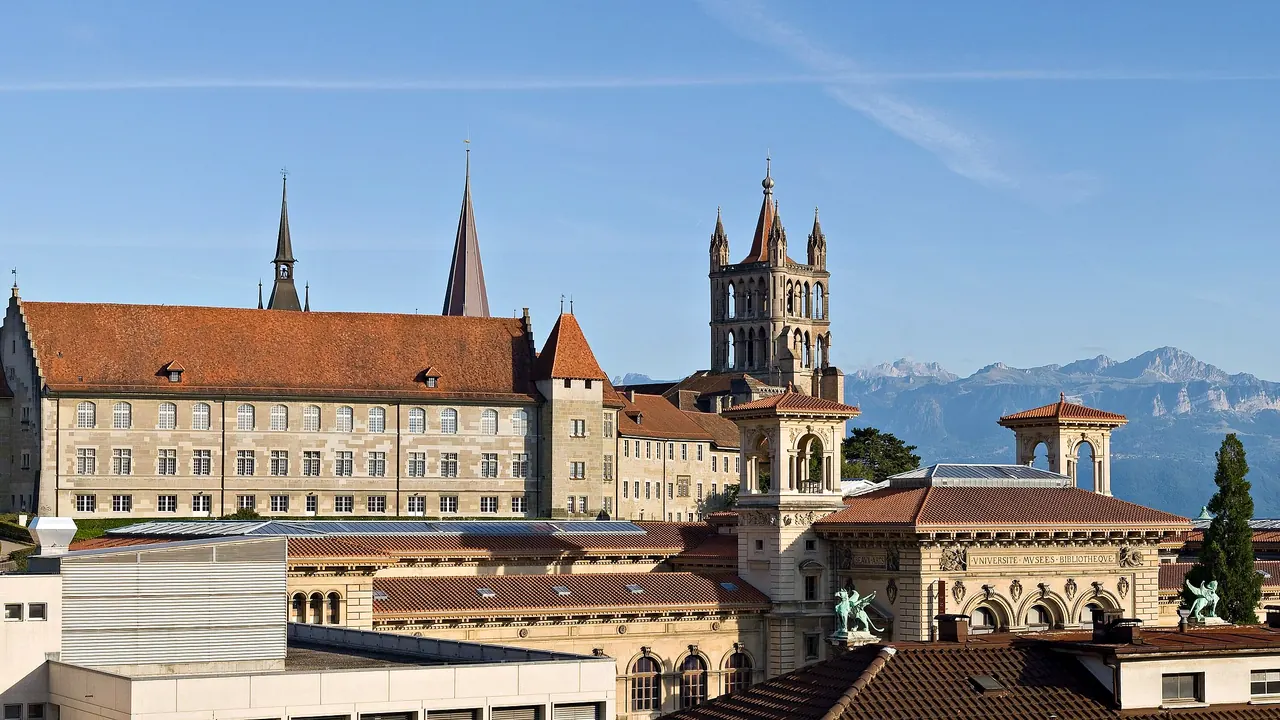
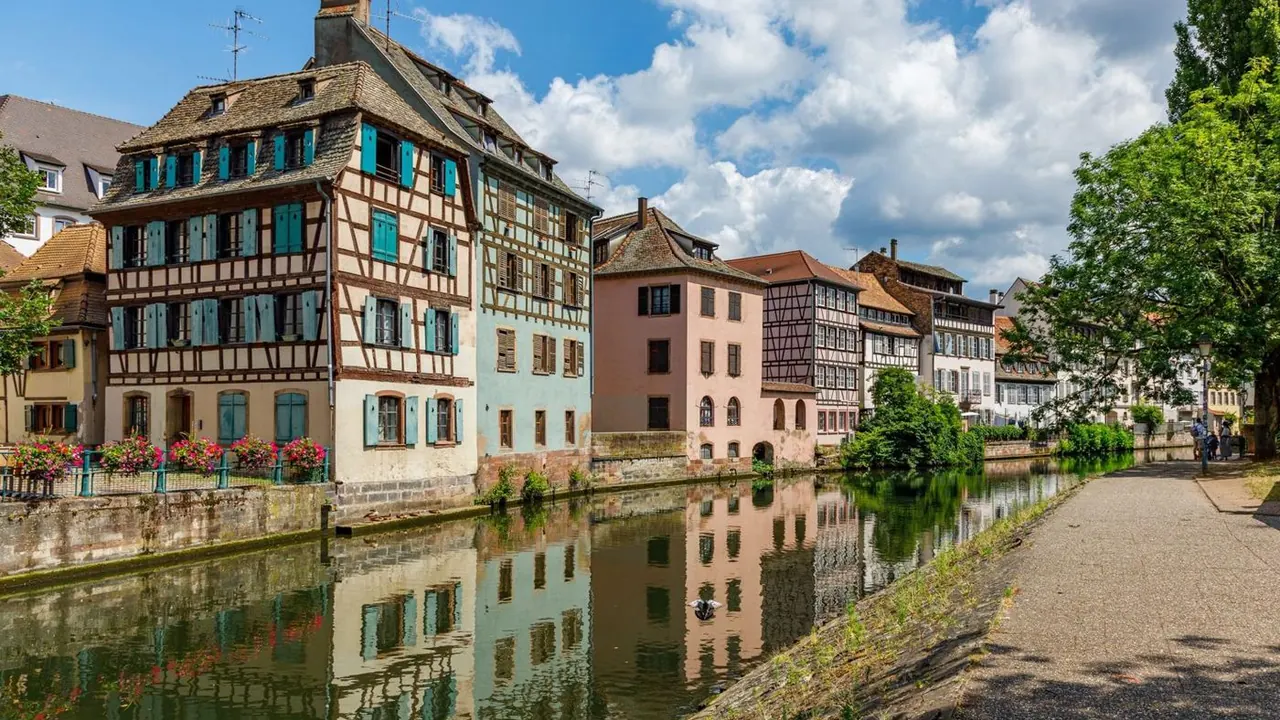
Photos: Lausanne by Christian Mehlführer, CC BY-SA 3.0, cropped; Strasbourg by Edoardo Colombo, Pexels License.
Lausanne or Strasbourg?
Our verdict in twelve categories, each scored against the same fixed benchmark cities, and the climate month by month, so you can choose for your trip.
Choose Lausanne for
- beaches
- nature and the outdoors
- day trips
Lausanne suits travellers who want the landscape to do the work. The Alps rise straight out of the lake opposite, the Lavaux terraces are a short walk east, and trains reach ski slopes, glaciers and Jura ridges within an hour. In summer you can swim off the lawns at Bellerive. It fits walkers, skiers and anyone happy to pay Swiss prices for a base with that view.
Choose Strasbourg for
- prices
- culture and sights
- food and drink
Strasbourg is the better pick if you want the city itself to be the attraction. The cathedral, the timber-framed lanes of Petite France and the imperial Neustadt make a richer old town to wander. Winstub meals with Alsace wine give the food more character, and a stay costs a good deal less. Its flat streets and tram lines also make it an easy few days with children or on a bike.
Scoreboard
Twelve categories on one fixed scale from 0 to 100. The shaded stretch is the gap between the two.
Your match
Pick a travel style or drag the sliders, and both match scores follow your weighting.
Too close to call, 1 point apart
Wins on beaches and nature and the outdoors with your weighting.
Wins on prices and culture and sights with your weighting.
What matters to you?
Category by category
What the scores mean for a trip.
Beaches & swimming
Neither city has a coast, but Lausanne comes much closer to offering a summer swim. Lake Geneva is the city's bathing water, reached from lawns, piers and small pebble shores at Vidy, Bellerive and along towards Lutry, and the old Bellerive lido is a classic afternoon out.
In Strasbourg, swimming means the gravel-pit lakes on the edge of the city. The Baggersee is the best known and is on the tram line, while the Rhine is unsafe. These lakes are fine on a hot day, but they lack the Alpine backdrop and the lakefront setting that make a swim in Lausanne memorable.
Food & drink
Strasbourg is the stronger city for eating. Its Alsatian cooking, with choucroute, baeckeoffe, tarte flambée and foie gras, has a setting of its own in the wood-panelled winstub, where Riesling or Pinot Gris comes by the jug. Rich food and plenty of local beer make it especially rewarding in the cold months. Avoid the tourist menus around the cathedral and Petite France.
Lausanne's cooking is simpler: lake perch, papet vaudois, and fondue in winter. Its high point is the Chasselas tasted in the Lavaux caveaux. The top restaurants are excellent, but the everyday middle is ordinary and expensive.
Culture & sights
Strasbourg has more to see on foot. The pink sandstone cathedral with its astronomical clock, the half-timbered houses over the locks of Petite France and the grand avenues of the Neustadt form one UNESCO-listed townscape. The Palais Rohan, the Oeuvre Notre-Dame and the Alsatian Museum add depth.
Lausanne's Gothic cathedral, where a night watchman still calls the hours, crowns a small old town of stairways and steep lanes, but the streets are not the main reason to visit. The draws are the Olympic Museum at Ouchy, the museum quarter at Plateforme 10 and the unusual Collection de l'Art Brut.
Nightlife
Both cities are student towns that go out modestly, but the styles differ. Lausanne has the clubs, stacked in the old warehouses of the Flon and busy on Friday and Saturday nights, though drinks there are steep. Strasbourg is more about bars and beer cellars in the Krutenau and around Place Saint-Étienne, with riverside terraces in summer and most places quiet by midnight.
Nature & outdoors
Lausanne has much more on its doorstep. The French Alps rise across the lake, the Lavaux terraces offer one of Switzerland's finest walks, and the Vaud Alps are within an hour by train, with skiing at Villars and Les Diablerets and a glacier at Glacier 3000. The Jura adds long ridge hikes and cross-country trails.
Strasbourg's countryside is gentler and flatter. It suits cycling along the Rhine and the canals and spotting storks and beavers in the riverside forests. The Vosges and the Black Forest are about an hour away, but they are easier to reach by car than by train.
Day trips
Both cities make excellent bases, though the trips are different in character. From Lausanne, the train does almost everything: Montreux and the Château de Chillon along the lake, Gruyères for cheese and its castle, and Bern, Fribourg and Geneva for old towns. Boats also cross to Évian.
Strasbourg puts two countries within reach. The Alsace wine villages such as Riquewihr and Eguisheim, plus Colmar's Isenheim Altarpiece, are on one side. Baden-Baden, Freiburg and Heidelberg are across the Rhine. For the vineyard villages, a car or bike helps.
Good for families
Families are equally well looked after in both, but the terrain makes a difference. Strasbourg is flat and largely car-free, so it is easy with a pushchair. It has boat trips around the Grande Ile, storks and rowing boats in the Orangerie, and Europa-Park about an hour away.
Lausanne's slopes are hard work with small children. In return, it has the hands-on Olympic Museum, the aquarium-vivarium, pedal boats and a lookout tower at Sauvabelin, and paddle-steamer outings on the lake.
Getting around
Lausanne is a steep city and Strasbourg a flat one, and that shapes how you get around each. In Lausanne the m2 metro does the climbing, rising more than 300m from the lakeshore through the station to the upper town, while stairways, bridges and lifts link the levels in between.
Strasbourg's island centre is small enough to cross on foot in twenty minutes. Trams and separated bike lanes cover everything else, and one tram line runs across the Rhine to Kehl.
Shopping & style
Strasbourg gives shoppers a little more to work with. Its lanes near the cathedral have independent shops, delicatessens and bookshops, and regional crafts such as Soufflenheim pottery and printed linens make better souvenirs. December brings one of Europe's oldest Christmas markets.
Lausanne's Rue de Bourg is the place for a Swiss watch, chocolate or a bottle of Lavaux wine, but beyond those, its shops are mostly familiar chains.
Affordability
This is where the two differ most. Lausanne carries full Swiss prices for hotels, restaurant meals, wine and taxis, so even a simple lunch adds up. Budget visitors there rely on supermarket picnics and free lakeside walks.
Strasbourg costs what a French regional city does. Winstub meals, tarte flambée, wine by the pichet and tram fares are all reasonable. The main thing to watch is hotel rooms, which climb steeply during the Christmas market and the weeks the European Parliament sits.
Live music & performing arts
Dance is Lausanne's speciality. The Béjart Ballet Lausanne is based here, the Prix de Lausanne brings young dancers to compete, and the lakeside Théâtre de Vidy stages contemporary work that tours Europe. In July, the Montreux Jazz Festival is a short train ride along the lake.
Strasbourg leans towards opera and drama, with the Opéra national du Rhin on Place Broglie and the Théâtre National de Strasbourg, one of France's leading stages. Its autumn Musica festival makes it the better choice for contemporary music, though you need to plan your evenings around the season.
Wellness & relaxation
The two are close here, and both have the best thermal water outside town. Strasbourg has its own historic Bains municipaux, with tiled pools, a hammam and saunas, and Baden-Baden's grand baths are under an hour away. Its flat canal walks make for an unhurried stay.
Lausanne relies on the spas of its grand lakeside hotels, with Yverdon's warm springs and Lavey's hot springs a short train ride away. The calm is found on the promenades and in the vineyards rather than in the steep centre.
When should you go?
Pick your month. The climate figures are measured averages, not a forecast.
Lausanne in July
Strasbourg in July
Daytime high, °C
Rainfall in the month, mm
Where the figures come from
Lausanne's temperatures are measured 40 km from the centre, at Payerne.
Lausanne has no rain gauge within 25 km of the centre, so its rainfall comes from a gridded climate dataset read at the city rather than from a gauge further away.
Temperature and rainfall are climate normals, averaged over the years shown. Lausanne: 1991-2020 (sunshine 1961-1990) normals, Payerne (39.7 km from centre). Strasbourg: 1991-2020 normals, Strasbourg (9.1 km from centre).
The two follow much the same curve through the year. Both are cold from December to February, with highs of around 4°C to 6°C, and both reach about 26°C in July and August. Strasbourg warms a little sooner in spring and holds the warmth a little longer into autumn, so May and September are comfortable for long days of walking. Lausanne's lake is only warm enough for swimming from late June to early September.
The real difference is rain. Strasbourg is the drier of the two all year, and its winter months are especially dry. Lausanne is wettest in summer, at about 115mm in July, although it also gets more sunshine than Strasbourg in those months, so showers tend to pass between bright spells. Lausanne's winters are grey with fog in town, but the nearby mountains are often sunny above it, which makes it a good winter base for skiers.
Which traveller are you?
On an outdoors trip, Lausanne is the stronger base. You can spend each day somewhere different, on the water, along the vineyard paths or high in the mountains, and still be back in town by train for dinner, in summer or winter.
For a trip on a tight budget, Strasbourg lets you travel normally rather than defensively. You can eat out every day, add an extra night and take the day trips without much worry. In Lausanne you would have to ration almost everything.
On a culture and arts trip, Strasbourg suits the visitor who likes to wander, because its history is in the streets as much as behind museum doors. Lausanne fits a more targeted visit: a few strong collections and an evening of ballet or theatre.
Before you go
| Measure | Lausanne | Strasbourg |
|---|---|---|
| Official language | French, German, Italian, Romansh | French |
| Currency | Swiss Franc (CHF) | Euro (EUR) |
| Sockets | CJ230 V, 50 Hz | CE230 V, 50 Hz |
| Driving side | Right | Right |
| Time zone | UTC+1, UTC+2 in summer | UTC+1, UTC+2 in summer |
| Emergency number | 112 | 112 |
| Elevation | 495 m | 132 m |
| Main airport | Geneva International Airport (GVA)52 km from centre150 non-stop destinations | Strasbourg Airport (SXB)10 km from centre43 non-stop destinations |
| Public holidays this year | 9 days | 11 days |
By the numbers
| Measure | Lausanne | Strasbourg |
|---|---|---|
| City population | 144,873 | 293,771 |
| People per km² | 3,499 | 3,752 |
| Museums within 10 km | 31 | 21 |
| UNESCO World Heritage sites within 50 km | 3 | 3 |
Where else could you go?
Every comparison below shares a destination with this one, so you can follow Lausanne or Strasbourg somewhere new.
- Baden-Badenvs Strasbourg
- Genevavs Lausanne
- Colmarvs Strasbourg
- Chamonixvs Lausanne
- Bernvs Lausanne
- Annecyvs Lausanne