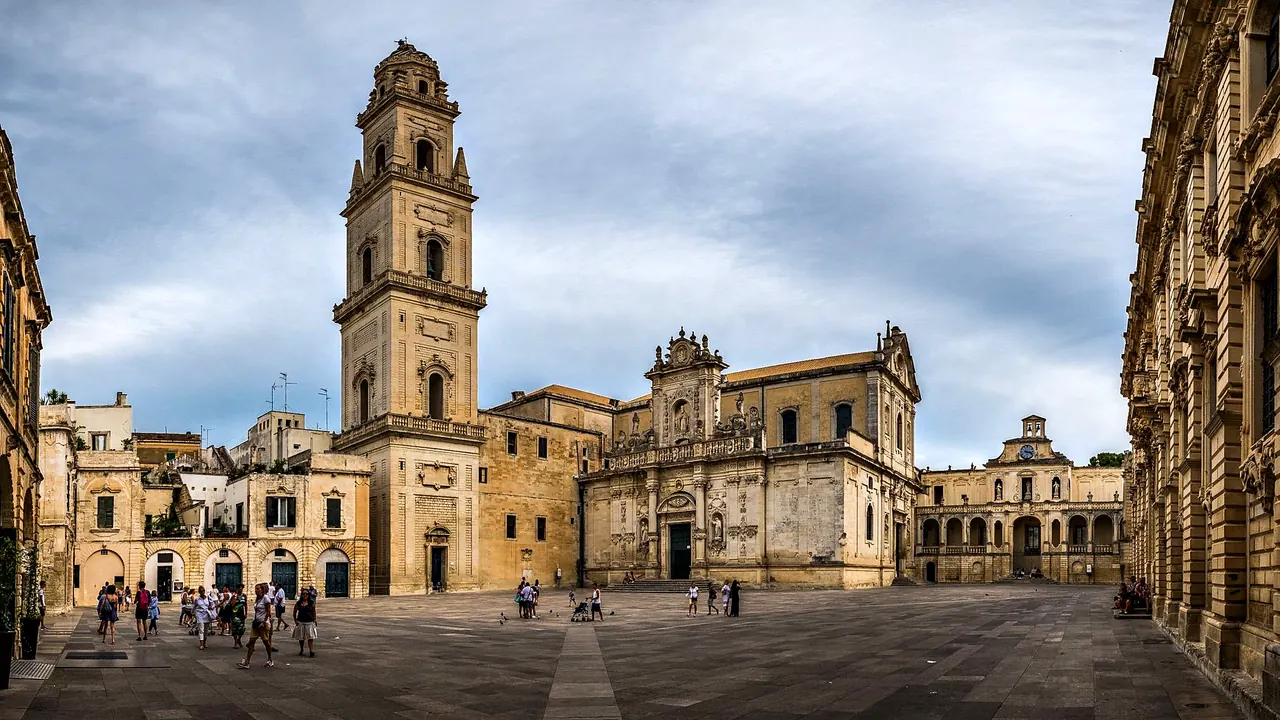
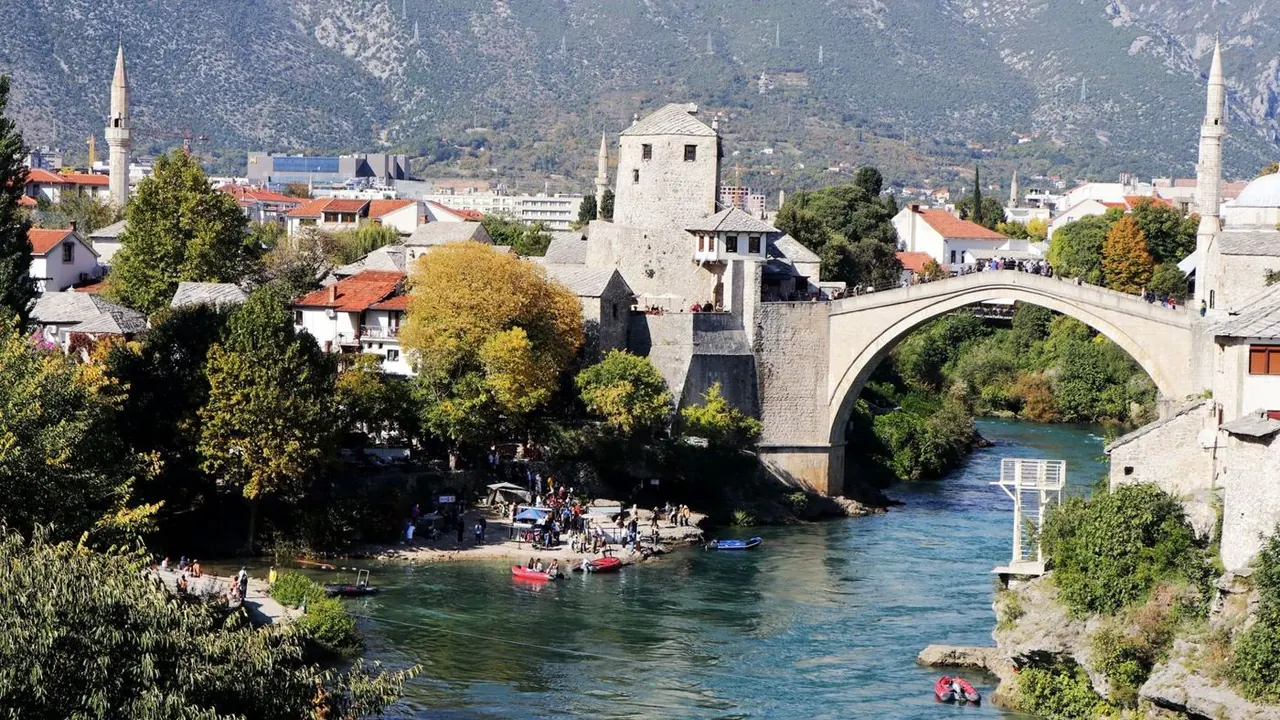
Photos: Lecce by Giuseppe Milo, CC BY 3.0, cropped; Mostar by Alan Wang, Pexels License.
Lecce or Mostar?
Our verdict in twelve categories, each scored against the same fixed benchmark cities, and the climate month by month, so you can choose for your trip.
Choose Lecce for
- beaches
- wellness
- food and drink
Lecce is the choice for a summer week built around the sea. Two coasts of sand and clear water are within an hour, the carved Baroque streets make the evenings, and the cooking, the pizzica festivals and the spa masserie add to the stay. Its flat, traffic-free lanes and shallow beaches also make it the easier of the two with children.
Choose Mostar for
- prices
- nature and the outdoors
Pick Mostar if you want mountains and a smaller bill. The Old Bridge and the Ottoman lanes fill a day or two, and then Herzegovina takes over, with rafting in the Neretva canyons, hiking below Velež and Prenj, and the spring at Blagaj. Guesthouses and meals cost far less than in the Salento, which suits travellers on a budget and anyone touring the Balkans.
Scoreboard
Twelve categories on one fixed scale from 0 to 100. The shaded stretch is the gap between the two.
Your match
Pick a travel style or drag the sliders, and both match scores follow your weighting.
Wins on beaches and wellness with your weighting.
Wins on prices and nature and the outdoors with your weighting.
What matters to you?
Category by category
What the scores mean for a trip.
Beaches & swimming
This is the widest gap between the two. Lecce is close to two seas: the coves and sea stacks of Torre dell'Orso on the Adriatic, and the long, shallow, clear beaches of Porto Cesareo and Punta Prosciutto on the Ionian. In summer the whole stay can be built around mornings on the sand.
Mostar has no beach life at all. The Neretva is too cold for more than a quick jump from the rocks, the pool beneath the Kravica waterfalls is the real swim, and the sea at Neum or Makarska means a full day out.
Food & drink
Lecce has the richer table. Its day runs from pasticciotto and iced almond coffee through rustico at mid-morning to ciceri e tria and orecchiette with turnip tops, with Negroamaro and Primitivo on the side, and the simple osterie of the old town do it well.
Mostar's cooking is hearty and satisfying, built on charcoal-grilled ćevapi, burek and slow-cooked stews, with Žilavka and Blatina wines and the ritual of Bosnian coffee. It has fewer dishes to explore, and the terraces by the bridge are more about the view than the cooking.
Culture & sights
Lecce gives you a whole town of carved honey-coloured stone, from Santa Croce to the enclosed Piazza del Duomo, with a Roman amphitheatre under the main square and underground Messapian layers. You can walk it for days and keep finding facades.
Mostar's sights centre on one great image, the rebuilt Stari Most with divers leaping from it, plus the bazaar, a climbable minaret and Ottoman houses. The war-scarred front line adds a recent history Lecce does not have, but the set is done in a day or two.
Nightlife
Neither city is a reason to go out, but Lecce has more evening to it. The passeggiata leads into aperitivo on the piazzas and on to wine and cocktail bars in the lanes, students keep weekends lively, and summer adds beach clubs near Gallipoli. Mostar's evenings mostly end at dinner on a terrace facing the lit bridge, with only a few bars and clubs open late.
Nature & outdoors
Mostar has the wilder setting. Bare limestone mountains surround it, the Prenj range is among the most rugged in the Balkans, and the Neretva canyons offer rafting and kayaking, with the Buna spring, Blidinje plateau and Hutovo Blato wetland all within reach.
Lecce's countryside is a flat plain of olive groves, good for gentle cycling. Its outdoors is the sea: clifftop paths and sea caves from Roca Vecchia to Leuca, the pine woods of Porto Selvaggio, and snorkelling and diving rather than mountains.
Day trips
Lecce opens up a wider region. Otranto's cathedral mosaic, Gallipoli on its island, Galatina's frescoes, white Ostuni and the trulli of Alberobello add up to a full week of outings.
Mostar's trips are smaller and more intimate: the dervish house at Blagaj, the hillside village of Počitelj, Stolac's medieval tombstones and the bridges of Jablanica and Konjic. Sarajevo makes a long day by train through the gorge. In both places a car makes most of these far easier.
Good for families
Lecce is the easier place with children. The old town is flat and mostly free of traffic, families fill the piazzas at night, and the shallow sand around Porto Cesareo suits toddlers.
Mostar works for a short visit, with the bridge divers and Kravica as the highlights, and children are welcomed everywhere. But its steep, polished cobbles are hard with a pushchair, and the valley heat is tougher on small children than Lecce's.
Getting around
The two are much the same: easy on foot in the centre, harder beyond it. Lecce's old town is flat and partly pedestrian, and its trains run quickly north to Bari, though the Salento coast really needs a car. Mostar's centre is a short riverside walk on slippery cobbles, and Blagaj or Kravica need a car, taxi or tour, while the train to Sarajevo is a scenic way out.
Shopping & style
Neither is somewhere to shop seriously, and they differ in craft. In Lecce, look for cartapesta saints and nativity figures from the old-town workshops, small pieces carved in local stone, and olive oil and wine. In Mostar, the Kujundžiluk sells hand-hammered copper coffee sets and kilims, though only among a lot of imported souvenirs.
Affordability
Mostar is clearly the cheaper of the two. Rooms in family guesthouses, grilled meals and local wine cost little, and prices drop a few streets away from the bridge.
Lecce is good value by Italian standards, with cheap pastries and trattorias, but it costs more overall. August pushes up rooms and beach loungers across the Salento, and a hire car adds to the bill.
Live music & performing arts
Lecce has the stronger live scene, mostly because of pizzica, the tambourine dance played at village festivals all summer and at the huge Notte della Taranta in Melpignano in August. The Teatro Paisiello and Politeama Greco add opera and concerts. Mostar's theatres perform mostly in local languages, and outside summer concerts, live music rarely goes beyond a band in a café.
Wellness & relaxation
Lecce offers more for a restful stay. The sulphur grottoes of Santa Cesarea Terme are under an hour away above the sea, and old fortified masserie on the plain have become quiet spa retreats.
Mostar's hammam no longer works as a bath, and treatments are limited to a few hotels. Rest there comes from slow coffees in the shade and the quiet old town early in the morning, before the tour groups arrive.
When should you go?
Pick your month. The climate figures are measured averages, not a forecast.
Lecce in July
Mostar in July
Daytime high, °C
Rainfall in the month, mm
Where the figures come from
Lecce's temperatures are measured 38 km from the centre, at Brindisi.
Lecce has no rain gauge within 25 km of the centre, so its rainfall comes from a gridded climate dataset read at the city rather than from a gauge further away.
Temperature and rainfall are climate normals, averaged over the years shown. Lecce: 1991-2020 (sunshine 1981-2010) normals, Brindisi (38 km from centre). Mostar: 1991-2020 normals, Mostar (0.9 km from centre).
Lecce is at its best from late May to early October. The sea is warm enough to swim in from June and reaches about 26°C in August, and summer is dry and very sunny. Midday in July and August is hot, so June and September are better for walking the old town. Rain arrives in autumn and is heaviest in November. Winter is mild but grey, fine for the Baroque streets and little else.
Mostar has bigger swings. The valley reaches 33°C in July and August, which makes the middle of the day hard for sightseeing. Winter is colder and much wetter, with nearly 200mm of rain in December. May and June are its best months, warm and fairly dry for the canyons and the old town. September is cooler but the rain returns, with 143mm, so plan a visit then around wet days. Lecce stays the drier of the two well into autumn.
Which traveller are you?
For a beach and sun trip, Lecce wins easily. Sandy Ionian beaches at Porto Cesareo and the coves of Torre dell'Orso are within an hour, while Mostar's swimming is a cold river plunge or a day trip to Kravica.
On a tight budget, Mostar stretches the money further. Guesthouses, ćevapi, local wine and coffee all cost little, whereas Lecce, though fair for Italy, turns expensive in August and usually needs a hire car to reach the coast.
On a relaxing and wellness trip, Lecce has more to offer. The sulphur springs of Santa Cesarea Terme are close, country masserie have spas, and the long afternoon rest sets a slow pace. Mostar's hammam is a monument, not a working bath.
Before you go
| Measure | Lecce | Mostar |
|---|---|---|
| Official language | Italian | Croatian, Serbian, Bosnian |
| Currency | Euro (EUR) | Convertible Mark (BAM) |
| Sockets | CFL230 V, 50 Hz | CF230 V, 50 Hz |
| Driving side | Right | Right |
| Time zone | UTC+1, UTC+2 in summer | UTC+1, UTC+2 in summer |
| Emergency number | 112 | 112 |
| Elevation | 49 m | 60 m |
| Main airport | Brindisi Airport (BDS)39 km from centre49 non-stop destinations | Sarajevo International Airport (SJJ)68 km from centre38 non-stop destinations |
| Public holidays this year | 13 days | 8 days |
By the numbers
| Measure | Lecce | Mostar |
|---|---|---|
| City population | 94,783 | 105,448 |
| People per km² | 393 | 90 |
| Museums within 10 km | 11 | 3 |
| UNESCO World Heritage sites within 50 km | 0 | 1 |
| Swim season, months above 21 °C | 4 months | - |
Where else could you go?
Every comparison below shares a destination with this one, so you can follow Lecce or Mostar somewhere new.