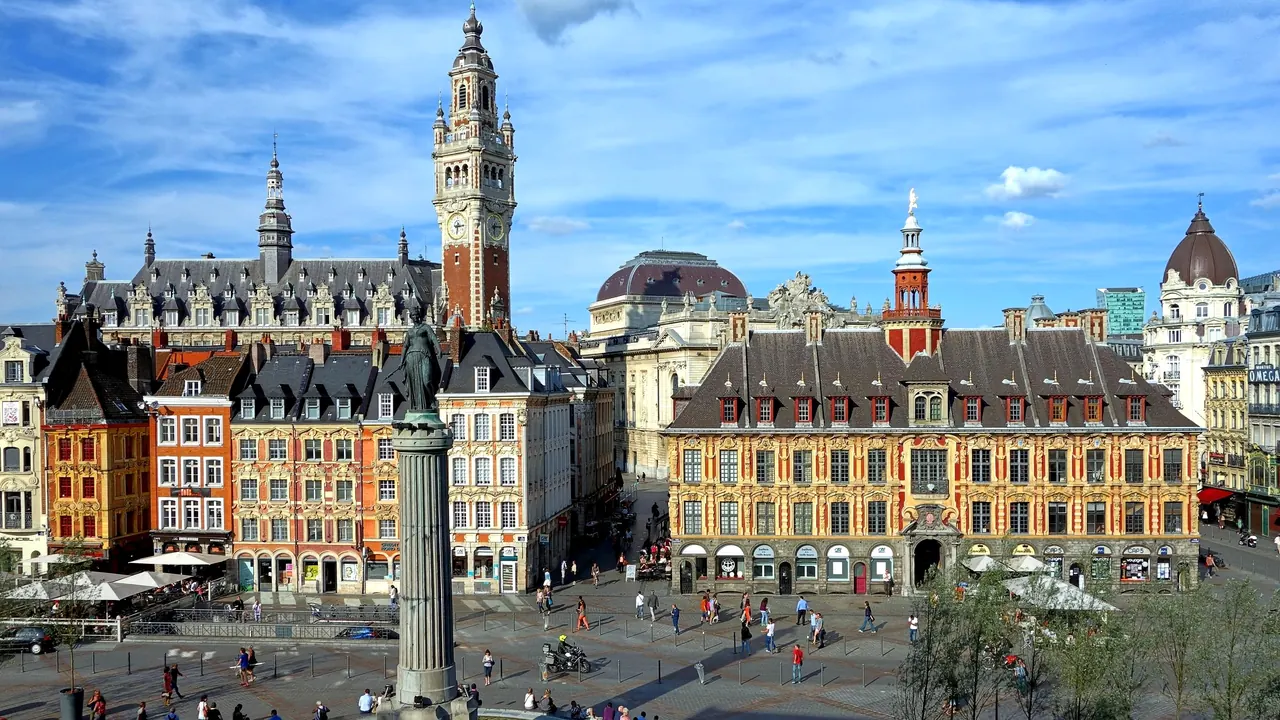
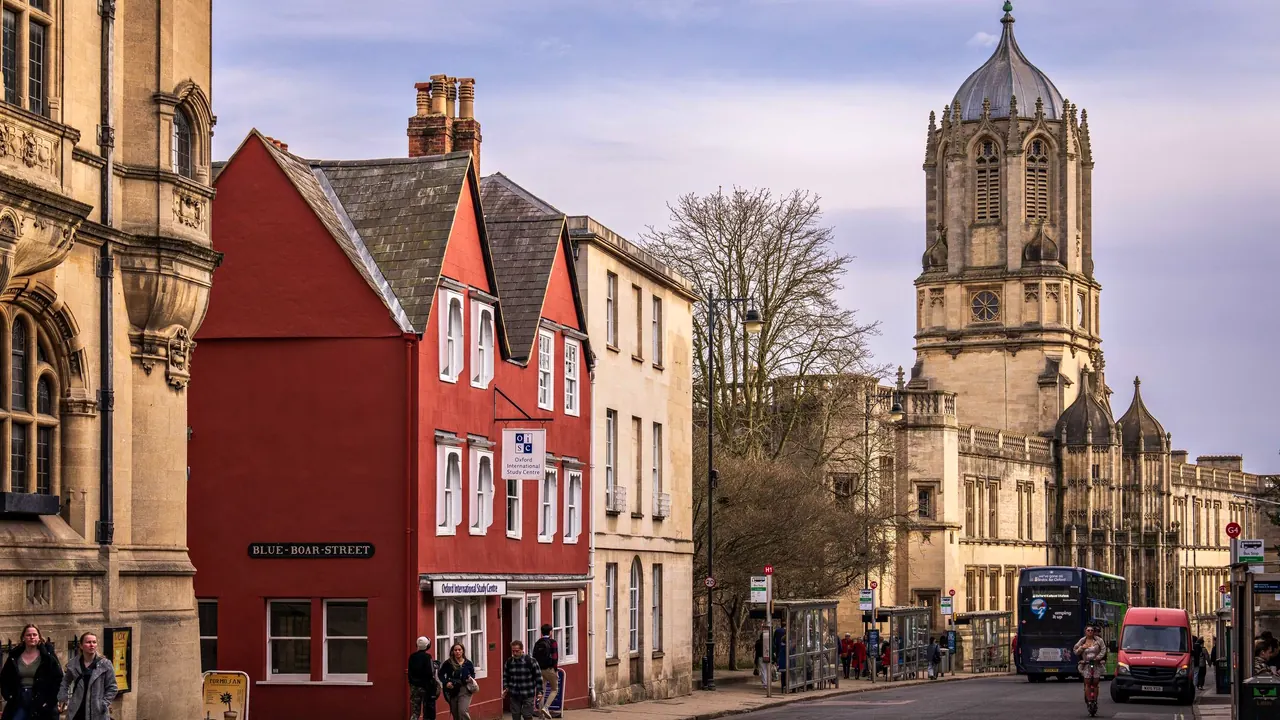
Photos: Lille by Velvet, CC BY-SA 3.0, cropped; Oxford by Mark Stebnicki, Pexels License.
Lille or Oxford?
Our verdict in twelve categories, each scored against the same fixed benchmark cities, and the climate month by month, so you can choose for your trip.
Choose Lille for
- food and drink
- nightlife
- prices
Lille suits travellers who want to eat and drink well, go out in the evening and keep costs down. Its Flemish taverns, beer culture and student bar streets give the evenings more life than Oxford's. Its stations sit beside the old town, so Brussels, Ghent and Paris are easy to reach, which makes it a strong base for a trip that crosses borders.
Choose Oxford for
- nature and the outdoors
- culture and sights
- wellness
Choose Oxford when the setting itself is the point. It has college quads and libraries, Evensong in candlelit chapels, and meadows and river walks a few minutes from the centre. It costs more to sleep in and goes to bed earlier. Even so, for scholarly architecture, free museums and Cotswold countryside on the doorstep, it is the better choice.
Scoreboard
Twelve categories on one fixed scale from 0 to 100. The shaded stretch is the gap between the two.
Your match
Pick a travel style or drag the sliders, and both match scores follow your weighting.
Wins on food and drink and nightlife with your weighting.
Wins on nature and the outdoors and culture and sights with your weighting.
What matters to you?
Category by category
What the scores mean for a trip.
Beaches & swimming
Neither city is a place for beach life, but Lille is the one with sand within reach. Malo-les-Bains at Dunkirk is about an hour away by train, with the Opal Coast dunes further on, though the North Sea stays cold. Oxford has no coast nearby at all, so swimming there means a summer dip in the Thames at Port Meadow, in the Cherwell or at the open-air pool at Hinksey.
Food & drink
Lille has a regional cooking tradition of its own, and that is the big difference. Wood-panelled estaminets serve beer-braised carbonnade, waterzooi, Maroilles tarts and the welsh, with Belgian and northern French ales taking the place wine has elsewhere in France. On Sundays, Wazemmes market adds a multi-ethnic spread.
In Oxford you eat well rather than memorably: a Sunday roast at a riverside pub, lunch at the Covered Market stalls, and cheap international food along Cowley Road. Neither city has much fine dining, but only Lille gives you a reason to plan your meals around local dishes.
Culture & sights
Oxford has the stronger and more concentrated set of sights. Its honey-coloured colleges, the Radcliffe Camera, the Bodleian and Christ Church make up a working medieval university you can walk through. The Ashmolean, the Pitt Rivers and the Natural History Museum add more depth than you would expect in a city this size.
Lille relies mainly on one great museum, the Palais des Beaux-Arts, with its Flemish masters and relief maps, plus the Flemish baroque buildings of the Vieille Bourse and the Grand Place. La Piscine in Roubaix is a memorable extra, but Lille's sights are more spread out than Oxford's.
Nightlife
Lille has the much stronger night out. Its large student population packs Rue Masséna and Rue Solférino on Thursdays, Vieux-Lille's brick cellars hold quieter beer and cocktail bars, and the Belgian border is close for late-night clubbing.
Oxford's evenings centre on historic pubs and riverside terraces, and Cowley Road is its only lively strip. The centre is usually calm by midnight, and quieter still outside term.
Nature & outdoors
Oxford has far more green space close at hand. Port Meadow, Christ Church Meadow and the University Parks are all within walking distance, and punting is the classic pastime. For proper long walks, the Cotswolds, the Chilterns and the Ridgeway are within an hour.
Around Lille, French Flanders is flat farmland. The Citadel park and the Deûle towpaths are good for easy cycling and the Monts de Flandre for short walks, but for real scenery you need a long day out to the cliffs at Cap Blanc-Nez.
Day trips
Both cities make excellent bases, and the difference is where the trips take you. From Lille they cross borders: fast trains reach Brussels in about half an hour, Ghent, Bruges and Antwerp soon after, and Paris in around an hour by TGV. Closer to home, Arras, Amiens cathedral and the Louvre-Lens are easy outings, though the First World War battlefields around Ypres, Vimy and the Somme are best seen by car or with a tour.
Oxford's trips stay in England, to stately homes and countryside. Blenheim Palace is twenty minutes away, Stratford, Warwick, Windsor and Bath are within about an hour and a half, and London is an hour by train. As with Lille's battlefields, the Cotswold villages are much easier with a car or a tour.
Good for families
Neither city is built around children, but both work well for a few days. In Lille the main draw is the Citadel park, with its small zoo, playgrounds and flat paths. The Forum des Sciences is a metro ride away, and Pairi Daiza and Nausicaá make bigger days out.
Oxford's strengths are its free museums, with dinosaur skeletons and the curiosities of the Pitt Rivers, plus punting, and the Harry Potter settings at Christ Church for older children. Pushchairs cope better with Oxford's traffic-free streets than with the cobbles of Vieux-Lille.
Getting around
Both centres are flat and small enough to walk, and a car is a hindrance in either. Lille also has a fully automated metro and a tram to Roubaix and Tourcoing. Its two stations sit beside the old town, which makes its rail day trips easy.
Beyond the centre, Oxford relies on buses and bicycles. Drivers leave their cars at the park-and-ride sites, and the railway station is a short walk from the colleges.
Shopping & style
Lille has a slight edge, mostly thanks to Vieux-Lille's independent fashion and design shops and delicatessens, along with the Euralille mall and the Sunday market at Wazemmes. Its September Braderie turns the whole city into a flea market, and it is worth timing a visit around it.
Oxford's shopping is about speciality rather than range: Covered Market traders, antique maps and prints, a historic bookshop on Broad Street and university clothing. For designer labels, the outlet village near Bicester is close by.
Affordability
Lille is noticeably cheaper. Hotel rooms are reasonably priced except during the Braderie and the big trade fairs, and estaminet meals, beer and the metro are all fairly priced.
Oxford's problem is where to sleep. There are few central rooms and steady demand from university events, which keeps prices high, so many visitors stay by the ring road or come for the day from London. Free museums and pub meals help once you are there, but college entry fees add up.
Live music & performing arts
Both have a solid season rather than a headline draw, but the character differs. In Lille the emphasis is on the big stage: opera and dance at the Opéra de Lille, the Orchestre National de Lille, the Théâtre du Nord, and contemporary dance in Roubaix and Tourcoing.
Oxford's speciality is choral music. In term, the choirs of Christ Church, Magdalen and New College sing Evensong, and there are concerts at the Sheldonian and the Holywell Music Room.
Wellness & relaxation
Neither city is a spa destination, and in both the main option for treatments is a hotel spa. Lille's nearest thermal bath is a train ride out at Saint-Amand-les-Eaux, and in town, relaxing means tea rooms and terraces in Vieux-Lille.
Oxford's calm is right in the centre: the Botanic Garden, the walled college gardens, Addison's Walk and an afternoon on a punt. These are best early in the day, before the tour groups arrive.
When should you go?
Pick your month. The climate figures are measured averages, not a forecast.
Lille in July
Oxford in July
Daytime high, °C
Rainfall in the month, mm
Where the figures come from
Oxford's temperatures are measured 37 km from the centre, at Fairford Royal Air Force Base.
Oxford has no rain gauge within 25 km of the centre, so its rainfall comes from a gridded climate dataset read at the city rather than from a gauge further away.
Oxford's sunshine is measured 57 km from the centre, at Lyneham.
Temperature and rainfall are climate normals, averaged over the years shown. Lille: 1991-2020 normals, Lille (7.8 km from centre). Oxford: 1961-1990 (sunshine 1991-2020, rainfall 1991-2020) normals, Fairford Royal Air Force Base (37 km from centre).
Both cities have a mild, changeable northern climate, and neither is a beach destination in any month. Lille runs a little warmer, reaching about 24°C in July and August against Oxford's peak of 22°C in July. That makes Lille's high summer the better time for a day on the North Sea coast. Summer sunshine is almost the same in both, at around 200 hours a month from May to August.
Rain falls all year in both, but the pattern differs. Lille is wettest in late autumn and winter, peaking at 76mm in December, while Oxford's wettest stretch is October and November at about 69mm. Winters are cool and dull in both, never too cold for sightseeing but short on light. May to September is the best time for either, and late spring is especially good for Oxford's meadows and gardens.
Which traveller are you?
For a food and nightlife trip, Lille is the clear choice. You get estaminets serving carbonnade and potjevleesch, Belgian ales and brewery taps, then student bars on Rue Masséna or cellar bars in Vieux-Lille. Oxford's pubs mostly go quiet by midnight.
On an outdoors trip, Oxford wins. Port Meadow, the Thames Path and punting all start a short walk from the colleges, and the Cotswolds, Chilterns and Ridgeway are within an hour. Lille's flat Flanders farmland mostly offers canal towpaths and low hills.
On a tight budget, Lille makes your money go further. Its hotels are reasonably priced for most of the year and estaminet meals are fairly priced. In Oxford, central rooms are scarce and expensive, which pushes many visitors out to the ring road, although its free museums help.
Before you go
| Measure | Lille | Oxford |
|---|---|---|
| Official language | French | English |
| Currency | Euro (EUR) | Pound Sterling (GBP) |
| Sockets | CE230 V, 50 Hz | G230 V, 50 Hz |
| Driving side | Right | Left |
| Time zone | UTC+1, UTC+2 in summer | UTC, UTC+1 in summer |
| Emergency number | 112 | 112 or 999 |
| Elevation | 17 m | 73 m |
| Main airport | Lille Airport (LIL)8 km from centre61 non-stop destinations | London Heathrow Airport (LHR)63 km from centre224 non-stop destinations |
| Public holidays this year | 11 days | 8 days |
By the numbers
| Measure | Lille | Oxford |
|---|---|---|
| City population | 238,246 | 147,500 |
| People per km² | 6,846 | 3,235 |
| Museums within 10 km | 23 | 11 |
| UNESCO World Heritage sites within 50 km | 6 | 1 |
Where else could you go?
Every comparison below shares a destination with this one, so you can follow Lille or Oxford somewhere new.