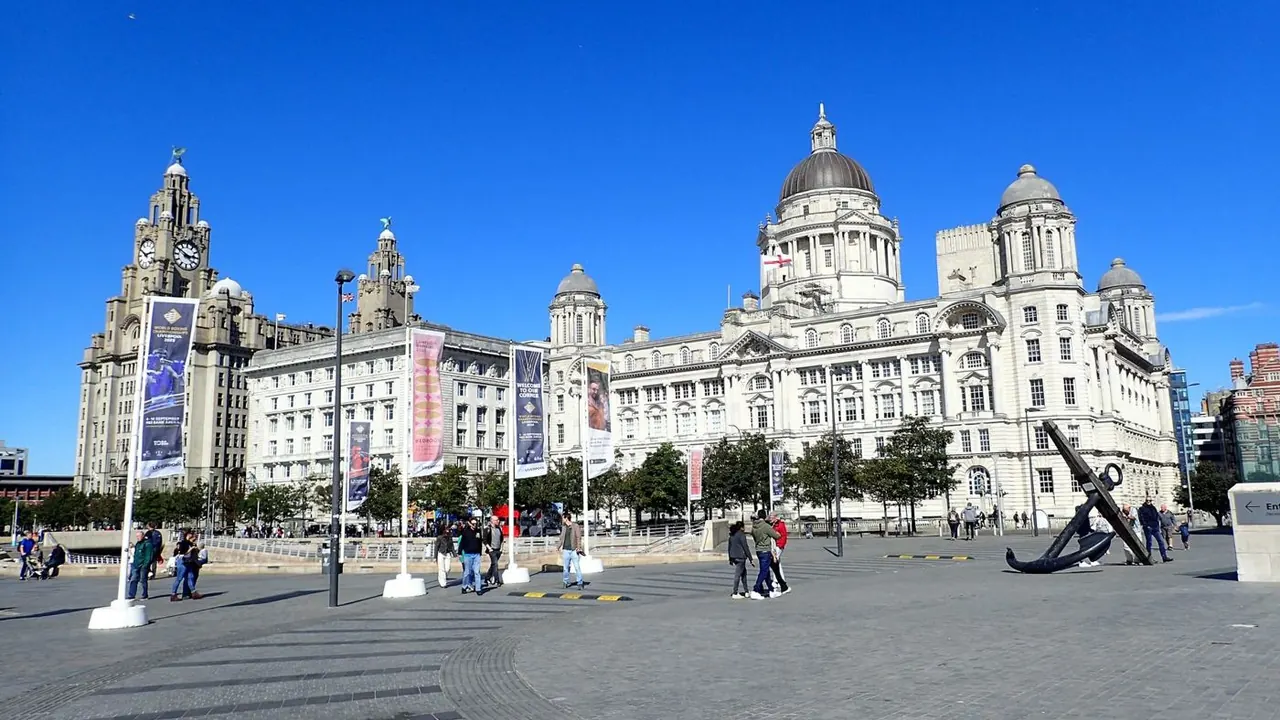
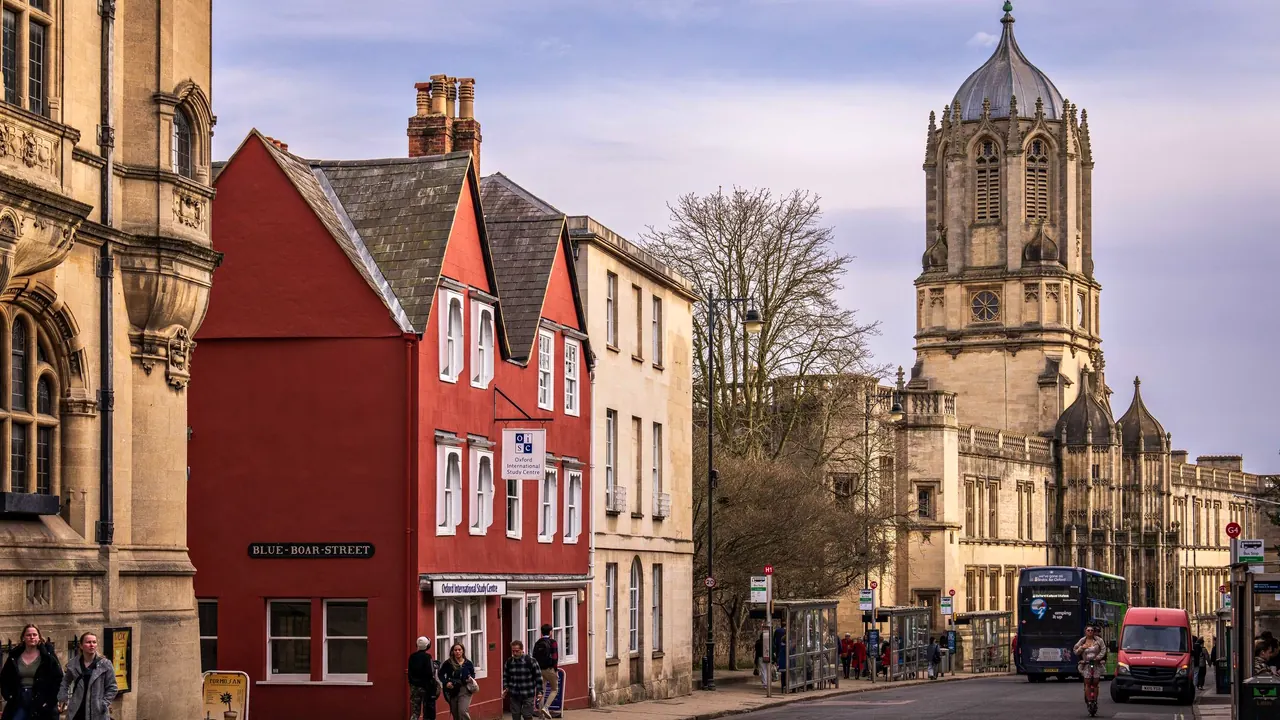
Photos: Liverpool by Marathon, CC BY-SA 2.0, cropped; Oxford by Mark Stebnicki, Pexels License.
Liverpool or Oxford?
Our verdict in twelve categories, each scored against the same fixed benchmark cities, and the climate month by month, so you can choose for your trip.
Choose Liverpool for
- nightlife
- prices
- beaches
Liverpool is the better pick if you want a lively city that doesn't cost too much. Its nights run late through Concert Square and the Baltic Triangle, live bands play somewhere most evenings, and the great port museums on the Albert Dock are free. Hotels cost noticeably less than in Oxford, so a long weekend of music, pubs and waterfront sightseeing goes a good deal further here.
Choose Oxford for
- day trips
- wellness
- culture and sights
Oxford suits a quieter, more scholarly trip. Its college quadrangles, libraries and the Ashmolean are packed into a few walkable streets, and it makes an outstanding base for exploring further afield, with Blenheim, the Cotswold villages, Bath and London all within easy reach. It is the dearer place to sleep and calm by midnight, but for anyone who wants Evensong, gardens and a different outing each day, it is the stronger choice.
Scoreboard
Twelve categories on one fixed scale from 0 to 100. The shaded stretch is the gap between the two.
Your match
Pick a travel style or drag the sliders, and both match scores follow your weighting.
Wins on nightlife and prices with your weighting.
Wins on day trips and wellness with your weighting.
What matters to you?
Category by category
What the scores mean for a trip.
Beaches & swimming
Liverpool at least has a coastline. Merseyrail runs out to the Gormley figures at Crosby and the dune-backed sands of Formby, and New Brighton and West Kirby lie across the river. The Irish Sea stays cold, though, and the tides and mud make the shore a place for windy walks rather than swimming.
Oxford is about as far from the sea as you can get in England. Its swimming is fresh water: the Thames by Port Meadow, the Cherwell and the open-air pool at Hinksey. These are good for a dip on a hot day, but there is no beach of any kind.
Food & drink
Liverpool eats a little more interestingly. It has a dish of its own in scouse, a long-established Chinatown, the independent cafés and international kitchens of Bold Street and the street-food halls of the Baltic Triangle. Oxford's best meals are pub meals, a riverside Sunday roast or lunch at a stall in the Covered Market, with Cowley Road for cheap Middle Eastern and South Asian food. Neither city is a reason to travel for fine dining, but Liverpool gives you more variety.
Culture & sights
Oxford has the edge because so much of its history is still in use and so close together. The Radcliffe Camera, the Bodleian, the Sheldonian and the colleges of Christ Church, Magdalen and Merton are all a few minutes apart on foot. The Ashmolean, Pitt Rivers and Natural History Museum are much stronger than you would expect in a city this small.
Liverpool tells a different story, that of a great port. You get the Three Graces, the warehouses of the Royal Albert Dock with the maritime and slavery museums, the Pre-Raphaelite paintings at the Walker and two very different 20th-century cathedrals. It is rich, but more spread out and more modern in feel.
Nightlife
This is where the two differ most. Liverpool is a party city: Concert Square and Seel Street fill up at weekends, stag and hen groups are part of the scene, and the Baltic Triangle's warehouses run late electronic nights. Lark Lane offers something quieter.
In Oxford, an evening out usually means a historic tavern or a riverside pub. Cowley Road has a few late bars and small clubs, but the centre is calm by midnight and quieter still during the long summer break.
Nature & outdoors
The two are broadly level, but the landscapes are different. Liverpool's outdoors is coastal: the pinewoods and dunes at Formby with their red squirrels, the Wirral Way out to the wading birds of the Dee estuary, and Sefton Park with its palm house. Real hills are two hours off.
Oxford's green space starts right in the centre, with Port Meadow, Christ Church Meadow and punting on the Cherwell. The Cotswolds, the Chilterns and the Ridgeway are all within an hour, so gentle hill walking is much easier to reach from here.
Day trips
Oxford is the far better base. Blenheim Palace is twenty minutes away, the Cotswold villages such as Burford and Bibury are within an hour by car, and London is an hour by train. Stratford, Warwick, Windsor and Bath all make full days out.
Liverpool has Chester's Roman walls and Rows close by, Manchester under an hour away, and Port Sunlight and Southport nearer still. Beyond Conwy and Llandudno the choice thins out quickly, and the Lake District is really too far for a day.
Good for families
Both cities are easy with children, and both have free museums with dinosaurs. Liverpool has more within the city itself: the World Museum's planetarium and aquarium room, a play gallery at the Museum of Liverpool and the Mersey ferry, with Chester Zoo and Knowsley Safari Park close by. Its loud weekend centre is something to plan around.
Oxford wins children over with punting, the masks and boats of the Pitt Rivers and Harry Potter settings at Christ Church. Beyond that, most of what the city offers is aimed at adults.
Getting around
Oxford is slightly easier to get around. Its flat core can be crossed on foot in twenty minutes, several streets are closed to through traffic, bikes are everywhere and the station is a short walk from the colleges. Drivers are better off using the park-and-ride.
Liverpool's main sights lie within about 2km of one another, but Hope Street means a climb. Merseyrail is excellent for the coast and the Wirral. Sefton Park and Anfield, though, mean dealing with a bus network that confuses visitors.
Shopping & style
For everyday shopping there is little between them, but the character differs. Liverpool ONE gathers the big chains and department stores in one open-air district, while Bold Street is the place for vintage clothes and records. Oxford's appeal is in its smaller details: the Covered Market, antique map sellers and the vast basement of Blackwell's. It also has the outlet village near Bicester for designer labels, which Liverpool lacks.
Affordability
Liverpool is clearly cheaper, mainly because of where you sleep. Its hotels cost well below Oxford's except on match, race and concert weekends. In Oxford, the small supply of central rooms and constant university events keep prices high, and many visitors stay by the ring road or come for the day from London. Both cities have free main museums and reasonable pub food, but Oxford's college entry fees and library tours add to the bill.
Live music & performing arts
Liverpool has more going on night after night. Bands play the pubs and small venues of Mathew Street and the Baltic Triangle, the Cavern keeps its cellar busy, the Royal Liverpool Philharmonic plays a full season on Hope Street, and the Everyman and Playhouse produce their own theatre.
Oxford's strength is narrower but special. Choral Evensong at Christ Church, Magdalen and New College, sung by choirs of world standing, is something Liverpool cannot match, and there is chamber music in the historic Holywell Music Room. Its theatre and gigs are smaller and mostly touring productions.
Wellness & relaxation
Neither city has spas or a bathing tradition worth travelling for, but Oxford is the easier place to slow down. The Botanic Garden, the walled college gardens and the deer park and Addison's Walk at Magdalen are lovely early in the day, and a lazy punt does the rest. Liverpool's quiet comes in smaller doses, such as a walk in Sefton Park or a ferry crossing, and its centre gets loud at weekends.
When should you go?
Pick your month. The climate figures are measured averages, not a forecast.
Liverpool in July
Oxford in July
Daytime high, °C
Rainfall in the month, mm
Where the figures come from
Liverpool's temperatures are measured 47 km from the centre, at Manchester Airport.
Liverpool has no rain gauge within 25 km of the centre, so its rainfall comes from a gridded climate dataset read at the city rather than from a gauge further away.
Oxford's temperatures are measured 37 km from the centre, at Fairford Royal Air Force Base.
Oxford has no rain gauge within 25 km of the centre, so its rainfall comes from a gridded climate dataset read at the city rather than from a gauge further away.
Oxford's sunshine is measured 57 km from the centre, at Lyneham.
Temperature and rainfall are climate normals, averaged over the years shown. Liverpool: 1991-2020 normals, Manchester Airport (47.4 km from centre). Oxford: 1961-1990 (sunshine 1991-2020, rainfall 1991-2020) normals, Fairford Royal Air Force Base (37 km from centre).
Both cities are at their best from late May to September, when afternoons are mild enough for long walks and outdoor drinks. July peaks at around 21°C in Liverpool and 22°C in Oxford. Oxford is the sunnier and drier of the two through spring and summer. Liverpool's sea only reaches about 17°C in August, so its beaches are for walking rather than swimming even at the height of summer.
Autumn turns wet sooner on the Mersey, where rain builds to around 85mm in October and stays heavy into winter. Oxford gets less rain, but it is the colder city in winter, with January highs of about 5°C against Liverpool's slightly milder coastal air. In both cities the dark, damp months from November to February are best spent indoors, in the museums, pubs and concert halls.
Which traveller are you?
On a food and nightlife trip, Liverpool wins clearly. Scouse in a Victorian gin palace, the small kitchens of Bold Street, then bars and late club nights around Seel Street and the Baltic Triangle make for an evening that Oxford's quiet pubs cannot match.
On a tight budget, Liverpool stretches further. You can spend the days in the Walker and the World Museum or take the train out to Formby's dunes, all for little or nothing, and what you save on a room pays for a pub supper and a band.
For a relaxing and wellness trip, Oxford has the slower rhythm. A morning on Port Meadow among the grazing horses, a long lunch at a Thames-side pub and Evensong in a college chapel make a calm day. In Liverpool, real rest means leaving the centre for the Wirral or the coast.
Before you go
| Measure | Liverpool | Oxford |
|---|---|---|
| Official language | English | English |
| Currency | Pound Sterling (GBP) | Pound Sterling (GBP) |
| Sockets | G230 V, 50 Hz | G230 V, 50 Hz |
| Driving side | Left | Left |
| Time zone | UTC, UTC+1 in summer | UTC, UTC+1 in summer |
| Emergency number | 112 or 999 | 112 or 999 |
| Elevation | 70 m | 73 m |
| Main airport | Liverpool John Lennon Airport (LPL)12 km from centre75 non-stop destinations | London Heathrow Airport (LHR)63 km from centre224 non-stop destinations |
| Public holidays this year | 8 days | 8 days |
By the numbers
| Measure | Liverpool | Oxford |
|---|---|---|
| City population | 513,441 | 147,500 |
| People per km² | 4,592 | 3,235 |
| Museums within 10 km | 31 | 11 |
| UNESCO World Heritage sites within 50 km | 2 | 1 |
| Swim season, months above 21 °C | None | - |
Where else could you go?
Every comparison below shares a destination with this one, so you can follow Liverpool or Oxford somewhere new.
- Manchestervs Liverpool
- Londonvs Oxford
- Bathvs Oxford
- Bristolvs Oxford
- Cambridgevs Oxford
- Brightonvs Oxford