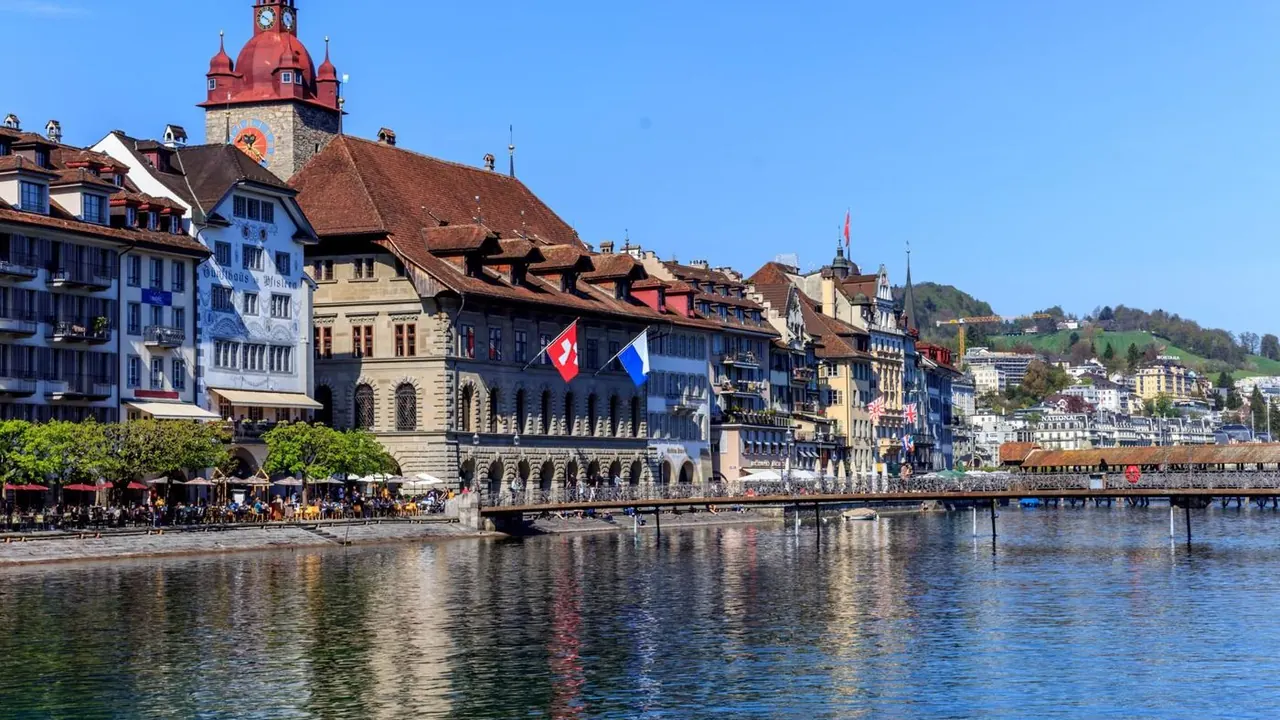
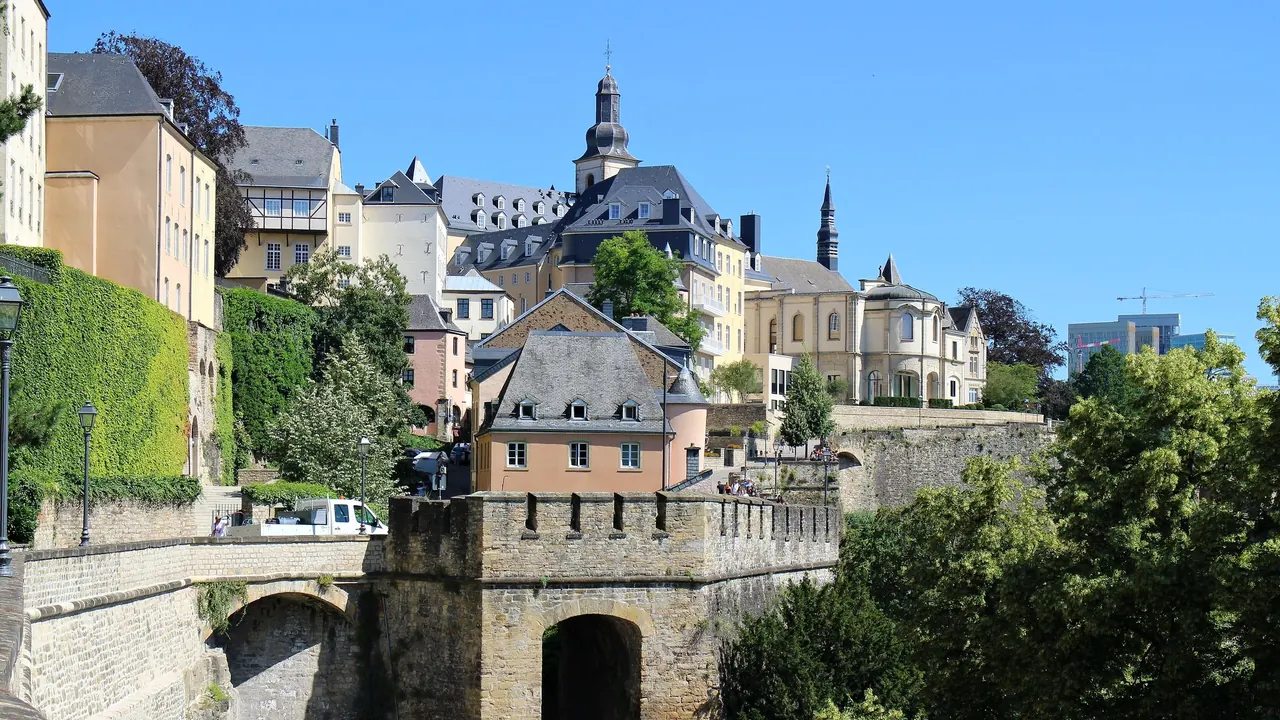
Photos: Lucerne by ILOVESwitzerland, Pexels License; Luxembourg by Suicasmo, CC BY-SA 4.0, cropped.
Lucerne or Luxembourg?
Our verdict in twelve categories, each scored against the same fixed benchmark cities, and the climate month by month, so you can choose for your trip.
Choose Lucerne for
- nature and the outdoors
- beaches
- families
Choose Lucerne if the mountains are the point of the trip. Pilatus, Rigi and Titlis are all close, the paddle steamers and cogwheel railways turn every day out into a scenic journey, and the lake gives you a proper summer swim. Classical music lovers get the Lucerne Festival as a bonus, and families get the Transport Museum. The food is plain and the bill is steep.
Choose Luxembourg for
- food and drink
- prices
- nightlife
Luxembourg is the better pick for a calmer, more urban break built around a fortress city, good wine and easy hops across three borders. You eat better here, with French cooking, Moselle Riesling and crémant by the glass. Free public transport takes some of the sting out of the prices, and Trier and Metz are each a short train ride away. Its countryside is pleasant forest and gorge rather than Alpine drama.
Scoreboard
Twelve categories on one fixed scale from 0 to 100. The shaded stretch is the gap between the two.
Your match
Pick a travel style or drag the sliders, and both match scores follow your weighting.
Wins on nature and the outdoors and beaches with your weighting.
Wins on food and drink and prices with your weighting.
What matters to you?
Category by category
What the scores mean for a trip.
Beaches & swimming
Neither city has a sea, but Lucerne's lake comes right into town. You can swim from the old wooden lake baths or the lawns at Ufschötti, a short walk from the Old Town, with mountains across the water.
Luxembourg's swimming lies out of town, at the Upper Sûre reservoir about an hour north or the old gravel pits at Remerschen. Both are fine for a hot day, but the trip makes them an outing rather than a quick dip between sights.
Food & drink
Luxembourg eats noticeably better. Its restaurants draw on French cooking with German, Belgian, Portuguese and Italian influences, and it has an unusually strong fine-dining tier for its size. Moselle Riesling and crémant give meals a local signature.
Lucerne sticks closer to hearty Swiss food: Chügelipastete, fondue, raclette and lake perch in wood-panelled guild houses. The quality is good, but the choice is narrow, and many places by the Chapel Bridge cater to tour groups.
Culture & sights
The two are evenly matched, and both can be seen in a day or two. Lucerne's appeal is a picture-book medieval centre: the covered Chapel Bridge, frescoed squares, the climbable towers of the Musegg Wall and the carved Lion Monument, with the Rosengart Collection's Picasso and Klee for art.
Luxembourg's strength is its fortress setting. You walk through casemate tunnels cut into the rock and look down from the Corniche into the gorge-bottom Grund, and you can then cross to Kirchberg for contemporary art at MUDAM and the European institutions.
Nightlife
Neither is a place for a big night out, and both go quiet early. Lucerne's evenings mean wine bars and pubs along the Reuss, with a few cocktail bars near the station. Once a year Fasnacht turns the whole Old Town into an all-night carnival.
Luxembourg has slightly more going on, packed into pockets such as the old brewery site at Rives de Clausen and the late venues of Hollerich. Its international crowd of young professionals fills them on Thursdays and Fridays rather than at weekends.
Nature & outdoors
This is Lucerne's biggest advantage. The city sits on a branching lake below Pilatus and Rigi, with Titlis and its year-round snow about an hour away, and it offers ridge walks in summer and skiing and sledging in winter.
Luxembourg's outdoors are gentler. Wooded gorges run through the city itself, and the mossy rock passages and beech forest of the Müllerthal lie half an hour away. There are also Ardennes hills and Moselle vineyard cycle paths, but no mountains or big views.
Day trips
Both make excellent bases, and the difference lies in where you go. From Lucerne the outings are Swiss: Bern, Basel and Zurich each under an hour by train, and boats down the lake to the Rütli meadow and the William Tell country around Altdorf.
From Luxembourg you cross borders. Roman Trier in Germany and Metz in France are each under an hour away, and closer to home you have the castle at Vianden, Echternach's abbey and the Moselle wine villages.
Good for families
Lucerne gives children more to do. The Swiss Museum of Transport is a full day of trains, planes and a planetarium, and the steamers, cogwheel railways and summer toboggan run on Pilatus feel like rides of their own, weather permitting.
Luxembourg is calm and safe, and the casemate tunnels are a real adventure. Beyond them there is only the small Parc Merveilleux at Bettembourg and castle outings, so it suits two or three days rather than a longer family stay.
Getting around
Both are among the easiest places to get around, and in neither do you need a car. Lucerne is flat and compact along the river, with the station, boat piers and Old Town side by side. Its integrated Swiss tickets carry you straight onto lake steamers and mountain railways.
Luxembourg is built on several levels, so you will use public lifts and a funicular between the upper town and the valley quarters. Its trump card is that trams, buses and trains across the whole country are free.
Shopping & style
Lucerne sells watches and Luxembourg sells fashion. In Lucerne the big watch and jewellery houses on Schwanenplatz and the lakefront sit beside shops full of army knives, chocolate and cuckoo clocks, all aimed at the tour groups. A few independent boutiques are tucked into the Old Town lanes, but there is little in the way of clothes.
Luxembourg's Grand-Rue has international luxury and premium labels for a wealthy local clientele, and the high-street chains are on Avenue de la Gare. Villeroy & Boch porcelain from the factory outlet and a bottle of Moselle sparkling wine are the things to take home. Neither city has much independent design.
Affordability
Both are costly, but Luxembourg is a little easier on the wallet. Free public transport, museums that charge nothing, reasonably priced wine by the glass and weekend hotel rates all help. Some visitors even sleep in Trier or Metz.
Lucerne is harder to economise in, because the mountain railways and cable cars that make the visit worthwhile add heavily to already high hotel and restaurant costs. Lakeside picnics and a Swiss travel pass soften the bill only so much.
Live music & performing arts
Lucerne has the stronger classical calling card. The Lucerne Festival brings the world's leading orchestras to Jean Nouvel's lakefront hall, which is famous for its acoustics, mainly in late summer, and the hall has a year-round season of its own.
Luxembourg's Philharmonie on Kirchberg is also a fine hall with its own orchestra, and the Grand Théâtre and the Rotondes broaden the mix. Most of what plays there comes from elsewhere, though, without a festival of comparable standing.
Wellness & relaxation
The two are much alike: quiet cities for slowing down, without a bathing culture of their own. Luxembourg has a proper spa town half an hour away in Mondorf-les-Bains, where a mineral spring feeds pools and saunas in a park.
Lucerne's best soak is the Botta-designed mineral bath high on the Rigi, an outing by boat and cogwheel train with mountain views. An unhurried steamer ride on the lake is restful in its own right.
When should you go?
Pick your month. The climate figures are measured averages, not a forecast.
Lucerne in July
Luxembourg in July
Daytime high, °C
Rainfall in the month, mm
Where the figures come from
Lucerne has no rain gauge within 25 km of the centre, so its rainfall comes from a gridded climate dataset read at the city rather than from a gauge further away.
Lucerne's sunshine is measured 42 km from the centre, at Zurich Town / Ville..
Temperature and rainfall are climate normals, averaged over the years shown. Lucerne: 2005-2025 (sunshine 1991-2020, rainfall 1991-2020) normals, Emmen (4.2 km from centre). Luxembourg: 1991-2020 normals, Luxembourg / Luxembourg (6.3 km from centre).
The two cities have almost the same temperatures through the year. Both reach about 24°C in July and August and drop to around 4°C in midwinter, so June to September is the season for lake swimming and long days outside, while May and late September are the most comfortable months for walking the streets. The difference is the rain. Lucerne's wettest months fall in high summer, with about 141mm in July and August, when cloud and showers often build over the mountains and can hide the views. Luxembourg's rain is spread evenly, at around 72mm in summer, and it gets more sunshine from April to September.
From November to February both cities are grey and cold, with very little sun. Lucerne at least has the snow on the nearby peaks for skiing and sledging. Luxembourg's best months are spring and autumn, when the forests turn and the Moselle grapes are harvested in October.
Which traveller are you?
For an outdoors trip, Lucerne is the clear choice. Pilatus, Rigi and the glacier on Titlis are all within easy reach by boat, rack railway and cable car, and you can link lake and summit in a single day, something Luxembourg's wooded hills cannot match.
On a food and nightlife trip, Luxembourg suits better. French kitchens, a serious tier of fine dining and Moselle crémant poured everywhere give it more range than Lucerne's fondue and rösti, and the bars in Clausen and the Grund stay livelier on Thursdays and Fridays.
On a family trip with children, Lucerne offers more. The Swiss Museum of Transport easily fills a day, and the steamers, cogwheel trains and summer toboggan run are adventures in themselves. Luxembourg's casemates and small amusement park suit only a short stay.
Before you go
| Measure | Lucerne | Luxembourg |
|---|---|---|
| Official language | French, German, Italian, Romansh | French, German, Luxembourgish |
| Currency | Swiss Franc (CHF) | Euro (EUR) |
| Sockets | CJ230 V, 50 Hz | CF230 V, 50 Hz |
| Driving side | Right | Right |
| Time zone | UTC+1, UTC+2 in summer | UTC+1, UTC+2 in summer |
| Emergency number | 112 | 112 |
| Elevation | 436 m | 300 m |
| Main airport | Zürich Airport (ZRH)49 km from centre226 non-stop destinations | Luxembourg-Findel International Airport (LUX)6 km from centre115 non-stop destinations |
| Public holidays this year | 12 days | 12 days |
By the numbers
| Measure | Lucerne | Luxembourg |
|---|---|---|
| City population | 86,234 | 137,678 |
| People per km² | 2,963 | 2,663 |
| Museums within 10 km | 14 | 19 |
| UNESCO World Heritage sites within 50 km | 1 | 4 |
Where else could you go?
Every comparison below shares a destination with this one, so you can follow Lucerne or Luxembourg somewhere new.
- Zurichvs Lucerne
- Interlakenvs Lucerne
- Bernvs Lucerne
- Baselvs Lucerne
- Freiburgvs Lucerne
- Zermattvs Lucerne