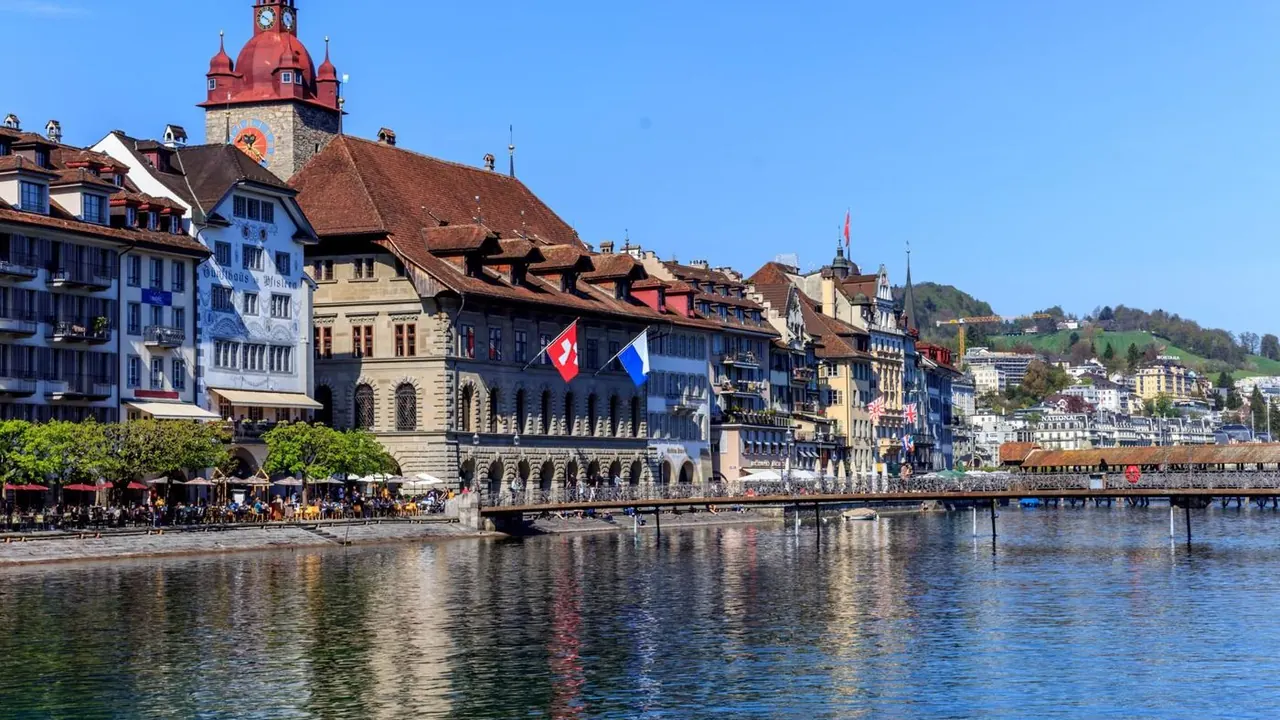
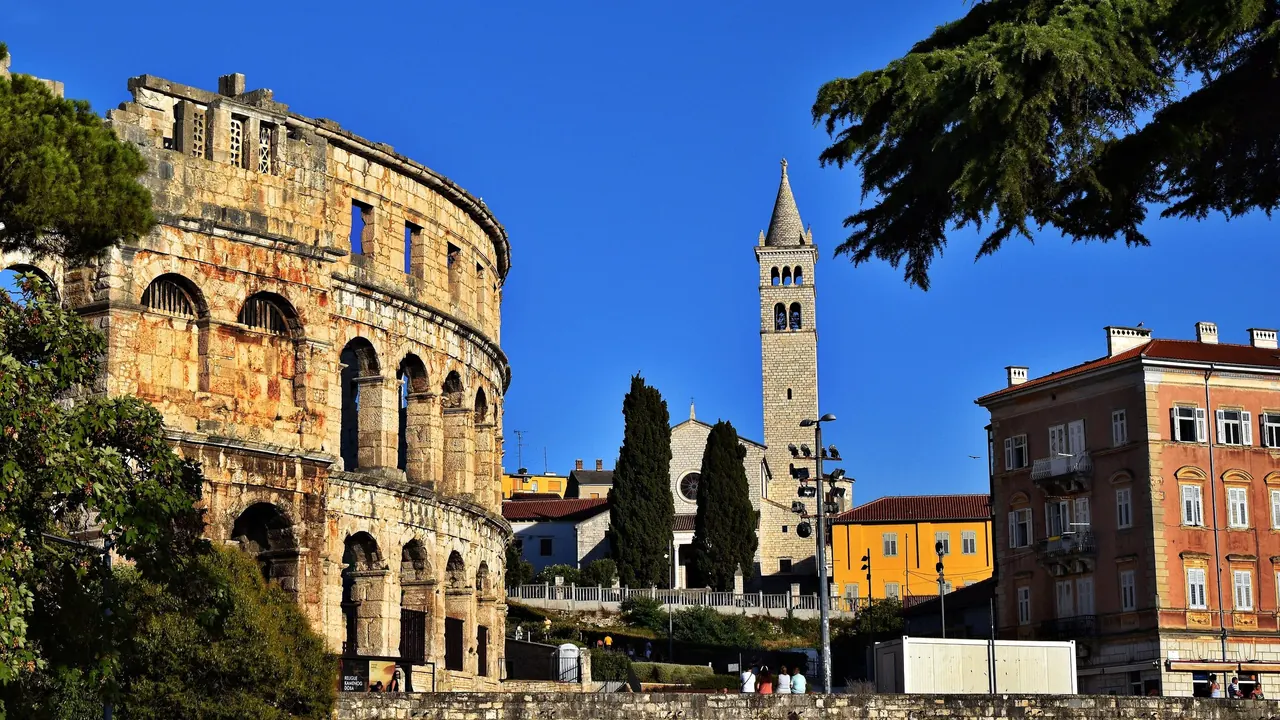
Photos: Lucerne by ILOVESwitzerland, Pexels License; Pula by Miroslav.vajdic, CC BY-SA 4.0, cropped.
Lucerne or Pula?
Our verdict in twelve categories, each scored against the same fixed benchmark cities, and the climate month by month, so you can choose for your trip.
Choose Lucerne for
- getting around
- live music and the arts
- nature and the outdoors
Lucerne is the pick for travellers who want mountains on the doorstep and a trip run on trains and lake steamers rather than a hire car. Pilatus, Rigi and the boats turn every day into an excursion, and in the evenings there is classical music of real standing in Jean Nouvel's concert hall on the lake. It suits people who can live with very high costs and a cooler, often cloudy summer.
Choose Pula for
- prices
- beaches
- food and drink
For a warm summer by the sea with Roman ruins as the backdrop, Pula is the better choice. The swimming in the clear coves of Verudela and Kamenjak, the Istrian cooking of truffles, seafood and Malvazija, and much lower costs make it the easier trip for sun-seekers watching their budget. You will want a car, though, for the hill towns and the best stretches of coast.
Scoreboard
Twelve categories on one fixed scale from 0 to 100. The shaded stretch is the gap between the two.
Your match
Pick a travel style or drag the sliders, and both match scores follow your weighting.
Too close to call, 2 points apart
Wins on getting around and live music and the arts with your weighting.
Wins on prices and beaches with your weighting.
What matters to you?
Category by category
What the scores mean for a trip.
Beaches & swimming
Pula is the place for a swimming vacation. Its rocky and pebbly coast south of the centre, from Verudela and Stoja to the coves of Kamenjak, has very clear water and pine shade down to the shore, and the season lasts from June to late September. Water shoes are wise, and families head for the shallow bays around Medulin.
Lucerne has a pleasant bathing culture on the lake, at the Lido, the old wooden lake baths and the lawns of Ufschötti. The water is clean and calm, with mountains behind it, but it is only warm enough in high summer. A swim there fits between excursions rather than being the point of the trip.
Food & drink
Pula eats better because it sits in Istria, with fuži pasta with truffle, scampi buzara, pršut, estate olive oil and Teran wine all produced close by. The best meals are often in village taverns inland or by the coastal harbours rather than near the Arena.
Lucerne serves well-made Swiss comfort food, such as Chügelipastete, rösti, fondue and lake perch, in wood-panelled guild houses. The choice is narrow and costly, though, and you would not plan a trip around it.
Culture & sights
The two are about even, but they offer very different pasts. Lucerne is medieval and Swiss, with the covered Chapel Bridge, the towers of the Musegg Wall, the Lion Monument and a fine Picasso and Klee collection at the Rosengart. Pula is Roman first, with a near-complete amphitheatre, the Temple of Augustus on the Forum and the Arch of the Sergii, plus Venetian and Habsburg layers above them. Either can be seen properly in a day or two.
Nightlife
Neither city is built for big nights, but Pula has a little more going on in summer. Evenings move from Forum terraces to beach bars on Verudela and around Medulin, and a few small clubs fill up at weekends.
Lucerne usually goes quiet by midnight, and its evenings mostly mean a drink by the Reuss or a few cocktail bars in the Neustadt. The exception is Fasnacht, when the whole town is out in costume until dawn.
Nature & outdoors
Lucerne's landscape is in another league. A branching lake meets mountains you can ride straight up: Pilatus by the world's steepest cogwheel railway, Rigi by Europe's oldest mountain railway, and Titlis with its glacier an hour away. Hikes, boat trips and cable cars combine easily in one day.
Pula's outdoors is gentler and shaped by the sea. Kamenjak offers car-free walking and cycling among cliffs and wild flowers, and there is kayaking, windsurfing and wreck diving. Proper hiking means driving about an hour and a half to Učka.
Day trips
Both are strong bases, but you tour them differently. From Lucerne, fast trains reach Bern, Basel and Zurich in under an hour each, and lake steamers carry you to the Rütli meadow and William Tell country without any planning beyond a timetable.
From Pula the trips are about Istria: Rovinj on its peninsula, the Byzantine mosaics of Poreč, and the hill towns of Motovun and Hum among truffle and wine estates. The Brijuni islands are a short boat ride away, but buses are sparse and most outings need a car.
Good for families
Lucerne has a slight edge with children, mainly because of the Swiss Museum of Transport, which fills a whole day, and a small, safe, flat centre where everything can be reached without a car. Cogwheel trains and steamers are part of the fun, although they are costly and depend on the weather.
Pula's family days happen at the sea. The shallow bays around Medulin, the aquarium in an old fort and climbing around the Arena are its main draws, but rocky shores, summer heat and reliance on a car make it more work.
Getting around
Lucerne is far easier. The station, the boat piers and the Old Town sit together on the lakefront, and trains, steamers and cable cars run on one integrated ticket system, so a car is never needed.
Pula's compact centre is easy on foot and buses reach Verudela, but beyond the city the trains are slow and regional buses infrequent. Kamenjak, the hill towns and the wider coast really call for a car or scooter.
Shopping & style
Lucerne has more to buy, though most of it is Swiss watches, jewellery, army knives and chocolate on Schwanenplatz, with little fashion or design beyond that. Pula has chain stores and souvenirs on its main street, and its real offer is edible: olive oil, truffle products, wine, honey and pršut from the market hall or straight from producers.
Affordability
This is the widest gap between the two. Lucerne is among the most expensive stops in Europe, and the mountain railways that make it worthwhile add a large share to the bill, so there is no way to do it cheaply.
Pula is mid-priced, with private apartments and simple taverns keeping spring and autumn stays reasonable. Rooms do rise sharply in July and August, and car hire and boat trips add up.
Live music & performing arts
Lucerne is far stronger. The Lucerne Festival brings leading orchestras to a concert hall famous for its acoustics, which keeps a year-round programme alongside the city theatre's opera and dance.
Pula has one great setting: concerts and film screenings in the Roman Arena on summer nights. Outside the season there is mostly Croatian-language drama at the Istrian National Theatre.
Wellness & relaxation
Neither has a bathing tradition, but Lucerne offers more ways to unwind. The Botta-designed mineral bath on the Rigi gives a soak with a mountain view, and quiet evenings and slow steamer afternoons make the city restful once the midday tour groups leave.
In Pula, wellness means resort hotel spas on Verudela and in Medulin. Its calm comes instead from coffee on the Forum and walks along pine-shaded paths by the sea outside high summer.
When should you go?
Pick your month. The climate figures are measured averages, not a forecast.
Lucerne in July
Pula in July
Daytime high, °C
Rainfall in the month, mm
Where the figures come from
Lucerne has no rain gauge within 25 km of the centre, so its rainfall comes from a gridded climate dataset read at the city rather than from a gauge further away.
Lucerne's sunshine is measured 42 km from the centre, at Zurich Town / Ville..
Pula's temperatures are measured 87 km from the centre, at Trieste.
Pula has no rain gauge within 25 km of the centre, so its rainfall comes from a gridded climate dataset read at the city rather than from a gauge further away.
Temperature and rainfall are climate normals, averaged over the years shown. Lucerne: 2005-2025 (sunshine 1991-2020, rainfall 1991-2020) normals, Emmen (4.2 km from centre). Pula: 1991-2020 normals, Trieste (87 km from centre).
Lucerne is at its best from June to September, when days reach about 24°C and the mountain trails are clear of snow. The lake is warm enough for most swimmers only in July and August, so a swim belongs to high summer. Those months are also the wettest, with around 141mm of rain in each, and low cloud can hide the peaks. Winter is cold, grey and short on sun, which makes walking the streets less pleasant, but it brings skiing and sledging in the mountains nearby.
Pula is warmer and sunnier all year. July and August reach about 29°C with the sea at around 25°C. That is ideal for the beach but hot for exploring the ruins at midday. June and September give warm water with gentler heat, and spring is good for sightseeing and cycling. The rain arrives in autumn and peaks at about 107mm in November, whereas Lucerne gets most of its rain in summer.
Which traveller are you?
On a beach and sun trip, Pula is the clear choice. It has a long swimming season, clear Adriatic water and the wild coves of Cape Kamenjak, while Lucerne offers a short summer of lake swims from lawns and jetties.
For an outdoors trip, Lucerne wins easily. Pilatus, Rigi, the Stanserhorn and the glacier on Titlis are all reachable by train, boat or cable car. Pula's low coastline is good for cycling and kayaking but has no real high ground nearby.
On a trip with a tight budget, Pula is far kinder. Private apartments, simple konobas and cheap city buses keep costs reasonable, especially outside high summer. In Lucerne, even with picnics by the lake, hotels, meals and mountain railways stay very expensive.
Before you go
| Measure | Lucerne | Pula |
|---|---|---|
| Official language | French, German, Italian, Romansh | Croatian |
| Currency | Swiss Franc (CHF) | Euro (EUR) |
| Sockets | CJ230 V, 50 Hz | CF230 V, 50 Hz |
| Driving side | Right | Right |
| Time zone | UTC+1, UTC+2 in summer | UTC+1, UTC+2 in summer |
| Emergency number | 112 | 112 |
| Elevation | 436 m | 5 m |
| Main airport | Zürich Airport (ZRH)49 km from centre226 non-stop destinations | Pula Airport (PUY)7 km from centre34 non-stop destinations |
| Public holidays this year | 12 days | 14 days |
By the numbers
| Measure | Lucerne | Pula |
|---|---|---|
| City population | 86,234 | 52,220 |
| People per km² | 2,963 | 971 |
| Museums within 10 km | 14 | 4 |
| UNESCO World Heritage sites within 50 km | 1 | 1 |
| Swim season, months above 21 °C | - | 4 months |
Where else could you go?
Every comparison below shares a destination with this one, so you can follow Lucerne or Pula somewhere new.