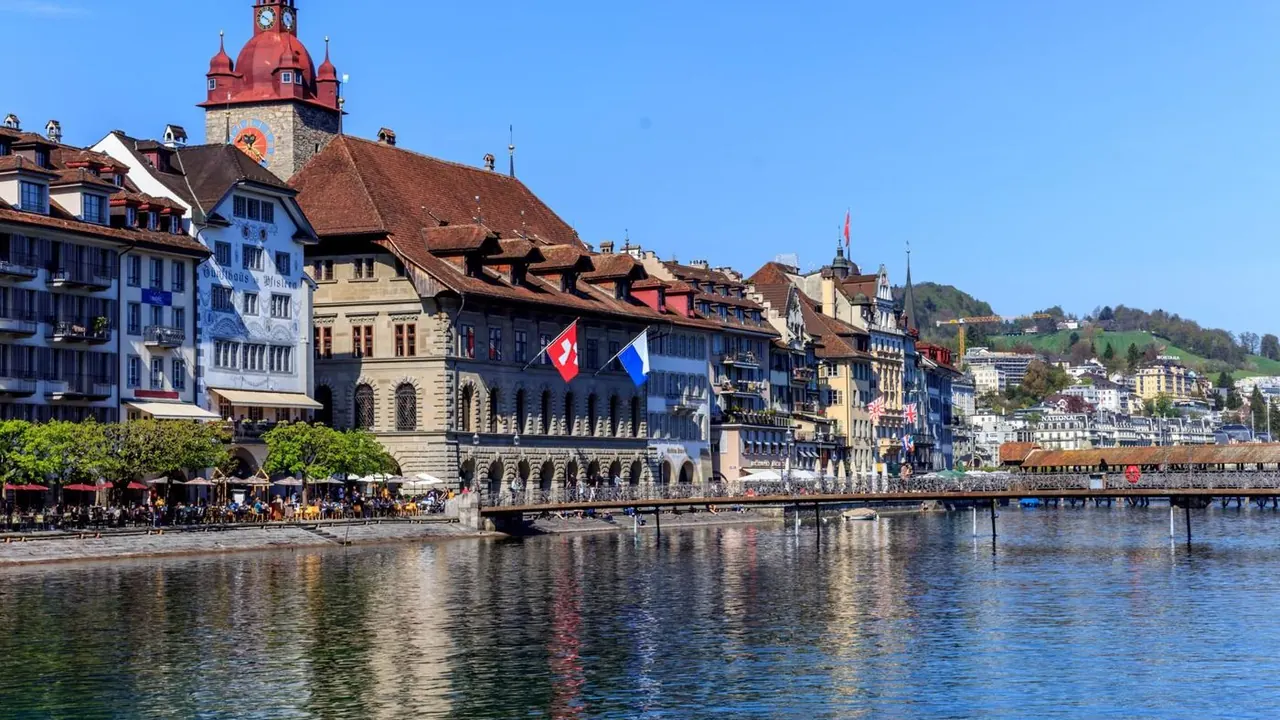
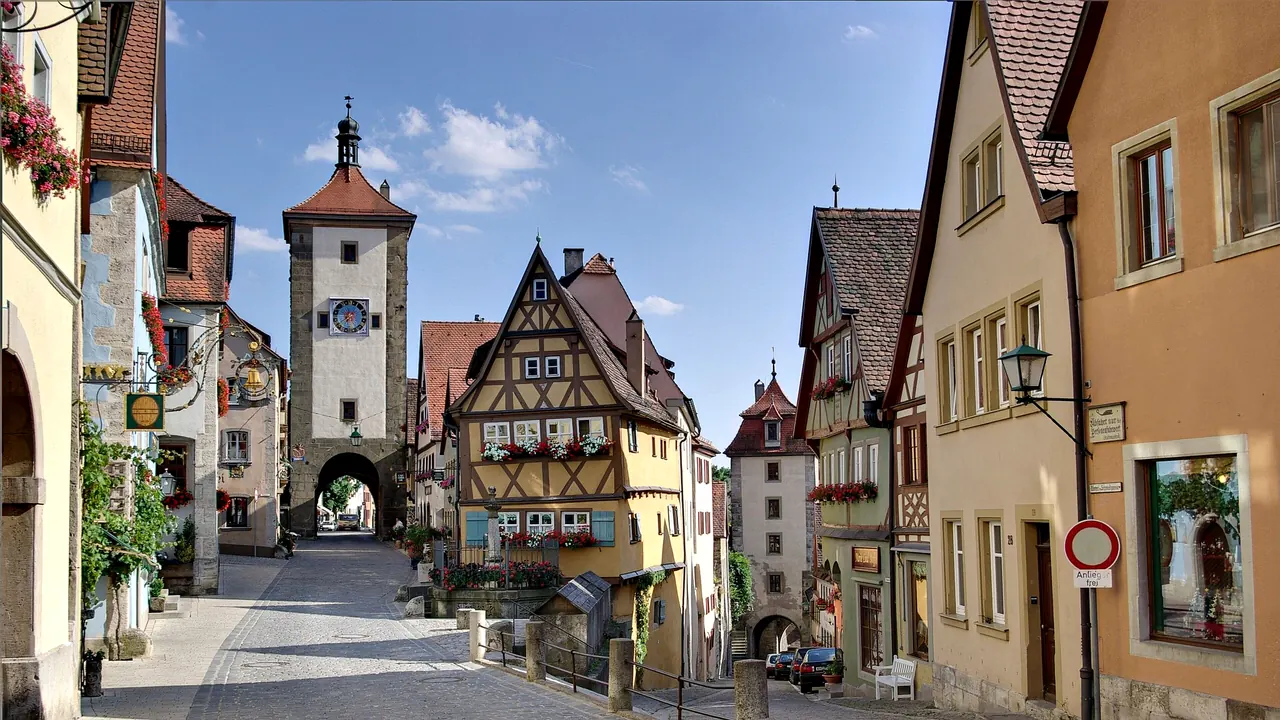
Photos: Lucerne by ILOVESwitzerland, Pexels License; Rothenburg ob der Tauber by Berthold Werner, Public domain.
Lucerne or Rothenburg ob der Tauber?
Our verdict in twelve categories, each scored against the same fixed benchmark cities, and the climate month by month, so you can choose for your trip.
Choose Lucerne for
- nature and the outdoors
- live music and the arts
- beaches
Lucerne is the choice for travellers who want mountains on the doorstep. Lake steamers, cogwheel railways up Pilatus and Rigi, and hiking or skiing are all reached from the station without a car. It also has the stronger concert life, easier transport and more to keep children busy, as long as the budget can take a very expensive stay.
Choose Rothenburg ob der Tauber for
- prices
- culture and sights
Rothenburg ob der Tauber suits a slower and cheaper trip built around one remarkable place: a medieval walled town that is almost untouched inside its ramparts, best seen early and late when the coach groups have gone. Bring a car and it makes a good base for touring the other Romantic Road towns, and it costs far less than Lucerne. Evenings and the countryside are much quieter, though.
Scoreboard
Twelve categories on one fixed scale from 0 to 100. The shaded stretch is the gap between the two.
Your match
Pick a travel style or drag the sliders, and both match scores follow your weighting.
Wins on nature and the outdoors and live music and the arts with your weighting.
Wins on prices and culture and sights with your weighting.
What matters to you?
Category by category
What the scores mean for a trip.
Beaches & swimming
Neither town has a coast, but Lucerne at least has a lake you can swim in. In July and August the water is warm enough for a dip from the Lido, the old wooden lake baths or the lawns at Ufschötti, with mountains across the water.
In Rothenburg the choice is the town's outdoor pool or a drive of about an hour to the artificial lakes of the Franconian lake district, such as the Altmühlsee. Neither is a beach vacation, but in Lucerne a swim fits easily between excursions.
Food & drink
Both kitchens are hearty and regional with a narrow range, and in both the restaurants around the main sights cook for tour groups. The difference is in what you eat. Lucerne leans on cheese and lake fish: fondue, raclette, perch and the veal-filled Chügelipastete, with a few modern bistros in the Neustadt.
Rothenburg is pork and beer country, with Schäufele, bratwurst and dumplings, dry Silvaner from the Tauber valley, and family-run wine taverns away from the Marktplatz. Meals there cost noticeably less, while Lucerne has the riverside terraces for a long coffee.
Culture & sights
Sightseeing in both towns is about equally rewarding and equally brief, but it works differently. Lucerne has a handful of famous set pieces: the Chapel Bridge and Water Tower, the Lion Monument and the Musegg towers. It also has real art in the Rosengart Collection's Picasso and Klee, and in the Bourbaki Panorama.
In Rothenburg the walled town itself is the sight. You walk the covered ramparts, stand at the Plönlein and find almost nothing modern inside the walls. Its one great work of art is Riemenschneider's Holy Blood Altar in St Jakob's, and the Medieval Crime Museum is its only substantial collection.
Nightlife
Neither town is made for a big night out, but Lucerne at least gives you some choice. It has wine bars along the Reuss, cocktail bars and a small club scene in the Neustadt near the station, and student weekends. At Fasnacht the whole town stays up until dawn.
Rothenburg's lanes are mostly silent by eleven, and its most popular evening outing is the night watchman's walking tour. For anything livelier you would have to go to Würzburg or Nuremberg.
Nature & outdoors
This is where the two differ most. Lucerne sits on a branching lake beneath real mountains. Cogwheel trains climb Pilatus and Rigi, an open-top cable car goes up the Stanserhorn, and the glacier on Titlis is about an hour away, all linked by paddle steamers. Summer and early autumn are for hiking, and winter brings skiing and sledging.
Rothenburg's countryside is gentle by comparison. Paths drop from the walls into the Tauber valley, the riverside cycle path runs through vineyards, and the Frankenhöhe orchards look their best in spring blossom and autumn colour. It suits easy walks and family cycling, not days in the Alps.
Day trips
Both make good bases, but Lucerne's day trips are easier to reach. Zurich, Bern and Basel are each under an hour by train. The lake is an outing in itself, with boats to Vitznau, Brunnen and the Rütli meadow of the William Tell story.
Rothenburg's strength is the string of towns along the Romantic Road: Dinkelsbühl, Nördlingen in its meteorite crater and Schwäbisch Hall. Würzburg's Residenz and Nuremberg's castle are about an hour away. Almost all of these trips mean driving, because the trains need a change on a quiet branch line.
Good for families
Lucerne gives children more to do. The Swiss Museum of Transport fills a whole day. The cogwheel trains, steamers and summer toboggan run on Pilatus turn the excursions themselves into the fun, though they depend on clear weather.
For a day or two, Rothenburg is like a storybook for children. They can walk the ramparts, climb the Rathaus tower and follow the night watchman, and older children like the torture devices in the Crime Museum. After that it runs short of ideas, and the cobbles and steep valley paths are hard on pushchairs and small legs.
Getting around
Lucerne is the easier place to manage without a car. The station, the boat piers and the Old Town sit together on the lakefront. One integrated ticket system takes you onto the steamers, cogwheel railways and cable cars.
Inside its walls Rothenburg is just as walkable, with fifteen minutes from one side to the other, though on cobbles and with a steep climb back up from the valley. Beyond the gates, a branch line with a change at Steinach and sparse buses make a car the practical choice.
Shopping & style
Both towns sell mainly to visitors, but Lucerne has a little more range. Its speciality is Swiss watches, sold in large shops on Schwanenplatz and along the lakefront. There are also army knives and chocolate, a few Old Town boutiques and the Saturday riverside market.
Rothenburg sells Christmas all year round: glass baubles, nutcrackers, smoking men and Erzgebirge carvings, plus teddy bears and pewter along the Herrngasse. Its Christmas market on the Marktplatz is one of the most atmospheric in Germany, but there is almost no fashion or everyday shopping.
Affordability
Rothenburg is far easier on the budget. Prices are those of small-town Germany with a tourist premium, beer and wine in the inns are reasonably priced, and staying in a village outside the walls saves a good deal.
Lucerne is expensive in every way: central hotels, simple meals and above all the mountain railways and cable cars that are the reason to go. A Swiss travel pass and picnics by the lake help, but there is no way to make it a cheap trip.
Live music & performing arts
For its size, Lucerne is a serious music city. The Lucerne Festival brings leading orchestras to the lakefront concert hall, famous for its acoustics, mainly in late summer. The Lucerne Symphony Orchestra and the city theatre keep up a year-round programme of concerts, opera, drama and dance.
Rothenburg's performances are mostly about its own history, above all the costumed Meistertrunk play, along with summer open-air theatre and organ and choral concerts in St Jakob's. On most evenings there is no show to go to.
Wellness & relaxation
Neither town has a bathing tradition, and in both the reward is peace and quiet more than spa treatments. Lucerne has a slight edge. Its calm comes from the water, with slow walks along the lake promenades and afternoons on the steamers. Mario Botta's mineral bath on the Rigi, reached by boat and train, offers a soak with a mountain view.
Rothenburg is at its most peaceful early and late in the day, when the coach groups have gone and the walls and the Tauber valley are empty. For thermal water you drive about an hour to the salt-water pool at Bad Windsheim or to Bad Mergentheim.
When should you go?
Pick your month. The climate figures are measured averages, not a forecast.
Lucerne in July
Rothenburg ob der Tauber in July
Daytime high, °C
Rainfall in the month, mm
Where the figures come from
Lucerne has no rain gauge within 25 km of the centre, so its rainfall comes from a gridded climate dataset read at the city rather than from a gauge further away.
Lucerne's sunshine is measured 42 km from the centre, at Zurich Town / Ville..
Rothenburg ob der Tauber's sunshine is measured 27 km from the centre, at Feuchtwangen-heilbronn.
Temperature and rainfall are climate normals, averaged over the years shown. Lucerne: 2005-2025 (sunshine 1991-2020, rainfall 1991-2020) normals, Emmen (4.2 km from centre). Rothenburg ob der Tauber: 1991-2020 normals, Rothenburg ob der Tauber (0.9 km from centre).
The two towns follow almost the same temperature curve. Summer highs reach about 24°C from June to August, and winters are cold and grey, with daytime highs of only about 4°C. Late May to September is the best time for both. In Lucerne, July and August are the only months warm enough for lake swimming, and they also bring the most sunshine for mountain views.
The real difference is rain. Lucerne's summer is its wettest season, with about 141mm in both July and August, while Rothenburg stays much drier at around 60mm a month and gets a little more sun. Winter is dark in both, with very little sunshine in December. In winter Rothenburg suits a Christmas visit, while Lucerne is mainly for skiers.
Which traveller are you?
For an outdoors trip, choose Lucerne. In summer, cogwheel railways and lake steamers from the station take you hiking on Pilatus and Rigi, and in winter the nearby slopes are for skiing and sledging. Rothenburg has gentle valley walks and cycling.
On a trip on a tight budget, Rothenburg makes far more sense. Rooms in villages outside the walls, reasonably priced beer and wine in the inns and free walks on the ramparts keep costs down. Lucerne's meals and mountain fares are very expensive.
On a family trip with children, Lucerne keeps them busy for longer, with the Transport Museum, paddle steamers, the summer toboggan run and the lakeside lawns. Rothenburg's ramparts and night watchman delight children for a day or two, then the cobbles wear them down.
Before you go
| Measure | Lucerne | Rothenburg ob der Tauber |
|---|---|---|
| Official language | French, German, Italian, Romansh | German |
| Currency | Swiss Franc (CHF) | Euro (EUR) |
| Sockets | CJ230 V, 50 Hz | CF230 V, 50 Hz |
| Driving side | Right | Right |
| Time zone | UTC+1, UTC+2 in summer | UTC+1, UTC+2 in summer |
| Emergency number | 112 | 112 |
| Elevation | 436 m | 430 m |
| Main airport | Zürich Airport (ZRH)49 km from centre226 non-stop destinations | Nuremberg Airport (NUE)66 km from centre56 non-stop destinations |
| Public holidays this year | 12 days | 12 days |
By the numbers
| Measure | Lucerne | Rothenburg ob der Tauber |
|---|---|---|
| City population | 86,234 | 11,331 |
| People per km² | 2,963 | 272 |
| Museums within 10 km | 14 | 6 |
| UNESCO World Heritage sites within 50 km | 1 | 2 |
Where else could you go?
Every comparison below shares a destination with this one, so you can follow Lucerne or Rothenburg ob der Tauber somewhere new.
- Zurichvs Lucerne
- Interlakenvs Lucerne
- Nurembergvs Rothenburg ob der Tauber
- Bernvs Lucerne
- Bambergvs Rothenburg ob der Tauber
- Baselvs Lucerne