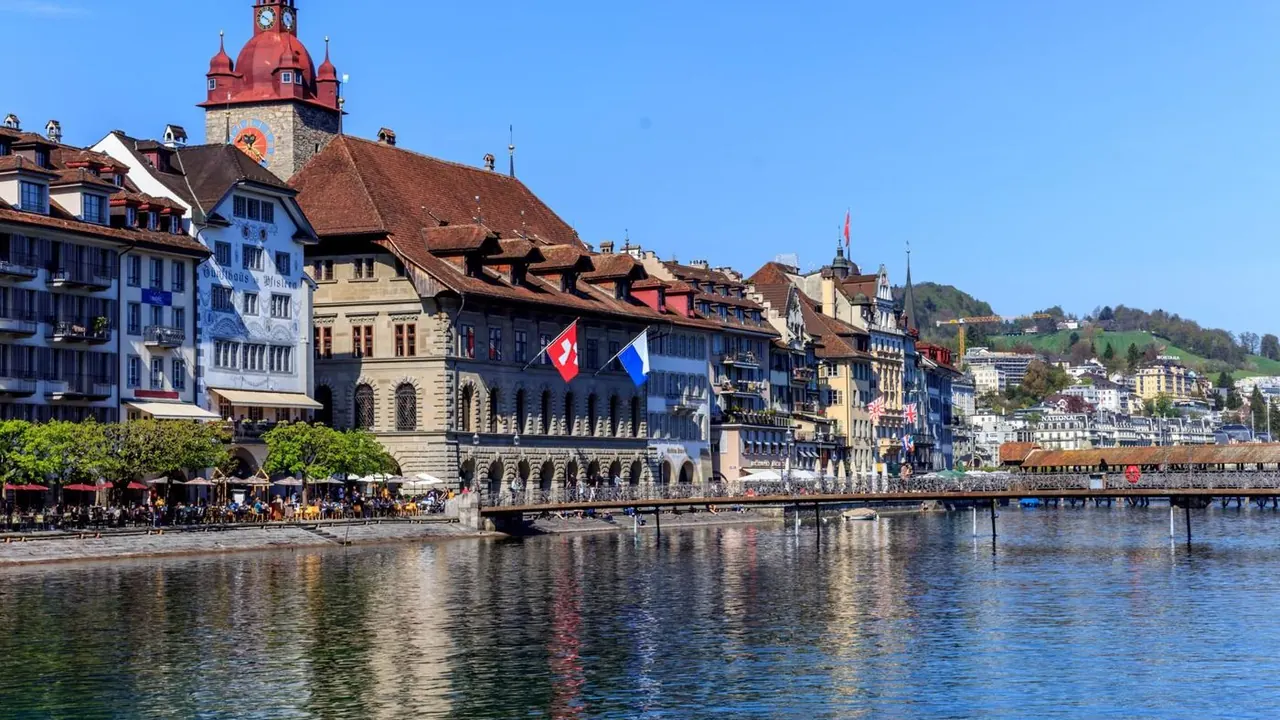
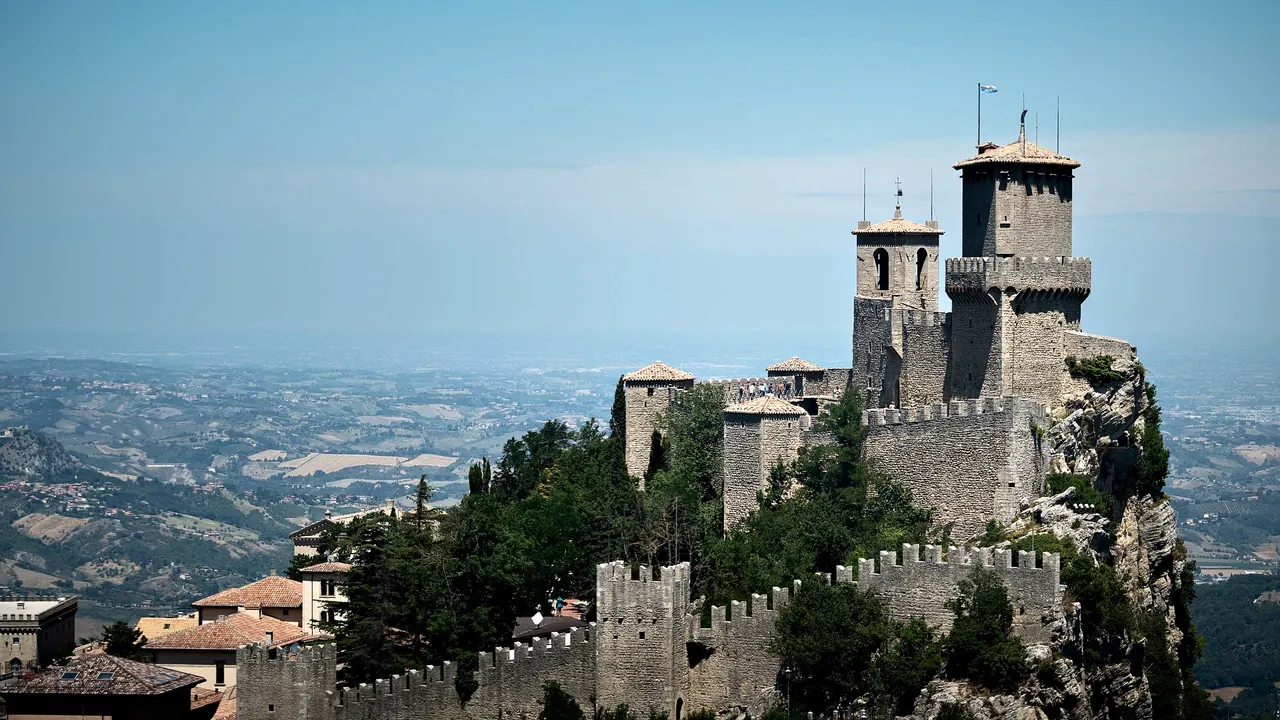
Photos: Lucerne by ILOVESwitzerland, Pexels License; San Marino by Tibor Szabo, Pexels License.
Lucerne or San Marino?
Our verdict in twelve categories, each scored against the same fixed benchmark cities, and the climate month by month, so you can choose for your trip.
Choose Lucerne for
- live music and the arts
- nature and the outdoors
- getting around
Lucerne suits travellers who want mountains, lakes and a city where things simply work. Pilatus, Rigi and the paddle steamers start from the lakefront, trains run to Bern and Basel, and evenings can end at a world-class concert. The catch is the cost. It is one of the dearest places in Europe to spend a week, and the excursions that make it special add a lot to the bill.
Choose San Marino for
- prices
- beaches
San Marino is for a slower, cheaper trip in Italian hill country. The walled summit town and its three towers take half a day, and the real draw is what lies below. There is a proper sandy beach half an hour away, Urbino and Ravenna are close enough for day trips, and the trattoria meals cost what they would in provincial Italy. It works best with a car and with little interest in nightlife or the arts.
Scoreboard
Twelve categories on one fixed scale from 0 to 100. The shaded stretch is the gap between the two.
Your match
Pick a travel style or drag the sliders, and both match scores follow your weighting.
Wins on live music and the arts and nature and the outdoors with your weighting.
Wins on prices and beaches with your weighting.
What matters to you?
Category by category
What the scores mean for a trip.
Beaches & swimming
Neither city sits on a beach, but San Marino has the sea within easy reach. Rimini and Riccione lie below the mountain, with miles of sand, rows of umbrellas and shallow water. In high summer the Adriatic is warmer than Lake Lucerne by several degrees, which makes it a real beach day out rather than a quick dip.
Lucerne's swimming is a different pleasure. You bathe in clean, calm lake water from the Lido, the old wooden baths or the lawns at Ufschötti, with mountains behind. It is close to the centre, so you can swim between sights, but there is no sand and the season is only a few weeks long.
Food & drink
Neither city is worth the trip for its food, but the cooking is very different. Lucerne serves Swiss alpine comfort food: fondue, rösti, lake perch and the creamy Chügelipastete, eaten in wood-panelled guild houses or on terraces along the Reuss. It is reliable and well made, but it costs a lot.
San Marino eats like the Romagna around it, with hand-rolled pasta, passatelli, piadina and its own small-vineyard Sangiovese. The summit terraces sell the view more than the cooking, so the better meals are down in Borgo Maggiore or over the border.
Culture & sights
Lucerne has more to see and more depth. Besides the Chapel Bridge, the Water Tower and the Musegg towers, there is the Lion Monument, the Rosengart Collection with its Picasso and Klee, the Bourbaki Panorama and Wagner's villa at Tribschen, enough for a full day or two.
San Marino's appeal is the town as a whole. The walled crest of Monte Titano, the clifftop towers of Guaita and Cesta, and the Palazzo Pubblico where the Captains Regent take office tell the story of a very old republic. It is memorable, but most visitors have seen it by lunchtime.
Nightlife
Lucerne is no party town, but it does have evenings out: wine bars along the river, a few cocktail bars and a small club scene around the Neustadt, and the all-night street party of Fasnacht once a year. San Marino has almost none of this. After the coaches leave, there is a quiet drink on a terrace above the lights of the coast, and anyone wanting a late night drives down to the Riviera clubs in Rimini.
Nature & outdoors
This is where the two cities differ most. Lucerne sits on a branching lake beneath real mountains. Pilatus rises to 2,128m and is reached by the world's steepest cogwheel railway, Rigi has long ridge walks, and Titlis has a glacier about an hour away. You can do boat, rail and hike in a single day.
Monte Titano is a 740m limestone ridge with fine views to the Adriatic and woodland paths down to Borgo Maggiore. The Montefeltro hills beyond are gentle farmland that suits cycling or a drive, not serious hiking, and there are no adventure sports nearby.
Day trips
Both make good bases, and Lucerne is the easier one. Zurich, Bern and Basel are each under an hour by train, and the lake steamers run to the Rütli meadow and the William Tell country around Altdorf without any planning.
San Marino's list is just as tempting: the fortress of San Leo, Renaissance Urbino, the mosaics of Ravenna and the castle at Gradara. Apart from the bus to Rimini, though, you will need a car, so the outings take more organising.
Good for families
Lucerne is easier with children. The Swiss Museum of Transport can fill a whole day, the Glacier Garden and the Goldau wildlife park add more, and the cogwheel trains and paddle steamers are part of the fun. The flat riverside centre is easy with a pushchair.
San Marino's towers and battlements thrill children for a morning, and the cable car is a treat, but the steep streets and steps are hard work with small children. The real family attractions, Italia in Miniatura, Fiabilandia and the waterparks, are down on the coast and need a car.
Getting around
Lucerne is far easier to move around. Step off the train and the Chapel Bridge and the steamer quays are a few minutes away on foot, and the riverside streets are level. Only the lanes up to the Musegg Wall ask for any effort. Buses, boats, trains and the mountain railways all work on one ticket system, so you can reach the summits without ever hiring a car. Linking a steamer to a cogwheel train takes a look at the timetable first, but after that the connections hold.\n\nSan Marino asks more of your legs and of your planning.
The old town is compact, about half an hour from one end to the other, but it is built on a slope, and stairways join many of the lanes. A cable car takes you down to Borgo Maggiore, and the bus up from Rimini, which meets the Italian trains, is the only dependable way in without a car. Buses to the surrounding villages are too infrequent to plan a day around, so most visitors drive.
Shopping & style
Lucerne has the stronger offer, though it is narrow. The big watch and jewellery houses around Schwanenplatz are the main draw, alongside Swiss chocolate, army knives, a few independent boutiques in the Old Town and the Saturday market by the river.
San Marino's lanes mostly sell souvenirs: decorative crossbows, ceramics, liqueurs, and stamps and coins for collectors. Lower taxes bring Italians up for perfume and spirits, and there is an outlet centre in the valley, but there is little of real quality.
Affordability
There is a big gap here. In Lucerne almost everything is expensive, from central hotels and simple restaurant meals to the mountain railways and cable cars you came for. A Swiss travel pass and supermarket picnics by the lake soften the cost a little, but cannot make it cheap.
San Marino is priced like provincial central Italy. Only the summit hotels and view terraces charge extra, and staying a few kilometres down the slope brings prices back to normal.
Live music & performing arts
For music, Lucerne is far ahead. The Lucerne Festival brings leading orchestras to Jean Nouvel's lakefront hall, known for its acoustics, and outside the festival the Lucerne Symphony Orchestra and the city theatre keep opera, drama and dance on the calendar all year.
San Marino has a small theatre, the odd local concert and open-air music in summer. Its highlight is the Medieval Days festival of costumed musicians and flag-throwers. For opera, you would go to Pesaro or Bologna.
Wellness & relaxation
Lucerne gives you more ways to unwind, even without thermal baths of its own. The best place for a soak is Mario Botta's mineral bath high on the Rigi, about an hour away by boat and cogwheel train, with views across the peaks. Closer in, the old wooden lake baths are a simple summer pleasure, and an afternoon on a steamer watching the shore go by is about as restful as sightseeing gets.
San Marino has a few hotel spas and no bathing culture, so its calm comes in the evening, when the day visitors have gone and you can walk the walls above the plain. For thermal spas you would make a separate outing to the Romagna coast or the Apennine valleys.
When should you go?
Pick your month. The climate figures are measured averages, not a forecast.
Lucerne in July
San Marino in July
Daytime high, °C
Rainfall in the month, mm
Where the figures come from
Lucerne has no rain gauge within 25 km of the centre, so its rainfall comes from a gridded climate dataset read at the city rather than from a gauge further away.
Lucerne's sunshine is measured 42 km from the centre, at Zurich Town / Ville..
San Marino's temperatures are measured 52 km from the centre, at Frontone.
San Marino has no rain gauge within 25 km of the centre, so its rainfall comes from a gridded climate dataset read at the city rather than from a gauge further away.
Temperature and rainfall are climate normals, averaged over the years shown. Lucerne: 2005-2025 (sunshine 1991-2020, rainfall 1991-2020) normals, Emmen (4.2 km from centre). San Marino: 1991-2020 normals, Frontone (51.5 km from centre).
Lucerne is a summer and early autumn city. From June to August daytime highs settle around 24°C, which is ideal for walking and for a swim in the lake. Those are also its wettest months, though, with about 141mm of rain in July and August, much of it in short heavy showers between long sunny spells. September is quieter and still warm enough for mountain walks. From November to February the days are cold, short and often grey, and that suits skiing and sledging up the mountain better than sightseeing in town.
San Marino runs warmer and drier through the summer. July reaches about 30°C, which makes the steep summit streets hard going at midday, but it is also the driest month and the right time for the coast below, where the sea is about 25 to 26°C in July and August. May, June and September are the most comfortable months for walking the walls. From October the rain picks up and the hilltop turns damp and cool, though its winters stay a little milder than Lucerne's.
Which traveller are you?
For an outdoors trip, Lucerne is clearly the better choice. Cogwheel railways and cable cars climb straight to Pilatus, Rigi and the Stanserhorn, steamers link up with the hiking trails, and Titlis has snow all year. San Marino's ridge is good for a morning walk and little more.
On a trip on a tight budget, San Marino is the realistic option. Hotels are moderately priced, family trattorias in the lower villages are fairly priced, and the sights cost little. In Lucerne every meal, room and mountain railway stretches the budget, however carefully you plan.
On a beach and sun trip, choose San Marino. Rimini and Riccione have long sandy beaches with shallow water about half an hour down the hill, and summers are hot and dry. Lucerne offers lake swimming from lawns and jetties for a few warm weeks.
Before you go
| Measure | Lucerne | San Marino |
|---|---|---|
| Official language | French, German, Italian, Romansh | Italian |
| Currency | Swiss Franc (CHF) | Euro (EUR) |
| Sockets | CJ230 V, 50 Hz | CFL230 V, 50 Hz |
| Driving side | Right | Right |
| Time zone | UTC+1, UTC+2 in summer | UTC+1, UTC+2 in summer |
| Emergency number | 112 | 112 |
| Elevation | 436 m | 675 m |
| Main airport | Zürich Airport (ZRH)49 km from centre226 non-stop destinations | Bologna Guglielmo Marconi Airport (BLQ)114 km from centre98 non-stop destinations |
| Public holidays this year | 12 days | 18 days |
By the numbers
| Measure | Lucerne | San Marino |
|---|---|---|
| City population | 86,234 | 4,040 |
| People per km² | 2,963 | 569 |
| Museums within 10 km | 14 | 19 |
| UNESCO World Heritage sites within 50 km | 1 | 2 |
| Swim season, months above 21 °C | - | 4 months |
Where else could you go?
Every comparison below shares a destination with this one, so you can follow Lucerne or San Marino somewhere new.
- Zurichvs Lucerne
- Interlakenvs Lucerne
- Bernvs Lucerne
- Baselvs Lucerne
- Assisivs San Marino
- Florencevs San Marino