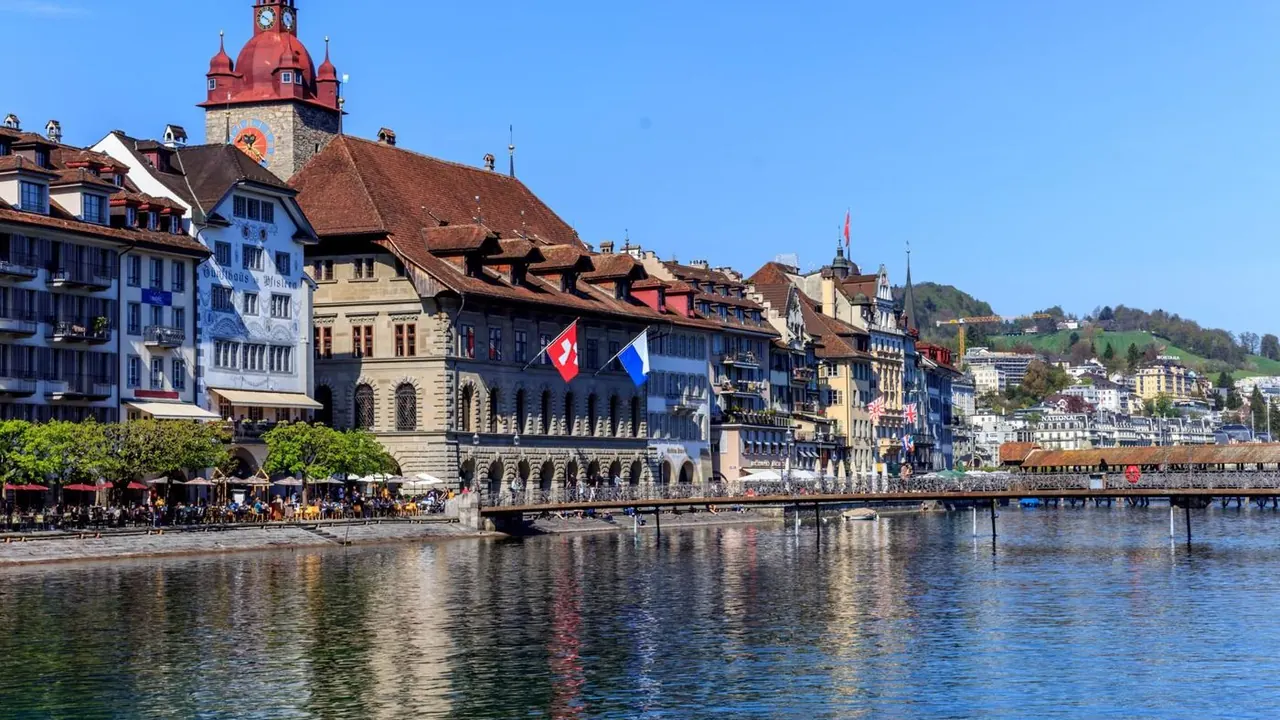
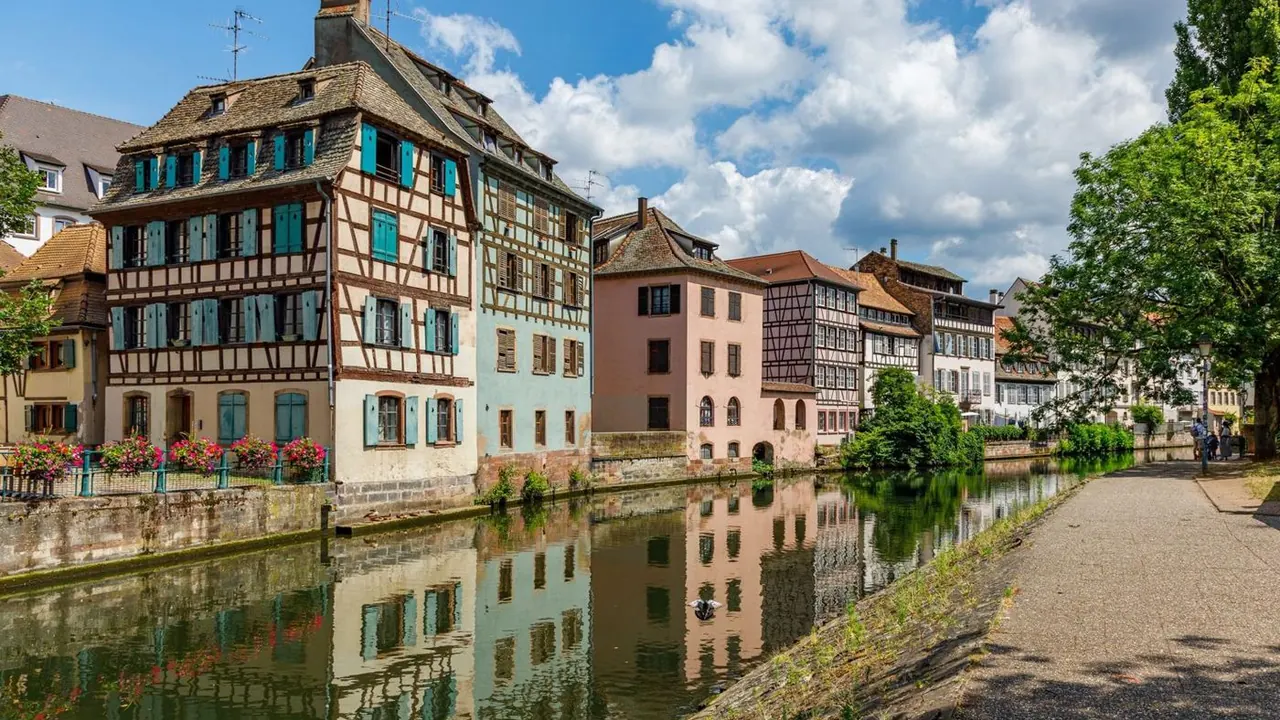
Photos: Lucerne by ILOVESwitzerland, Pexels License; Strasbourg by Edoardo Colombo, Pexels License.
Lucerne or Strasbourg?
Our verdict in twelve categories, each scored against the same fixed benchmark cities, and the climate month by month, so you can choose for your trip.
Choose Lucerne for
- nature and the outdoors
- beaches
- live music and the arts
Lucerne is the pick for travellers who want mountains on the doorstep. Pilatus and Rigi rise from the lake shore, steamers link the villages, and railways and cable cars carry you to the ridges without a car. It suits a scenery-led trip with hiking, a lake swim in summer or snow in winter, and classical music lovers in festival season, as long as the budget can take Swiss prices.
Choose Strasbourg for
- prices
- food and drink
- culture and sights
Choose Strasbourg if the trip is about the table and the old streets. Winstubs and Alsace wine, the cathedral and an old town island of half-timbered houses give it more to eat, see and do in the evening, and day to day it costs far less. The Vosges and the Black Forest are within reach, but here the outdoors is a day out, not the view from your window.
Scoreboard
Twelve categories on one fixed scale from 0 to 100. The shaded stretch is the gap between the two.
Your match
Pick a travel style or drag the sliders, and both match scores follow your weighting.
Wins on nature and the outdoors and beaches with your weighting.
Wins on prices and food and drink with your weighting.
What matters to you?
Category by category
What the scores mean for a trip.
Beaches & swimming
Neither city has a sea, but Lucerne's lake gives it a real summer swimming culture: the Lido, the old wooden lake baths near the centre and the lawns at Ufschötti, with clear water and mountains behind. Strasbourg's swimming means a tram ride out to gravel-pit lakes such as the Baggersee, which are fine on a hot afternoon but have no view and are not worth planning a trip around. In both cities the season is July and August, and the shores are grass and jetties, not sand.
Food & drink
Strasbourg is the clear winner at the table. Alsace's blend of French and German cooking gives it a real regional cuisine: choucroute, baeckeoffe and tarte flambée with a pichet of Riesling in a wood-panelled winstub. On top of that come foie gras, a fine-dining tier and good covered and street markets.
Lucerne eats well but within a narrow range: fondue, rösti, lake perch and the creamy Chügelipastete in the old guild houses, with terraces along the Reuss for a long coffee. Both cities serve tourist menus around their best-known sights. In Lucerne there is less beyond them, and every meal costs more.
Culture & sights
Lucerne's sights are a handful of famous images: the Chapel Bridge and Water Tower, the climbable Musegg towers, the carved Lion Monument and the Rosengart's Picasso and Klee. A day or two covers them.
Strasbourg has more depth. The cathedral with its astronomical clock, the Grande Ile, Petite France and the German-built Neustadt make up one UNESCO ensemble, and the Palais Rohan, the cathedral sculpture museum and the Alsatian Museum can fill another day. The European Parliament and the Council of Europe add a modern side that Lucerne has nothing to match.
Nightlife
Neither is a late city, but Strasbourg has more going on after dinner. Its large university fills the bars and beer cellars of the Krutenau and the streets around Place Saint-Étienne, and the terraces on the quays stay busy on summer evenings. In Lucerne an evening means a drink by the water and an early night, with a small club scene near the station, and only Fasnacht keeps the whole town out until dawn.
Nature & outdoors
Lucerne has one of Europe's great mountain and lake settings. Pilatus and Rigi rise from the shore with railways to their summits, Titlis keeps glacier snow all year, and the steamers make it easy to combine a boat, a train and a hike in one day. Winter brings skiing and sledging.
Strasbourg's own landscape is flat: the Orangerie park, riverside forests with storks and beavers, and long, level cycle routes along the Rhine. The Vosges and the Black Forest offer good walking within an hour, but they are gentler hills, and a car makes them much easier to reach.
Day trips
Both cities make excellent bases, and the difference is in the kind of trip. From Lucerne the outings are Swiss cities by fast train, with Bern, Basel and Zurich each under an hour away. The lake itself is another day out, with boats to the Rütli meadow and the William Tell country.
From Strasbourg the outings take in wine villages and two countries. Colmar is half an hour away, Riquewihr and Eguisheim sit on the Alsace wine route, and Freiburg and Heidelberg lie across the Rhine. Lucerne's trips all run on rails and boats, while the Alsace villages are easiest by car or bike.
Good for families
The two are equally good with children, in different ways. Lucerne's draws are the Swiss Museum of Transport and the journeys themselves: cogwheel trains, paddle steamers and the summer toboggan run on Pilatus. All of these depend on clear weather, and the costs add up quickly.
Strasbourg gives families more to do in town for less money. There are boat trips around the Grande Ile, storks and rowing boats in the Orangerie, and the Le Vaisseau science centre. Its big extra is one of Europe's largest theme parks, about an hour away across the border.
Getting around
Both are easy without a car, but Lucerne has the edge because its excursions are part of the same system. The station, the boat piers and the Old Town sit together on the lakefront, and steamers, cogwheel railways and cable cars run on integrated Swiss tickets right up into the mountains.
Strasbourg's compact, largely pedestrianised island is easy to cover on foot. Trams run out to the European quarter and across the Rhine to Kehl, and a bike is often the quickest way about. A car is only worth having for the wine villages and the Vosges.
Shopping & style
Swiss watches are the reason to shop in Lucerne, and not much else. The big watch and jewellery houses on Schwanenplatz and along the lakefront cater to the tour groups, alongside shelves of army knives, chocolate and cuckoo clocks. There is little fashion, no department store worth a visit, and the main streets are short.
Strasbourg has a wider and more everyday mix, so it comes out a little ahead. Chain stores and a department store line the streets around Place Kléber and the Rue des Grandes Arcades, and the lanes near the cathedral hold independent delicatessens and bookshops. Alsace wine, Soufflenheim pottery and printed linens give more choice of regional things to take home, and December adds one of Europe's oldest Christmas markets.
Affordability
Strasbourg is far easier on the wallet. It costs what you would expect of a large French regional city. Winstub meals, wine by the pichet, trams and bike hire are all reasonable, and the cathedral and the old town are free. Hotels are the main expense, especially during the Christmas market and the weeks when the European Parliament sits.
Lucerne is very expensive at every step, from rooms and simple meals to the mountain railways that are the reason to come. A Swiss travel pass and picnics by the lake soften the cost, but you still need to plan a generous budget.
Live music & performing arts
For an evening of music, Lucerne is the stronger choice, mainly because of the Lucerne Festival. In late summer, and in shorter seasons at other times of year, it brings the world's leading orchestras and soloists to Jean Nouvel's lakefront hall. The hall is famous for its acoustics and runs a year-round programme with the Lucerne Symphony Orchestra, and the city theatre adds opera, drama and dance. At Fasnacht, Guggenmusik brass bands fill the Old Town.
Strasbourg can't match that level, but it has a solid calendar of its own. The Opéra national du Rhin plays on Place Broglie, the philharmonic has a full season, the Théâtre National de Strasbourg is one of France's leading stages, and every autumn the Musica festival is devoted to contemporary music. In both cities you'll need to plan evenings around the season, because there is little live music to stumble on.
Wellness & relaxation
Strasbourg is the better choice for bathing. Locals use its early twentieth-century Bains municipaux, with tiled pools, a hammam and saunas, as a matter of course. The Friedrichsbad and Caracalla thermal baths at Baden-Baden are under an hour away.
Lucerne has no bathhouse tradition of its own, so a soak means a hotel spa or Mario Botta's mineral bath high on the Rigi. What it offers instead is calm: quiet evenings, lakeside promenades and slow afternoons on a steamer, away from the tour groups that crowd the Old Town at midday.
When should you go?
Pick your month. The climate figures are measured averages, not a forecast.
Lucerne in July
Strasbourg in July
Daytime high, °C
Rainfall in the month, mm
Where the figures come from
Lucerne has no rain gauge within 25 km of the centre, so its rainfall comes from a gridded climate dataset read at the city rather than from a gauge further away.
Lucerne's sunshine is measured 42 km from the centre, at Zurich Town / Ville..
Temperature and rainfall are climate normals, averaged over the years shown. Lucerne: 2005-2025 (sunshine 1991-2020, rainfall 1991-2020) normals, Emmen (4.2 km from centre). Strasbourg: 1991-2020 normals, Strasbourg (9.1 km from centre).
Both cities have the usual central European pattern of warm summers and grey winters, but Strasbourg is a little warmer and much drier. July and August are the months for a swim in either place. Lucerne reaches about 24°C and Strasbourg about 26°C, which is warm enough for the lake baths and the gravel-pit lakes, though neither city gets truly hot. Rain is the thing to watch in Lucerne. It is heaviest from May to August, at around 141mm a month, and brings the low cloud that can hide the peaks. Strasbourg rarely gets more than 75mm in any month.
For walking the streets, May, June and September suit both cities. In both, July is the sunniest month. From November to February both are cold, with highs only a few degrees above freezing and short, dull days. That is when Lucerne's mountains turn to skiing and sledging, and Strasbourg is mainly for indoor sightseeing and long meals.
Which traveller are you?
On an outdoors trip, Lucerne is the obvious choice. Pilatus, Rigi and the Stanserhorn rise straight from the lake, railways and cable cars reach the ridges without a car, and winter adds skiing. Strasbourg's hills mean a day out, and often a car.
For a food and nightlife trip, Strasbourg wins clearly. Evenings start in a winstub over choucroute and Riesling and carry on in the student bars of the Krutenau. Lucerne offers solid Swiss dishes and a quiet drink by the lake before an early night.
On a trip on a tight budget, Strasbourg is the realistic option. Tarte flambée, wine by the pichet, cheap trams and a free cathedral keep costs down. Lucerne charges heavily for rooms and meals, and for the mountain trains that are the reason to go.
Before you go
| Measure | Lucerne | Strasbourg |
|---|---|---|
| Official language | French, German, Italian, Romansh | French |
| Currency | Swiss Franc (CHF) | Euro (EUR) |
| Sockets | CJ230 V, 50 Hz | CE230 V, 50 Hz |
| Driving side | Right | Right |
| Time zone | UTC+1, UTC+2 in summer | UTC+1, UTC+2 in summer |
| Emergency number | 112 | 112 |
| Elevation | 436 m | 132 m |
| Main airport | Zürich Airport (ZRH)49 km from centre226 non-stop destinations | Strasbourg Airport (SXB)10 km from centre43 non-stop destinations |
| Public holidays this year | 12 days | 11 days |
By the numbers
| Measure | Lucerne | Strasbourg |
|---|---|---|
| City population | 86,234 | 293,771 |
| People per km² | 2,963 | 3,752 |
| Museums within 10 km | 14 | 21 |
| UNESCO World Heritage sites within 50 km | 1 | 1 |
Where else could you go?
Every comparison below shares a destination with this one, so you can follow Lucerne or Strasbourg somewhere new.