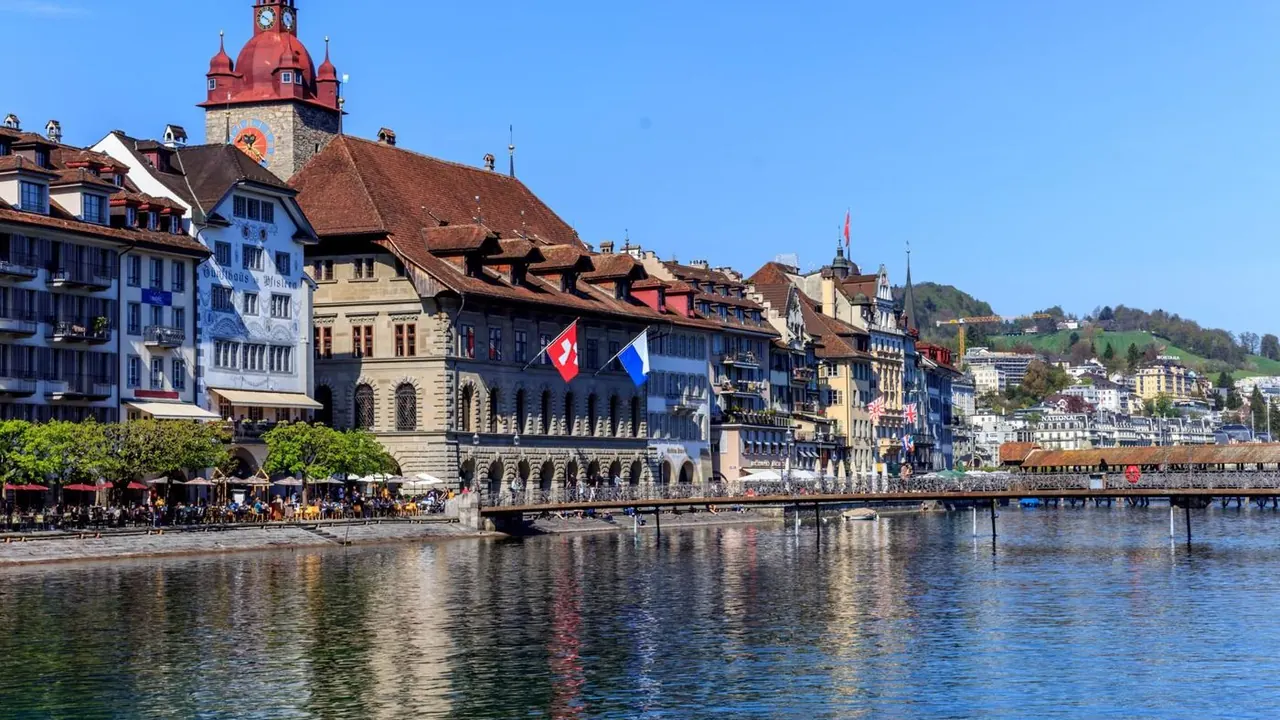
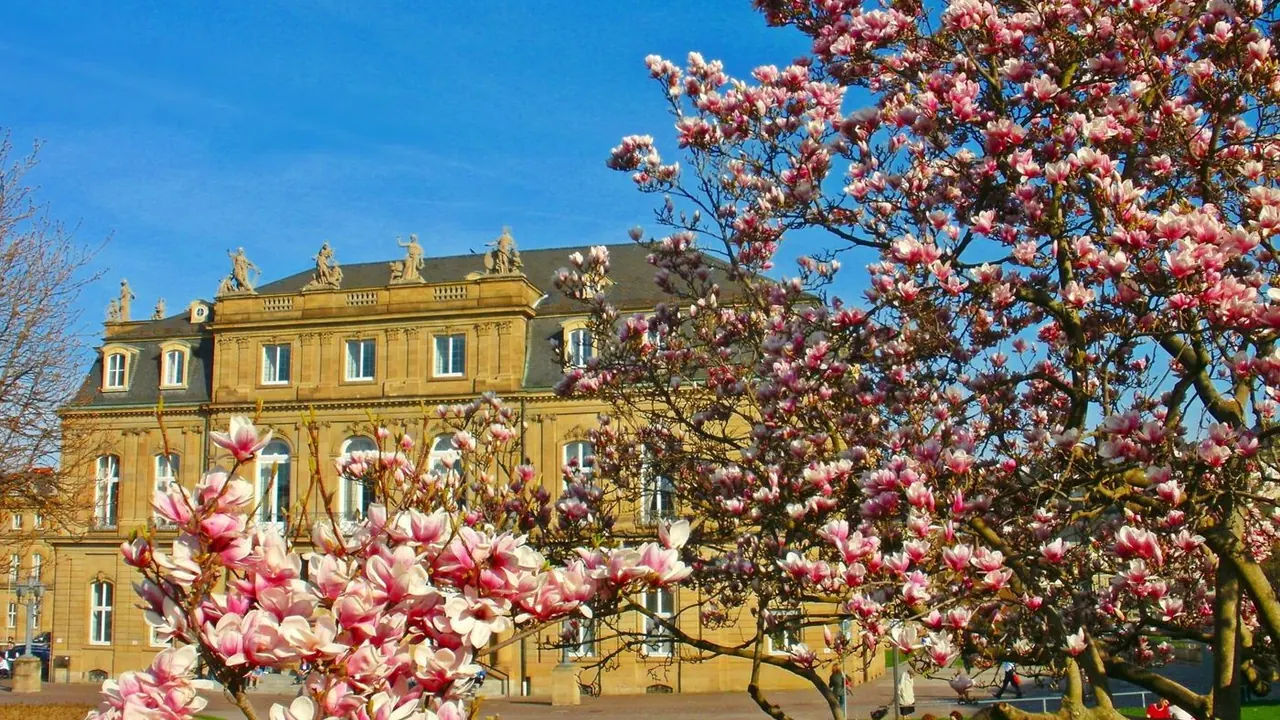
Photos: Lucerne by ILOVESwitzerland, Pexels License; Stuttgart by Baden de, CC BY 3.0, cropped.
Lucerne or Stuttgart?
Our verdict in twelve categories, each scored against the same fixed benchmark cities, and the climate month by month, so you can choose for your trip.
Choose Lucerne for
- nature and the outdoors
- beaches
- getting around
Lucerne is the choice when the landscape is the point of the trip. The lake and the peaks of Pilatus, Rigi and Titlis are right on the doorstep, and boats, cogwheel trains and cable cars leave from beside the station. A medieval Old Town and a summer swim from the lake baths complete it. It suits walkers, rail lovers and anyone happy to pay a lot for scenery, but it is a quiet place to eat and go out.
Choose Stuttgart for
- prices
- food and drink
- wellness
Stuttgart rewards the traveller who cares more about the table, the stage and the evening than the view. Swabian taverns and vineyards inside the city, a world-class ballet and opera, warm mineral baths and a livelier bar scene make it a fuller city break. It also costs far less than Lucerne. The countryside around it is green hills and forest rather than Alps.
Scoreboard
Twelve categories on one fixed scale from 0 to 100. The shaded stretch is the gap between the two.
Your match
Pick a travel style or drag the sliders, and both match scores follow your weighting.
Wins on nature and the outdoors and beaches with your weighting.
Wins on prices and food and drink with your weighting.
What matters to you?
Category by category
What the scores mean for a trip.
Beaches & swimming
Neither city has a beach, but only Lucerne has a lake you can swim in. In July and August locals swim from the Lido, the old wooden lake baths and the lawns at Ufschötti, in clean, calm water of around 20-22°C with mountains behind it.
In Stuttgart the Neckar is a working river with barges, so summer swimming means outdoor pools, some fed by mineral springs. The nearest open water worth the trip is Lake Constance, more than two hours away.
Food & drink
Stuttgart is the better place to eat. Swabian cooking has its own repertoire of Maultaschen, Käsespätzle and Zwiebelrostbraten. Vineyards inside the city limits supply the Riesling and Trollinger, the Art Nouveau Markthalle is good for browsing, and there is serious fine dining too.
Lucerne serves sound Swiss classics in its guild houses, such as Chügelipastete, fondue and perch from the lake. The range is narrow, though, and many tables near the Chapel Bridge cater to coach tours, so meals tend to cost a lot more than they deliver.
Culture & sights
The two are fairly even, but they offer very different sightseeing. Lucerne has the intact medieval picture: the covered Chapel Bridge, frescoed squares, the climbable towers of the Musegg Wall and the carved Lion Monument, with Picasso and Klee at the Rosengart Collection. It takes a day or two.
Stuttgart lost much of its old core in the war, so its strengths are industry and modern design. It has the Mercedes-Benz and Porsche museums, the Staatsgalerie and the Le Corbusier houses of the Weissenhof Estate, with baroque Schlossplatz as the historic centrepiece. Allow two to three days.
Nightlife
Stuttgart has more to offer after dark. Bars and lounges on Theodor-Heuss-Strasse fill at weekends, and small clubs in basements and old industrial spaces play electronic music. The Cannstatter Volksfest beer tents and the late-summer wine village make it lively for whole weeks.
Lucerne is mostly about a drink on a riverside terrace and an early night, and the lakefront is nearly empty by midnight. The big exception is Fasnacht, when the town stays out in costume until dawn.
Nature & outdoors
This is Lucerne's strongest category and where the two differ most. The lake winds into real mountains. Pilatus, Rigi and the Stanserhorn can be reached by cogwheel railway and cable car, Titlis has year-round snow about an hour away, and paddle steamers let you combine boat, train and hike in one day. Winter brings skiing, though low cloud can hide the views for days.
Stuttgart's outdoors is gentler: wooded hills, vineyard paths above the Neckar, deer forests, and the cliffs and caves of the Swabian Jura or the Black Forest about an hour away. It is good walking and cycling country, but not high mountains.
Day trips
Both are excellent bases, and the difference is the kind of outing. From Lucerne, Zurich, Bern and Basel are each under an hour by train, and the lake itself is an excursion, with steamers to the Rütli meadow and Altdorf, where the William Tell story is set.
Stuttgart's trips are more about palaces, castles and old towns. Ludwigsburg's baroque palace and the university towns of Tübingen and Heidelberg are within an hour, and Maulbronn monastery and Hohenzollern Castle are further out. Strasbourg makes a long day across the border.
Good for families
Lucerne's big day out with children is the Swiss Museum of Transport on the lakeshore, a hands-on collection of trains, planes, ships and cars with a planetarium. After that, the fun is in the journeys: paddle steamers, cogwheel trains and the summer toboggan run on Pilatus. All of these need clear weather, and there is no zoo to fall back on when it rains.
Stuttgart's answer is Wilhelma, a historic zoo and botanical garden set among Moorish-style pavilions. Add the narrow-gauge railway on the Killesberg, the fairy-tale garden at Ludwigsburg and the car museums for older children. The hills make pushchairs harder work than on Lucerne's flat riverside.
Getting around
Lucerne is the easier of the two. The station, the boat piers and the Old Town sit together on the lakefront, most sights are a flat walk away, and the boats, trains and mountain lifts all use the same Swiss tickets. You only have to check the connections.
Stuttgart's centre is just as walkable, but the city climbs steeply up the sides of its basin. Beyond Königstrasse and Schlossplatz you rely on the Stadtbahn, the S-Bahn, a rack railway, or the steep public stairways called Stäffele.
Shopping & style
Stuttgart is the better shopping city. Königstrasse is a long pedestrian high street, and a long-established family department store just off it covers luxury fashion. Independent shops cluster around Calwer Strasse and the Bohnenviertel, and the outlet town of Metzingen is about half an hour away.
Lucerne's shopping is mainly Swiss watches and jewellery on Schwanenplatz, along with army knives, chocolate and cuckoo clocks for tour groups. Clothes and homeware are thin on the ground.
Affordability
Stuttgart is clearly the cheaper stay, though it is not a bargain. Hotels cost much less at weekends and outside trade fairs, and tavern meals and day tickets are fair for what you get.
Lucerne is one of the most expensive places you could choose. Central rooms and simple meals are costly, and the boat, rail and cable car trips that make the visit worthwhile add a lot more. Swiss travel passes and lakeside picnics help a little.
Live music & performing arts
Stuttgart has the deeper year-round programme. The Stuttgart Ballet is one of Europe's most respected companies and shares the state theatre with a bold opera house. The Liederhalle has a strong Bach tradition, and there are big musicals and jazz throughout the week.
Lucerne's moment is the Lucerne Festival, mainly in late summer, when leading orchestras play Jean Nouvel's lakefront hall, which is famous for its acoustics. Outside those weeks it has the good but limited calendar of a small city.
Wellness & relaxation
Stuttgart has a real bathing tradition that Lucerne lacks. The springs of Bad Cannstatt and Berg feed public mineral baths, where you can soak in naturally fizzy warm water indoors or outdoors and then use the saunas.
Lucerne offers calm rather than spas. You get slow lakeside walks and lazy steamer afternoons, and the nearest proper soak is Mario Botta's mineral bath high on the Rigi, about an hour away.
When should you go?
Pick your month. The climate figures are measured averages, not a forecast.
Lucerne in July
Stuttgart in July
Daytime high, °C
Rainfall in the month, mm
Where the figures come from
Lucerne has no rain gauge within 25 km of the centre, so its rainfall comes from a gridded climate dataset read at the city rather than from a gauge further away.
Lucerne's sunshine is measured 42 km from the centre, at Zurich Town / Ville..
Temperature and rainfall are climate normals, averaged over the years shown. Lucerne: 2005-2025 (sunshine 1991-2020, rainfall 1991-2020) normals, Emmen (4.2 km from centre). Stuttgart: 1991-2020 normals, Stuttgart / Neckartal (2.8 km from centre).
Both cities are at their best from late May to September, and Stuttgart is a little warmer almost all year, reaching about 26°C in July and August against Lucerne's 24°C. Lucerne is also much wetter in summer. Rain peaks at around 124mm a month from May to July, often as mountain showers and low cloud that can hide the peaks, while Stuttgart's wettest months stay under 79mm. July and August are the only months warm enough for a swim in Lake Lucerne. Both cities get most sun in July.
Winter is cold in both, with daytime highs of about 4°C in Lucerne and a couple of degrees more in Stuttgart. Lucerne turns that into skiing and sledging up in the mountains, while Stuttgart is better used then for museums and mineral baths. Early autumn is a good compromise: September is mild and drier in both cities, which suits hiking above the lake or walking the vineyard slopes and the Swabian Jura.
Which traveller are you?
For an outdoors trip, Lucerne is far ahead. You can hike ridge paths on Rigi, ride the cogwheel railway up Pilatus or see Titlis's glacier, all without a car. Stuttgart's vineyard trails and the nearby Jura are pleasant but much gentler.
On a tight budget, Stuttgart is the realistic option. Hotels get cheaper at weekends, tavern portions are generous and day tickets cover the city. In Lucerne even simple meals are expensive, and the mountain excursions are what eat up the money.
For a food and nightlife trip, choose Stuttgart. It has Maultaschen and local Trollinger in wine taverns, seasonal Besen taverns run by growers and a bar strip on Theodor-Heuss-Strasse that fills at weekends. Outside carnival, Lucerne's evenings end with a quiet drink by the water.
Before you go
| Measure | Lucerne | Stuttgart |
|---|---|---|
| Official language | French, German, Italian, Romansh | German |
| Currency | Swiss Franc (CHF) | Euro (EUR) |
| Sockets | CJ230 V, 50 Hz | CF230 V, 50 Hz |
| Driving side | Right | Right |
| Time zone | UTC+1, UTC+2 in summer | UTC+1, UTC+2 in summer |
| Emergency number | 112 | 112 |
| Elevation | 436 m | 245 m |
| Main airport | Zürich Airport (ZRH)49 km from centre226 non-stop destinations | Stuttgart Airport (STR)10 km from centre124 non-stop destinations |
| Public holidays this year | 12 days | 12 days |
By the numbers
| Measure | Lucerne | Stuttgart |
|---|---|---|
| City population | 86,234 | 609,365 |
| People per km² | 2,963 | 2,938 |
| Museums within 10 km | 14 | 42 |
| UNESCO World Heritage sites within 50 km | 1 | 3 |
Where else could you go?
Every comparison below shares a destination with this one, so you can follow Lucerne or Stuttgart somewhere new.