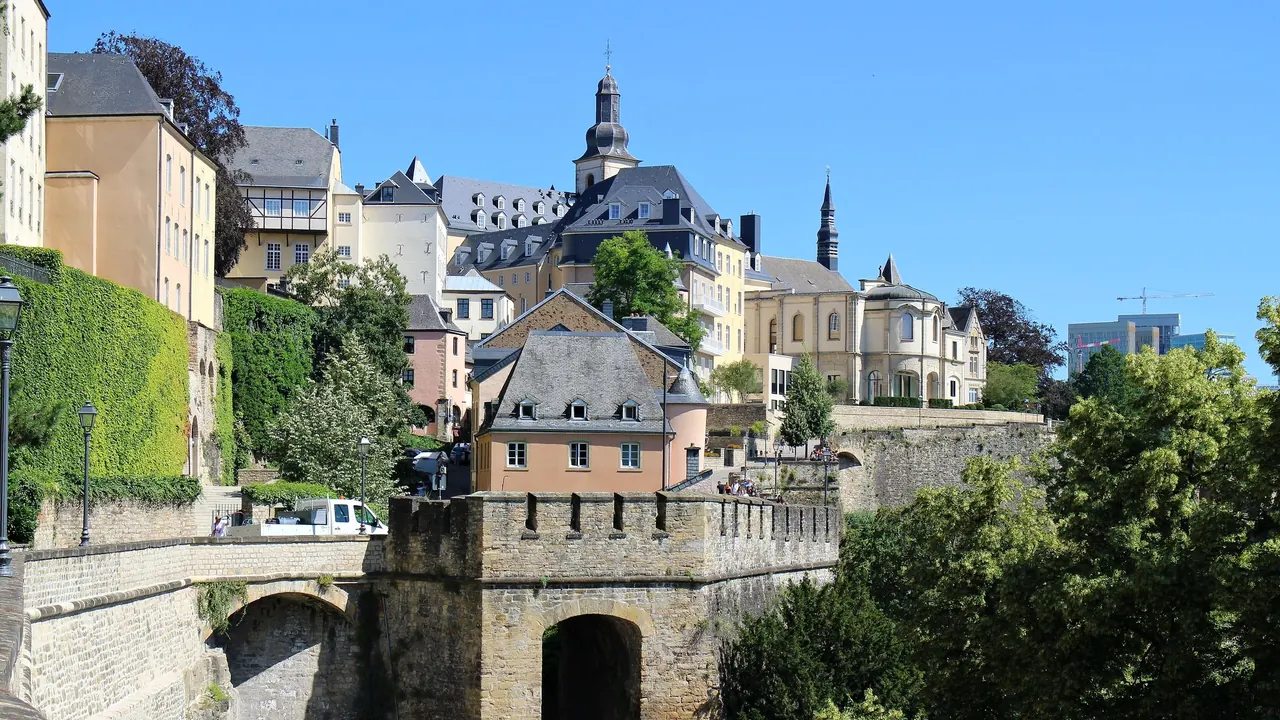
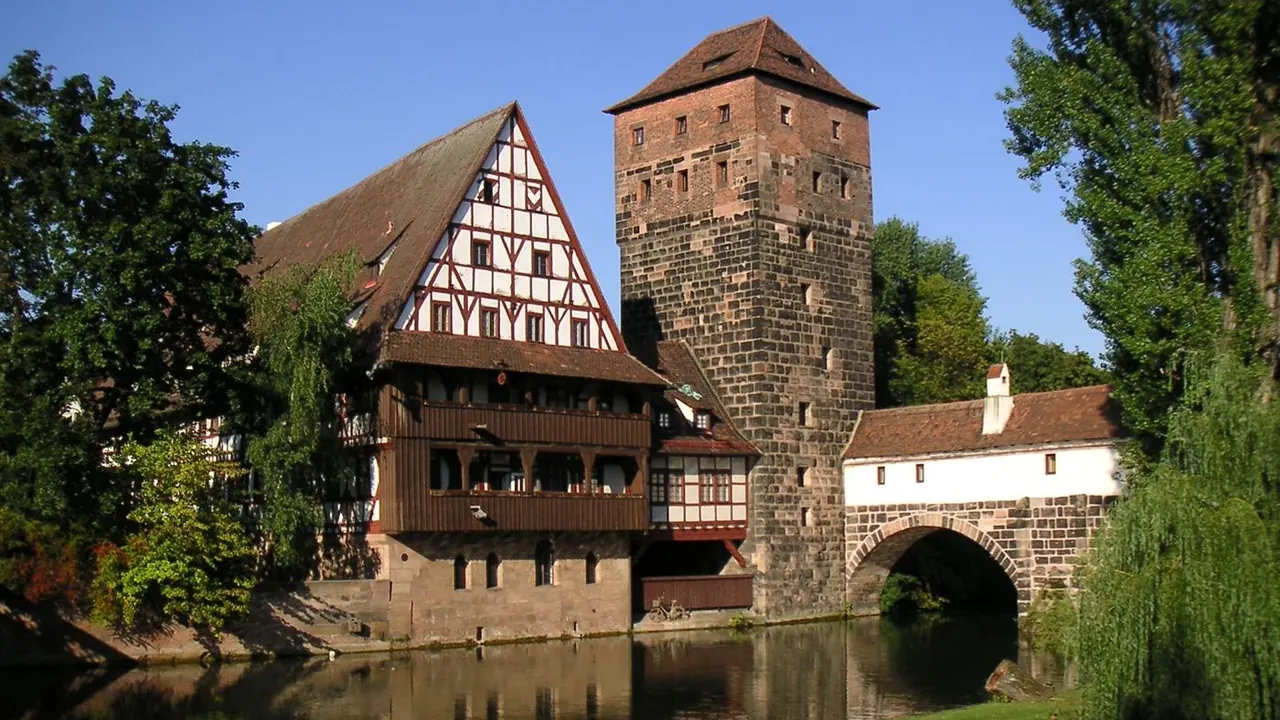
Photos: Luxembourg by Suicasmo, CC BY-SA 4.0, cropped; Nuremberg by Horst Gutmann, CC BY 2.0, cropped.
Luxembourg or Nuremberg?
Our verdict in twelve categories, each scored against the same fixed benchmark cities, and the climate month by month, so you can choose for your trip.
Choose Luxembourg for
- nature and the outdoors
- getting around
- wellness
Luxembourg suits a short, unhurried break for travellers who care more about the setting than the cost. The old town sits on its sandstone plateau, ringed by fortress walls above wooded gorges, and fills two or three quiet days. Free public transport takes you to Clervaux by train, and buses go to Vianden's castle and the Moselle wine villages, so you won't need a car. Trier and Metz are an easy train ride across the border. It is best for couples with a generous budget who would rather have a terrace and a glass of crémant than a late night.
Choose Nuremberg for
- prices
- families
- culture and sights
Families, history lovers and anyone watching their spending will get more from Nuremberg. Its walled medieval centre and imperial castle sit alongside the Rally Grounds and Courtroom 600, its toy-making past keeps children busy and Gostenhof makes for livelier evenings. Prices are much gentler, and beer, bratwurst and day trips to Bamberg or Rothenburg make it a fuller stay.
Scoreboard
Twelve categories on one fixed scale from 0 to 100. The shaded stretch is the gap between the two.
Your match
Pick a travel style or drag the sliders, and both match scores follow your weighting.
Wins on nature and the outdoors and getting around with your weighting.
Wins on prices and families with your weighting.
What matters to you?
Category by category
What the scores mean for a trip.
Beaches & swimming
Neither city is a beach destination, and in both a swim means a lake about an hour away. Luxembourg has the wooded reservoir of the Upper Sûre and the gravel-pit lakes at Remerschen. Nuremberg has the larger Franconian Lake District, where the Brombachsee has grassy shores, small sandy strips and room for sailing. Both are short-season outings for a hot day, and in town both cities rely on their pools.
Food & drink
The two are level in quality but very different in character. Luxembourg eats in a French way, with German, Belgian, Portuguese and Italian influences. It has a surprisingly serious fine-dining tier, and crisp Moselle Riesling and crémant are poured everywhere by the glass.
Nuremberg is a beer and pork city. You eat finger-sized bratwurst grilled over beechwood, Schäufele with crackling and Lebkuchen, and drink in taverns and beer gardens served by Franconia's dense web of small breweries. Choose Luxembourg for wine and a refined dinner, Nuremberg for a hearty, cheaper meal with a smoky Kellerbier.
Culture & sights
Nuremberg has more to see. Its walled old town, the Kaiserburg, the churches of St Sebaldus and St Lorenz and Dürer's house already make a full medieval set. On top of that come the Germanisches Nationalmuseum, which can take a day by itself, and the Rally Grounds and Courtroom 600, which make it a major stop for twentieth-century history.
Luxembourg's strength is its setting. The UNESCO-listed fortress wraps around a plateau above two gorges, and you can walk through the Bock casemates and look down from the Corniche onto the Grund. Add the palace, the cathedral and MUDAM on Kirchberg, and it is striking but finished in a couple of days.
Nightlife
Nuremberg makes for the better night out. It still runs on bars rather than clubs, but Gostenhof's small bars and alternative venues have real character. Students from the city and Erlangen fill the squares and riverbanks on summer weekends.
Luxembourg's evenings gather in a few pockets: the old brewery site at Rives de Clausen, the stone pubs of the Grund and later venues in Hollerich. The crowd is international, and it goes quiet at weekends, when many residents leave town.
Nature & outdoors
Both cities give walkers and cyclists plenty to do, with no mountains in either. Luxembourg has green space right in the centre, where paths run along the bottoms of the Pétrusse and Alzette gorges. Half an hour away, the Müllerthal has mossy sandstone passages, and the Ardennes and the Moselle vineyards are further out.
Nuremberg's woods start at the edge of town in the Reichswald pine forest. Its best country is Franconian Switzerland, about an hour north, where limestone towers and caves draw climbers as well as hikers.
Day trips
Both are excellent bases, and what differs is the direction you travel. From Luxembourg you cross borders: Roman Trier and Gothic Metz are each under an hour by train. Closer to home are Vianden's castle, Echternach and the Moselle wine villages.
From Nuremberg the trips stay in Bavaria: Bamberg, Regensburg and Würzburg are each about an hour away, with the walled towns of the Romantic Road beyond them. Munich is close enough by fast train for a day out.
Good for families
Nuremberg can fill a family week, and Luxembourg can't. Its toy-making past shows in the Toy Museum. The railway museum, the large zoo with its dolphin and manatee house and the play park in Zirndorf give children several full days, and in Advent there is a children's Christmas market with carousels.
Luxembourg is calm, safe and easy with a buggy thanks to its lifts and funicular. Its casemate tunnels feel like an adventure, but beyond the small Parc Merveilleux there is no zoo or theme park.
Getting around
Both cities are easy to manage without a car, in different ways. Luxembourg's public transport is free across the whole country, with no ticket to buy for trams, buses or trains to Vianden and the Moselle. The upper and lower town are linked by lifts and a funicular.
Nuremberg's old town is flat enough to walk end to end inside its walls, apart from the cobbled climb to the castle. One ticket covers the U-Bahn, trams and S-Bahn out to the Rally Grounds and Fürth.
Shopping & style
Neither is a shopping destination, and what to take home is very different. Luxembourg's Grand-Rue serves wealthy locals with luxury brands, and the things worth buying are Villeroy & Boch porcelain and Moselle crémant. Nuremberg's main streets are full of chains, but Lebkuchen tins, wooden toys and the Handwerkerhof's crafts make better souvenirs. In Advent the Christkindlesmarkt gives it a seasonal edge.
Affordability
This is where the two differ most. In Luxembourg, keeping costs down takes planning. You book a Friday or Saturday night, when the business guests have gone and room rates can drop. You make lunch the main meal and fill the afternoons with museums that cost nothing. Some visitors skip staying in the city altogether and come in by train from Trier or Metz. The easy savings are the free trams and buses and wine by the glass.
Nuremberg asks much less of you. A room, a hearty dinner and a day of sightseeing cost well below what Munich charges. The only planning is the calendar: during the big trade fairs, above all the toy fair, and in the weeks of the Christmas market, rooms run short and rates climb.
Live music & performing arts
The two are on a par, with good regional programmes and no world-famous tradition. Luxembourg's Philharmonie on Kirchberg is a fine concert hall and draws touring orchestras and soloists, and the Grand Théâtre hosts visiting opera and dance. Nuremberg produces more of its own work, with repertory opera and ballet at the Art Nouveau Staatstheater. Its summer is lively, with the free Bardentreffen folk weekend and a large rock festival at the Zeppelinfeld.
Wellness & relaxation
Both are calm places to unwind without a famous spa scene of their own. Luxembourg's answer is Mondorf-les-Bains, a nineteenth-century thermal spa in a landscaped park half an hour away, and its gorge walks are very peaceful. Nuremberg leans on the German sauna habit, with a large thermal spa in Fürth and saline floating pools at Bad Windsheim. Expect nude, mixed saunas there, and slow afternoons in beer gardens.
When should you go?
Pick your month. The climate figures are measured averages, not a forecast.
Luxembourg in July
Nuremberg in July
Daytime high, °C
Rainfall in the month, mm
Temperature and rainfall are climate normals, averaged over the years shown. Luxembourg: 1991-2020 normals, Luxembourg / Luxembourg (6.3 km from centre). Nuremberg: 1991-2020 normals, Nuernberg (5.5 km from centre).
Both cities have the same continental pattern. Winters are cold, with daytime highs of about 4°C, and summers are mild. May to September is the comfortable season for walking the streets. July and August are warm enough for an afternoon at a lake, and Nuremberg runs about a degree warmer through the summer. Neither city gets uncomfortably hot, so midsummer is fine for sightseeing in both.
The real difference is rain. Luxembourg is wet all year, with about 70mm in most months and a soggy December near 90mm. Nuremberg is much drier in winter and spring, with around 35mm in the early months, and its wettest spell comes in July. Luxembourg gets slightly more sunshine in high summer, which helps its gorges and vineyards in June and July. Nuremberg's dry winter suits a cold but crisp December visit better.
Which traveller are you?
On a tight budget, Nuremberg is the clear choice. Its tavern meals and local beer are cheap, and hotels are fairly priced outside trade-fair weeks. Luxembourg's hotels and restaurants are priced for business travellers, and its free public transport only partly makes up for that.
On a family trip with children, Nuremberg has far more made for young visitors. There is the Toy Museum, the railway museum with full-size locomotives, the large zoo in old quarries and a play park in Zirndorf. Luxembourg's casemate tunnels are fun, but the city fills only a few days.
For a culture and arts trip, Nuremberg has more depth. It offers the Kaiserburg, Gothic churches, Dürer's house, the vast Germanisches Nationalmuseum and the sobering Nazi-era sites. Luxembourg's fortress and gorges are memorable, but the city's sights are covered comfortably in two days.
Before you go
| Measure | Luxembourg | Nuremberg |
|---|---|---|
| Official language | French, German, Luxembourgish | German |
| Currency | Euro (EUR) | Euro (EUR) |
| Sockets | CF230 V, 50 Hz | CF230 V, 50 Hz |
| Driving side | Right | Right |
| Time zone | UTC+1, UTC+2 in summer | UTC+1, UTC+2 in summer |
| Emergency number | 112 | 112 |
| Elevation | 300 m | 209 m |
| Main airport | Luxembourg-Findel International Airport (LUX)6 km from centre115 non-stop destinations | Nuremberg Airport (NUE)5 km from centre56 non-stop destinations |
| Public holidays this year | 12 days | 12 days |
By the numbers
| Measure | Luxembourg | Nuremberg |
|---|---|---|
| City population | 137,678 | 531,159 |
| People per km² | 2,663 | 2,848 |
| Museums within 10 km | 19 | 50 |
| UNESCO World Heritage sites within 50 km | 4 | 1 |
Where else could you go?
Every comparison below shares a destination with this one, so you can follow Luxembourg or Nuremberg somewhere new.
- Maastrichtvs Luxembourg
- Munichvs Nuremberg
- Karlovy Varyvs Nuremberg
- Stuttgartvs Nuremberg
- Colognevs Luxembourg
- Strasbourgvs Luxembourg