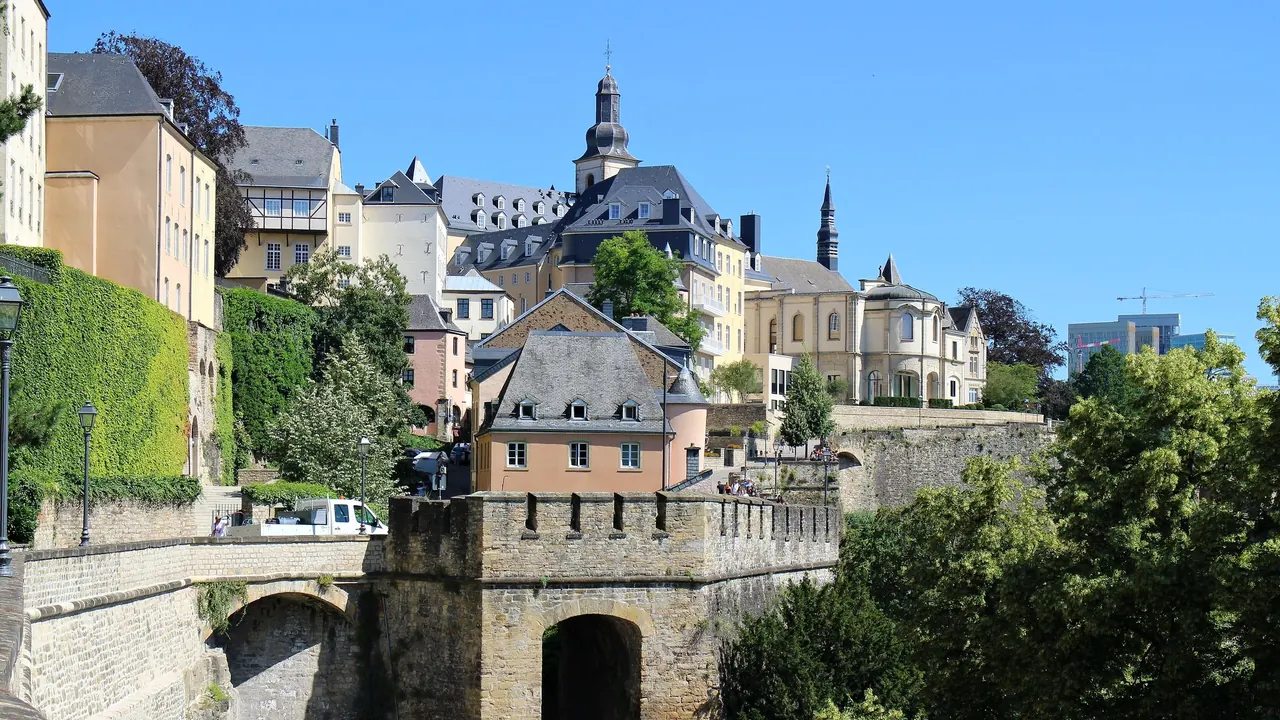
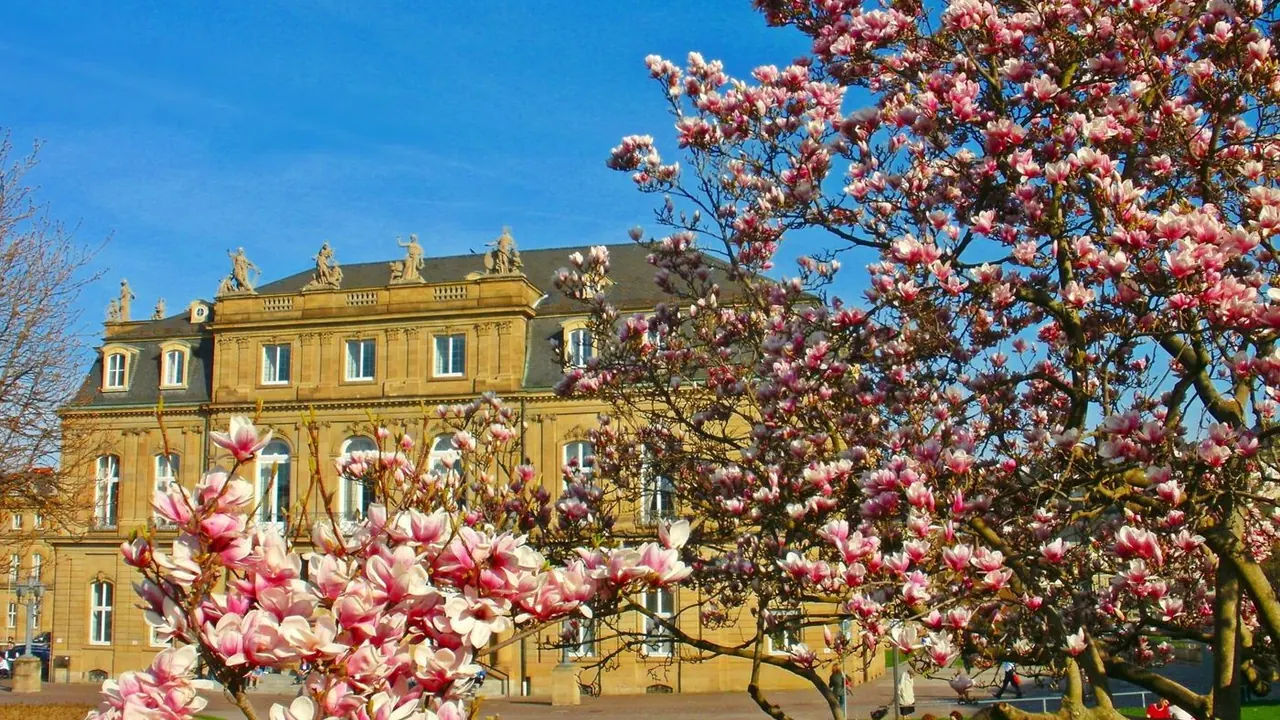
Photos: Luxembourg by Suicasmo, CC BY-SA 4.0, cropped; Stuttgart by Baden de, CC BY 3.0, cropped.
Luxembourg or Stuttgart?
Our verdict in twelve categories, each scored against the same fixed benchmark cities, and the climate month by month, so you can choose for your trip.
Choose Luxembourg for
- getting around
- beaches
Luxembourg suits a short, unhurried stay built around its setting: an old town on a rock above wooded gorges, fortress tunnels to walk through, and lifts down to the stone houses of the Grund. Within the country, free buses and trains take you to Vianden's castle, the Müllerthal and the Moselle wine villages without a ticket. Across the border, Trier and Metz are each under an hour away by train. Of the two cities it is the quieter and the dearer one. It suits couples and walkers who don't mind paying more for calm streets and a glass of crémant on a terrace.
Choose Stuttgart for
- prices
- live music and the arts
- shopping
A longer trip gets more out of Stuttgart, and the money goes further there. It has a ballet and opera of European standing, mineral baths you can soak in without leaving town, Wilhelma for the children, and Swabian taverns pouring wine grown on the city's own slopes. Go there for evenings at the theatre, a serious day of shopping and a city that keeps a family busy for most of a week.
Scoreboard
Twelve categories on one fixed scale from 0 to 100. The shaded stretch is the gap between the two.
Your match
Pick a travel style or drag the sliders, and both match scores follow your weighting.
Wins on getting around and beaches with your weighting.
Wins on prices and live music and the arts with your weighting.
What matters to you?
Category by category
What the scores mean for a trip.
Beaches & swimming
Neither city works for a beach trip, but Luxembourg at least gives you somewhere natural to swim. On a hot day you can drive about an hour to the bathing spots on the Upper Sûre reservoir, or go to the old gravel pits at Remerschen, where the water reaches about 20°C in high summer.
Stuttgart has nothing like that. The Neckar is a working river and Max-Eyth-See is for boating rather than bathing. Locals swim in outdoor pools instead, some of them fed by the mineral springs, and the nearest real lake is Lake Constance, more than two hours away.
Food & drink
Stuttgart has the stronger food identity of the two. Swabian cooking is a cuisine of its own, with Maultaschen, Käsespätzle and onion-topped roast beef served in wine taverns. In season, growers open Besen taverns in their own houses and serve their wine with onion tart. The Art Nouveau Markthalle is good for an hour of browsing.
Luxembourg eats in a mix of borrowed styles: French in the better dining rooms, brasseries in the German and Belgian manner, and Portuguese and Italian neighbourhood places. Its own dishes are few, and its real treat is Moselle Riesling and crémant by the glass. Both cities have a serious fine-dining tier and little cheap street food.
Culture & sights
Their sightseeing is roughly equal, but the two are very different in kind. Luxembourg's main sight is the place itself: a UNESCO-listed fortress wrapped around a sandstone plateau, casemate tunnels cut into the rock, and the view from the Chemin de la Corniche down to the Grund. MUDAM and the national museum add to that, without changing the picture.
Stuttgart lost much of its old centre to bombing, so its strengths are industry and modern design. You get the Mercedes-Benz and Porsche museums, the Staatsgalerie's painting collection and the Le Corbusier houses on the Weissenhof Estate. Choose Luxembourg for atmosphere and history, and Stuttgart for collections and architecture.
Nightlife
Stuttgart has more going on after dark. There is a strip of bars and lounges along Theodor-Heuss-Strasse, clubs in basements and old industrial buildings with a loyal electronic crowd, and the big beer tents of the Cannstatter Volksfest in autumn. Weekends are the busiest time.
In Luxembourg it works the other way round. Thursday and Friday are the big nights, because many residents leave the city at the weekend. What there is clusters in the old brewery buildings of the Rives de Clausen, the Grund's riverside pubs and later venues in Hollerich, and most evenings end early.
Nature & outdoors
There is little between them for walkers. Luxembourg's green starts in the centre, where paths run along the bottom of the Pétrusse and Alzette gorges. The mossy rock passages of the Müllerthal are only about half an hour away, with the Ardennes further north.
Stuttgart is ringed by vineyards and forests with deer, and it has more variety within about an hour. The cliff-edge trails and caves of the Swabian Jura lie in one direction and the fir-covered ridges of the northern Black Forest in another. Both are at their best in autumn.
Day trips
Both make excellent bases, and the difference is the kind of trip. From Luxembourg you cross borders: Roman Trier and Gothic Metz are each under an hour by train, Nancy's eighteenth-century squares are a little further, and Vianden's castle and the Moselle wine villages lie closer to home.
Stuttgart's choices are packed closely around it. Ludwigsburg's baroque palace and half-timbered Esslingen are a short S-Bahn ride away, and Tübingen and Heidelberg are under an hour. Further out are Maulbronn, Hohenzollern Castle and Ulm's huge spire, with Strasbourg possible on a long day.
Good for families
Stuttgart keeps children busy for longer. Wilhelma's zoo and botanical gardens can fill a whole day, Killesberg park has a narrow-gauge railway and animal enclosures, and a ride on the little rack railway is a treat in itself. The hills do mean some pushing with a pushchair.
Luxembourg is calm and safe, and public lifts make buggies easy, but there is less to do. The casemate tunnels and the natural history museum are the main attractions, the small Parc Merveilleux is the only place built for families, and there is no zoo. It suits two or three days rather than a school vacation week.
Getting around
Luxembourg is the easier city to get around, mainly because all public transport in the country is free. The tram, buses and trains to Vianden, Clervaux and the Moselle need no ticket at all, and public lifts and a funicular link the plateau to the river quarters below.
Stuttgart also works well. Its flat core around Königstrasse and Schlossplatz is easy to walk, and one integrated ticket covers the Stadtbahn, S-Bahn, buses and rack railway up the sides of the basin. You do have to buy that ticket, though, and the steep Stäffele stairways make walking beyond the centre harder work.
Shopping & style
Stuttgart is the better place to shop. Königstrasse is one of Germany's longest pedestrian streets, Breuninger has been the city's department store for designer fashion since the nineteenth century, and the Bohnenviertel has smaller independent shops. The outlet town of Metzingen is about half an hour away.
Luxembourg's Grand-Rue has luxury brands for a wealthy local clientele, but there is little to browse beyond that. The best things to take home are Villeroy & Boch porcelain from the factory outlet and a few bottles of crémant from the Moselle.
Affordability
Stuttgart is noticeably cheaper, though still above average for Western Europe. The portions in its taverns and beer gardens are good for the price, and hotel rooms are cheaper at weekends, except during the big trade fairs.
Luxembourg is one of the more expensive places in Europe to stay or eat out, with hotels priced for business travel and the EU institutions. Free transport, free museums and a set lunch soften the bill, and many visitors save money by sleeping in Trier or Metz and coming in by train.
Live music & performing arts
This is Stuttgart's strongest advantage. The Stuttgart Ballet has been famous since John Cranko's time and shares the state theatre by the palace gardens with an adventurous opera company. Add symphony and Bach concerts at the Liederhalle, long-running musicals at Möhringen and a well-known jazz club, and you could fill every evening. Book early for the ballet, as tickets are hard to get.
Luxembourg's Philharmonie has superb acoustics and its own orchestra, and Neimënster puts on open-air concerts in summer. Most of what plays at the Grand Théâtre and elsewhere, however, is on tour from abroad.
Wellness & relaxation
Stuttgart has a bathing culture inside the city. The mineral springs at Bad Cannstatt and Berg feed public baths where you soak in naturally fizzy warm water, indoors and out, with saunas next door. An afternoon there needs no planning.
In Luxembourg you take a half-hour trip to the thermal park at Mondorf-les-Bains, which makes a pleasant day out. In return the city itself is quieter. Its evenings and weekends are slower than Stuttgart's businesslike pace, and the river walks through the Grund are very calm.
When should you go?
Pick your month. The climate figures are measured averages, not a forecast.
Luxembourg in July
Stuttgart in July
Daytime high, °C
Rainfall in the month, mm
Temperature and rainfall are climate normals, averaged over the years shown. Luxembourg: 1991-2020 normals, Luxembourg / Luxembourg (6.3 km from centre). Stuttgart: 1991-2020 normals, Stuttgart / Neckartal (2.8 km from centre).
Both cities are best from May to September, but Stuttgart runs a little warmer all year. Its summer afternoons reach about 26°C, against 24°C in Luxembourg, so it makes the better choice early and late in the season. In July and August Luxembourg's lakes are warm enough for a swim, and it gets slightly more summer sunshine. Autumn suits both, with the forests turning and the grapes being harvested. Neither city is too hot for walking the streets at any time of year.
Rain is where they differ most. In Luxembourg it is spread evenly through the year and peaks in December at 89mm, so winter there is grey, wet and close to freezing. Stuttgart's winters are much drier, with around 35mm in January, which makes a cold-weather city break more comfortable. Its wettest stretch is early summer, from May to July, which usually means showers and storms rather than settled rain.
Which traveller are you?
For a culture and arts trip, Stuttgart is the clear pick. Its ballet is one of the most respected companies in Europe, the opera is known for bold productions, and the car museums and Staatsgalerie hold collections of real international standing.
On a tight budget, Stuttgart is the better choice. Neither city is cheap, but Luxembourg's hotels and restaurants are priced for bankers and EU officials. In Stuttgart, hearty tavern portions and cheaper weekend rooms stretch the money further.
For a short city break, Luxembourg makes a neat two days. The fortress, the casemates and the Grund are all within walking distance, lifts link the different levels of the town, and public transport is free, so you never need to buy a ticket.
Before you go
| Measure | Luxembourg | Stuttgart |
|---|---|---|
| Official language | French, German, Luxembourgish | German |
| Currency | Euro (EUR) | Euro (EUR) |
| Sockets | CF230 V, 50 Hz | CF230 V, 50 Hz |
| Driving side | Right | Right |
| Time zone | UTC+1, UTC+2 in summer | UTC+1, UTC+2 in summer |
| Emergency number | 112 | 112 |
| Elevation | 300 m | 245 m |
| Main airport | Luxembourg-Findel International Airport (LUX)6 km from centre115 non-stop destinations | Stuttgart Airport (STR)10 km from centre124 non-stop destinations |
| Public holidays this year | 12 days | 12 days |
By the numbers
| Measure | Luxembourg | Stuttgart |
|---|---|---|
| City population | 137,678 | 609,365 |
| People per km² | 2,663 | 2,938 |
| Museums within 10 km | 19 | 42 |
| UNESCO World Heritage sites within 50 km | 4 | 3 |
Where else could you go?
Every comparison below shares a destination with this one, so you can follow Luxembourg or Stuttgart somewhere new.
- Baden-Badenvs Stuttgart
- Heidelbergvs Stuttgart
- Strasbourgvs Stuttgart
- Freiburgvs Stuttgart
- Maastrichtvs Luxembourg
- Frankfurtvs Stuttgart