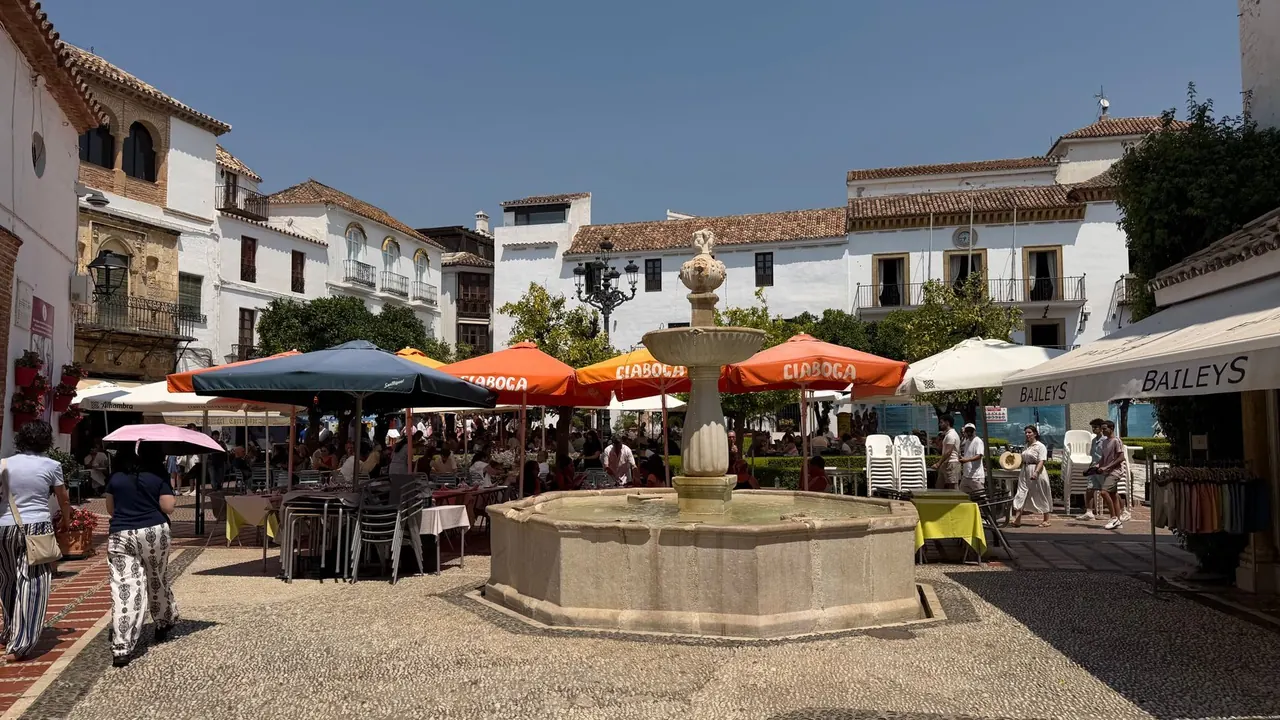
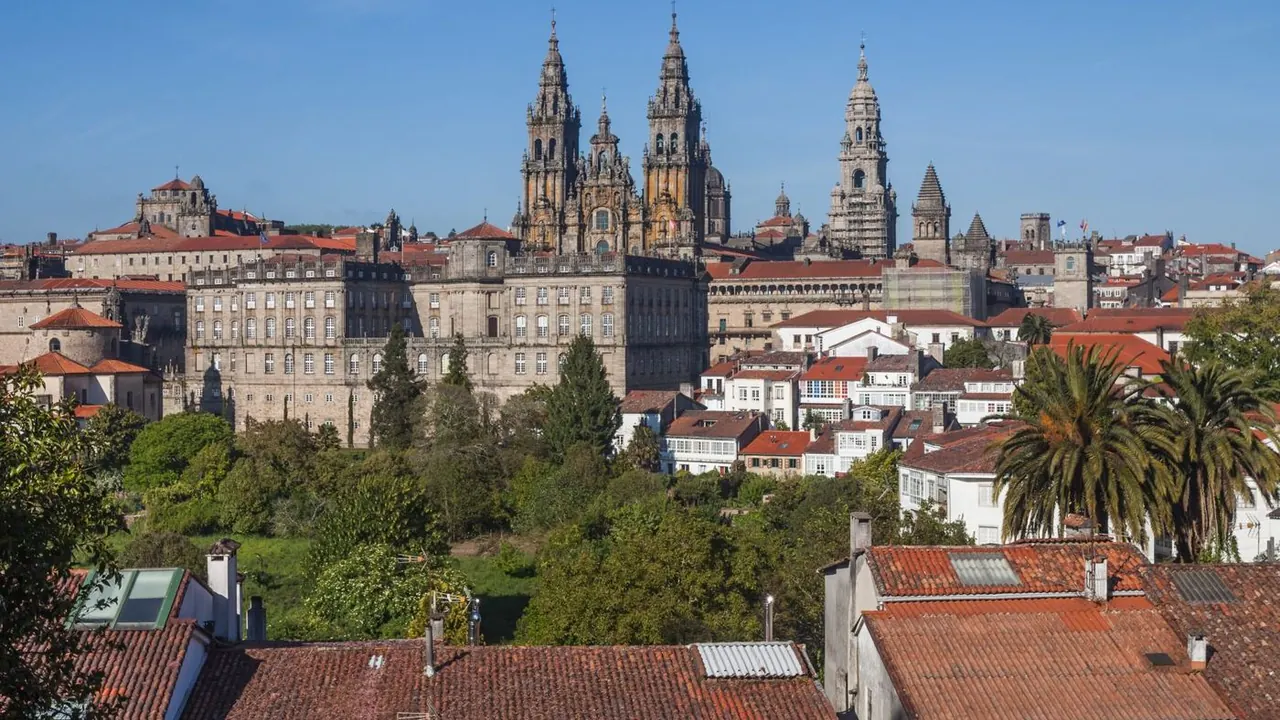
Photos: Marbella by Décio Franchini, Pexels License; Santiago de Compostela by Luis Miguel Bugallo Sánchez (Lmbuga), CC BY-SA 3.0, cropped.
Marbella or Santiago de Compostela?
Our verdict in twelve categories, each scored against the same fixed benchmark cities, and the climate month by month, so you can choose for your trip.
Choose Marbella for
- beaches
- families
- shopping
Marbella suits a sun-and-sea vacation: long beaches, dry warm weather for much of the year, mountains behind the town for walking, resort spas and summer nights that run until dawn. It works well for families and for anyone happy to hire a car and spend freely, but there is little history to see.
Choose Santiago de Compostela for
- culture and sights
- prices
- getting around
Choose Santiago de Compostela if you want a city to explore rather than a beach to lie on. The cathedral and granite old town are among Spain's great sights, the seafood is superb, everything is within walking distance and costs stay low. Pack a waterproof, though, and look elsewhere if you want to swim.
Scoreboard
Twelve categories on one fixed scale from 0 to 100. The shaded stretch is the gap between the two.
Your match
Pick a travel style or drag the sliders, and both match scores follow your weighting.
Too close to call, 1 point apart
Wins on beaches and families with your weighting.
Wins on culture and sights and prices with your weighting.
What matters to you?
Category by category
What the scores mean for a trip.
Beaches & swimming
Marbella is a true beach destination. More than two dozen beaches run along its shore, from La Venus and El Fuerte in town to the dunes at Cabopino, with chiringuitos and loungers all the way and water you can swim in from June into October.
Santiago is inland, and the nearest sand is about 35km away on the Ría de Muros e Noia and the Ría de Arousa. These sheltered white beaches are lovely, but the water stays cold and the summer is short. Here the beach is a day out, not the centre of the trip.
Food & drink
Santiago eats better and more consistently. Galician seafood is the draw: pulpo á feira, scallops in the shell and razor clams. At the Mercado de Abastos some counters will cook what you buy, and the taverns of Rúa do Franco pour Albariño. It is one cuisine done very well, with little else on offer.
Marbella has more range but less consistency. At one end are sardines grilled on the beach and tapas in the old town, at the other are tasting menus on the Golden Mile, and in between are dull, overpriced menus around the port. To eat well there, choose carefully and go a few streets inland.
Culture & sights
Here Santiago is in another league. The cathedral with the Pórtico da Gloria and the shrine of Saint James, the Praza do Obradoiro and the UNESCO-listed granite old town of monasteries and arcades fill two or three days. The Museo do Pobo Galego and the Cidade da Cultura add more.
You can see Marbella's heritage in an afternoon: the whitewashed lanes around the Plaza de los Naranjos, the Dalí bronzes on the Avenida del Mar, a print museum and the Roman villa at Río Verde. For major monuments you drive to Málaga, Ronda or Granada.
Nightlife
Marbella's nights are bigger and later, at least in summer. There are yachts and champagne bars at Puerto Banús, beach clubs with DJs along the Golden Mile and clubs open until dawn. It is polished and costly, and from November to March it shrinks to a quiet drink.
Santiago's nights are smaller and driven by students: wine on Rúa do Franco, pub-like bars around the Praza de Cervantes, folk sessions and a few late clubs. Its busy season is the opposite of Marbella's, with the city liveliest in term time and quiet in summer, when the pilgrims go to bed early.
Nature & outdoors
Marbella has the more dramatic setting. Sierra Blanca and the climb to La Concha rise straight behind the town, the fir forests and gorges of the Sierra de las Nieves lie inland, and El Torcal and the Caminito del Rey are within reach. Mild winters make it a walking base all year, though the coast itself is heavily built up.
Santiago's countryside is greener and gentler. You can walk the Camino paths straight out of town, see the cliffs of the Costa da Morte and the ancient Fragas do Eume woodland, and kayak in the rías. There are no high mountains, and rain is part of the experience.
Day trips
Both cities make excellent bases, and the real difference is how you get around. From Marbella the highlights are Ronda's gorge, Málaga, Gibraltar, white villages such as Casares and, on a long day, the Alhambra. With no train, you really need a car.
From Santiago, trains reach A Coruña in about half an hour, and Pontevedra, Vigo and Ourense are also easy by rail, so you can manage without a car. Lugo, inside its complete Roman walls, takes a full day, and a car or a tour makes the Rías Baixas wine country and Fisterra much easier.
Good for families
For children, Marbella is the easier choice. It has sheltered, lifeguarded town beaches, a flat promenade for scooters, apartments built around pools, and animal parks, water parks and an aquarium along the coast, which are easiest to reach by car. The main drawback is the heat of high summer.
Santiago is safe and relaxed, but its sights are churches and museums, the cobbled old town is hard work with a pushchair, and rain can keep everyone indoors. Most families will see it in a day or two, and the aquarium in A Coruña is the obvious outing.
Getting around
Santiago is far easier without a car. Almost everything lies within a pedestrian old town you can cross in twenty minutes, and trains run to the main Galician cities. Watch out for the granite paving, which is slippery in the rain.
Marbella is long and thin, stretching along the motorway from San Pedro to Cabopino. The old town and the promenade are pleasant on foot, but beyond them you depend on slow buses, taxis or a hire car, and there is no train.
Shopping & style
Marbella is the place to shop for fashion and luxury. International boutiques and jewellers line the port at Puerto Banús, there is a department store and there are malls, and the old-town lanes sell linen, leather and ceramics. Beyond the big labels, there is little independent design.
Santiago's shopping is narrower but more distinctive. You can buy jet amulets in the Azabachería, silver around the Praza das Praterías, Sargadelos ceramics, and tetilla cheese and tinned seafood from the delicatessens. Beyond these, it is pilgrim souvenirs and ordinary high-street shops.
Affordability
Your money goes much further in Santiago. Tapas often come free with a drink, set lunches are generous, seafood and wine are cheap, the centre is walkable and there are pilgrim hostels. The exception is the feast of Saint James in July, when rooms cost noticeably more.
Marbella is expensive by Spanish standards, especially in July and August and around Puerto Banús and the Golden Mile. Old-town tapas bars and cheaper rooms outside summer help, and many visitors save by staying in a neighbouring town.
Live music & performing arts
Neither city is a destination for the performing arts, but Santiago offers more all year. The Real Filharmonía de Galicia plays at the Auditorio de Galicia, the Teatro Principal stages drama, and you can hear genuine Galician music, with bagpipes in old-town bars and student tunas singing in the streets.
Marbella's live culture is mostly in summer and mostly brought in from outside: big pop and rock acts at the festival in the old quarry amphitheatre, DJs in the beach clubs and flamenco shows staged for visitors. For classical music or serious flamenco, you go to Málaga.
Wellness & relaxation
Marbella is built for resting in a way Santiago is not. Spa resorts, wellness retreats and detox clinics are spread across the Golden Mile and the hills, there are a few Arab-style bathhouses, and the calm, sunny months from October to May suit promenade walks and golf. High summer undoes much of that.
Santiago itself has only a few hotel spas and its quiet arcades in the evening. Its strength lies nearby: the old spa towns of Caldas de Reis and Cuntis and the riverside thermal pools of Ourense make a pleasant outing, though not a reason to choose the city.
When should you go?
Pick your month. The climate figures are measured averages, not a forecast.
Marbella in July
Santiago de Compostela in July
Daytime high, °C
Rainfall in the month, mm
Where the figures come from
Marbella's temperatures are measured 40 km from the centre, at Malaga / Aeropuerto.
Marbella has no rain gauge within 25 km of the centre, so its rainfall comes from a gridded climate dataset read at the city rather than from a gauge further away.
Temperature and rainfall are climate normals, averaged over the years shown. Marbella: 1991-2020 normals, Malaga / Aeropuerto (39.7 km from centre). Santiago de Compostela: 1991-2020 normals, Santiago / Labacolla (8.4 km from centre).
Marbella is a warm-weather city with a long season. From June to early October the days are dry and sunny and the sea is fine for swimming, reaching about 22°C in August. Highs of 32°C that month make midday sightseeing hard work. Spring and autumn are the best seasons for walking, and winter stays mild and fairly sunny, although November and December are the wettest months.
Santiago is cooler and much wetter. From October to January more than 200mm of rain falls each month, and the drier, brighter months are June to September. Then highs of around 25°C are ideal for walking the old town. Even in summer the sea stays near 17°C, so in the rías a swim is a short, bracing dip.
Which traveller are you?
On a beach and sun trip, Marbella is the clear choice. It has kilometres of sand from La Venus to Cabopino, calm water warm enough to swim from June to October, and summers that are reliably dry. Santiago's beaches are a bus ride away and the water is cold.
For a culture and arts trip, Santiago wins easily. The cathedral, the Obradoiro and the UNESCO-listed old town fill several days, and folk sessions and a resident orchestra take care of the evenings. Marbella's sights take an afternoon, and the great Andalusian monuments are a drive away.
On a trip on a tight budget, Santiago asks for fewer compromises. Its main sight, the cathedral, is free to enter, and trains reach A Coruña and Vigo without a hire car. Saving money in Marbella means skipping the beach clubs and the port, which are much of what people go for.
Before you go
| Measure | Marbella | Santiago de Compostela |
|---|---|---|
| Official language | Spanish | Spanish |
| Currency | Euro (EUR) | Euro (EUR) |
| Sockets | CF230 V, 50 Hz | CF230 V, 50 Hz |
| Driving side | Right | Right |
| Time zone | UTC+1, UTC+2 in summer | UTC+1, UTC+2 in summer |
| Emergency number | 112 | 112 |
| Elevation | 22 m | 260 m |
| Main airport | Málaga-Costa del Sol Airport (AGP)39 km from centre166 non-stop destinations | Santiago-Rosalía de Castro Airport (SCQ)10 km from centre29 non-stop destinations |
| Public holidays this year | 12 days | 13 days |
By the numbers
| Measure | Marbella | Santiago de Compostela |
|---|---|---|
| City population | 159,786 | 100,965 |
| People per km² | 1,398 | 459 |
| Museums within 10 km | 6 | 6 |
| UNESCO World Heritage sites within 50 km | 0 | 2 |
| Swim season, months above 21 °C | 3 months | None |
Where else could you go?
Every comparison below shares a destination with this one, so you can follow Marbella or Santiago de Compostela somewhere new.