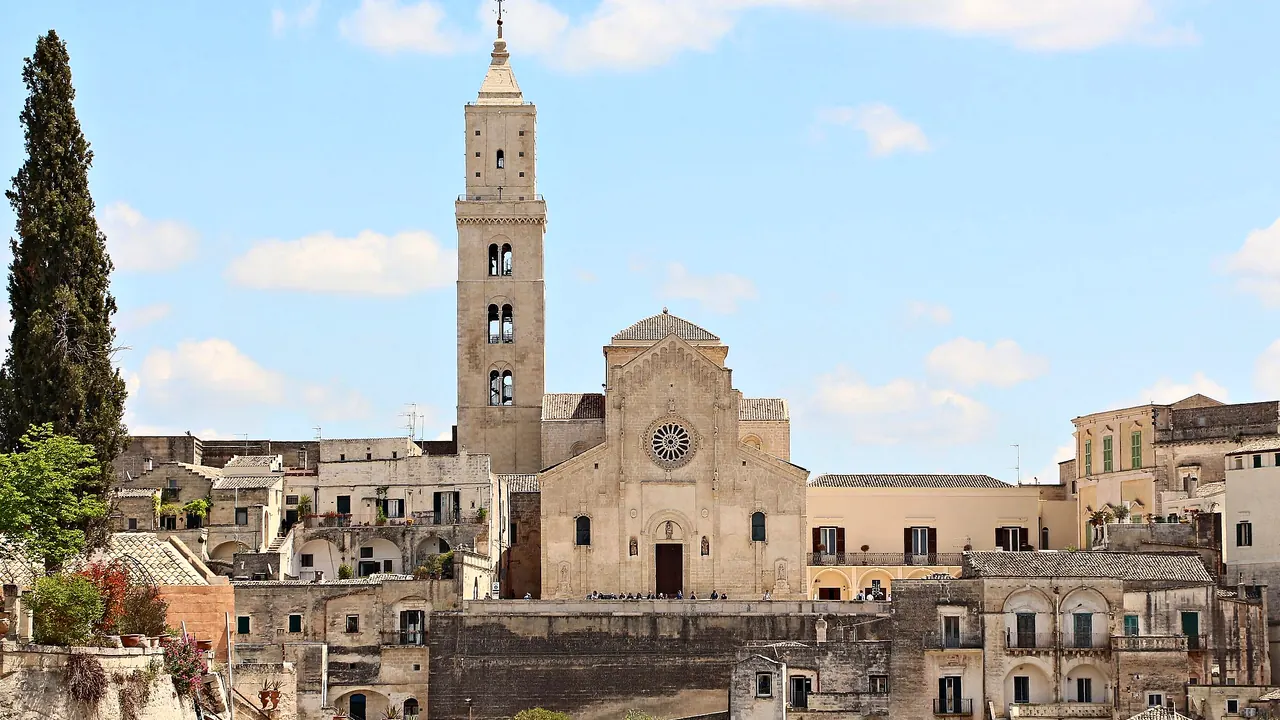
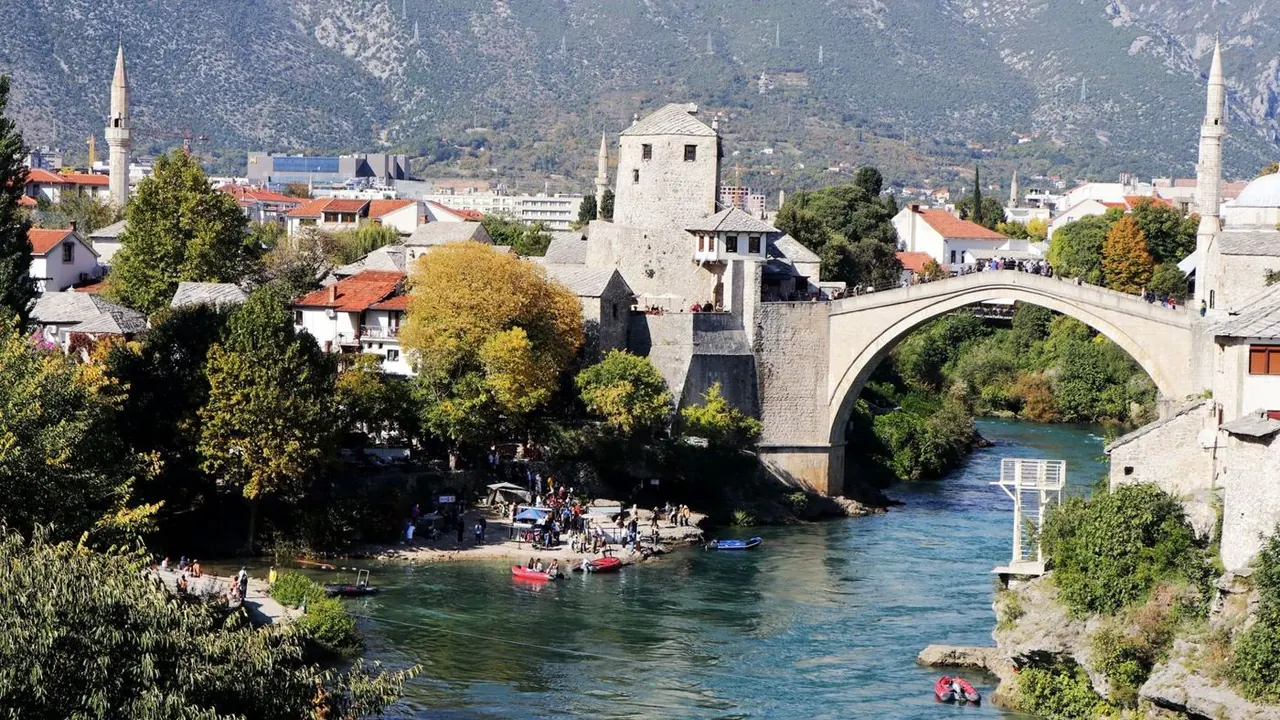
Photos: Matera by Bernard Gagnon, CC BY 4.0, cropped; Mostar by Alan Wang, Pexels License.
Matera or Mostar?
Our verdict in twelve categories, each scored against the same fixed benchmark cities, and the climate month by month, so you can choose for your trip.
Choose Matera for
- day trips
- beaches
- culture and sights
Matera suits travellers who want a place unlike anywhere else and are prepared to drive. The cave districts of the Sassi, with their frescoed rock churches and the gorge below, reward several slow days. A hire car turns the town into a base for the trulli and white towns of Puglia, the sandy Ionian shore and the peaks of Basilicata. Couples who care about a beautiful setting for dinner, and a spa in a rock-cut room, will be happiest here.
Choose Mostar for
- prices
- shopping
- nightlife
Mostar is the better pick for a shorter, cheaper stop, often as one leg of a wider Balkan journey. The Ottoman bridge and its old town take a day or two. Beyond that, rafting on the Neretva, the spring at Blagaj and the train through the gorge to Sarajevo fill the rest of the stay. Rooms, meals and wine cost much less than in southern Italy, and the city's recent history gives a visit a weight that Matera's quieter story does not.
Scoreboard
Twelve categories on one fixed scale from 0 to 100. The shaded stretch is the gap between the two.
Your match
Pick a travel style or drag the sliders, and both match scores follow your weighting.
Wins on day trips and beaches with your weighting.
Wins on prices and shopping with your weighting.
What matters to you?
Category by category
What the scores mean for a trip.
Beaches & swimming
Neither town is a beach destination, but Matera brings the sea closer. About 45 minutes away by car, the Ionian shore at Metaponto and Policoro has long, wide sandy beaches backed by pine woods. The water there is calm, shallow and warm by late summer, and the rockier coves of Puglia are a longer drive.
From Mostar the coast at Neum is over an hour away and the Makarska beaches further still. Most visitors cool off at the Kravica waterfalls or take a quick, cold jump into the Neretva.
Food & drink
Both cities offer regional home cooking and little else, but Matera's table is the richer one. The crusty pane di Matera comes with crapiata, hand-made cavatelli, roast lamb and crackling fried peperoni cruschi, alongside hill cheeses and a strong Aglianico. Some dining rooms are carved into the cave walls of the Sassi.
Mostar keeps to a shorter Bosnian repertoire: charcoal-grilled ćevapi in somun bread, burek and slow-cooked stuffed vegetables. Its real pleasures are the local Žilavka and Blatina wines and the slow ritual of coffee from a copper džezva.
Culture & sights
Matera has the deeper set of sights. People have lived in its cave dwellings since prehistoric times, and the rock churches still hold Byzantine frescoes. The Palombaro Lungo cistern runs under the main square, and MUSMA shows sculpture in carved rooms. Exploring all of this takes several unhurried days.
Mostar's appeal is concentrated on Stari Most, the Ottoman arch rebuilt after its destruction in 1993, together with the bridge divers, the climbable minaret of Koski Mehmed Pasha and a few carpeted Ottoman houses. The war damage along the old front line gives it a recent, sobering story that Matera does not have.
Nightlife
Evenings are quiet in both, and they are spent much the same way, over a long dinner with a view: the lit Sassi in Matera, the floodlit bridge in Mostar. The small difference is that Mostar has a few student clubs that open late on summer weekends. Matera has no clubs at all, only cave wine bars and the passeggiata along Via del Corso.
Nature & outdoors
The outdoors is equally strong in both, but the landscapes differ. In Matera you can walk straight out of town, down into the Gravina gorge and up to Murgia Timone, past abandoned rock churches and Neolithic village sites. The sandstone spires of the Lucanian Dolomites and the forests of the Pollino are a drive away.
Mostar's surroundings are wilder and wetter. The bare Prenj and Velež mountains rise around the city, and the Neretva canyons upstream are used for rafting and kayaking. The Hutovo Blato wetland draws migrating birds.
Day trips
Matera is the far better base. Within about an hour lie the trulli of Alberobello, the white towns of the Valle d'Itria, Bari, Castel del Monte and the cliffs of Polignano a Mare. Closer to home are the ghost town of Craco and the mountain villages of Castelmezzano and Pietrapertosa.
Mostar's outings are smaller places: the dervish house at Blagaj, the walled village of Počitelj, the stećci tombstones at Stolac and Tito's bunker at Konjic. Sarajevo, the one major city within reach, is a long day there and back by train. Both cities need a car for most trips.
Good for families
Both are manageable with children for a short stay, and neither has much built for them. Steep stone underfoot is a problem in each: endless stairways in the Sassi, worn and slippery cobbles in Mostar's old town. Summer heat in both makes the afternoons hard on small children.
What changes is the outing they will remember. In Matera it is the caves, the underground cistern and a drive to the shallow Ionian beaches. In Mostar it is watching the divers leap from the bridge and swimming beneath the Kravica falls.
Getting around
Each has a centre you cover on foot and a hinterland that needs a car. Matera's walk is the harder one, with flat streets above and steep stairways down into the Sassi. Mostar's old town and Austro-Hungarian centre make an easier stroll along the river, as long as you have shoes with grip.
Further afield, Mostar is better connected. A train runs through the gorge to Sarajevo, and long-distance buses serve the region. Matera sits off the national rail network, with only a slow narrow-gauge line to Bari.
Shopping & style
Shopping is limited in both, and Mostar has slightly more to look at. Along the Kujundžiluk, a few coppersmiths still hammer coffee sets and plates by hand, among kilims, embroidery and lamps, though much of the stock is imported.
Matera's stalls in the Sassi sell the painted cuccù whistle and small tufa carvings, but the better things to take home are dried peppers, local pasta and Aglianico.
Affordability
Mostar is clearly the cheaper of the two. Guesthouses and family apartments cost little, and so do meals of grilled meat, bottles of local wine and the daily coffee. Only the terraces facing the bridge and old-town rooms in midsummer charge more.
Matera is good value for Italy, especially in the trattorias of the upper town. However, its speciality is the cave hotel, and staying in the Sassi costs considerably more than any room in Mostar.
Live music & performing arts
Neither city offers much live performance, so plan evenings around dinner rather than a stage. Matera's big night is the Festa della Bruna, when a papier-mâché float is torn apart, and its summer jazz and open-air events sometimes use the Sassi as a backdrop. Mostar has a national theatre and a youth theatre, but they perform mostly in local languages, so open-air concerts in summer suit visitors better.
Wellness & relaxation
Matera is the more restful place to stay. Some of its hotel spas are set in candlelit caves with pools cut into the rock, and from autumn to spring the Sassi are very quiet in the mornings.
Mostar's Ottoman hammam is now a monument rather than a working bath, and treatments are limited to a few hotels. Rest there comes from long coffees in the shade and the hours after the coach groups leave.
When should you go?
Pick your month. The climate figures are measured averages, not a forecast.
Matera in July
Mostar in July
Daytime high, °C
Rainfall in the month, mm
Where the figures come from
Matera has no rain gauge within 25 km of the centre, so its rainfall comes from a gridded climate dataset read at the city rather than from a gauge further away.
Temperature and rainfall are climate normals, averaged over the years shown. Matera: 2005-2025, 10 years observed (rainfall 1991-2020) normals, Matera / Martella (4.8 km from centre). Mostar: 1991-2020 normals, Mostar (0.9 km from centre).
Matera is at its best for walking in May and again from late September into October, when the days are warm without the glare off the bare plateau. July reaches 32°C, too hot for the steps of the Sassi in the afternoon, so summer days are best started early. The Ionian sea within reach is warm enough to swim from June to September and warmest in August at 26°C. Rain picks up in autumn and peaks in November, though even then Matera stays much drier than Mostar.
Mostar has the same pattern through the year, but with greater extremes. Its valley is hotter in July and August, at 33°C, and those are also its sunniest months, better suited to a swim at Kravica than a walk through the old town. Late May and June are the most comfortable time, warm and fairly dry. September cools to pleasant walking temperatures, but the heavy rain comes back with it. Winter is very wet, with close to 200mm of rain in each of November and December.
Which traveller are you?
On a culture and arts trip, Matera is the stronger choice. The Sassi, the frescoed rock churches, the walk-through cistern and Levi's painted panorama of Lucanian life give several days of looking, where Mostar's bridge and Ottoman houses fill one or two.
On a trip on a tight budget, Mostar makes the money go much further. Family guesthouses, plates of ćevapi and local wine cost little. In Matera the cave hotels that give the town its character are expensive, and only the simpler upper town eases the bill.
For a beach and sun trip, Matera works better if you have a car. The long, sandy, shallow beaches of the Ionian coast are under an hour away. From Mostar the sea at Neum is further, and the usual swim is a pool under a waterfall.
Before you go
| Measure | Matera | Mostar |
|---|---|---|
| Official language | Italian | Croatian, Serbian, Bosnian |
| Currency | Euro (EUR) | Convertible Mark (BAM) |
| Sockets | CFL230 V, 50 Hz | CF230 V, 50 Hz |
| Driving side | Right | Right |
| Time zone | UTC+1, UTC+2 in summer | UTC+1, UTC+2 in summer |
| Emergency number | 112 | 112 |
| Elevation | 401 m | 60 m |
| Main airport | Bari Karol Wojtyła International Airport (BRI)54 km from centre104 non-stop destinations | Sarajevo International Airport (SJJ)68 km from centre38 non-stop destinations |
| Public holidays this year | 13 days | 8 days |
By the numbers
| Measure | Matera | Mostar |
|---|---|---|
| City population | 59,685 | 105,448 |
| People per km² | 152 | 90 |
| Museums within 10 km | 8 | 3 |
| UNESCO World Heritage sites within 50 km | 1 | 1 |
| Swim season, months above 21 °C | 5 months | - |
Where else could you go?
Every comparison below shares a destination with this one, so you can follow Matera or Mostar somewhere new.