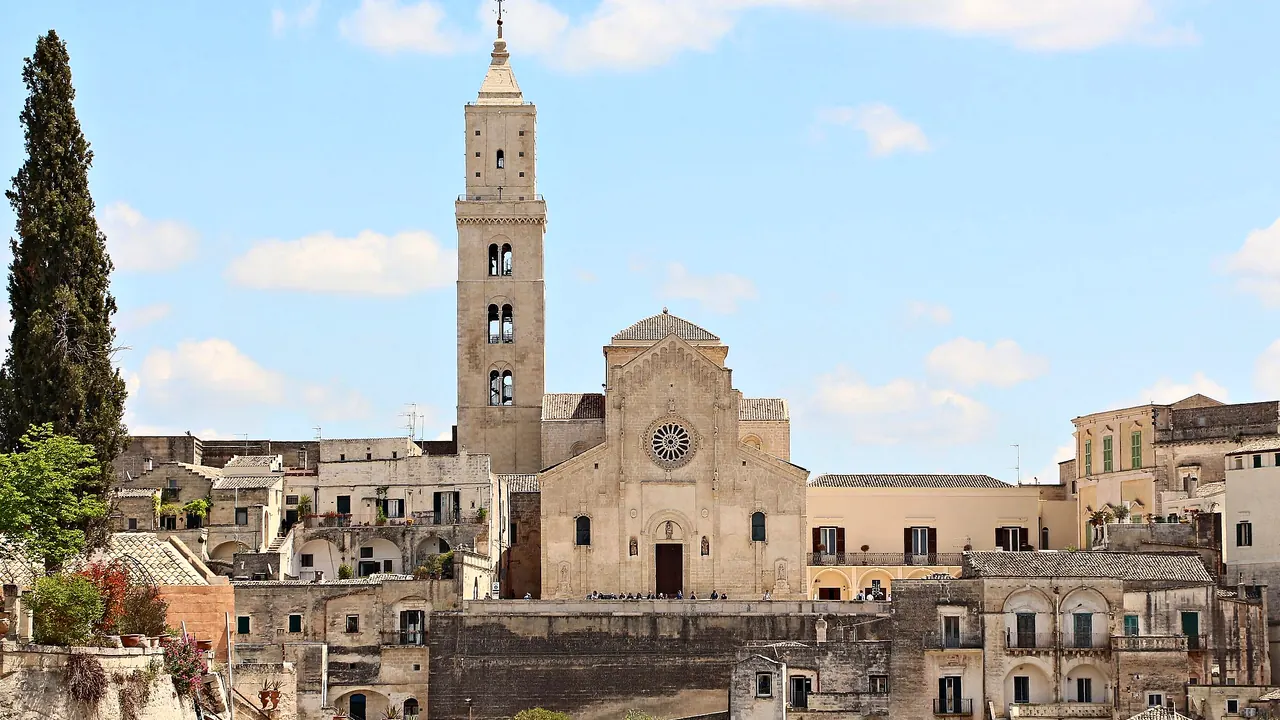
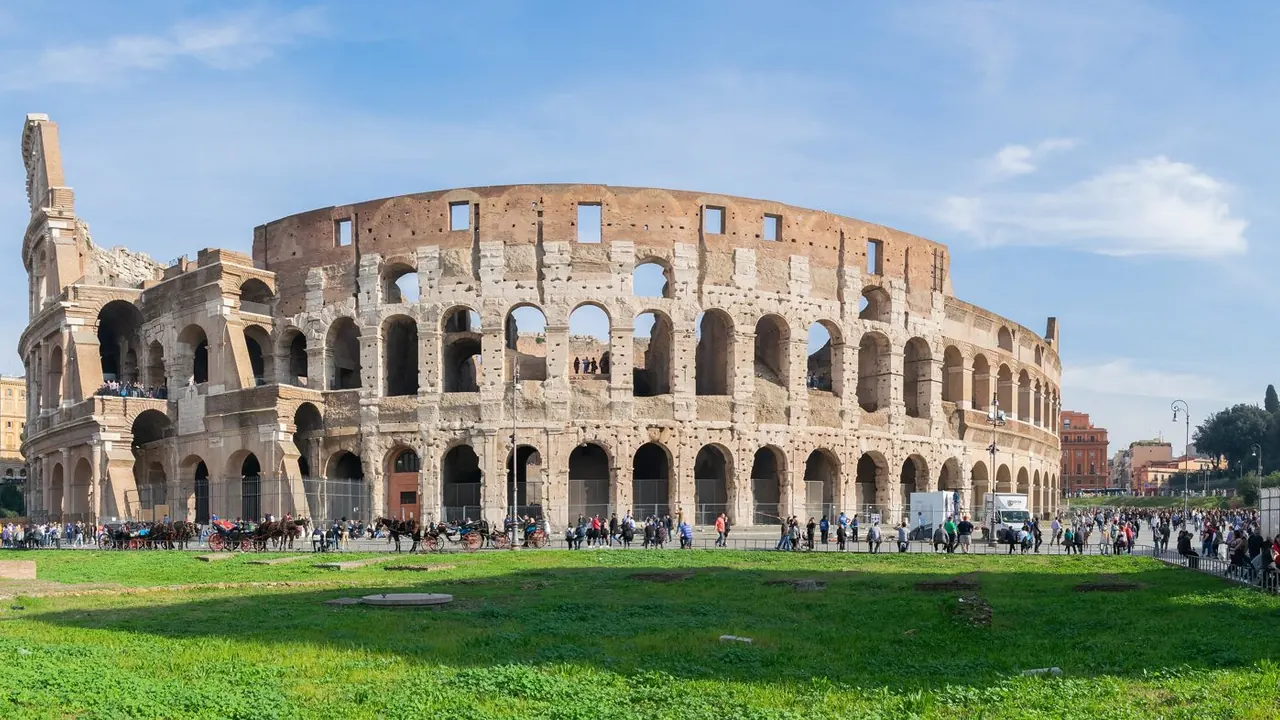
Photos: Matera by Bernard Gagnon, CC BY 4.0, cropped; Rome by Tournasol7, CC BY-SA 4.0, cropped.
Matera or Rome?
Our verdict in twelve categories, each scored against the same fixed benchmark cities, and the climate month by month, so you can choose for your trip.
Choose Matera for
- prices
- nature and the outdoors
Matera suits a slower, smaller trip: two or three days among the cave districts of the Sassi, a walk across the gorge into the Murgia, and evenings with a glass of Aglianico above the lit ravine. Eating and sleeping there cost less, and with a hire car it makes a fine base for the trulli and white towns of Puglia. It is best for couples who want one extraordinary setting rather than a long list of sights.
Choose Rome for
- live music and the arts
- shopping
- nightlife
Rome is the stronger pick for almost any trip that wants range. Its ancient monuments, Vatican collections and Baroque churches outweigh anything else in Italy. Its trattorias and street food go far beyond Basilicata's peasant cooking, and it has the opera, the shopping and the late evenings in Trastevere that Matera lacks. Fast trains to Florence and Naples, plus a beach you can reach by suburban train, mean you can do it all without a car.
Scoreboard
Twelve categories on one fixed scale from 0 to 100. The shaded stretch is the gap between the two.
Your match
Pick a travel style or drag the sliders, and both match scores follow your weighting.
Wins on prices and nature and the outdoors with your weighting.
Wins on live music and the arts and shopping with your weighting.
What matters to you?
Category by category
What the scores mean for a trip.
Beaches & swimming
Neither is a beach destination, but Rome's sea is easier to reach. A suburban train runs to Ostia in about half an hour. The sand there is dark and volcanic, most of it is divided into paid lidos, and it fills with Romans at weekends.
Matera's nearest beaches, on the Ionian coast around Metaponto and Policoro, are actually the gentler sand: wide, backed by pine woods and shallow enough for small children. But you need a car and most of an hour each way, which is why most visitors to Matera never swim.
Food & drink
Rome is one of Italy's great places to eat, and Matera is a pleasant regional stop. In Rome you can eat carbonara and cacio e pepe in Trastevere and Monti, Jewish-style artichokes in the Ghetto, offal dishes in Testaccio, and supplì and pizza al taglio on the street.
Matera's cooking is honest Basilicata peasant food: crusty pane di Matera, crapiata, cavatelli and crackling peperoni cruschi. It is worth trying, but there is little beyond it and no street food or market culture to explore.
Culture & sights
Matera has one sight that is unlike anything else: the Sassi, cave dwellings and frescoed rock churches stacked up the Gravina gorge. Add the Palombaro Lungo cistern and MUSMA, and the whole set fits into a couple of unhurried days.
Rome works on a different scale. The Forum, the Pantheon, the Vatican Museums, the Sistine Chapel and the Borghese Gallery are only the start, with Bernini fountains and Caravaggio altarpieces between them. A week there still leaves things out.
Nightlife
Matera's evenings end early: a passeggiata along Via del Corso, a long dinner, and perhaps a drink in a cave bar above the lit Sassi. That is lovely for a couple but offers nothing beyond it.
Rome gives you a proper night out, even if it is more about bars than clubs. You can start with aperitivo, move on to the crowded lanes of Trastevere and Monti's small cocktail bars, or try student San Lorenzo and arty Pigneto. There is some dancing in Testaccio and Ostiense.
Nature & outdoors
The two are broadly level, but the outdoors works differently. In Matera, wild country starts right at the edge of town: a path drops from Sasso Caveoso into the gorge and climbs to the Murgia plateau, with its abandoned rock churches and nesting kestrels. The Lucanian Dolomites are a drive away.
Rome's green spaces are gentler and more cultivated. There are the villa parks, a bike ride along the Appian Way past tombs and aqueducts, and the crater lakes of the Alban Hills. Further out, the Apennines offer hiking and winter skiing.
Day trips
Both make excellent bases, but Rome's day trips are richer and easier. Ostia Antica, Tivoli's villas, Etruscan tombs, Orvieto and Civita di Bagnoregio are all close, and high-speed trains reach Florence and Naples in about ninety minutes.
From Matera, Puglia is right next door: Altamura, Alberobello's trulli, the white towns of the Valle d'Itria and Castel del Monte. Ghostly Craco and the peak villages of Castelmezzano and Pietrapertosa are nearby too. Nearly all of them need a car.
Good for families
Matera works best with children old enough to climb. What it offers them is an adventure on foot: poking into cave houses, going underground into the vast cistern beneath the main square, and picking a way down to the stream at the bottom of the gorge. Toddlers have a harder time, because the old districts are almost all stairs and the plateau bakes in summer. Even a day at the beach means a drive.
Rome is the easier choice with younger children, mainly because there are places to let off steam between sights. Matera has nothing like the zoo and boating lake in Villa Borghese or the children's museum, and stories of gladiators at the Colosseum or a visit to the dark catacombs keep school-age children curious. Long queues and rough cobbles still make full days tiring, but a family can get around without a car.
Getting around
Both centres are best on foot. Matera's upper town is flat, but reaching the Sassi means steep stairways. Rome's walk from the Colosseum to Trastevere is short but rough on the feet over the cobbles.
The real difference is getting further afield. Rome has a limited metro, trams and buses, and fast trains to the rest of Italy. Matera sits off the national rail network, with only a slow narrow-gauge line to Bari and few buses, so for most outings you need a hire car.
Shopping & style
Rome is a real shopping city. The big fashion houses line Via Condotti, Monti has independent and vintage boutiques, Via Margutta has antique dealers, and the Porta Portese flea market runs on Sundays.
Matera offers little beyond souvenirs: painted cuccù whistles, tufa carvings and ceramics in the Sassi. The best things to take home are its dried peppers, pasta and Aglianico.
Affordability
Matera is noticeably easier on the wallet. Upper-town trattorias are cheap, guesthouses in the newer town are a short walk from the Sassi, and most sights cost little. Only the cave hotels and the peak summer weeks push prices up.
Rome's daily costs can be fair if you stick to standing espresso, pizza by weight and free water from the fountains. But rooms in the centre are expensive and small, and the Vatican, the Colosseum and the Borghese all charge substantial entry fees.
Live music & performing arts
Rome has a real classical calendar. There is opera and ballet at the Teatro dell'Opera, summer opera among the ruins of the Baths of Caracalla, and the Santa Cecilia orchestra at Renzo Piano's Auditorium, along with church concerts and jazz clubs.
Matera offers a few conservatory concerts, a summer jazz festival and the Festa della Bruna, when the papier-mâché float is torn apart. Most of its evenings are spent over dinner rather than at a performance.
Wellness & relaxation
The two are close here, and neither has a bathing tradition of its own. Matera's calm comes from its pace, with empty Sassi in the early morning and hotel spas set in candlelit cave rooms with pools cut into the rock.
Rome's centre is loud, but real thermal water is within reach: the sulphur pools of Bagni di Tivoli, and the open-air hot springs around Viterbo, about ninety minutes away.
When should you go?
Pick your month. The climate figures are measured averages, not a forecast.
Matera in July
Rome in July
Daytime high, °C
Rainfall in the month, mm
Where the figures come from
Matera has no rain gauge within 25 km of the centre, so its rainfall comes from a gridded climate dataset read at the city rather than from a gauge further away.
Rome's sunshine is measured 31 km from the centre, at Vigna Di Valle.
Temperature and rainfall are climate normals, averaged over the years shown. Matera: 2005-2025, 10 years observed (rainfall 1991-2020) normals, Matera / Martella (4.8 km from centre). Rome: 1991-2020 normals, Roma / Ciampino (15.1 km from centre).
Both cities follow the southern Italian year, with hot, dry summers and rain that arrives in autumn. On Matera's bare limestone plateau July peaks at about 32°C, which makes the Sassi steps and the Murgia paths hard going after mid-morning, and winters up there are cool and damp. Rome is a degree or two milder in winter and much the same in summer, but its autumn is wetter: November is its rainiest month at around 114mm, against 89mm in Matera.
The best months for walking either city are May and late September into October. For swimming, both coasts are warm enough from June to September, and the Ionian shore below Matera reaches about 26°C in August, a touch warmer than the sea at Ostia. Rome's summers are also very sunny, with roughly 347 hours of sunshine in July.
Which traveller are you?
On a culture and arts trip, Rome is the clear choice. Matera's cave churches and the Sassi are unforgettable but fit into two days. Rome adds the Colosseum, the Vatican Museums, the Borghese Caravaggios and summer opera at the Baths of Caracalla.
For a food and nightlife trip, Rome wins again. The four classic pastas, supplì, pizza al taglio, Testaccio's market and late aperitivo in Trastevere and Monti offer far more than Matera's few cave wine bars and its quiet nights after dinner.
On a tight budget, Matera stretches your money further. Trattorias and guesthouses in the upper town cost much less than central Rome's small, pricey rooms. Walking the Sassi and the Murgia is free, and you skip Rome's hefty museum entry fees.
Before you go
| Measure | Matera | Rome |
|---|---|---|
| Official language | Italian | Italian |
| Currency | Euro (EUR) | Euro (EUR) |
| Sockets | CFL230 V, 50 Hz | CFL230 V, 50 Hz |
| Driving side | Right | Right |
| Time zone | UTC+1, UTC+2 in summer | UTC+1, UTC+2 in summer |
| Emergency number | 112 | 112 |
| Elevation | 401 m | 21 m |
| Main airport | Bari Karol Wojtyła International Airport (BRI)54 km from centre104 non-stop destinations | Rome–Fiumicino Leonardo da Vinci International Airport (FCO)23 km from centre242 non-stop destinations |
| Public holidays this year | 13 days | 13 days |
By the numbers
| Measure | Matera | Rome |
|---|---|---|
| City population | 59,685 | 2,748,109 |
| People per km² | 152 | 2,135 |
| Museums within 10 km | 8 | 178 |
| UNESCO World Heritage sites within 50 km | 1 | 8 |
| Swim season, months above 21 °C | 5 months | 5 months |
Where else could you go?
Every comparison below shares a destination with this one, so you can follow Matera or Rome somewhere new.