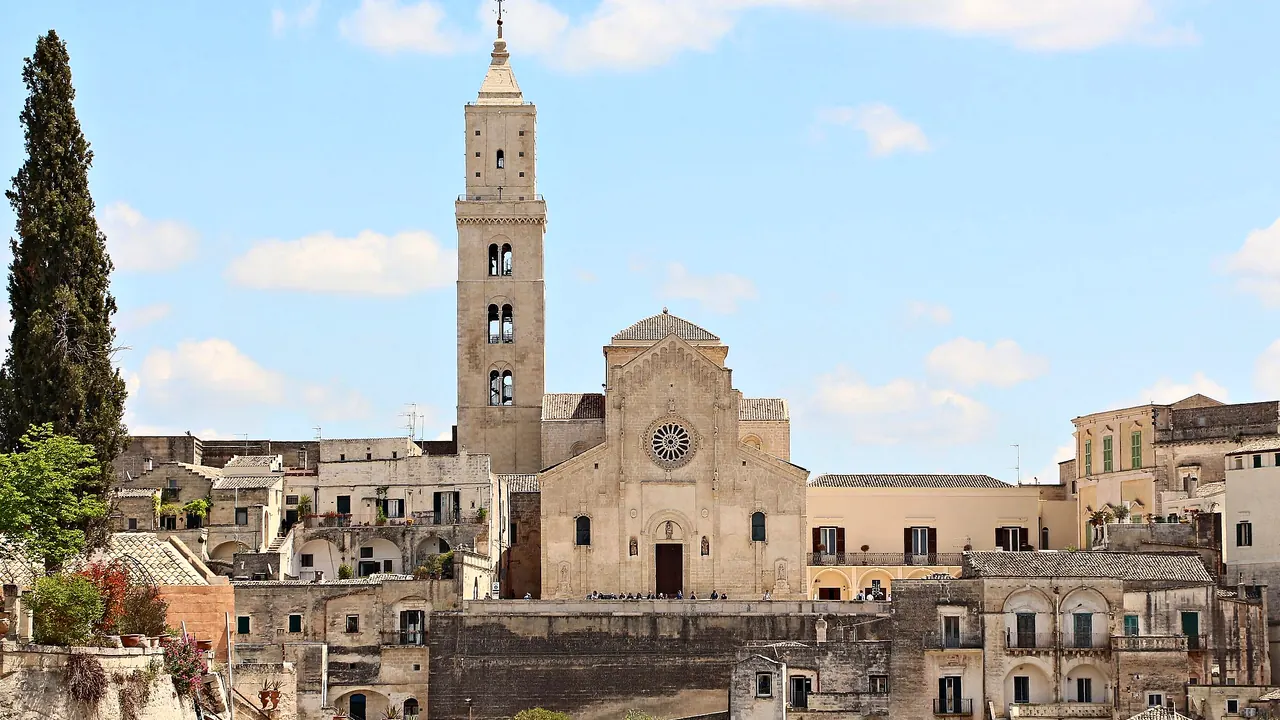
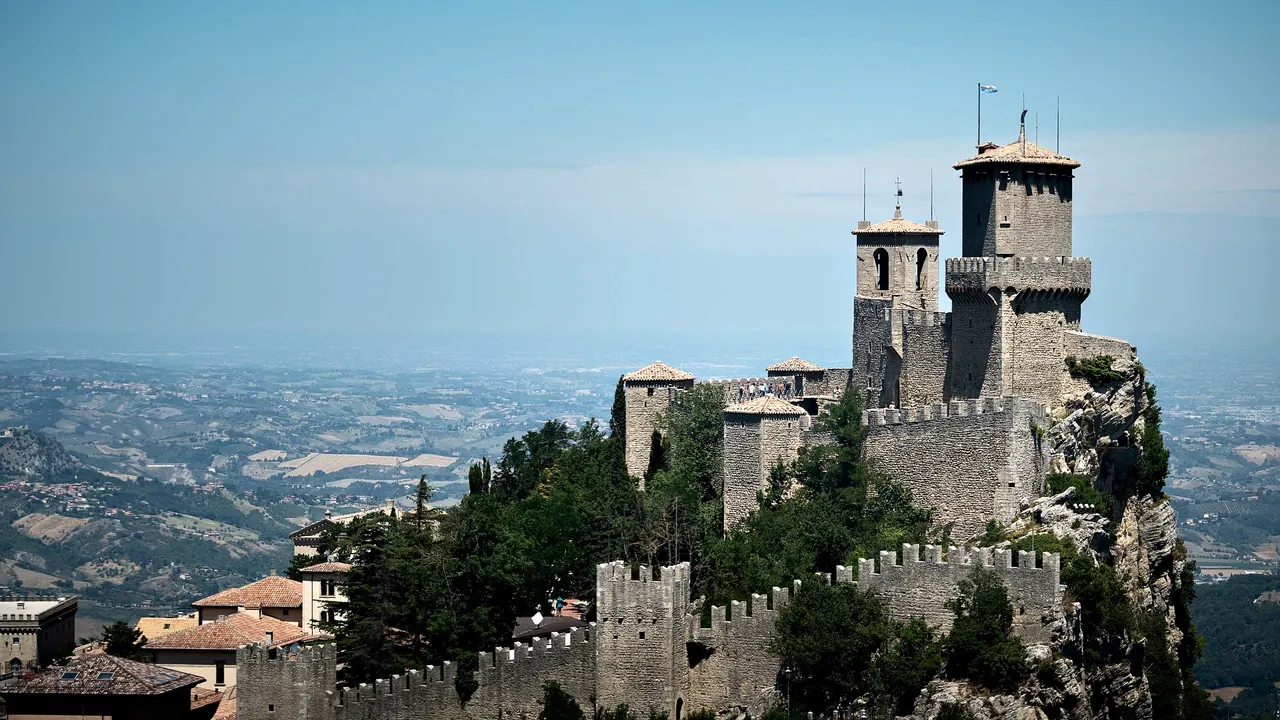
Photos: Matera by Bernard Gagnon, CC BY 4.0, cropped; San Marino by Tibor Szabo, Pexels License.
Matera or San Marino?
Our verdict in twelve categories, each scored against the same fixed benchmark cities, and the climate month by month, so you can choose for your trip.
Choose Matera for
- culture and sights
- nature and the outdoors
- food and drink
Matera is the one for travellers who want a place that stays with them. The Sassi, its cave districts carved into the side of the Gravina gorge, have frescoed rock churches and walk-through cisterns, and they easily fill two or three unhurried days. The Murgia plateau is right across the ravine for walking, and the regional cooking is more rewarding. It suits couples, walkers and anyone curious about history, especially with a car for the Puglia towns nearby.
Choose San Marino for
- families
- beaches
- shopping
San Marino works better as one part of a wider trip through Romagna and the Marche, and it is the easier choice with children. The towers and walls on Monte Titano make a striking half day. The Rimini coast below has the sandy beaches, theme parks and waterparks that Matera cannot match for families. Choose it if you want mountain mornings and seaside afternoons, with Urbino and Ravenna within reach.
Scoreboard
Twelve categories on one fixed scale from 0 to 100. The shaded stretch is the gap between the two.
Your match
Pick a travel style or drag the sliders, and both match scores follow your weighting.
Wins on culture and sights and nature and the outdoors with your weighting.
Wins on families and beaches with your weighting.
What matters to you?
Category by category
What the scores mean for a trip.
Beaches & swimming
Neither is a beach town, and the difference is in the kind of shore. From Matera you drive about 45 minutes to the Ionian coast at Metaponto and Policoro, where wide sandy beaches are backed by pine woods and the sea is calm and shallow. It feels open and uncrowded, but you really need a car.
From San Marino the Adriatic is closer, about half an hour to Rimini and Riccione, and a bus can get you there. This is the organised Romagna shore of numbered umbrellas and beach clubs, convenient and good for children, with very little wild coast.
Food & drink
Matera gives you more to eat with real character. Its cooking is the peasant food of Basilicata: the horn-shaped pane di Matera, crapiata soup, fave e cicoria and crackling peperoni cruschi, with Aglianico to drink. The trattorias of the upper town around Via Ridola cook it well.
San Marino's Romagna dishes are honest, from passatelli and strozzapreti to piadina and Tre Monti cake. The problem is that the summit is geared to day visitors, so the better meals mean heading down to Borgo Maggiore or across the border.
Culture & sights
Here Matera is in another league. The Sassi have been lived in since prehistoric times. Add the rock churches of Santa Maria de Idris and San Pietro Barisano, furnished cave houses and Carlo Levi's panorama at Palazzo Lanfranchi, and you have days of exploring, best of all at dusk.
San Marino's draw is the setting and the story of an ancient republic. You can climb the Guaita and Cesta towers, walk the cliffside path and see the Palazzo Pubblico and the Basilica. It is memorable, but most visitors have seen it by lunchtime.
Nightlife
Matera has more of an evening, though neither town gives you a real night out. After the passeggiata along Via del Corso and a long dinner, a few wine bars and cocktail bars in cave rooms stay open late in summer, and a small student crowd keeps them going. There are no clubs, and outside the warm months the town goes quiet soon after dinner.
On San Marino's summit the streets empty once the coaches leave. A drink on a terrace above the lights of the coast is about as late as the night gets. What San Marino has, and Matera lacks, is the Riviera below. The clubs and seafront bars of Rimini and Riccione are about half an hour's drive down the mountain and stay open late through summer.
Nature & outdoors
Matera has wilder country on its doorstep. The Gravina gorge lies right under the Sassi, and across it the Parco della Murgia Materana offers thyme-scented upland, kestrels on the cliffs and trails past rock churches. The Lucanian Dolomites and the Pollino forests are within a day's drive.
Monte Titano gives broad views over the Romagna plain to the sea, with woodland paths down to Borgo Maggiore and quiet cycling roads in the Montefeltro. It is gentle scenery for a morning, not a walking destination.
Day trips
Both make strong bases, and Matera has a slight edge in variety. Within about an hour you reach the trulli of Alberobello, the white towns of the Valle d'Itria, Castel del Monte and Polignano a Mare. Closer to home are Craco and the mountain villages of Castelmezzano and Pietrapertosa.
San Marino's outings lean more towards art. San Leo's fortress, Renaissance Urbino and the mosaics of Ravenna are all within reach. Rimini's Roman sights are just below, and Ravenna and Bologna can be reached by train from the coast, which is more than Matera manages for most of its trips.
Good for families
San Marino is clearly the better bet with children. The cable car, towers and battlements please them on the mountain, and the coast below adds Fiabilandia, waterparks, a marine park and shallow beaches, all within easy reach.
Older children enjoy Matera's caves, the underground cistern and scrambling into the gorge. Still, the town has nothing built for them, and its long staircases make a pushchair useless. It works best as a short stop with a baby carrier.
Getting around
On foot the two are similar: compact, car-free cores, but with steep steps everywhere. Matera's upper town is at least flat. San Marino has a cable car linking the summit and Borgo Maggiore. Arriving without a car is slightly simpler in San Marino, where a bus meets Italian trains at Rimini. Matera relies on a slow narrow-gauge line to Bari, and in both places you will want a hire car to explore.
Shopping & style
Neither is worth the trip for shopping, and they differ mainly in what they sell. Matera's buys are craft souvenirs, such as the painted cuccù whistle and tufa carvings, plus dried peppers and pasta to take home. San Marino trades on lower taxes, with perfume, watches, leather and spirits, an outlet centre in the valley, and stamps and coins for collectors.
Affordability
Overall costs are much the same, and in both places it pays to sleep just off the showpiece. In Matera, the cave hotels of the Sassi cost more, while guesthouses in the newer town are cheaper and close by. San Marino's summit hotels and view terraces carry a premium over the lower villages, though lower taxes make fuel and spirits cheaper there.
Live music & performing arts
Both are quiet for performance, and Matera has a little more going on. The conservatory gives concerts, a summer jazz festival plays against the backdrop of the Sassi, and the Festa della Bruna, with its float torn to pieces, is a remarkable night. San Marino's highlight is the costumed Medieval Days festival with its crossbow contests. For opera or a concert season you would go to Bologna or Pesaro.
Wellness & relaxation
Matera's cave spas make it the more memorable place to unwind. Hotel spas set in candlelit rock rooms, with pools cut into the stone, feel like nowhere else. The town's slow rhythm of quiet mornings in the Sassi, long lunches and dusk over the gorge adds to the calm. Neither town has thermal baths or a bathing tradition of its own.
San Marino offers a few ordinary hotel spas, and its quiet comes in the evenings on the walls, once the summer crowds around the towers have gone. For proper thermal spas you need a separate trip down to the coast or into the Apennine valleys.
When should you go?
Pick your month. The climate figures are measured averages, not a forecast.
Matera in July
San Marino in July
Daytime high, °C
Rainfall in the month, mm
Where the figures come from
Matera has no rain gauge within 25 km of the centre, so its rainfall comes from a gridded climate dataset read at the city rather than from a gauge further away.
San Marino's temperatures are measured 52 km from the centre, at Frontone.
San Marino has no rain gauge within 25 km of the centre, so its rainfall comes from a gridded climate dataset read at the city rather than from a gauge further away.
Temperature and rainfall are climate normals, averaged over the years shown. Matera: 2005-2025, 10 years observed (rainfall 1991-2020) normals, Matera / Martella (4.8 km from centre). San Marino: 1991-2020 normals, Frontone (51.5 km from centre).
Matera is warmer than San Marino in almost every month and drier in most of them. Its summers are hot. July reaches about 32°C on the bare plateau, so the Sassi and the gorge are best walked early in the morning or in the evening. San Marino stays a little cooler on its ridge in summer, but its winters are colder, with January highs around 7°C. Its autumn is also clearly wetter: rain passes 100mm in November, while Matera's wettest month is lighter.
For walking and sightseeing, both are at their best in May and from late September into October, when the days are mild. For swimming, both coasts are warm enough from late June to mid-September, and the sea peaks at about 26°C in August. The Ionian off Matera holds its warmth a little longer into September. In winter Matera is the more comfortable of the two for walking the streets.
Which traveller are you?
On a culture and arts trip, choose Matera. Its cave churches with Byzantine frescoes, the Palombaro Lungo cistern and the rock-cut MUSMA sculpture rooms make up a world unlike anywhere else. San Marino's towers and Palazzo Pubblico can be seen well in half a day.
On a family trip with children, San Marino is the easier pick. Kids love the cable car and the battlements, and the Rimini coast below has Italia in Miniatura, waterparks and shallow beaches with playgrounds. Matera's steep stone steps and hot, shadeless afternoons are hard going.
For an outdoors trip, Matera wins clearly. A path drops from the Sassi into the Gravina gorge and climbs to the Murgia plateau's abandoned churches and Neolithic sites, and the Lucanian Dolomites and Pollino are within a drive. Monte Titano offers pleasant short walks rather than real trails.
Before you go
| Measure | Matera | San Marino |
|---|---|---|
| Official language | Italian | Italian |
| Currency | Euro (EUR) | Euro (EUR) |
| Sockets | CFL230 V, 50 Hz | CFL230 V, 50 Hz |
| Driving side | Right | Right |
| Time zone | UTC+1, UTC+2 in summer | UTC+1, UTC+2 in summer |
| Emergency number | 112 | 112 |
| Elevation | 401 m | 675 m |
| Main airport | Bari Karol Wojtyła International Airport (BRI)54 km from centre104 non-stop destinations | Bologna Guglielmo Marconi Airport (BLQ)114 km from centre98 non-stop destinations |
| Public holidays this year | 13 days | 18 days |
By the numbers
| Measure | Matera | San Marino |
|---|---|---|
| City population | 59,685 | 4,040 |
| People per km² | 152 | 569 |
| Museums within 10 km | 8 | 19 |
| UNESCO World Heritage sites within 50 km | 1 | 2 |
| Swim season, months above 21 °C | 5 months | 4 months |
Where else could you go?
Every comparison below shares a destination with this one, so you can follow Matera or San Marino somewhere new.
- Barivs Matera
- Assisivs San Marino
- Florencevs San Marino
- Bolognavs San Marino
- Sienavs San Marino
- Leccevs Matera