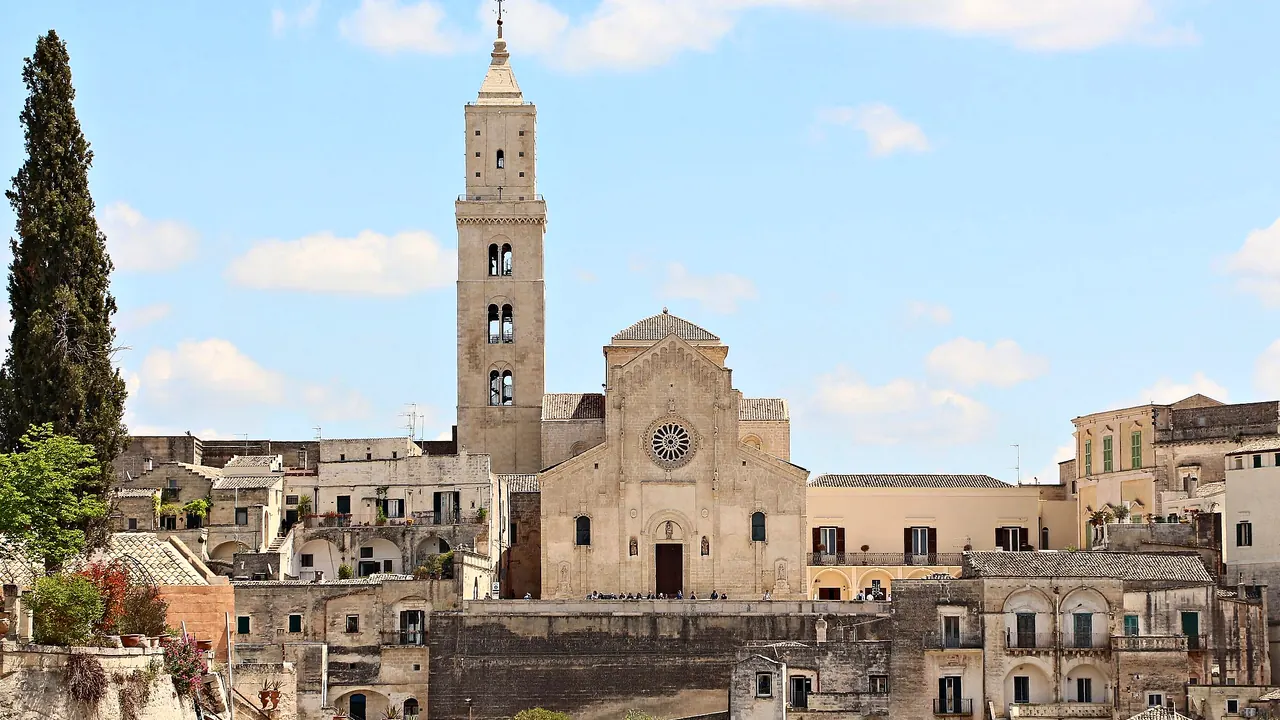
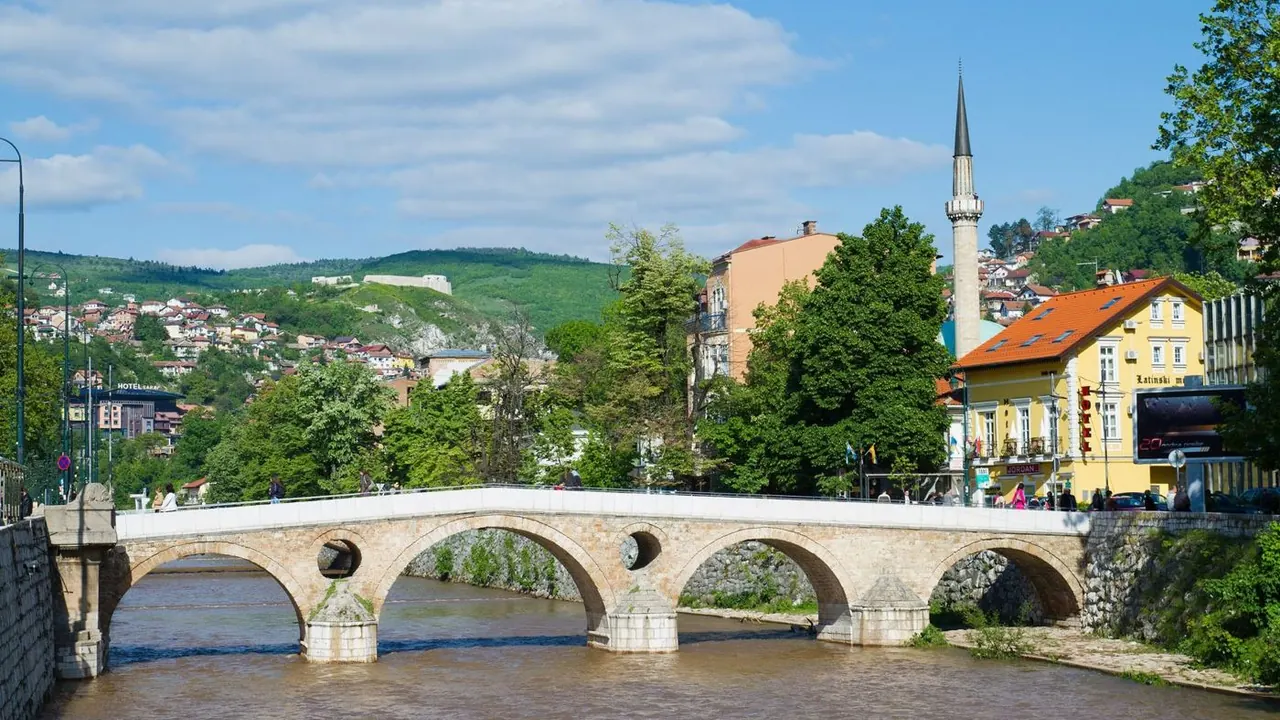
Photos: Matera by Bernard Gagnon, CC BY 4.0, cropped; Sarajevo by Tumi-1983, CC0.
Matera or Sarajevo?
Our verdict in twelve categories, each scored against the same fixed benchmark cities, and the climate month by month, so you can choose for your trip.
Choose Matera for
- beaches
- day trips
- culture and sights
Matera suits a traveller who wants one extraordinary place and a car to explore from it. The cave districts of the Sassi are unlike anything in Sarajevo, the trulli and white towns of Puglia lie within an hour, and the sandy Ionian coast is close enough for a day by the sea. Evenings are quiet: dinner, a glass of wine and the lights coming on over the gorge.
Choose Sarajevo for
- prices
- nightlife
- live music and the arts
Choose Sarajevo for a cheaper, livelier stay with mountains on the doorstep. Its Ottoman bazaar and Austro-Hungarian avenues tell a harder and more recent story, the café-bars stay busy into the night, and a tram and cheap taxis make it easy to manage without a car. In winter the Olympic ski slopes are under an hour away.
Scoreboard
Twelve categories on one fixed scale from 0 to 100. The shaded stretch is the gap between the two.
Your match
Pick a travel style or drag the sliders, and both match scores follow your weighting.
Wins on beaches and day trips with your weighting.
Wins on prices and nightlife with your weighting.
What matters to you?
Category by category
What the scores mean for a trip.
Beaches & swimming
Neither is a beach city, but Matera at least has the sea within a day's reach. The Ionian shore around Metaponto and Policoro is under an hour by car, with wide sand, pine woods and calm, shallow water that suits children.
Sarajevo is about three hours from the Adriatic, so swimming there means a cold mountain river, the Jablanica lake on the road south, or a pool. If you want the sea on a Bosnian trip, add a few days on the Croatian or Montenegrin coast.
Food & drink
Both cities cook hearty regional food with little range beyond it, but Sarajevo's is the more distinctive to eat your way through. Ćevapi in somun with kajmak, burek sold by weight and lamb cooked under a metal lid, followed by Bosnian coffee from a copper džezva with baklava, give each day a rhythm.
Matera's Basilicata peasant cooking is honest and good, built on its horn-shaped durum loaf, cavatelli, crapiata and crackling peperoni cruschi. It has none of Sarajevo's street food, though, and the better tables are in the upper town rather than the cave restaurants of the Sassi.
Culture & sights
Matera has the edge, because nothing in Sarajevo, or anywhere else, looks like the Sassi. Sarajevo shows several worlds meeting, while Matera shows a single way of life carried on in the same rock since prehistory: cave houses still furnished as families left them in the 1950s, and rock churches with frescoes faded almost to shadows. The whole town is the sight, and it looks its best at dusk when the lights come on across the gorge.
Sarajevo rewards an interest in history more than a love of beautiful scenery. Within a short walk the Ottoman mosque and bazaar give way to Habsburg avenues, churches of two Christian traditions and a synagogue. The corner by the Latin Bridge, where Archduke Franz Ferdinand was shot, and the Tunnel of Hope from the siege bring the twentieth century close, so a day of sightseeing here is more sobering than picturesque.
Nightlife
Of the two, Sarajevo is where you can actually go out. Café-bars fill from the afternoon and get louder after dark, cellar bars and small clubs keep going past midnight at weekends, and drinks are cheap, though many nights end over rakija rather than on a dancefloor.
Matera has no clubs at all. Its evening is the passeggiata along Via del Corso, a long dinner and a few cave wine bars in summer, and outside the warm months the town falls quiet soon after dinner.
Nature & outdoors
Sarajevo has real mountains at its edge. A cable car climbs from the Old Town to Trebević and the overgrown Olympic bobsleigh track, Jahorina and Bjelašnica give winter skiing and summer ridge walks under an hour away, and the shepherds' village of Lukomir sits high above the Rakitnica canyon.
Matera's outdoors is drier and smaller in scale: the path down into the Gravina gorge and up to Murgia Timone, past abandoned rock churches and Neolithic sites. The Lucanian Dolomites and Pollino lie further out. It makes for fine walking in spring or autumn rather than a mountain vacation.
Day trips
Matera is the better base because it sits where two regions meet. Altamura and Gravina in Puglia are close by. Within about an hour you reach the trulli of Alberobello, the white towns of the Valle d'Itria, Castel del Monte and Bari, and on the Basilicata side there are Craco and the temple at Metaponto. You need a car for nearly all of them.
From Sarajevo the one outstanding outing is Mostar, reached by a scenic train through the Neretva gorge, with Konjic and its old stone bridge on the way. Blagaj's dervish house and the fortress village of Počitelj lie beyond Mostar and pair well with it if you go by car or tour. Travnik and the bridge at Višegrad are worth the drive, but slow, winding roads mean fewer trips fit into a stay.
Good for families
Neither city is built around children, but Sarajevo is a little easier. The Old Town is flat, and the Trebević cable car, carriage rides to the streams of Vrelo Bosne, the small zoo and gentle winter skiing fill a few days, though grill smoke and winter smog bother small lungs.
In Matera the Sassi are all steep stone steps where a pushchair is useless, and summer afternoons are hot with little shade. Older children enjoy the caves and the cistern, and the shallow Ionian beaches are a real plus for families with a car.
Getting around
Sarajevo is simpler to manage without a car. The compact centre is easy on foot, and a tram runs along the valley floor from Baščaršija out to Ilidža, backed by buses, trolleybuses and cheap taxis. The airport, the Tunnel of Hope and the ski mountains still call for a taxi or tour.
Matera's centre is walkable too, but the Sassi are reached by steep stairways, and the town is off the national rail network. With only a slow narrow-gauge line to Bari and sparse buses, most visitors hire a car for the coast and the countryside.
Shopping & style
Sarajevo has the more absorbing place to browse: Kazandžiluk, where coppersmiths still hammer coffee sets by hand, and the Bezistan with its kilims, leather slippers and filigree, though much of it is souvenir stock. Matera's offer is small, mostly cuccù whistles, tufa carvings and ceramics in the Sassi, and its best buys are edible: dried peppers, local pasta and Aglianico.
Affordability
Sarajevo is the much cheaper stay. Meals, coffee, trams, taxis, museum entry and central hotels all sit well below Western European levels, rising only a little in the Old Town and during the summer film festival.
Matera is good value for Italy, with modest trattorias in the upper town and free walks through the Sassi and the Murgia. Its cave hotels are a priced speciality, though, and the car most visitors need adds to the bill.
Live music & performing arts
Live performance is the thinnest part of a Matera trip. Beyond conservatory concerts and open-air summer events against the backdrop of the Sassi, the one big night is the Festa della Bruna, when the procession ends with the papier-mâché float being torn apart.
In Sarajevo there is a modest season all year. The Austro-Hungarian National Theatre stages drama, opera and ballet, and the Philharmonic gives concerts. The MESS theatre festival comes in autumn and a jazz festival in November. Sevdah, the slow Bosnian love songs, can be heard in traditional restaurants, though most plays are in the local language.
Wellness & relaxation
Calm in Matera comes mostly from its pace: quiet mornings in the Sassi, long lunches and the light fading over the gorge, best in the quieter months from autumn to spring. There are no thermal waters, but hotel spas in candlelit caves with rock-cut pools are an unusual place to unwind.
For an actual bathing tradition, take the tram to Ilidža at the end of the line in Sarajevo. Its sulphurous springs have been used since Roman times, and a spa there offers warm pools and treatments. The shaded avenue of Vrelo Bosne is close by, though winter smog in the valley takes away some of the calm.
When should you go?
Pick your month. The climate figures are measured averages, not a forecast.
Matera in July
Sarajevo in July
Daytime high, °C
Rainfall in the month, mm
Where the figures come from
Matera has no rain gauge within 25 km of the centre, so its rainfall comes from a gridded climate dataset read at the city rather than from a gauge further away.
Temperature and rainfall are climate normals, averaged over the years shown. Matera: 2005-2025, 10 years observed (rainfall 1991-2020) normals, Matera / Martella (4.8 km from centre). Sarajevo: 1991-2020 (rainfall 1971-2000) normals, Sarajevo-Bejelave (2 km from centre).
Matera is at its best in May, September and October, when the days are warm enough for the Sassi steps and the Murgia trails without being punishing. July and August reach about 32°C, too hot for walking the bare plateau at midday, but this is when the Ionian sea is warmest, around 26°C, so beach days work best from June to September. The rain comes in autumn and is heaviest in November, at about 89mm.
Sarajevo is cooler all year. Summer highs of about 28°C are comfortable for city streets and mountain hikes, and July and August are its sunniest months. Rain is spread fairly evenly through the year, with late spring and autumn a little wetter. Winter is cold and grey, around 4°C by day in December and January, which suits skiers rather than sightseers. In high summer Sarajevo is the gentler choice for walking, while Matera is the better one for heat and the sea.
Which traveller are you?
For a beach and sun trip, Matera is the clear pick. With a car, the long sandy beaches around Metaponto and Policoro are under an hour away, with warm, shallow water. Sarajevo is three hours from the Adriatic and offers only cold rivers and pools.
On a trip on a tight budget, Sarajevo goes much further. Ćevapi, pastries from the pita bakeries, trams, taxis and central guesthouses all cost little. In Matera the cave hotels in the Sassi are priced as a speciality, and day trips usually mean paying for a hire car.
For a food and nightlife trip, Sarajevo has more to offer. The grills and bakeries of Baščaršija, the slow coffee ritual and café-bars that get louder as the night goes on outdo Matera, where evenings end with a long dinner and some Aglianico on a terrace.
Before you go
| Measure | Matera | Sarajevo |
|---|---|---|
| Official language | Italian | Croatian, Serbian, Bosnian |
| Currency | Euro (EUR) | Convertible Mark (BAM) |
| Sockets | CFL230 V, 50 Hz | CF230 V, 50 Hz |
| Driving side | Right | Right |
| Time zone | UTC+1, UTC+2 in summer | UTC+1, UTC+2 in summer |
| Emergency number | 112 | 112 |
| Elevation | 401 m | 518 m |
| Main airport | Bari Karol Wojtyła International Airport (BRI)54 km from centre104 non-stop destinations | Sarajevo International Airport (SJJ)7 km from centre38 non-stop destinations |
| Public holidays this year | 13 days | 8 days |
By the numbers
| Measure | Matera | Sarajevo |
|---|---|---|
| City population | 59,685 | 275,524 |
| People per km² | 152 | 1,947 |
| Museums within 10 km | 8 | 26 |
| UNESCO World Heritage sites within 50 km | 1 | 1 |
| Swim season, months above 21 °C | 5 months | - |
Where else could you go?
Every comparison below shares a destination with this one, so you can follow Matera or Sarajevo somewhere new.