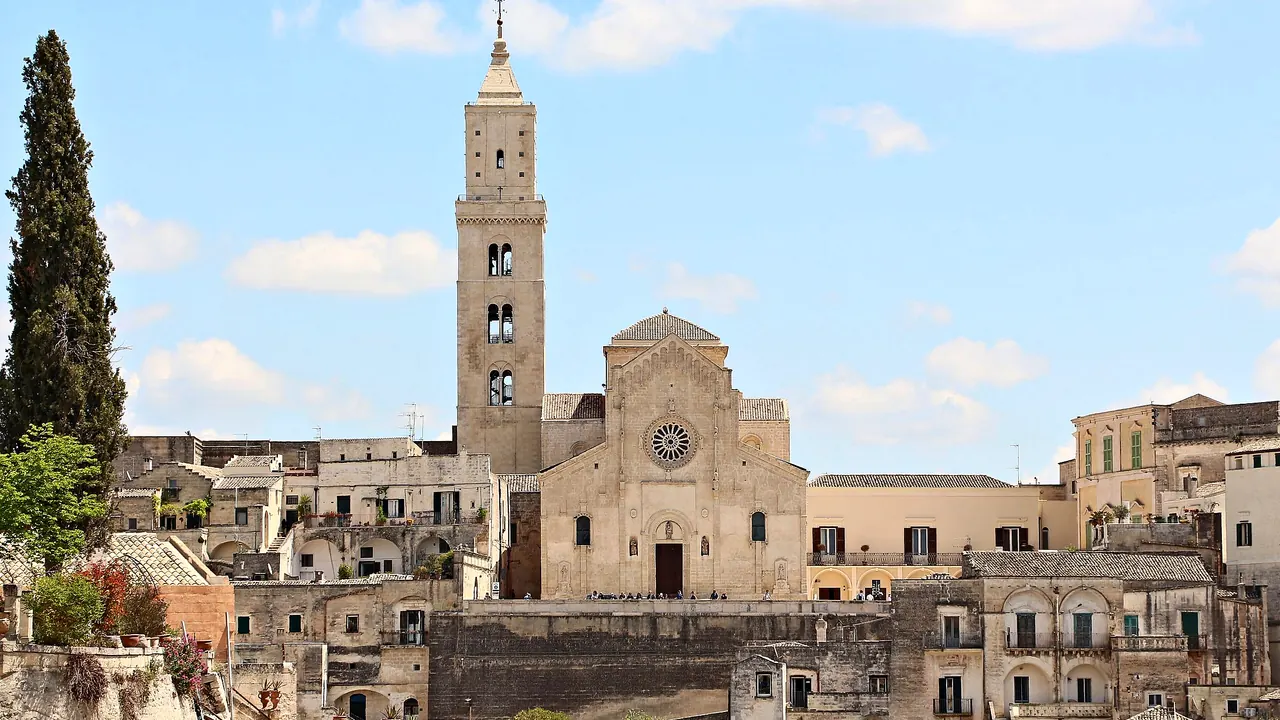
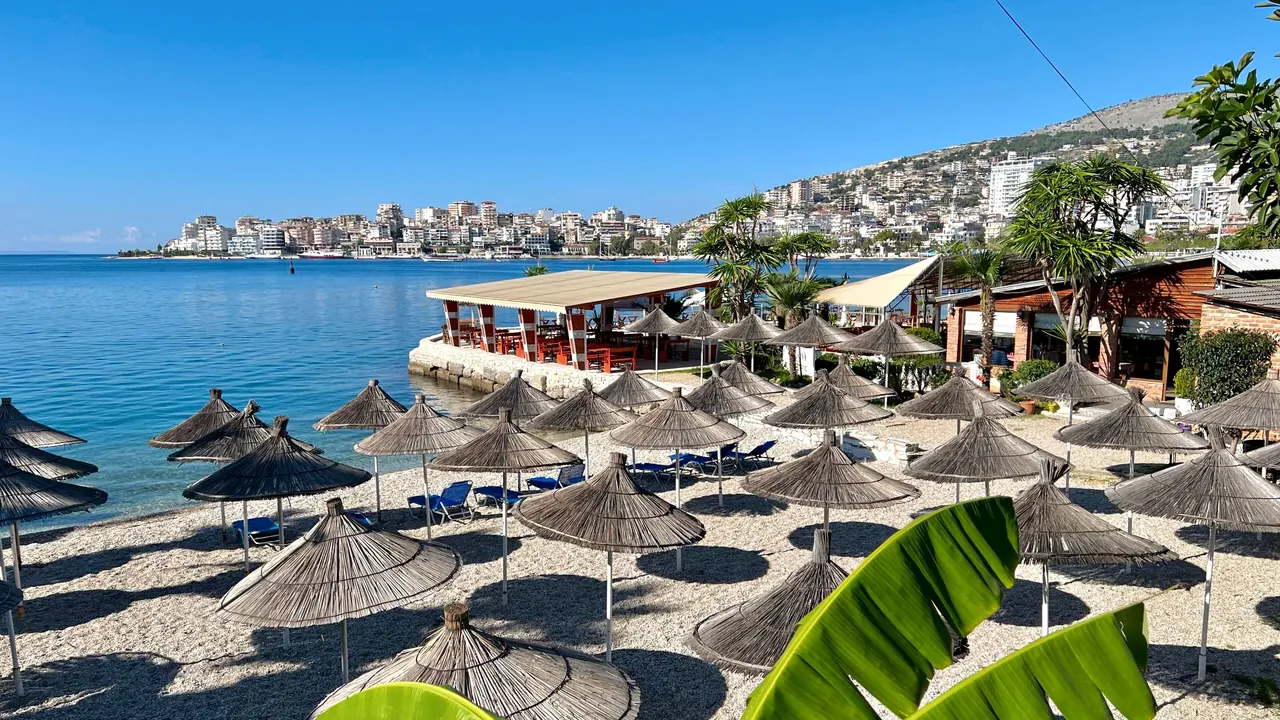
Photos: Matera by Bernard Gagnon, CC BY 4.0, cropped; Saranda by Sharon Hahn Darlin, CC BY 2.0, cropped.
Matera or Saranda?
Our verdict in twelve categories, each scored against the same fixed benchmark cities, and the climate month by month, so you can choose for your trip.
Choose Matera for
- culture and sights
- food and drink
- live music and the arts
Matera suits travellers who want to walk through a place unlike any other: the cave districts of the Sassi, frescoed rock churches and the gorge beneath them. Good regional cooking and a long list of outings into Puglia add to it. It rewards a few slow days and a hire car, and it is the better choice for a couple or a curious traveller who cares more about history than the sea.
Choose Saranda for
- beaches
- nightlife
- prices
Pick Saranda if the trip is about swimming. The clear coves at Ksamil and the bays up the Riviera are close by, the town costs less, and summer evenings on the promenade are livelier. History comes from day trips to Butrint, Gjirokaster and Corfu rather than from the town itself.
Scoreboard
Twelve categories on one fixed scale from 0 to 100. The shaded stretch is the gap between the two.
Your match
Pick a travel style or drag the sliders, and both match scores follow your weighting.
Too close to call, 1 point apart
Wins on culture and sights and food and drink with your weighting.
Wins on beaches and nightlife with your weighting.
What matters to you?
Category by category
What the scores mean for a trip.
Beaches & swimming
Matera is inland, so swimming means a drive of about 45 minutes to the long sandy beaches of the Ionian coast at Metaponto and Policoro. The water there is calm and shallow and good for small children, but it is hard to reach without a car, and most visitors never swim.
Saranda is built around the sea. Small pebble beaches sit right below the promenade, the clear coves and islets of Ksamil are twenty minutes south, and the bays of Lukova and Borsh lie further up the Riviera. The trade-off is pebble rather than sand, and sunbeds packed close together in high summer.
Food & drink
Matera has the stronger table. Its Basilicata cooking runs from the crusty pane di Matera and crapiata to hand-made cavatelli, roast lamb and crackling peperoni cruschi, with Aglianico del Vulture to drink, and the upper town around Via Ridola cooks well.
Saranda's food is simpler: Butrint lagoon mussels, grilled fish and octopus on the promenade, byrek in the morning and raki in the evening. Seafood lovers eat well there, but the range is narrower and the wine culture thin. Neither town offers much beyond its regional cooking.
Culture & sights
This is where the two towns are furthest apart. In Matera the town itself is the sight: the cave dwellings of Sasso Caveoso and Sasso Barisano, the Romanesque cathedral on the Civita, frescoed rock churches such as Santa Maria de Idris, the Palombaro Lungo cistern and MUSMA's sculpture in carved rooms.
Saranda is a modern resort. It has a synagogue ruin with mosaic floors, a few stretches of old wall and the views from Lekuresi Castle. Its serious history lies outside town, at Butrint.
Nightlife
Neither is a place for clubbing, but Saranda has more going on after dark. In July and August its promenade fills with loud cocktail bars until well past midnight, and beach clubs at Ksamil run later with DJs, for a young crowd that is largely Albanian and Kosovar.
Matera's evenings are quieter and more grown-up: the passeggiata on Via del Corso, a long dinner and a glass of wine in a cave bar above the lit Sassi. Out of season, both towns go quiet early.
Nature & outdoors
The two are evenly matched outdoors, but the landscapes differ. Matera has dry upland: the Gravina gorge below the Sassi, the Murgia park with its abandoned rock churches and Neolithic sites and, further out, the sandstone peaks of the Lucanian Dolomites and the forests of the Pollino.
Saranda's nature is wetter and bluer. It has Butrint's lagoon and reed beds for birdwatching, the deep spring of the Blue Eye, and sea kayaking and boat trips to the caves along the Riviera. In both places, summer heat limits serious walking to spring and autumn.
Day trips
Both make good bases, and Matera has a slight edge in the sheer number of outings. Altamura and Gravina in Puglia are close. Within about an hour you can reach the trulli of Alberobello, the white towns of the Valle d'Itria, Bari, Castel del Monte and Polignano a Mare, and Basilicata adds Craco and the villages of Castelmezzano and Pietrapertosa among the peaks.
Saranda's list is shorter but strong: the layered ancient city at Butrint, the Ottoman stone town of Gjirokaster, and a ferry to Corfu that takes under an hour. Almost all of Matera's outings need a car, while from Saranda a bus or the ferry covers some of the best ones.
Good for families
Saranda works a little better with children, mainly because of the water. The sheltered coves at Ksamil suit young swimmers, and the evening promenade has ice cream and rides. The drawbacks are steep streets, summer traffic and packed beaches in August.
In Matera, older children enjoy the caves and the cistern, but the steep stone steps of the Sassi defeat a pushchair, there is little shade, and the beach is a drive away. Neither town has anything built specially for children.
Getting around
Both towns are explored on foot, and both get harder to manage beyond the centre. Matera's upper town is flat, with steep stairways down into the car-free Sassi. Saranda's centre runs along a long seafront promenade, with climbs to the hotels on the slopes above.
The difference lies further out. Matera is off the main rail network, with only a slow line to Bari. Saranda has local buses to Ksamil and Butrint and a ferry to Corfu, though there are no printed timetables. In both towns, a hire car makes the outlying sights far easier to reach.
Shopping & style
Neither is a shopping destination, though Matera has a little more character. Workshops in the Sassi sell the painted cuccù whistle, carvings in tufa stone and ceramics, and Via del Corso has ordinary Italian high-street shops. Saranda offers beachwear and souvenirs, and its best buys are olive oil, mountain honey and raki, while for crafts it is better to wait for the bazaar in Gjirokaster.
Affordability
Saranda is the cheaper stay. Grilled fish, byrek, buses and taxis cost little, and apartments and family hotels away from the seafront are good value outside July and August, when sunbeds at Ksamil and seafront rooms cost noticeably more.
Matera's trattorias in the upper town are reasonable for Italy, and walking the Sassi and the Murgia costs nothing. The cave hotels that make a stay there memorable cost more, though, and sleeping in the newer town brings the bill down.
Live music & performing arts
There is little live performance in either town, but Matera has a bit more. Its conservatory gives concerts, a summer jazz festival uses the Sassi as a backdrop, and the Festa della Bruna, with its procession and the ritual tearing apart of the float, is a real event. Saranda has occasional summer concerts, the odd performance in Butrint's ancient theatre and live Albanian music in restaurants, and for polyphonic singing you go inland to Gjirokaster.
Wellness & relaxation
Neither town has a bathing tradition, so rest comes more from the pace than from spas. Matera is the calmer of the two, with quiet mornings in the Sassi, long lunches and dusk over the gorge, and hotel spas where pools are cut into the rock of candlelit caves.
Saranda can be restful in May, June and late September, with quiet terraces and walks along the bay. In July and August it is loud with music and traffic late into the night.
When should you go?
Pick your month. The climate figures are measured averages, not a forecast.
Matera in July
Saranda in July
Daytime high, °C
Rainfall in the month, mm
Where the figures come from
Matera has no rain gauge within 25 km of the centre, so its rainfall comes from a gridded climate dataset read at the destination rather than from a gauge further away.
Saranda's temperatures are measured 30 km from the centre, at Kerkyra Airport.
Saranda has no rain gauge within 25 km of the centre, so its rainfall comes from a gridded climate dataset read at the destination rather than from a gauge further away.
Temperature and rainfall are climate normals, averaged over the years shown. Matera: 2005-2025, 10 years observed (rainfall 1991-2020) normals, Matera / Martella (4.8 km from centre). Saranda: 1991-2020 normals, Kerkyra Airport (29.8 km from centre).
Matera is a town for walking, and it is at its best from April to early June and again in September and October. July and August reach 32°C on a bare plateau with little shade, which makes midday in the Sassi hard work. That is also when the Ionian beaches, under an hour's drive away, are at their warmest. Winters are cool rather than harsh, and the rain builds through the autumn to its peak in November.
Saranda is a summer place. June to August are hot, dry and very sunny, and the sea is warm enough to swim from June well into October, reaching about 25°C in August. Rain returns in September, at about 109mm, so warm swimming days come with wet spells. From October the rain grows heavy, passing 220mm in both November and December, which makes Saranda far wetter than Matera. Both towns are pleasant in late spring, but Saranda swings much more sharply between a bright, dry summer and a wet winter.
Which traveller are you?
For a beach and sun trip, Saranda is the clear pick. Ksamil's pale coves and islets are twenty minutes away, longer bays line the Riviera to the north, and the sea stays warm from June into October. From Matera, the sand is a drive away.
On a culture and arts trip, Matera wins easily. The Sassi, the frescoed rock churches, the walk-through cistern and Carlo Levi's panorama at Palazzo Lanfranchi fill several days. Saranda has few sights of its own, and its history waits at Butrint.
On a trip on a tight budget, Saranda makes the money go further. Grilled fish, byrek, local buses and rooms in family hotels cost little for most of the year. Matera's trattorias are fair, but its cave hotels in the Sassi are priced as the town's speciality.
Before you go
| Measure | Matera | Saranda |
|---|---|---|
| Official language | Italian | Albanian |
| Currency | Euro (EUR) | Lek (ALL) |
| Sockets | CFL230 V, 50 Hz | CF220 V, 50 Hz |
| Driving side | Right | Right |
| Time zone | UTC+1, UTC+2 in summer | UTC+1, UTC+2 in summer |
| Emergency number | 112 | 112 |
| Elevation | 401 m | 0 m |
| Main airport | Bari Karol Wojtyła International Airport (BRI)54 km from centre104 non-stop destinations | Corfu Ioannis Kapodistrias International Airport (CFU)32 km from centre88 non-stop destinations |
| Public holidays this year | 13 days | 14 days |
By the numbers
| Measure | Matera | Saranda |
|---|---|---|
| Population | 59,685 | 22,613 |
| People per km² | 152 | 383 |
| Museums within 10 km | 8 | 0 |
| UNESCO World Heritage sites within 50 km | 1 | 3 |
| Swim season, months above 21 °C | 5 months | 5 months |
Where else could you go?
Every comparison below shares a destination with this one, so you can follow Matera or Saranda somewhere new.