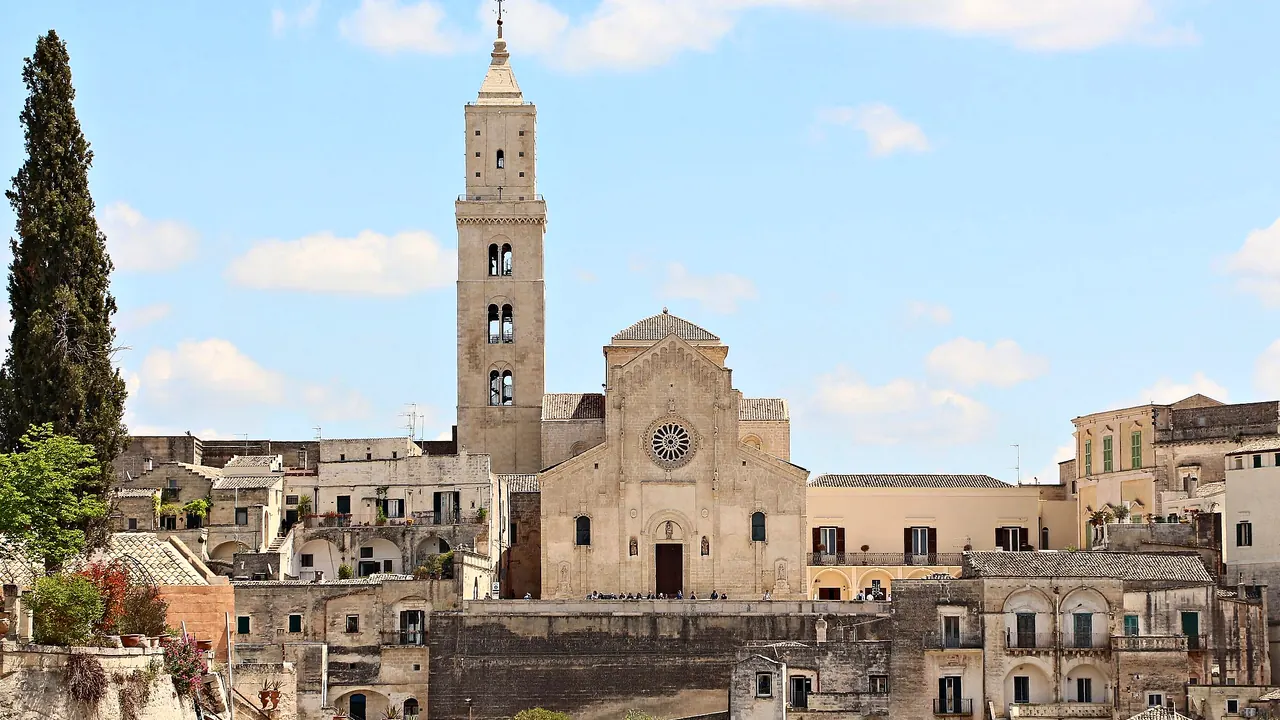
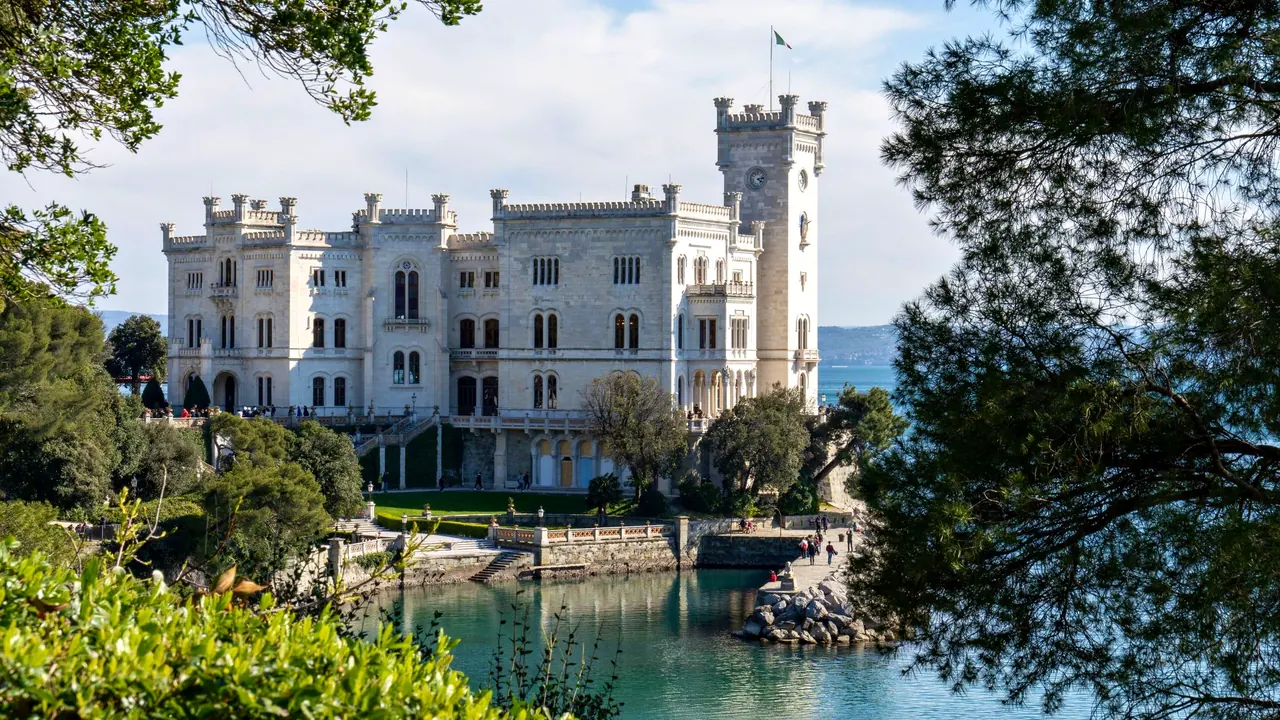
Photos: Matera by Bernard Gagnon, CC BY 4.0, cropped; Trieste by Tibor Szabo, Pexels License.
Matera or Trieste?
Our verdict in twelve categories, each scored against the same fixed benchmark cities, and the climate month by month, so you can choose for your trip.
Choose Matera for
- culture and sights
Matera is for the traveller who wants one extraordinary place and is happy to build the trip around it. The cave districts of the Sassi, the rock churches with their old frescoes and the gorge below make a setting with no real equal in Italy. With a hire car, the trulli and white towns of Puglia are close by. Choose it for a slow, atmospheric stay of a few days. Don't choose it for evenings out, shopping or easy logistics.
Choose Trieste for
- live music and the arts
- families
- getting around
Trieste suits travellers who want a working city with more going on. It has a Habsburg seafront, coffee houses and buffets, an opera season at the Teatro Verdi, and the Adriatic close enough for a swim before dinner. It is easier with children and easier without a car. Walking country on the Karst starts just behind the town, and Slovenia and Venice are both within a day's reach.
Scoreboard
Twelve categories on one fixed scale from 0 to 100. The shaded stretch is the gap between the two.
Your match
Pick a travel style or drag the sliders, and both match scores follow your weighting.
Wins on culture and sights with your weighting.
Wins on live music and the arts and families with your weighting.
What matters to you?
Category by category
What the scores mean for a trip.
Beaches & swimming
In Trieste the sea is part of daily life. Locals climb down ladders off Barcola's concrete platforms into clear Adriatic water, and pebble coves at Sistiana and Grignano are a short ride away. Sand is almost absent, though.
Matera has the softer beaches but not the convenience. The long sandy shores at Metaponto and Policoro have shallow water that is good for small children, but they are about 45 minutes away by car. Without one, most visitors never swim.
Food & drink
Matera cooks the peasant food of Basilicata, and cooks it well. The horn-shaped durum loaf, crapiata, hand-made cavatelli and peperoni cruschi fried until they crackle come with Aglianico to drink. The range stops there, though. There is little beyond Lucanian dishes and no street food or market life to explore.
Trieste has the wider table, drawing on Italy, Austria and the Slavic world. Buffet counters carve boiled pork with horseradish and sauerkraut, menus run from jota and sardoni to presnitz, and the coffee has its own vocabulary. Up on the Karst, farmhouse osmize take turns opening for a few weeks at a time, selling their own Vitovska, Terrano and cured meats.
Culture & sights
Matera edges ahead because its sights are unique. You can walk through cave homes inhabited until the 1950s, see frescoed rock churches like Santa Maria de Idris, and explore a vast cistern beneath the main piazza. The whole set is best seen at dusk from the Civita hill.
Trieste's appeal is grander and more conventional. It has a seafront square framed by Habsburg palaces, the Borgo Teresiano grid along the canal, San Giusto's mosaics, Miramare Castle and a major synagogue. It is a fine city to look at, but you can find similar Habsburg cities elsewhere in Central Europe.
Nightlife
Neither is a place for clubbing, but Trieste has more life after dark. Aperitivo crowds fill Cavana and the canal, students keep a few streets of wine bars and pubs going, and in summer the kiosks along Barcola stay open late. Matera offers the passeggiata, dinner and a few cave bars, and outside summer it is quiet soon after the meal.
Nature & outdoors
Matera's outdoors begins at the edge of the Sassi. A path drops into the Gravina gorge and climbs to the Murgia plateau, past abandoned rock churches and Neolithic village sites, while kestrels circle the cliffs. Beyond that one landscape, the Lucanian Dolomites and the Pollino forests mean a long drive.
Trieste offers far more variety. On the Karst you can walk the Strada Napoleonica above the gulf, climb in Val Rosandra and go underground at the Škocjan Caves. The sea adds sailing and snorkelling in the Miramare marine reserve, and the Julian Alps are within reach for bigger mountain days.
Day trips
Both are excellent bases, but the trips are very different. From Matera, almost everything lies in Puglia and Basilicata: Altamura, Alberobello's trulli, Ostuni, Castel del Monte and the ghost town of Craco. You need a car for nearly all of them.
From Trieste the reach crosses borders. You can see Aquileia's mosaics and star-shaped Palmanova in Friuli, then Piran, Ljubljana and Postojna in Slovenia. Venice is a long but realistic day by train.
Good for families
Matera suits children old enough to scramble. For a ten-year-old, the cave houses, the walk-through cistern and the path down into the gorge feel like an adventure. Still, nothing in the town is made for children, and the uneven stone steps of the Sassi rule out a pushchair. With small children, a baby carrier, a short stay and a car for a day on the sandy Ionian shore or among the trulli make the trip workable rather than easy.
Trieste is the calmer and more practical base, though it too works best for school-age children rather than toddlers. Castles, caves and boats are where it shines, and local families spend summer days on the Barcola promenade. Its limits are the steep streets behind the waterfront, swimming from rocks and steps instead of sandy shallows, and winter days when the Bora blows.
Getting around
Trieste works without a car. The flat centre is walkable, buses run along the coast and up onto the Karst, boats cross to Muggia, and the main rail line links it to Venice. Only the climb to San Giusto is tiring.
Matera is fine on foot, though the Sassi stairs are hard on the legs. Beyond the town, things get difficult: it has no main-line rail, the narrow-gauge train to Bari is slow and buses are sparse. A hire car becomes almost essential.
Shopping & style
Matera's shops are mostly for visitors. Workshops in the Sassi sell cuccù whistles, tufa carvings and papier-mâché, and Via del Corso has ordinary high-street stores.
Trieste gives you a little more to browse, especially the antique and second-hand shops in the old-town lanes, which recall its merchant past, as well as coffee from the city's roasters. Neither is worth the journey for shopping alone. The best things to take home are edible: dried peppers and Aglianico from Matera, Karst wine and presnitz from Trieste.
Affordability
Overall costs are much the same, but the money goes in different places. In Matera, meals in the upper town are cheap, and the cave hotels in the Sassi are where the expense lies. Simple guesthouses in the newer town keep a stay affordable.
In Trieste, buffet meals, coffee and buses cost little, while seafood restaurants and smarter hotels charge normal city rates. Rooms tighten around the autumn regatta.
Live music & performing arts
Trieste has a real stage culture. The Teatro Verdi runs a full season of opera and ballet, operetta survives as a Habsburg legacy, and there is theatre in both Italian and Slovenian.
Matera has a conservatory, a summer jazz festival and the Festa della Bruna, but little you can count on during an ordinary week.
Wellness & relaxation
Neither city has thermal baths, and in both the calm comes from the pace more than from treatments. In Matera, that means a hotel spa with pools cut into candlelit rock, quiet mornings in the Sassi and evenings watching the gorge darken. Trieste offers a long sitting in a coffee house, a sunset walk on the Molo Audace and a swim off Barcola.
When should you go?
Pick your month. The climate figures are measured averages, not a forecast.
Matera in July
Trieste in July
Daytime high, °C
Rainfall in the month, mm
Where the figures come from
Matera has no rain gauge within 25 km of the centre, so its rainfall comes from a gridded climate dataset read at the city rather than from a gauge further away.
Temperature and rainfall are climate normals, averaged over the years shown. Matera: 2005-2025, 10 years observed (rainfall 1991-2020) normals, Matera / Martella (4.8 km from centre). Trieste: 1991-2020 normals, Trieste (1.6 km from centre).
Matera has hotter, drier summers. July reaches about 32°C on the bare plateau, which is too hot for climbing the Sassi stairways in the afternoon. The Ionian beaches are best from late June to September, when that sea is at its warmest. May and late September to October are the best months for walking the town and the Murgia. The rain comes in late autumn, and the winter months are cool and quiet.
Trieste's summer is milder, peaking at about 29°C. July is the sunniest month, and the sea at Barcola is good for swimming from June to September. It is the wetter city of the two through most of the year. September to November is especially wet, with November bringing about 125mm. Winter adds the cold Bora, so late spring and early summer are the easiest times for a mix of town and sea.
Which traveller are you?
For a culture and arts trip built around sights, Matera wins. The Sassi, the carved rock churches, the Palombaro Lungo cistern and Carlo Levi's panorama at Palazzo Lanfranchi are unlike anything else in Italy. Trieste is the better pick only if opera matters most.
On a family trip with children, Trieste is the easier choice. Its flat waterfront, the aquarium, the science centre, Miramare's gardens and the Grotta Gigante cave fill the days well. Matera's steep stone steps defeat pushchairs, and the summer heat there offers little shade.
For a food and nightlife trip, Trieste offers more. You get buffets carving boiled pork, grand coffee houses and Karst osmize, then aperitivo on Piazza Unità and late summer drinks along Barcola. Matera's evenings are a single dinner and a terrace glass above the Sassi.
Before you go
| Measure | Matera | Trieste |
|---|---|---|
| Official language | Italian | Italian |
| Currency | Euro (EUR) | Euro (EUR) |
| Sockets | CFL230 V, 50 Hz | CFL230 V, 50 Hz |
| Driving side | Right | Right |
| Time zone | UTC+1, UTC+2 in summer | UTC+1, UTC+2 in summer |
| Emergency number | 112 | 112 |
| Elevation | 401 m | 2 m |
| Main airport | Bari Karol Wojtyła International Airport (BRI)54 km from centre104 non-stop destinations | Trieste Airport (TRS)31 km from centre32 non-stop destinations |
| Public holidays this year | 13 days | 13 days |
By the numbers
| Measure | Matera | Trieste |
|---|---|---|
| City population | 59,685 | 198,417 |
| People per km² | 152 | 2,332 |
| Museums within 10 km | 8 | 33 |
| UNESCO World Heritage sites within 50 km | 1 | 5 |
| Swim season, months above 21 °C | 5 months | 4 months |
Where else could you go?
Every comparison below shares a destination with this one, so you can follow Matera or Trieste somewhere new.